
Construction Safety Compliance: What Sites Must Document
What is Construction Safety Compliance?
Construction safety compliance in India covers the legal obligations under the BOCW Act 1996 that every contractor employing 10 or more building workers must meet: establishment registration, worker registration cards, incident reporting, toolbox talks before high-risk activities, PPE documentation, and a site safety register from the first day of mobilization. These records prove compliance during Labour Inspector visits, accident investigations, and insurance claims.
Construction safety compliance in India is a set of legal obligations under the BOCW Act and the National Building Code. These are the obligations and codes that every contractor employing 10 or more workers needs to follow. They include establishment registration, worker registration cards, cess payment, incident reporting, toolbox talks before high-risk activities, PPE documentation, and maintaining a site safety register from the first day of mobilisation.
In this article, we will cover what each obligation requires, what documentation proves compliance, and why the records needed to resolve an inspection are almost never in place when they are required.
What Construction Safety Compliance Requires Under Indian Law
Construction safety compliance in India is primarily governed by the Building and Other Construction Workers (Regulation of Employment and Conditions of Service) Act, 1996. The Act applies to construction establishments that employ 10 or more building workers on any day during the preceding 12 months. State BOCW Boards and the central Directorate General Factory Advice Service and Labour Institutes oversee its requirements from the time a contractor starts work on site.
The first requirement is establishment registration. Before work begins, the contractor must register the construction establishment with the BOCW Board in the state where the project is located. This is separate from paying BOCW cess. Many contractors assume that paying cess on the project cost completes their BOCW obligations. However, cess payment fulfils a financial requirement, while registration fulfils a separate legal requirement. An establishment that has not been registered may receive a notice during the first Labour Inspector visit, even if its cess payments are up to date.
The second requirement concerns worker registration. Every building worker on the project must have a BOCW registration card issued by the state Board. The contractor is responsible for ensuring that workers obtain their cards before starting work. Workers without these cards are not covered by BOCW benefits, and the contractor may face liability for claims arising from this gap.
The third requirement is the appointment of a Safety Officer. Projects employing 500 or more building workers must appoint a qualified Safety Officer under the BOCW (RE&CS) Central Rules, 1998. Smaller projects should assign a designated safety in-charge with clearly documented responsibilities. However, specific requirements may vary by state.
The fourth requirement is accident reporting. Fatal accidents must be reported to the area Inspector within 24 hours, while serious injuries must be reported within 48 hours. Reports must use the prescribed form under the Central Rules. Informing the labour department verbally is not enough to meet this requirement.
The fifth requirement covers high-risk activities. National Building Code Part 7 requires induction training before a worker performs their first task on site, toolbox talks before dangerous or high-risk activities, and permits to work for confined space entry, work at heights above three metres, and excavations deeper than 1.5 metres.
The Directorate General Factory Advice Service and Labour Institutes publishes the BOCW Model Rules and construction safety codes at dgfasli.gov.in. These provide guidance on the safety and compliance requirements covered above.
The Safety Records Every Construction Site Must Maintain Daily
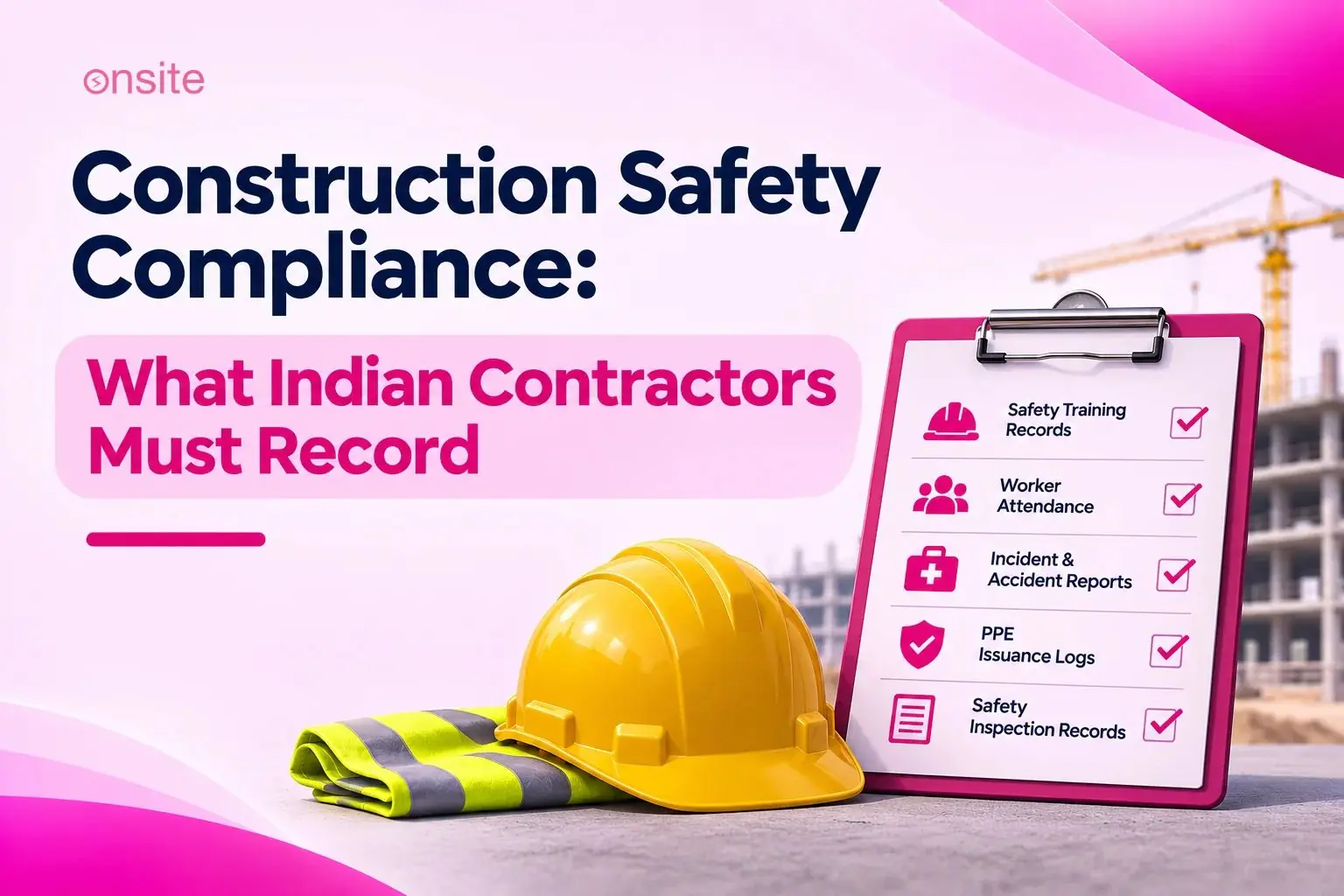
Construction sites must maintain five categories of safety records. Missing even one can create a compliance gap during a Labour Inspector’s visit or an accident investigation.
The site safety register is the main day-to-day record. It must include daily entries for unsafe conditions observed, corrective actions taken, the person responsible for each action, and the date the action was completed. A weekly summary is not a substitute for daily records under the BOCW Central Rules.
Inspectors in Maharashtra, Karnataka, and Delhi NCR also check whether the records cover the entire project period. A register that starts two months after work began does not meet this requirement, even if all later entries are accurate. The accident and near-miss log is particularly important during an investigation. Each entry must record the date and time, the worker’s name and BOCW card number, the injury or near-miss, witnesses present, the immediate cause, and the corrective action taken. The Central Rules require near-misses to be recorded as well as accidents.
The National Safety Council of India identifies construction as the sector with the highest number of industrial fatalities each year. Recording near-misses helps demonstrate that the site identifies and tracks potential hazards. Without these records, there is no documented evidence that repeated warning signs were recognised and addressed.
The toolbox talk attendance sheet confirms that workers received a briefing before a high-risk activity began. Each sheet must include the date, type of work, topics covered, supervisor’s name, and signatures of the workers who attended. A verbal briefing without a record cannot be verified during an investigation after an incident.
The PPE issue register records every item of protective equipment distributed on site. It must include the equipment type, issue date, worker’s name and BOCW card number, and the equipment’s condition when issued. Without this record, the contractor cannot show which workers received the required equipment. The permit to work log records authorisations for confined space entry, work at height, and excavation. Each entry must include the name of the person issuing the permit, the authorised work period, and confirmation that the permit was closed.
The pattern that creates recording failures in construction site expense management applies to safety records as well: the obligation to record is known, the format is defined, and entries still fail because no specific person owns the daily task of creating them.
Why Construction Safety Compliance Records Break Down at the Site Level
Three common problems explain why Indian construction sites often lack the records they are required to maintain when an inspection takes place.
The first is the ownership gap. The site engineer handles technical work, while the safety officer, where appointed, manages on-site hazards. But no one is specifically responsible for maintaining safety records.
For example, supervisors conduct verbal toolbox talks before concrete pours and lifting work because they know these activities are risky. However, no one completes the attendance sheet because the supervisor is focused on starting the work safely, not documenting the briefing. Similarly, an incident log may remain incomplete because the supervisor photographs an incident and sends it to the contractor on WhatsApp, assuming that this is enough to report it.
The second problem is the exclusion of contract workers from site records. Indian construction projects often use three groups of workers: those directly employed by the contractor, those supplied by labour contractors, and specialist subcontractor crews.
BOCW obligations apply to all building workers on the project, regardless of how they are employed. If a worker supplied by a labour contractor is injured, the main contractor’s safety records must also cover that worker. However, the main contractor often tracks only its direct employees. The labour contractor keeps a separate worker list, usually on paper, which may be incomplete and is rarely shared in a usable format.
The third problem is failure to formalise incident reporting. A supervisor may photograph a worker’s hand injury and send it to the contractor on WhatsApp. The contractor acknowledges the message, but the incident is never entered in the accident register.
A WhatsApp message confirms that the contractor was informed about the injury. It does not replace the prescribed Form XIII entry under the Central Rules. During an investigation, the message could also show that the contractor knew about the injury but failed to report it in the required format within the 48-hour reporting period for serious injuries.
The BOCW Act provides for fines ranging from Rs 1,000 to Rs 1 lakh for non-reporting, depending on the violation and whether it is repeated. Fatal accidents at non-compliant sites may also expose contractors to liability under Section 304A of the Indian Penal Code, which covers death caused by negligence.
These gaps do not necessarily arise because contractors ignore safety requirements. Most understand that documentation is necessary. The problem is the lack of a reliable system. Daily safety records need a process of their own, rather than depending on the site engineer or supervisor to complete them alongside their regular responsibilities.
The same issue affects construction cost control. Project-level budget variance tracking cannot work properly when daily site records are incomplete. Both safety compliance and cost control depend on consistent recording at the site level.
How Digital Recording Closes the Construction Safety Compliance Gap
The documentation problems described earlier have a common cause. Paper-based systems depend on someone starting the entry, finding the right form, and completing it before other site work takes priority. Digital recording moves this process to the point where the activity or incident happens, using a device the site team already carries.
Digital toolbox talk forms can be completed on a mobile phone before work begins. The supervisor selects the type of work, reviews the points on a standard checklist, and confirms attendance using the existing site worker register.
Submitting the form creates a timestamped record with the supervisor’s name, activity, briefing points, worker attendance, and time. There is no paper sheet to collect or handwriting to interpret. The record is available in the system before the task starts.
Mobile incident reporting allows the site team to create a structured report and notify the contractor at the same time. The site engineer opens the incident form, enters the worker’s name and BOCW card number, describes what happened, takes photographs, and submits the report.
The form includes the required Form XIII fields, allowing the incident details to be recorded in the prescribed format. This removes the gap between sending a photograph on WhatsApp and entering the incident in the formal register.
Digital permit to work requires the designated issuer to complete the safety checklist before opening a permit. The authorised work period is recorded with the permit. Once the work is complete, a separate submission confirms that the task has ended and the site has been returned to a safe condition. This keeps the permit log updated without requiring someone to compile it at the end of the day.
Construction management platforms such as Onsite bring safety checklists, inspection records, and corrective action tracking into the same system used to manage site work. This allows safety records to be created as work progresses instead of being treated as a separate filing task before an inspector arrives.
What Contractors Gain When Safety Compliance Records Stay Current
A contractor who maintains construction safety compliance records from the first day of mobilization is not performing additional administrative work. The records are legally required from day one. The difference between a compliant site and a non-compliant one is the system that creates the record at the right moment, not the intention to maintain one.
Three things change specifically. Inspector visits resolve in hours rather than weeks because every required record exists, is timestamped, and is retrievable by date. Insurance claims for worker injuries process against an established compliance record rather than a file reconstructed after the fact, which adjusters treat differently from a file built from scratch after the incident. Subcontractor accountability improves because the worker register and incident log cover all workers on site, including labour contractor and specialist subcontractor crews, removing the gap that leaves the main contractor holding liability for workers whose records were never maintained.
Onsite brings inspection records, safety checklist completions, and corrective action tracking into a single project record so the compliance file builds as a byproduct of site execution rather than as a separate administrative task.
A contractor who builds the recording system before mobilization does not wait for an inspection
Frequently Asked Questions About Construction Safety Compliance
What is construction safety compliance in India?
Construction safety compliance in India refers to the set of legal obligations every contractor employing 10 or more building workers must fulfil under the Building and Other Construction Workers Act 1996 and the National Building Code. These obligations cover establishment registration with the state BOCW Board, worker registration cards, cess payment on project cost, accident reporting to the Labour Inspector within prescribed time limits, toolbox talks before high-risk activities, PPE documentation, and a site safety register maintained from the first day of mobilization through project completion.
What are the BOCW Act obligations for a construction contractor?
The BOCW Act requires construction contractors to register the construction establishment with the state BOCW Board before work begins, separately from paying BOCW cess on project cost. Contractors must confirm that every building worker on site holds a valid BOCW registration card and must report fatal accidents to the Labour Inspector within 24 hours and serious injuries within 48 hours. Projects employing 500 or more workers must appoint a qualified Safety Officer under the BOCW Central Rules 1998. All these obligations apply from the first day of mobilization, not from the date the first incident occurs.
What records must a construction site safety register contain?
A construction site safety register must contain daily entries covering unsafe condition observations, the corrective action taken for each observation, the name of the person responsible for that action, and the resolution date. The register must run continuously from the first day of mobilization, with an entry for every working day. Inspectors check date continuity before reading entry content, so a register that begins two months into a project does not satisfy the legal requirement even if every entry is accurate. Maharashtra, Karnataka, and Delhi NCR inspectors expect entries in the prescribed BOCW state Board format.
What is a toolbox talk in construction and when is it required?
A toolbox talk is a pre-task safety briefing the site supervisor delivers before a high-risk activity begins. The National Building Code Part 7 requires toolbox talks before confined space entry, work at height above three metres, excavation below 1.5 metres, electrical work near live conductors, and any activity the site safety plan designates as high-risk. The briefing must appear on an attendance sheet carrying the date, work type, points covered, supervisor name, and worker signatures. A verbal briefing with no attendance record is legally unverifiable during a post-incident investigation.
What happens if a contractor fails a construction safety inspection?
A Labour Inspector who finds a construction site non-compliant with BOCW Act requirements can issue a written notice requiring corrective action within a specified period, direct site operations to cease until the contractor achieves compliance, or file a complaint under the Act. Fines range from Rs 1,000 to Rs one lakh per violation depending on severity and repetition. Fatal accidents at non-compliant sites can expose the contractor to liability under Section 304A of the Indian Penal Code, which covers death by negligence, in addition to the BOCW penalties. Non-compliant sites also face insurance claim complications.
Which construction activities require a permit to work in India?
Permit to work requirements in Indian construction apply to activities where standard safety controls alone cannot eliminate the hazard before work begins. The National Building Code and BOCW Central Rules specify permits for confined space entry, work at height above three metres without a full scaffold system, excavation below 1.5 metres, electrical work near live conductors, and hot work in areas with flammable materials. Each permit must name the issuing authority, state the authorized work window with start and end times, describe the specific work scope and location, and require a closure confirmation before the permit expires.
