
Construction Site Expenses: What Contractors Lose When Records Go Untracked
What is Construction Site Expenses?
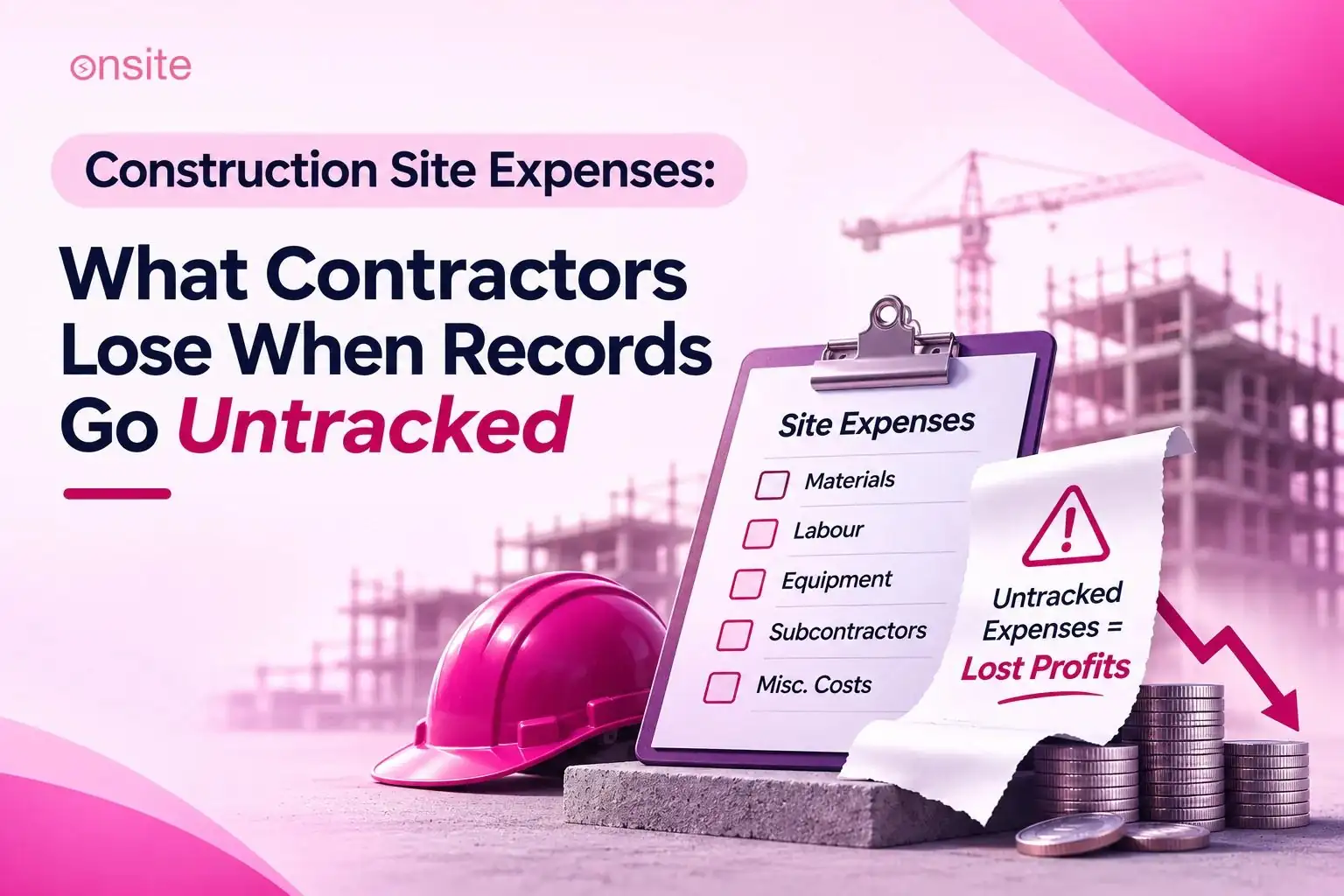
Construction site expenses are the daily cash transactions at a project site that fall outside the formal procurement system: petty cash disbursements, local material purchases, vendor advance payments, and daily labour settlements. These expenses move as cash without an automatic record, creating a reconciliation gap between the site register and company accounts if not entered at the point of payment.
Construction site expenses are the amounts that flow out of the budget of a construction project. They occur outside the formal procurement system, such as petty cash disbursements, local material purchases, vendor advance payments, daily labour wage settlements, and site service charges.
In this article, we will cover how to categorise these expenses, how an imprest cash system controls the site float, what a daily recording system requires, and what month-end reconciliation reveals about project margins.
A civil contractor running a ₹3 crore project maintained a ₹50,000 petty cash float at the site. By the time the project reached six months, the company’s accounts recorded ₹12 lakh in site expenses against a budget of ₹8 lakh. The ₹4 lakh variance appeared only when the contractor placed the site register and company ledger side by side at the monthly review meeting.
The problem was the failure to properly record expenses. Most payments were legitimate and within the approved rates. However, expenses were entered into the site register days after payment. Some never appeared at all, and the person recording them had no visibility into which budget head each payment belonged to. This gap is what turned a budgeted project into one that exhausted its margins before closeout.
What Construction Site Expenses Cover at the Project Level
A construction project has two types of financial transactions. The first is formal procurement, which covers bulk materials such as cement, steel, aggregate, bricks, and electrical or mechanical components. These purchases go through purchase orders, GRNs, and vendor billing cycles.
The second is construction site expenses. These are small, everyday payments made during site operations, usually in cash and outside the purchase order system. They often happen without a formal bill being issued on the same day.
Five main categories of site expenses are common across construction projects:
1. Petty cash expenses: Small payments for immediate site needs, such as transport, postage, stationery, minor tools, and refreshments for site meetings.
2. Local material purchases: Small quantities of materials bought from nearby suppliers outside the regular vendor list. These may include extra sand, gravel, or hardware that was not covered in the main procurement plan.
3. Advance payments: Payments made to vendors or subcontractors before the work is completed or materials are delivered. These are usually given to secure supplies or reserve capacity.
4. Daily and weekly labour payments: Wages paid to casual and daily rated workers. These workers make up a significant part of the workforce on many Indian residential and commercial construction sites.
5. Site service charges: Expenses for tool hire, transport from the main road to the site entrance, temporary repairs, and site cleaning.
The imprest cash system is commonly used in India to manage these expenses. The contractor provides a fixed cash amount to the site, usually between Rs 20,000 and Rs 1 lakh depending on the project size. The site engineer or storekeeper uses this amount for daily payments. Once a set portion of the cash has been spent, the site submits the bills and a reconciliation statement to the head office. The company then replenishes the cash. This process creates a record of site expenses at the company level.
The main difference between site expenses and formal procurement is how they are recorded. Formal procurement has a document trail from the time a purchase order is raised. Site expenses are documented only when someone records the payment and collects the supporting details at the time of spending. The material cost control process used for bulk purchases through purchase orders and GRNs does not cover these daily cash payments.
Why Site Expenses Drain Margin Before the Final Account Arrives
Poor tracking of site expenses can reduce project profit in four ways. These problems are common but can largely be avoided if payments are recorded properly at the site.
1. Delayed expense recording
A payment may be made on Tuesday but entered in the site register only on Friday. The monthly review may happen at the end of the month. By then, several weeks of expenses may have gone unrecorded or been entered late. As a result, the finance team sees lower spending than the actual amount and makes decisions about material purchases, vendor advances, and subcontractor payments based on incomplete figures. As more entries are delayed, the difference between recorded and actual spending keeps growing.
2. Payments approved by different people
On an active site, the engineer, foreman, storekeeper, and contractor’s representative may all approve small payments. Each person sees only the payments they approve, not the total spent by everyone. For example, the engineer approves Rs 3,000 for sand delivery, the foreman spends Rs 2,500 on transport, and the storekeeper issues Rs 1,800 for hardware. Each payment may be within the person’s approval limit, but nobody sees the combined spending. Over 30 working days, these small payments can add up to a monthly expense much higher than the budget, without anyone noticing in time.
3. Unsettled advances
A site engineer may give a subcontractor Rs 15,000 to reserve a crew for a concrete pour planned for the following week. If the work gets delayed and the subcontractor only partly mobilises, the advance may remain unsettled for months. It may later be adjusted against a bill that covers only part of the original amount. The remaining balance stays unrecovered, tying up project funds.
4. Duplicate payments
Duplicate payments can happen when a site pays cash against a bill shared on WhatsApp, and the accounts team later pays the same bill through NEFT after receiving the original copy by post. The duplicate may only be discovered during vendor reconciliation, often near project completion.
The Ministry of Statistics and Programme Implementation reports consistent cost overruns above 20 percent in central sector infrastructure projects. Unrecorded site expenses can contribute to the difference between estimated and actual costs. These gaps also reduce the profit margin contractors report at the end of a project.
The Daily Recording System Every Construction Site Needs
A daily recording system does not need accounting software or formal finance training. It needs a clear format that everyone follows and an approval process that controls how money is spent on site. The day book is the main record of site expenses. Every entry must include six details: date, payee or recipient, purpose linked to a budget head, amount, name of the person who approved the payment, and bill or receipt reference number. This reference number connects the entry to the original document. Every payment above a set limit, typically Rs 500 on most sites, must have a bill or receipt attached. Without this link, the register only lists reported payments, with no way to verify them.
The day book must handle three types of entries:
- Direct cash payments: When goods or services are received and paid for, record the payment on the same day and attach the bill.
- Advances: Record the advance on the day it is issued. Include its purpose and expected settlement date.
- Advance settlements: When a vendor or worker submits a bill against an advance, make a separate entry. Mention the original advance reference and record whether the bill matches the advance, leaves an outstanding balance, or requires an additional payment.
Keeping these entries separate ensures that every advance remains visible until it is settled, rather than getting lost among other expenses. A clear approval hierarchy also prevents payments from being approved by different people without anyone tracking the total. The suggested limits are:
- Payments below Rs 5,000: Site engineer
- Payments between Rs 5,000 and Rs 25,000: Project manager
- Payments above Rs 25,000: Contractor or owner
These limits keep payment approvals with a small group of people and ensure that each payment has a formal approval record. The end-of-day cash check is another important control. The cash issued to the site, minus all recorded expenses, must equal the physical cash remaining. If the figures do not match, there is a missing entry that must be identified before the working day ends. This five-minute check helps catch recording errors before they become larger monthly reconciliation problems.
WhatsApp-based bill submission shows why a day book is necessary. A vendor may photograph a bill and send it to the site engineer, who acknowledges receiving it. However, the bill remains only an image in a chat, without a reference number, approval timestamp, or link to the expense register. When the finance team asks for the month’s expenses, the engineer has to search through weeks of messages to find which bills were actually paid.
A day book avoids this problem by requiring every payment to be recorded and supported by a verifiable document on the day it happens. Project-level variance analysis under the construction cost leakage discipline can only be reliable when the daily records are complete.
Monthly Reconciliation of Construction Site Expenses
Month-end reconciliation turns the daily site register into a verified expense record. Without it, the register remains a list of reported payments that have not been checked against bills, advances, or company accounts.
The process has three stages:
1. Match cash replenishments with recorded expenses: Compare the total cash issued to the site during the month with the expenses recorded in the day book and the physical cash remaining.
For example, if the company issued Rs 1.5 lakh in cash replenishments and the register records Rs 1.4 lakh in expenses, the Rs 10,000 difference must be explained. It could be an unrecorded payment or cash still held at the site without a corresponding entry. Either way, the difference needs a written explanation before the accounts are closed.
2. Review unsettled advances: Check every advance that does not have a matching settlement entry. Record the status of each open advance:
- Bill expected, with the due date noted.
- Refund due from the person who received the advance.
- Partial recovery pending, with the remaining balance tracked separately.
Any advance that remains open for more than 30 days without a status update must be flagged in the project cost report and brought to the contractor’s attention during the monthly review.
3. Match vendor bills with day book entries; Every vendor bill submitted for the month must have a matching reference number in the day book. A bill without a reference number could indicate a duplicate or an unrecorded payment, so it must be investigated before being entered into the accounts.
Similarly, if the day book records a payment but there is no physical bill to support it, the entry has failed reconciliation. It should not be transferred to Tally or Zoho Books until the issue is resolved. GST input credit also needs to be checked separately. Purchases above Rs 10,000 from GST-registered vendors may include applicable GST, commonly 18% on construction goods and services. The contractor can claim input tax credit when the vendor’s GSTIN is shown on the bill and the transaction is correctly recorded.
Daily labour wages, petty cash purchases from unregistered vendors, and informal site services do not carry GST and therefore do not provide input tax credit. The GST Council publishes the current rates for construction goods and services at gstcouncil.gov.in.
Construction management platforms such as Onsite record site expenses against the project budget in the same system where the budget was created. This allows month-end reconciliation against actual project costs without manually comparing the site register with a separately maintained accounts file.
What Changes When Contractors Track Site Expenses Daily
A contractor who records site expenses at the point of payment does not eliminate cost pressure on a construction project. The costs that drive site spending remain tied to scope, duration, labour rates, and material prices. What changes is the visibility window in which the contractor can respond to spending that moves beyond the budget.
Three things change specifically. Budget overruns become visible at the billing cycle level rather than at project closeout, when recovery options have already narrowed to absorbing the loss or disputing costs with subcontractors who have already demobilized. Advance leakage stops because every advance carries an expected settlement date and an open advance that ages beyond 30 days appears as a risk item in the monthly reconciliation before it becomes a write-off. Month-end close takes days rather than weeks because every entry already exists in the system in the correct period and in the correct budget head.
Onsite connects daily site expense recording to the project budget so the variance between planned and actual spending appears on the same day the entry is made rather than at the end of the month when the project manager runs a manual comparison between two separate registers.
A contractor who closes the recording gap at the site level recovers visibility into project margin at the point where visibility still has time to change the outcome. That is the difference between a margin problem identified in time to respond and one that surfaces after the final account is settled.
Frequently Asked Questions About Construction Site Expenses
What are construction site expenses?
Construction site expenses are the daily cash outflows at a project site that fall outside the formal procurement system. They include petty cash disbursements for immediate small purchases, local material top-up quantities from nearby suppliers, advance payments issued to vendors or workers before work is complete, daily and weekly wage settlements for casual labour, and site service charges such as tool hire and inward transport. These transactions move as cash without a formal purchase order or same-day bill, creating a recording gap when entries are not made at the point of payment.
What is the imprest cash system in construction?
The imprest cash system is the standard method Indian contractors use to manage petty cash at a project site. The contractor issues a fixed float to the site, typically between Rs 20,000 and Rs one lakh depending on project scale, and the site engineer or storekeeper manages daily disbursements from that float. When expenses consume a defined portion of the float, the site submits bills and a reconciliation summary to the head office and receives a replenishment. The replenishment cycle creates the company-level record of site spending and sets the reconciliation interval for site-level cash management.
How do you record petty cash at a construction site?
Petty cash recording at a construction site requires a day book that captures six fields for every entry: date of payment, payee name or description, purpose mapped to a budget head, amount, the name of the authorizing person, and a bill or receipt reference number. Direct payments enter the day book on the day of payment with the bill attached. Advances enter when issued, with the purpose and expected settlement date noted. Settlements enter when a bill arrives against the advance, referencing the original entry. The end-of-day cash balance check confirms no entries are missing before the register closes for the day.
What is the difference between site expenses and project costs in construction?
Project costs in construction include all categories of expenditure in the project estimate: direct costs such as materials, labour, plant hire, and subcontractor payments, plus indirect costs such as supervision salaries, site establishment, testing fees, and insurance. Site expenses are the informal cash-based transactions within that larger cost base that occur daily during execution outside the purchase order system. The practical distinction matters for recording: formal procurement runs through the PO and GRN cycle, while site expenses run through the imprest float and day book, requiring a separate reconciliation before they transfer to company accounts.
How do you reconcile site expenses at month end?
Month-end reconciliation of construction site expenses runs in three stages. The first compares float replenishments issued during the month against total expenses recorded in the day book and physical cash remaining in the float, confirming the three figures balance. The second reviews every advance entry with no corresponding settlement and assigns a status to each: bill expected, refund due, or partial recovery pending. The third matches vendor bills submitted for the month against day book reference numbers, flagging bills without a matching reference as potential duplicates or unrecorded payments before transferring confirmed entries to company accounts.
Which construction site expenses attract GST input credit?
Construction site expenses attract GST input credit when purchased from a GST-registered vendor whose GSTIN appears on the bill. Goods and construction services at the standard 18 percent rate qualify for input tax credit when the transaction is recorded with a valid GST invoice. Daily labour wages paid to casual workers, petty cash purchases from unregistered small suppliers, and informal site services from unregistered parties fall outside the input credit claim. The contractor must record qualifying purchases correctly in the accounts to claim credit in the relevant GSTR filing period. The GST Council website lists current applicable rates for construction.
