
Construction Project Planning Software
Schedule Activities,
Track Progress & Predict Delays
A live, integrated construction project planning software keeps everyone aligned, helping you deliver projects on time and within budget.

Set clear tasks, timelines, and dependencies
Capture real-time progress from site
Spot delays early and act quickly
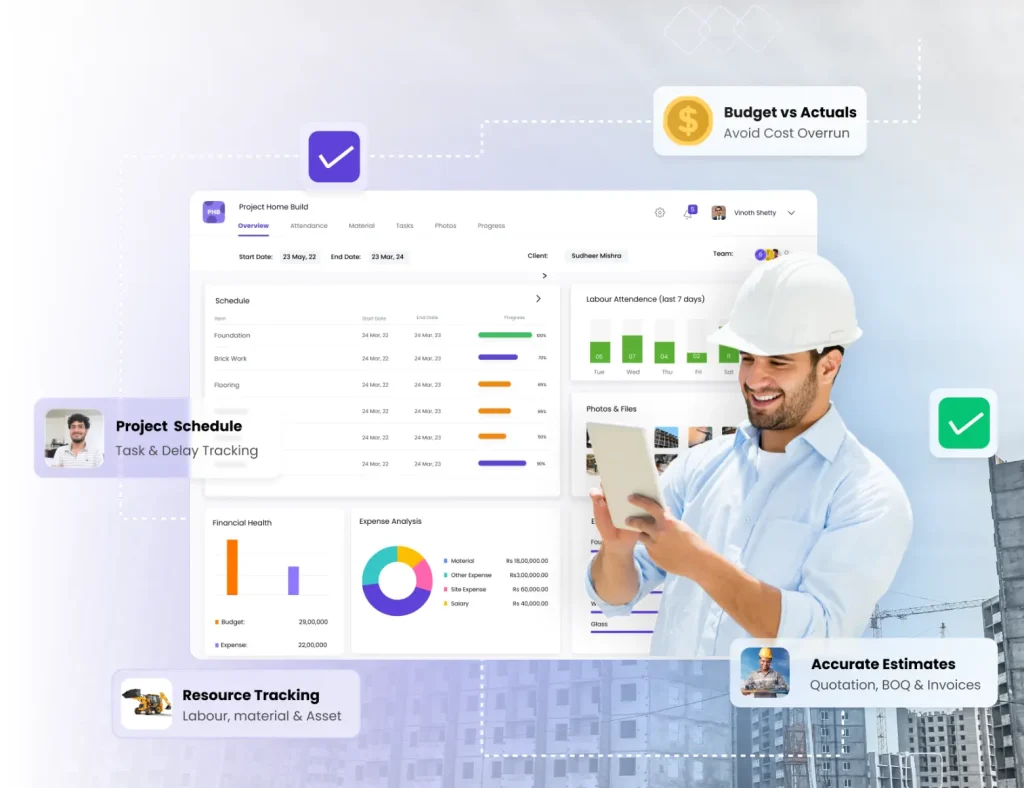
Trusted by leading construction companies
for Construction Planning
Construction teams plan activities, track progress, and stay ahead of delays with Onsite construction planning software.

Ideal for Teams Where One Delay Can Impact the Entire Project
A construction project planning software built for dependency-driven execution and early delay detection.
01
Infra & EPC Companies
Manage complex activity sequencing, dependencies, and milestone-based execution across large, multi-phase projects. Track critical paths and receive early alerts using real-time site updates.
02
Builders & Developers
Track multiple contractors’ timelines in one live construction schedule. Identify delays early, monitor milestone progress, and keep projects aligned with committed delivery schedules.
03
Contractors & Interiors Firms
Coordinate short-cycle, execution-heavy activities with frequent progress updates from site teams. Replace static timelines with live schedules that reflect actual on-ground progress.
04
Industrial Firms
Plan shutdowns, commissioning activities, and phased execution with accurate forecasting. Detect schedule risks early and maintain control over tightly linked activities.
From BOQ to Site to Dashboard: One Planning Workflow With No Manual Handovers
Onsite connects activity scheduling, field progress capture, dependency tracking, and delay detection in one system so the plan and the site stay aligned throughout execution.
Build BOQ-Linked Activity Schedules With Dependencies
Every activity in Onsite links to a specific BOQ line item, a responsible team member, defined start and end dates, and predecessor and successor relationships. Budget allocations connect to activities from day one so cost variance and schedule variance track together. Scope additions are controlled because every activity must exist in the schedule with a budget allocation before resources are committed.
Capture Live Progress From Site Through Mobile
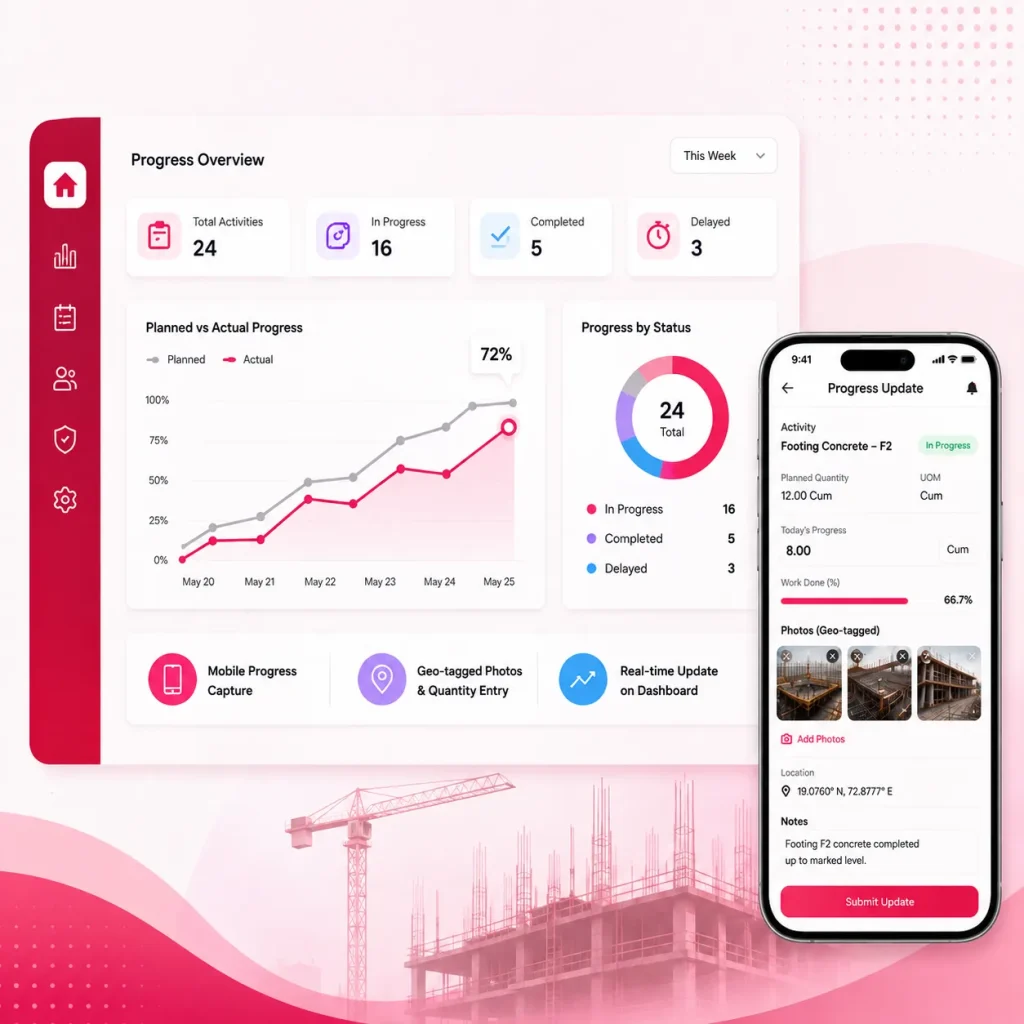
Site engineers update completion percentages, mark activity status, and flag issues directly from the Onsite mobile app without going through an office intermediary. Progress entries update the project dashboard instantly with geo-tagged photos and quantity records linked to specific activities. Planning teams see verified current progress rather than estimates compiled from morning phone calls.
Detect Delays Automatically With Early Warning Alerts
Onsite compares live progress against the planned schedule continuously and flags activities whose current trajectory will miss their completion date before the milestone passes. Alerts identify the specific activity at risk, the days of float remaining, and which dependent activities will be affected if the current progress rate continues. Managers act while the delay is still small rather than after float has been exhausted.
Track Critical Path and Dependency Impact Across Projects
Onsite identifies the critical path at any point during execution so recovery effort focuses on the activities actually determining the completion date. When a delay develops on a critical path activity, the cascading impact on successor activities is calculated and shown immediately. Teams know exactly which activities need acceleration and which have float to absorb without programme-level disruption.
Why Construction Schedule Management Fails Without a Connected Planning System?
Most schedule failures are not caused by unexpected events. They are caused by systems that cannot surface developing problems until damage has accumulated across multiple weeks of execution.
Schedules That Reflect Last Week, Not Today
Construction schedules in Excel or desktop planning tools cannot be updated by site teams from mobile. Progress travels from site to office through phone calls and WhatsApp messages, gets compiled by a planning engineer, and updates the schedule days after the work happened. By the time the planning team sees that an activity is behind, the delay has already compounded through dependent tasks.
Idle Labour Caused by Unmapped Dependencies
When activity dependencies are not formally mapped, site teams discover sequencing conflicts at the moment they arrive to begin work. The plastering crew reaches the zone before masonry is complete. Workers stand idle while the preceding trade finishes. Each idle day is labour cost without production. Across a project with dozens of concurrent activities, unmapped dependency failures accumulate into significant delay and unrecovered cost.
Delays Discovered After Milestones Are Missed
The standard scheduling process surfaces delays at the milestone review, after the planned completion date has passed and the work is incomplete. At that point, float has been consumed, acceleration costs money, and the client conversation has already become difficult. Without continuous progress monitoring against the live schedule, there is no mechanism to catch a developing delay while it is still small enough to manage.
Site and Office Working from Different Plans
Planning engineers update the schedule in the office. Site engineers work from their understanding of the last site meeting. When a design change or material delay modifies the plan, the update reaches some team members and not others. Site supervisors execute against a version of the plan that no longer reflects the current agreement, and office teams report against a schedule that does not match site reality.
Core Features of Onsite Construction Project Planning Software
Control activity scheduling, live progress tracking, dependency mapping, and delay detection across every active project from one platform built specifically for construction execution.
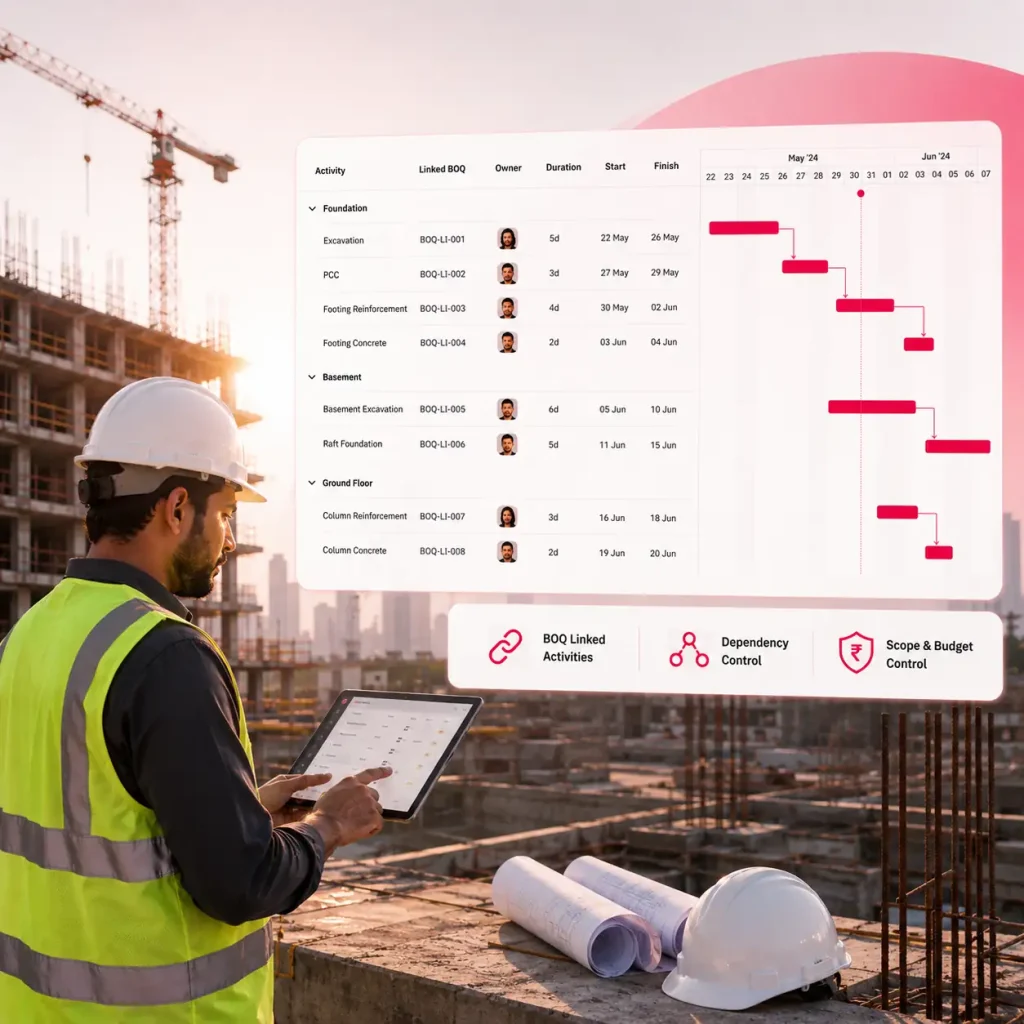
BOQ-Linked Activity Scheduling and Dependency Control
Every activity in Onsite connects to a BOQ line item, a named responsible owner, defined dates, and mapped predecessor and successor relationships before execution begins. Budget allocations link from project inception so cost and schedule track together. Scope creep is prevented because activities cannot be created without a BOQ linkage and budget allocation, removing the verbal scope additions that cause silent cost overruns.
Link every schedule activity to a BOQ line item with budget and responsible owner
Predecessor and successor dependency mapping across full project schedule
Scope and budget control from activity creation through completion
Live Field Progress Tracking from Mobile App
Site engineers capture daily progress against specific schedule activities from the Onsite mobile app, with geo-tagged photos and quantity entries updating the project dashboard in real time. Planning teams see verified progress rather than estimates from phone calls. The planned versus actual comparison updates automatically with every field entry so the schedule reflects what is actually happening at the time it is happening.
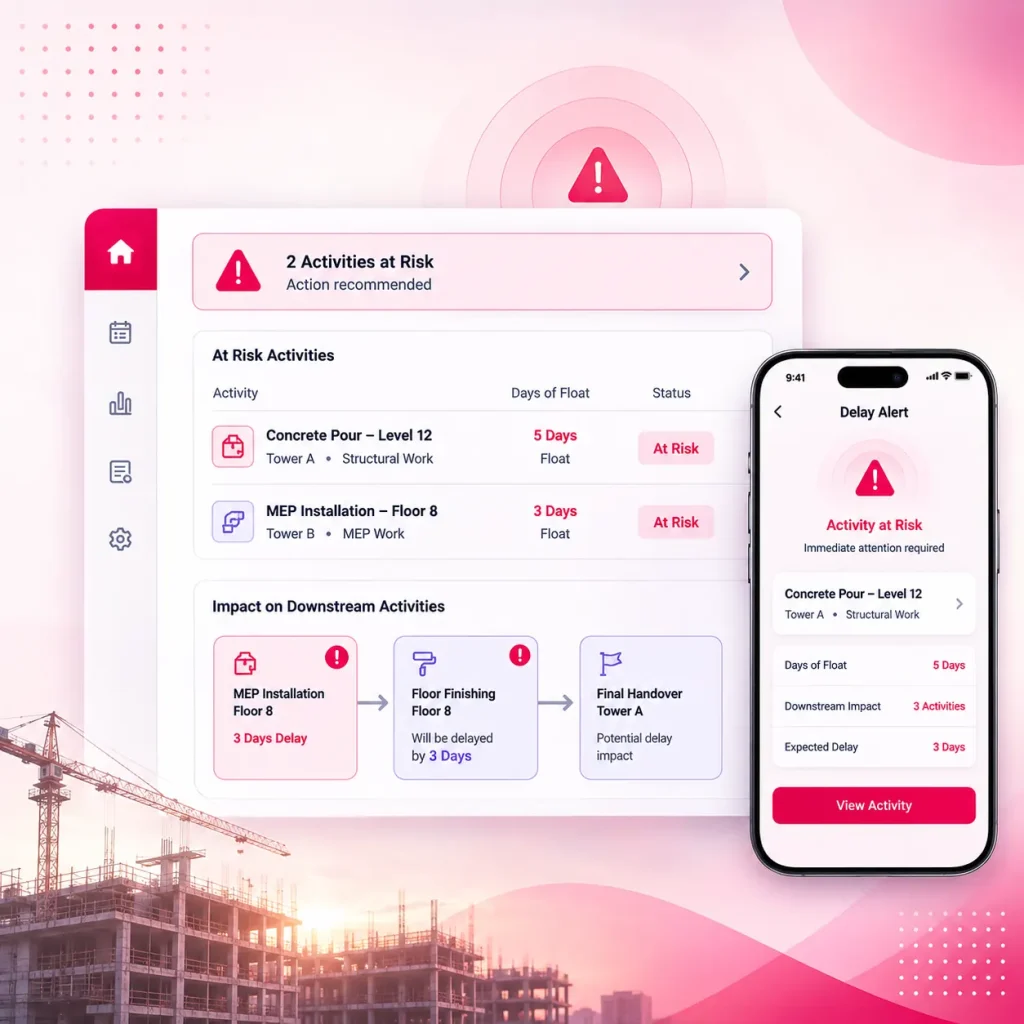
Automatic Delay Detection with Early Warning Alerts
Onsite monitors live progress continuously against the planned schedule and alerts project managers when an activity’s current trajectory will miss its completion date before the milestone passes. Each alert includes the activity at risk, days of float remaining, and downstream activities affected. Corrective action happens while the delay is still containable rather than after float has been consumed and the milestone has been missed.
Delay alerts triggered when activity progress falls behind planned rate
Impact analysis showing downstream activities affected by developing delay
Early warning delivered while corrective action is still possible
How Onsite Simplifies Construction Project Planning for Site Teams and Project Managers?
Most planning tools create work for the office team without changing how site teams operate. Onsite is built differently. The planning workflow starts with the BOQ, flows through field-level daily execution, and surfaces delay risks automatically so project managers spend time managing projects rather than compiling reports.
01
Build the Schedule from the BOQ
The project schedule in Onsite starts from the BOQ rather than a blank activity list. Every activity links to a specific BOQ line item with quantity, rate, and budget allocation already connected. Start dates, end dates, dependencies, and responsible owners are defined once and become the single source of truth for every team from site engineer to company owner.
02
Site Engineers Update Progress from Mobile
Site engineers open the Onsite mobile app at the start or end of each working day, select the activities worked on, enter completion percentages, add geo-tagged photos, and mark any issues for escalation. The entry takes two to five minutes per activity. The moment they submit, the project dashboard updates without anyone calling the site or compiling a report.
03
Onsite Calculates Delay Risk Automatically
When an activity’s progress rate falls below what the schedule requires, Onsite raises an alert with the activity name, the days at risk, and the downstream activities affected if the current rate continues. The project manager sees the problem while it is still a developing delay rather than a missed milestone. Intervention is targeted because the alert identifies which specific activity needs attention.
04
Approvals and Reports Without Manual Compilation
Senior management and directors view planned versus actual completion across all active projects from one dashboard, updated from live field entries. Projects developing schedule risks appear alongside the specific activities responsible. Resource reallocation, contractor escalation, or client communication happens while recovery is still possible, not after a weekly status meeting reveals a problem that has been compounding for days.
What Construction Companies Say About
Onsite Construction Project Planning Software?
Construction companies across India and the Middle East use Onsite to replace disconnected planning tools with a live construction schedule that site teams actually update.
Customer Success Story
“
We were looking for construction management software that could help us share clear project updates with clients. With Onsite, all the progress and cost details are visible in one place. It has made client discussions much smoother because we are now talking with actual site data instead of guesses.
★
★
★
★
★
✕ Before Onsite
Client updates based on guesses · No single source of truth · Project data scattered across teams
→
✓ After Onsite
Progress and cost visible in one place · Client discussions backed by real site data · Smoother conversations
Mr. Anvesh, Founder
Bhavya Developers · Building Construction Company · India
Why Excel and WhatsApp Cannot Handle Construction Project Planning?
Excel was built for data storage, not live construction schedule management. WhatsApp was built for messaging, not dependency mapping. Using both together for project planning produces a schedule that is always behind, always incomplete, and never trusted by the people it is meant to guide.
Excel schedules cannot be updated from site in real time- progress always arrives late and already outdated
WhatsApp progress updates have no connection to the planned schedule and cannot trigger automatic delay alerts
Dependency relationships cannot be mapped or enforced in Excel — sequencing conflicts surface only when teams collide on site
Portfolio visibility across multiple concurrent projects is impossible when each project runs on a separate Excel file managed by a different planning engineer
Additional Features That Strengthen Construction Project Planning
Beyond core scheduling and delay detection, Onsite provides a full set of planning support tools connecting the construction project schedule to daily execution, reporting, and financial tracking.
Daily Progress Reports
Lock the approved project schedule as a baseline and compare actual execution against it throughout the project. Variance from the original plan is visible at activity level so project managers understand not just where the project stands but how far it has deviated from the original commitment.
Geo-Tagged Site Photography
View planned versus actual progress across all active projects from one consolidated dashboard. Management identifies at-risk projects and developing delays without requesting individual status updates from project managers or waiting for weekly review meetings to surface problems already several days old.
Portfolio Dashboard
View schedule status, delay risk positions, and milestone progress across all active projects simultaneously from one consolidated dashboard. Owners and directors identify which projects need immediate attention and which are tracking to plan without a morning round of status calls to individual project managers.
Budget versus Actual at Activity Level
Every activity carries a budget allocation that tracks against actual cost as labour, material, and subcontractor entries are recorded against it. Cost variance at activity level is visible in real time rather than discovered at month-end project review when the overrun has already compounded.
Multi-Level Task Approvals
Configure approval hierarchies for activity completions, milestone sign-offs, and schedule revisions based on project role and authority level. Every approval decision creates a timestamped audit trail showing who approved what and when across the full project schedule without paper-based sign-off processes.
Project Health Report
Automated project health reports covering schedule performance, cost performance, delay risk positions, and activity completion rates generated from live execution data. Reports reach stakeholders in consistent format without manual assembly from scattered site records, phone calls, and WhatsApp update threads.
4 Tips to Manage Construction Project Planning More Efficiently
The planning system is only as useful as the discipline applied to maintaining it. These four practices separate construction companies that get value from their planning software from those that revert to WhatsApp and phone calls within six weeks of implementation.
Map Activity Dependencies Before Execution Begins, Not After
Dependencies mapped after work has started reflect execution as it happened, not the plan as it should have been. Define predecessor and successor relationships for every non-trivial activity at schedule creation. The conflicts this surfaces before mobilization cost nothing to resolve. The same conflicts discovered on site cost labour, time, and contractor goodwill.
Require Field Progress Updates at the End of Each Working Day
Weekly updates produce a schedule five days behind reality at the start of every review cycle. A delay that developed on Monday appears in the dashboard on Friday, by which time dependent activities have already started on assumed completion. Daily updates from site engineers take two to five minutes per activity and keep the schedule within 24 hours of actual site conditions.
Use the Schedule to Run Site Meetings, Not to Report on Them
Open the live Onsite dashboard at the start of each site meeting and use the delay alerts and progress variances as the agenda. The schedule shows which activities are behind, which dependencies are at risk, and which contractors need to be addressed. The meeting becomes a structured response to data rather than a verbal summary of what each supervisor thinks is happening.
Lock Baseline Before Execution & Treat Change as a Formal Revision
A schedule that gets informally adjusted whenever execution deviates stops being a useful control document within the first two weeks. Lock the approved baseline in Onsite before work begins. When scope changes or design revisions require schedule updates, process them as formal revisions with a date and a reason. This preserves the ability to show clients and management what changed.

Stop Discovering Delays After Milestones Are Already Missed. Start Planning with Onsite.
Every week a construction project schedule runs behind without detection costs money that cannot be recovered and time that cannot be bought back. Onsite connects BOQ-linked activity scheduling, live field progress from site engineers, and automated delay alerts in one platform so project managers see developing problems while corrective action is still possible. Check pricing or schedule a free demo today.
FAQs
What is Onsite construction project planning software?
Onsite construction project planning software helps contractors, developers, EPC firms, and interior companies create BOQ-linked activity schedules, map dependencies, capture live field progress through a mobile app, and detect delays automatically before milestones are missed. It connects office planning teams and site engineers on one platform so the project schedule always reflects verified site progress rather than estimates compiled from weekly status calls. Planning, progress tracking, delay detection, and financial tracking connect in one continuous workflow rather than operating as separate disconnected tools.
How does Onsite detect construction schedule delays before milestones are missed?
Onsite continuously compares actual progress rates captured from site against planned schedule targets for every active activity. When an activity’s current progress rate will result in a missed planned completion date, the system flags it and alerts the project manager before the milestone passes. The alert includes which activity is developing a delay, how many days are at risk, and which dependent activities will be affected if the current trajectory continues. Project managers receive this information while corrective action — resource reallocation, subcontractor escalation, scope compression — is still available.
How does BOQ-linked scheduling work in Onsite?
BOQ-linked scheduling in Onsite means every activity in the project schedule connects to a specific BOQ line item with a defined budget allocation, a quantity target, and a cost rate. When site engineers record progress against that activity, both the schedule position and the cost position update simultaneously. Budget versus actual tracking reflects verified site execution rather than estimates. Scope additions that are not linked to a BOQ item and a budget allocation cannot be entered into the schedule, preventing informal scope creep from expanding project cost without authorization.
Can site engineers update the construction schedule from mobile?
Yes. Site engineers update activity completion percentages, mark task status, add geo-tagged photographs, and record site issues directly through the Onsite mobile app from the active construction site. These entries reflect on the project schedule and the planning dashboard immediately without any office intermediary compiling or uploading the information. Planning engineers see current verified progress the moment it is recorded rather than seeing a compiled estimate at the next weekly meeting. The schedule stays accurate because field data flows directly into it without manual transfer steps.
Does Onsite support dependency mapping and critical path tracking?
Yes. Onsite allows project managers and planning engineers to define predecessor and successor relationships between activities across the full project schedule. When a delay develops in one activity, the system automatically calculates the impact on all dependent activities downstream and reflects the revised dates in the schedule. Critical path visibility shows which activities are directly determining the project completion date at any given point during execution, allowing recovery effort to be directed at the activities that will actually improve the completion date rather than at activities with remaining float.
What makes Onsite better than Excel for construction project planning?
Excel is a static document that cannot be updated from site in real time, cannot map activity dependencies in a way that automatically recalculates downstream impacts, and cannot generate delay alerts based on live progress data. A planning engineer who updates the Excel schedule weekly is always producing information that is already several days behind by the time anyone acts on it. Onsite provides a live construction schedule that updates continuously from verified field data, automatically recalculates dependency impacts, and delivers delay alerts before milestones are missed rather than confirming they have been.
Is Onsite construction project planning software suitable for interior and fit-out projects?
Yes. Interior and fit-out projects benefit significantly from Onsite’s planning capabilities because they involve tight activity sequencing across trades where one delayed activity directly prevents the next from starting, and where daily progress capture is essential to maintaining a schedule with minimal float. The mobile app allows site supervisors to update activity status from within the active site space without returning to the office. Dependency mapping prevents the idle crew situations that are most costly in short-cycle interior projects where subcontractor mobilization and demobilization are frequent.
Does Onsite support multi-project planning?
Yes. Project managers and company owners can view schedule status, delay risk positions, and milestone progress across all active projects simultaneously from the Onsite portfolio dashboard. Each project maintains its own detailed activity schedule while the portfolio view shows consolidated performance across the full active workload. Companies managing five or more concurrent projects can identify which sites need management attention and which are tracking to plan without requiring individual status calls to each project manager or site engineer every morning.
How does Onsite connect project planning to financial tracking?
Every activity in the Onsite project schedule carries a budget allocation linked to a BOQ line item. As site engineers record progress against activities, the cost tracking for those activities updates alongside the schedule position. Budget versus actual comparison at activity level reflects verified execution rather than month-end estimates. When an activity is falling behind schedule, the cost variance for that activity and its downstream dependencies is visible alongside the schedule variance, giving project managers the complete financial picture of a developing delay rather than just its programme impact.
How quickly can a construction company start using Onsite project planning software?
Onsite is designed for rapid deployment without lengthy technical setup or specialist implementation support. Most construction companies have their first project schedule active within days of account setup. The mobile app is designed for site engineers and supervisors who are not software specialists, with an interface that requires minimal training before field teams can begin capturing daily progress. Companies that have struggled with adoption of previous planning tools report that Onsite’s mobile-first design significantly reduces the friction between having a planning system and having site teams actually use it daily.