
Construction Equipment Management: Cost and Utilization
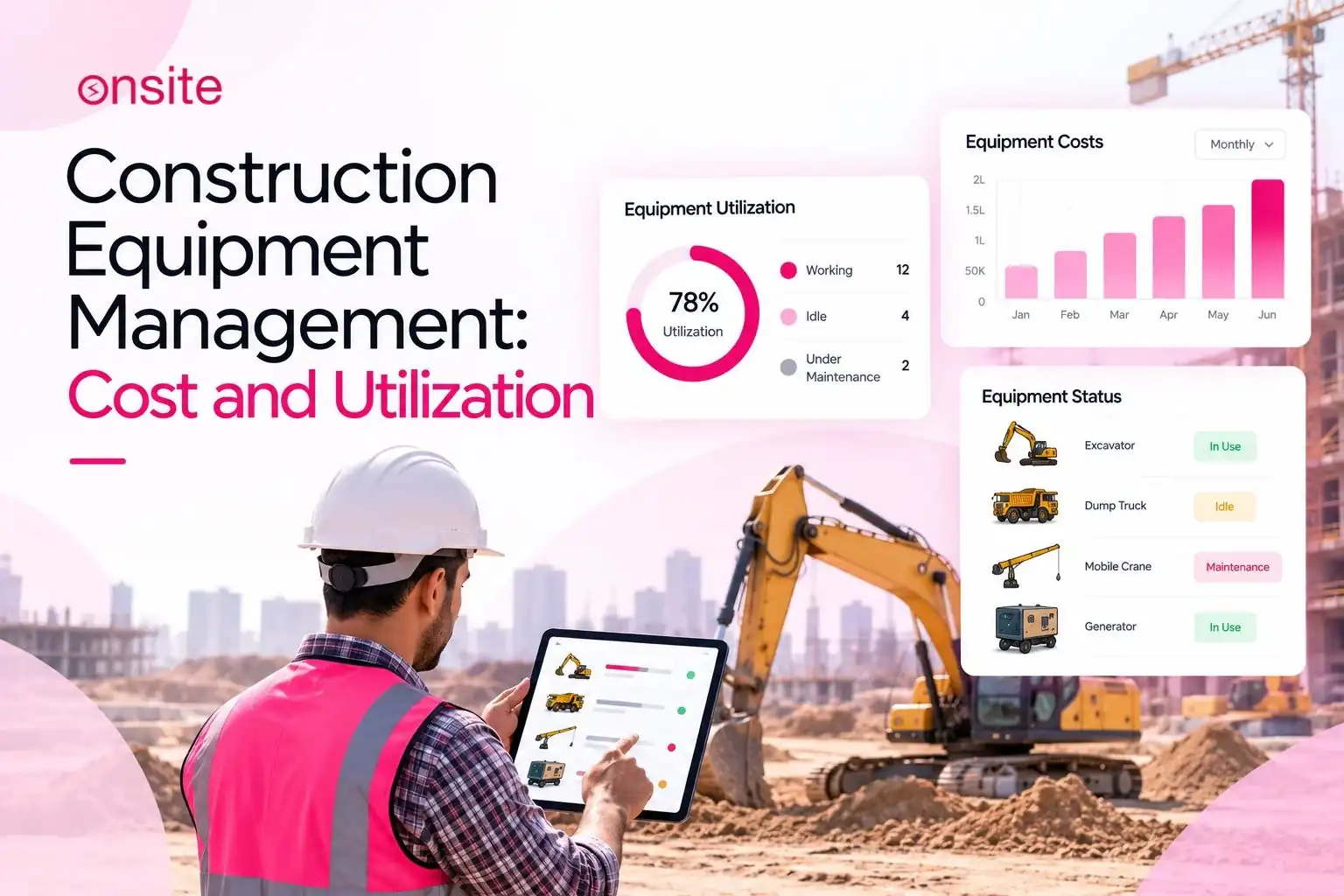
A contractor managing 3 residential projects in Hyderabad hired a 20 tonne excavator for Rs 85,000 per day to carry out foundation excavation at Site B. However, the contractor already owned an identical excavator that had been sitting idle at Site A since the earthworks finished two weeks earlier. Because there was no shared equipment register across the sites, no one realised the machine was available. The contractor hired the external excavator for 14 days while its own machine remained unused for the same period. The total hire cost came to Rs 11.9 lakh for equipment the contractor already had, just 12 kilometres away. This was not a procurement failure. It was a failure to track equipment availability across sites. Construction equipment management helps prevent such situations by keeping records of which machines are available, how many hours they operate, their maintenance status, and their operating costs. With this information for both owned and hired equipment, contractors can make allocation decisions based on current records rather than assumptions.
What is construction equipment management?
Construction equipment management is the process of tracking utilization hours, fuel consumption, maintenance schedules, and operator assignments across every machine on a project. Contractors who measure these four variables reduce idle cost, prevent unplanned breakdowns, and build the records needed to support final account claims.
What Construction Equipment Management Tracks Beyond Machine Location
Managing construction equipment involves more than knowing where each machine is. Contractors need to track four things: how many hours each machine operates, how much fuel it uses per operating hour compared with the manufacturer’s rated figures, whether maintenance is completed at the required operating hour intervals, and which operator uses the machine on each date and activity.
If a contractor tracks only location through WhatsApp updates or a paper register at the site gate, they can see where the equipment is but not whether it is working, how much it costs to operate per hour, or when it needs servicing. Location provides just one piece of information. Effective equipment management requires all four.
Ownership Cost vs Operating Cost: Understanding the difference between ownership costs and operating costs is essential when making equipment decisions. Ownership costs are fixed expenses such as EMIs, insurance, depreciation, and financing charges. These costs continue whether the machine is working or sitting idle. For example, a piling rig with a monthly ownership cost of Rs 1.8 lakh incurs that expense over all 30 days of the month, regardless of how many hours it operates.
Operating cost is variable: These include fuel, lubricants, operator wages, and consumables, which are incurred when the machine runs. If contractors cannot separate these two types of costs, they cannot tell whether a machine is unprofitable or simply underutilized. Each situation requires a different response.
How Utilization Affects Equipment Costs: The utilization rate shows how effectively equipment is being used and how its costs affect project finances.
Utilization rate = (Productive hours ÷ Available hours) × 100
For example, a concrete pump available for 200 hours in a month and used productively for 140 hours has a utilization rate of 70 percent. The remaining 60 hours still carry ownership costs, even though the pump is not being used productively. If the pump has a monthly ownership cost of Rs 1.08 lakh, each of those 200 available hours represents Rs 540 in fixed ownership costs. The cost associated with the 60 idle hours is therefore Rs 32,400. This expense can remain hidden in project accounts unless equipment logs distinguish available hours from productive hours and the finance team calculates utilization for each machine and period. ICEMA publishes industry data on construction equipment deployment in India that contractors can use as a reference when assessing utilization expectations for different machine categories.
How Equipment Records Support Other Project Activities: Equipment management records also support three important functions: checking invoices for hired equipment, auditing maintenance compliance, and substantiating final account claims for equipment used on variation work or kept idle because of client caused delays.
GPS records alone cannot support these activities because they show location, not actual usage or cost. Operating logs, fuel records, and maintenance history provide the additional evidence needed. Location tells the accounts team where a machine was, while the daily equipment log helps the quantity surveyor establish what it was doing, how long it operated, what it consumed, and what costs the contractor can substantiate for that deployment.
How Idle Time Drains Projects That Cannot Measure It
Construction equipment continues to incur ownership or hire costs even when it is not being used. For example, a tower crane hired for Rs 2.7 lakh per month costs Rs 90,000 over 10 days, even if work cannot proceed because the required structural drawings have not arrived. The contractor still has to pay for the equipment during that time.
Consider a commercial project in Chennai where a drawing revision stops crane work for 11 days. The contractor incurs Rs 9.9 lakh in hire costs during the delay. If the daily equipment log records the crane’s status and assigned activity for each day, the contractor has written evidence of the delay and can use it to support a formal claim for client caused standing time. Without these records, it becomes much harder to substantiate the claim, and the contractor may have to absorb the Rs 9.9 lakh cost.
Three Types of Equipment Idle Time: Idle time on Indian construction projects generally falls into three categories, and each has different cost implications.
- Planned idle: This includes scheduled maintenance and monsoon shutdowns. The contractor accounts for these periods as part of the project budget.
- Client caused idle: This happens when work is delayed because drawings are not issued on time, client approvals are pending, or site access is not provided as agreed.
- Contractor caused idle: This includes poor scheduling, mobilising the wrong equipment for an activity, or coordination gaps that leave machines waiting without assigned work.
Documented client caused idle may support a formal claim, subject to the contract and applicable requirements. Planned and contractor caused idle are generally costs the contractor must account for. Without a daily log recording why a machine was idle on each date, the project records may not clearly distinguish between these categories, leaving the contractor exposed to costs that might otherwise have been identified and addressed.
The Problem of Idle Equipment Across Multiple Sites: Idle time across multiple projects creates a different challenge. When contractors do not maintain a shared equipment register, a machine that finishes its work at one site may sit unused for weeks while another project’s procurement team requests an external hire for the same type of equipment.
The owned machine continues to incur ownership costs, while the other site may incur additional hire costs. If the machine has no active assignment, it can also disappear from view because no project is tracking its idle status.
Why Daily Equipment Logs Matter: A daily equipment log helps contractors track idle time, identify its cause, and maintain records that may support a claim for recoverable costs. If the log is treated as unnecessary paperwork, it may not be maintained when site pressure increases. Recording equipment status and the reason for any idle time from the day a machine arrives on site gives the contractor a stronger basis for managing utilization and documenting client caused delays.
Why Reactive Maintenance Costs More Than the Breakdown Itself
Planned maintenance is often much cheaper than dealing with an unexpected breakdown, especially when equipment downtime is included in the cost. Example, servicing a piling rig’s hydraulic pump costs Rs 80,000 in parts and takes one day during a scheduled stop. If the pump fails during operation, the rig may remain idle for three days while a replacement part is sourced. This can delay the pile cap pour and push the structural team’s floor cycle back by four to six days. The parts cost remains the same, but the contractor also faces idle crew costs, delays to the structural schedule, and possible liquidated damages (LD) if a contract milestone is missed.
Contractors do not always postpone maintenance because they fail to understand these costs. Cash flow pressure and poor maintenance records can make it harder to justify stopping a machine for servicing. For example, a site manager working on a delayed project may decide to keep a machine running through the next pour instead of stopping it for the manufacturer’s recommended service at 250 operating hours. The service requirement is known, but the immediate pressure to avoid a day’s stoppage takes priority.
The problem becomes harder to manage when equipment moves between sites without a shared maintenance register. If a machine works on two projects in the same month, each site manager may record only the operating hours logged at their own site. Without combining those records, no one has a complete count of the hours since the last service. As a result, the machine can pass its required service interval without anyone noticing that maintenance is due.
Maintenance records also affect the contractor’s position when equipment breaks down. If a machine has not been serviced according to the manufacturer’s requirements, its warranty coverage may be affected, and an insurance claim for breakdown related damage may be difficult to support. During government project audits, an equipment register showing 400 operating hours but no maintenance entries may also be insufficient to support plant and machinery costs in the final account. The Directorate General of Mines Safety publishes inspection and maintenance guidance relevant to equipment used on Indian sites, which contractors should consult for applicable requirements. Without proper maintenance records, a breakdown cost that might otherwise be recoverable can become a cost the contractor has to absorb.
What Equipment Records Decide at the Final Account Stage
When a contractor submits a final account claim for equipment used on variation work or kept idle because of client caused delays, the quantity surveyor (QS) needs records to verify it. The daily equipment log should identify the machine, its operator, its deployment status, and the activity assigned to it on each date. Without this information, the contractor may not have enough evidence to support the claim, and the QS may reject it. These records are not just a formality. They help establish the basis for equipment related claims in the final account.
Three Claims That Depend on Equipment Records:
Extension of time claims for client caused delays
If equipment stands idle because the client has delayed the work, the contractor needs daily records showing that the machine was on site and ready for use but could not proceed. The log should identify the reason for the delay, such as drawings not being issued, approvals being withheld, or a site area not being handed over by the agreed date.
Star rate claims for variation work
When equipment is used for variation work outside the original bill of quantities (BOQ), the contractor needs records showing how many machine hours were spent on that specific work. These hours should be recorded separately from the machine’s scheduled BOQ activities so the costs can be assessed against the variation.
Mobilization cost recovery after early contract termination
If the client terminates the contract early, the contractor may need to recover mobilization costs for equipment brought to the site. Records should identify which machines were deployed, when each arrived, and the verified daily cost rate for each machine during the relevant period.
Why Equipment Records Must Start Early: All three types of claims depend on the records maintained when the events occurred, not just on the documents prepared when the contractor submits the claim. If equipment logs are started only after a dispute arises, the contractor cannot easily recreate daily records to the same standard as records maintained at the time. Documents assembled later may not provide the same evidence. A daily equipment log is therefore an important financial record. Its value depends on how early the contractor starts maintaining it and how consistently the site team updates it, even during busy periods.
Construction management platforms like Onsite can maintain daily equipment deployment logs, maintenance records, and fuel consumption data across active projects. This allows records that may support final account claims to build up through routine site operations instead of being assembled only after a dispute begins.
When to Own Equipment and When to Hire It
Deciding whether to buy construction equipment depends on three main factors: how often it will be used across projects, whether the contractor can maintain it without disrupting work, and whether the future project pipeline justifies the investment. For example, a civil contractor handling continuous foundation and substructure work across five residential projects may find it worthwhile to own a fleet of excavators if their combined utilization rate exceeds 65 percent. At that level, the ownership cost per operating hour typically falls below the market hire rate for the same type of machine. However, a contractor working on a single road project lasting 12 months may not have enough certainty about future work to justify buying a machine. Once the project ends, the contractor still has to bear its ownership costs, even if the machine is no longer being used.
Check Existing Equipment Before Hiring: For many Indian civil contractors, the decision is not simply between buying and hiring equipment. There is a third option: using a machine the company already owns but which is either sitting idle at another site or will finish its current assignment in a few days. Without a shared equipment register, this option can easily be overlooked. If the contractor knows that an owned machine is available, it may be possible to move it to the site instead of paying for an external hire. But when each site manager maintains a separate equipment list, no one may have a complete view of availability across all projects.
This can leave contractors paying external hire charges while their own equipment remains unused. It is a common but often overlooked cost problem in construction companies managing multiple sites in India. The same issue is discussed in our article on why UAE contractors sometimes hire equipment they already own.
When Hiring Makes More Sense: Hiring can be the better option for specialist equipment needed for a short period, projects with uncertain future workloads, or machines that require maintenance support the contractor cannot provide internally. However, hiring still requires careful cost control. Before approving an invoice billed by the day or hour, the accounts team should check it against the daily equipment log. This helps identify charges for mobilization, standby time, or extended hire periods that are not supported by site records.
For example, seven days of standby charges at Rs 85,000 per day would amount to Rs 5.95 lakh. If the site log does not confirm that the equipment was on standby for those seven days, the contractor needs records to challenge the invoice. Maintaining the daily log from the start of the hire gives the team a basis for checking the billed period before releasing payment.
What Systematic Equipment Management Changes on Every Project
Construction equipment management is not just about record-keeping. It is the information layer that helps contractors make accurate allocation decisions, maintain equipment on time, and support financial claims with evidence.
Contractors who track only equipment locations and machine counts can see the assets they own. However, those who also track utilisation hours, fuel consumption, maintenance schedules, and daily deployment activities can understand the costs their assets generate and identify opportunities for cost recovery.
The impact becomes visible across two or three projects. Cross-site idle time falls when allocation decisions are based on a shared availability register rather than individual site-level assumptions. Reactive maintenance decreases when service intervals are tracked against actual operating hours rather than calendar estimates. Final account claims are more likely to succeed when daily logs have been maintained from day one instead of being assembled after a dispute has already begun.
Construction management platforms like Onsite connect daily equipment logs, maintenance records, fuel consumption data, and hired-equipment invoice verification across active projects in one workflow. Every downstream decision, including cross-site redeployment, maintenance scheduling, invoice approval, and final account claims, is only as reliable as the records available when the event occurs.
FAQs
1. What are the benefits of construction equipment management?
There are many benefits that equipment management offers. To modernise the construction equipment management the project managers have adopted a modern way to handle equipment which is by using construction project management apps like Onsite, Procore etc. So, by having an organised equipment management you can maximise the productivity of equipment. It also helps in avoiding overlaps and ensures when & where equipment is available.
2. Why is constant maintenance of equipment important?
It is important to maintain your equipment. It helps in quickly identifying any problems in the machine and helps you repair that timely. This saves you from the future loss and maintains the longevity of your equipment.
3. How does equipment management save cost?
You can track your equipment and can get to know its fuel consumption. If it is consuming more than usual, then there must be some issue. Through deep monitoring you can fix the issue and save yourself from a long-term loss. Also, regular maintenance can identify and fix problems which also helps in expenses.
