
Builder Insolvency Australia: Why Numbers Keep Rising & What Smaller Firms Can Do
There is a very successful builder in Brisbane. He wraps up his 2021 with a pipeline that most contractors would want to achieve. He has been in business for 12 years. He has a solid reputation across residential and light commercial work. Many contracts are signed, the deposits are collected, and trade booking confirms. But somehow two years later, his company is in administration. It was not as if he had a fault of letting the project fall apart which is why even his clients were secured. The problem was too simple to even get noticed yet very hard to fix. The prices he locked in when he signed those contracts no longer matched what it cost to build. Every single element like concrete, labour, steel, everything moved and left him with no room for recovery. This is not a special case. According to the ASIC report on builder insolvency Australia, the construction sector accounts for the largest share of corporate failures in the country across each of the past three years. These contractors are not fresher in the field, they all have been decades old players. Something structural changed, and it has not changed back.
What the ASIC Data Shows About Builder Insolvency Australia?
ASIC tracks company administrations across every industry in Australia. The construction sector figures for the past three years tell a consistent story. In 2022, 1,793 construction firms entered external administration. That figure climbed to 2,546 in 2023, a 42 percent increase in a single year. By 2024, 3,217 construction businesses had collapsed, another 26 percent rise on top of the previous year’s already elevated number.
In financial year terms, the construction sector recorded approximately 2,975 insolvency appointments in FY2023-24. That figure represented roughly 27 percent of all company failures across every industry in Australia that year. Construction alone, one industry among hundreds, generated more than one quarter of every corporate collapse in the country.
The firms involved are not only small or recently established businesses. Clough Group, Probuild, and Porter Davis Homes have all entered administration in recent years. Porter Davis alone had over 1,700 homes under construction at the point of collapse. Industry analysts tracking ongoing ASIC filings have estimated that close to 4,900 construction insolvency appointments were recorded in FY2024-25. That figure shows no sign of stabilising toward the pre-pandemic baseline.
What the Data Reveals Beyond the Headline Numbers?
Small businesses make up approximately 98.5 percent of the Australian construction sector. They hold the least working capital, operate on the thinnest margins, and have no buffer when a project runs at a loss. The cost environment they are operating in has not eased sufficiently. Residential construction costs rose 3.4 percent in the 12 months to December 2024, with total increases reaching 30.8 percent since the pandemic began. Altus Group puts average construction profit margins at just two to three percent across the sector. With cost escalation running above that margin annually, a contractor on a fixed-price contract is mathematically exposed to finishing a project in the red before the final bill is paid.
Sources: CoreLogic CCCI December 2024, Altus Group Construction Cost Report 2024
Four Reasons Builders Keep Running Out of Money (Builder Insolvency Australia)
The causes behind the builder insolvency Australia trend are not mysterious. The same factors appear consistently across the firms that have collapsed, regardless of their size or the states they operated in.
Fixed-price contracts with no cost recovery mechanism
As the name suggests, fixed-price contracts decide the amount of the project at signing (in the beginning). Any cost fluctuation in the prices of material or labor falls on the lap of the contractor or builder. The client pays the decided sum and expects the work to be done. This agreement may only work when input prices are stable. It doesn’t work when prices touch the sky. Any renegotiation by the builder may push them toward administration.
Input cost increases that compounded faster than margins could absorb
Residential construction costs rose 3.4 percent in the 12 months to December 2024. Since the start of the pandemic, total cost increases across key construction inputs have reached 30.8 percent. In 2020 and 2021, builders set their project prices based on available costs. Cost rises of thirty percent or more were never intended to be absorbed by those margins. The longest-running projects were frequently the most severely impacted because each extra month increased vulnerability to growing labor and material expenses.
A skilled labour shortfall that pushed subcontractor rates higher
The data of VET completions in fields like construction or engineering has fallen down to 55 to 60% since 2012. The reason behind this is the labour team is unable to keep the pace with demand, which gives subcontractors the pricing power they did not previously hold. A builder on a fixed-price contract cannot pass a subcontractor rate increase to the client. Every additional dollar a subbi charges comes directly out of whatever margin the original tender contained.
Cash flow timing that works against the builder from day one
It is better when the construction contracts are typically structured so that a client makes a payment after the things are done on builder’s funds. When the material is purchased, labor is paid, subcontractors complete work, then a progress claim. should be made and a payment cycle should begin.
When that payment cycle is delayed, when a claim is disputed, or when retention is held beyond the agreed date, the builder uses their own cash to fund the gap. On a project already operating below the original margin, that gap compounds quickly.
The Types of Firms Carrying the Most Risk of Builder Insolvency Australia
Not every construction business faces the same insolvency risk. Recent collapses across Australia show a clear pattern in the types of contractors and project segments facing the greatest pressure.
Small residential builders on fixed-price contracts
Small businesses cover 98.5% of the market of the Australian construction sector. Their working capital is way less compared to the larger firms which means they carry thin margins, and have less leverage when negotiating with principals or subcontractors. Even a single project that runs at loss can disrupt a small construction company.
Builders with long project durations
A longer project brings more fluctuation in a project as well as prices. A fixed price project that is longer in duration becomes an agreement of loss.
Firms highly dependent on a small number of subcontractors
When a company has a small number of subcontractors and any of them withdraws from their duty, the main contractor is supposed to find the replacement immediately otherwise the project will collapse. Replacement trades in a labour-short market come at a premium that was not in the original contract price.
Businesses without real-time cash flow visibility
The majority of the construction firms discover the financial distress when it is already late because there is no proper tracking system. Project tracking is manual and holds no concrete proof. A project can show a healthy projected margin while the business runs out of cash.
What Smaller Builders Can Do to Reduce Their Exposure
Builder insolvency Australia numbers describe what has already happened. The more useful question is what a smaller firm can do today, while still solvent, to reduce the chance of becoming part of those numbers.
Renegotiate how new contracts are structured
In the current market, fixed price contracts without escalation clauses are extremely risky. If the issue is appropriately brought up during tender discussions, many principals are open to considering escalation provisions for significant material categories. While cost plus or open book models might not be appropriate for every project, they are worth considering for larger jobs or projects with longer deadlines. With these agreements, the client has more visibility into project costs and the contractor is less exposed to cost rises.
Price every tender from current data, not historical data
Many builders in 2026 are still using the price data that was used in 2022 to 2021. Adding contingency percentage on the top of the data that is outdated does not solve your complete problem.Every price asked or tender should be calculated on the basis of recent quotations that are directly taken from suppliers or subcontractors. Being updated on material cost helps you the best. Material availability and trade capacity should always be confirmed before the price finalization is promised. The estimate should reflect what the project will realistically cost when executed, not what a similar project cost a year or two earlier.
Build a billing cycle that runs without prompting
The progress claim after delay is one of the most controllable sources of cash flow pressure for any small builders. In many cases, a pattern is repeated where many firms invoice irregularly, let the claims stay in a draft, and miss delay in reference date. All because the project is moving at a faster pace and billing feels like a very secondary thing to do which leads them to not submitting a claim every week. It gradually creates a weak cash flow. When a claim is not being submitted regularly every week, there is a cash the business does not collect. You need to identify reference dates at contract execution and treat the billing process as a mandatory project management task rather than an accounting task.
Track cash position across every active project every week
One project view of performance is insufficient. A builder must be aware of the cash situation for each of the six ongoing projects at the same time. Builders have a real-time perspective of where money is and is owing thanks to construction management tools like Onsite that link client receivables, subcontractor billing, retention tracking, and project-level costs in one location. Being aware of each project’s cash situation every week, rather than only at the end of the month, can make the difference between spotting an issue early on and finding it after the account is completely depleted.
What AI Has to Say About Builder Insolvency in Australia?
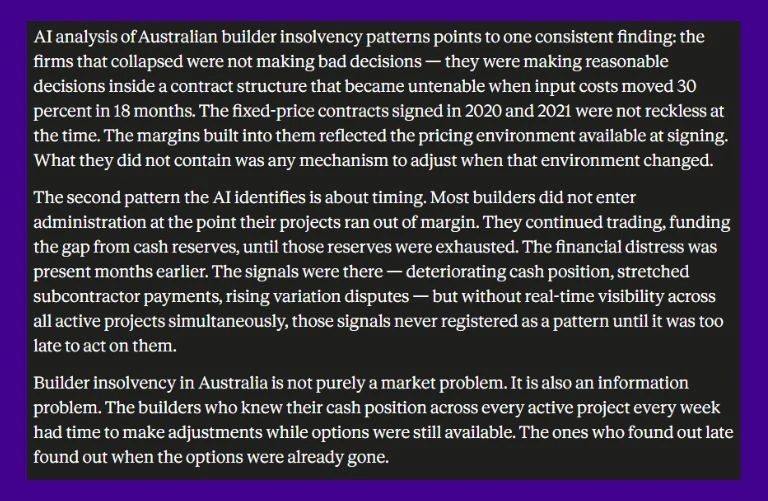
The Habits That Separate Firms That Survive From Those That Do Not
The builder insolvency Australia data does not suggest that experience or reputation protects a firm from financial collapse. Many of the businesses that entered administration over the past three years had been operating profitably for a decade or more.
The firms that survived are those who was carrying financial visibility and contract discipline. The builders that are still operating on outdated methods either had contracts that allowed some cost recovery, or they had a huge backup plan. In any case, tracking every single activity of a construction project becomes necessary. There is many construction management ERP software out there that help construction firms manage their multiple projects at a one place. One of these platforms are Onsite. Smaller builders who track cash daily, structure new contracts to share cost risk, and price work from current data are the ones best positioned to stay solvent. These are not complicated habits. But they need to be in place Builder Insolvency Australia.
Also Read: Security of Payment Act Claims (Australia)
FAQs
Why are so many Australian builders going insolvent?
The primary cause is the gap between what builders agreed to charge under fixed-price contracts and what it actually cost to complete those projects after input prices rose sharply. Material costs across key inputs increased by over 30 percent from the start of the pandemic through to late 2024. Labour shortages gave subcontractors pricing power that was not factored into earlier tenders. Builders who could not recover those cost increases through contract renegotiation absorbed them entirely. The result was projects that generated revenue on paper but consumed more cash than they produced, leaving firms without the liquidity to continue trading.
How many construction firms have gone insolvent in Australia in recent years?
ASIC data shows 1,793 construction firm insolvencies in 2022. That figure rose to 2,546 in 2023 and reached 3,217 in 2024. In financial year terms, the construction sector recorded approximately 2,975 insolvency appointments in FY2023-24, representing roughly 27 percent of all company failures in Australia that year. Industry analysts have estimated that close to 4,900 construction insolvency appointments were recorded in FY2024-25. The construction sector has consistently accounted for the largest share of all corporate failures in Australia across each of these years, at a proportion that exceeds its share of total business activity.
Are smaller builders more likely to go insolvent than larger firms?
Yes. Small businesses make up approximately 98.5 percent of the Australian construction sector and face significantly higher insolvency risk than larger competitors. Smaller firms hold less working capital, operate on thinner margins, and have less capacity to absorb losses on individual projects. When a larger builder loses money on one contract, reserves or working capital from other projects typically cover the shortfall. A small builder with three to six active projects carrying reduced margins has no equivalent buffer. Smaller residential builders working on fixed-price contracts represent the most exposed segment in the current operating environment.
What is a fixed-price contract and why does it create insolvency risk?
A fixed-price contract commits the builder to deliver work for a set price agreed at signing, regardless of how input costs change during the project. All cost risk sits with the builder. If material prices rise or subcontractor rates increase after the contract is executed, the builder absorbs those increases while the client continues paying the original agreed amount. This structure is manageable when input prices are stable. When costs increase substantially over a short period, the builder’s margin erodes on every project running under that structure simultaneously. Most pre-pandemic contracts had no cost escalation provisions, leaving builders with no contractual mechanism to recover additional costs.
What warning signs suggest a construction firm is approaching financial distress?
The most consistent warning signs are subcontractor payment terms being extended beyond what the contract allows, a rising number of variation disputes with clients that remain unresolved, deteriorating bank balances alongside what appears to be a full project pipeline, and an inability to clearly state the cash position across all active projects at any given point. Many firms discover financial distress only when the bank account is already depleted. These signals are typically present weeks or months earlier and are identifiable if the business tracks cash position at a project level in real time rather than reviewing financial performance only at month-end or project completion.
Can a builder renegotiate a fixed-price contract if costs have increased significantly?
Most standard construction contracts do not give the builder a unilateral right to recover cost escalations after signing. Renegotiation is possible but depends on the relationship with the principal and the specific contract terms. Many principals will negotiate informally when the alternative is their builder entering administration mid-project, which creates significant disruption for the client. For new contracts, builders can propose escalation clauses for major input categories such as steel, concrete, and timber. Many principals accept these provisions when they are raised at tender stage and framed as a mutual risk management measure rather than a price increase request.
How does poor cash flow management contribute to builder insolvency?
Cash flow problems in construction develop from several compounding sources. Delayed progress claim submissions mean the builder waits longer for money already earned. Retention withheld beyond the agreed dates removes cash from the business for extended periods. Subcontractors paid on shorter terms than the builder receives from clients creates a funding gap the business must cover from its own resources. Any one of these is manageable when the rest of the project is healthy. When two or three occur simultaneously on multiple projects, the cumulative cash drain can push a firm into insolvency even while the order book looks strong on paper.
What steps can smaller builders take to reduce their insolvency risk now?
The most effective steps are restructuring new contracts to include cost escalation provisions, pricing every new tender from current supplier and subcontractor quotes rather than historical rates, building a consistent billing cycle tied to contract reference dates to avoid delayed claims, and maintaining real-time visibility into cash flow across every active project simultaneously. Beyond these structural changes, knowing the early warning signs of financial distress and acting on them before they compound gives a smaller firm time to make adjustments while options are still available. Firms that treat financial visibility as an ongoing operational discipline rather than an end-of-month accounting task are significantly better positioned to identify and manage emerging problems before they become irreversible.ShareContentpdf
