
Security of Payment Act Claims: What Australian Contractors Keep Getting Wrong
A subcontractor in Brisbane spends six weeks completing formwork on a commercial build. The work is done. The quality is not in question. He submits his invoice to the head contractor and waits. Fifteen business days pass. No payment schedule arrives. No payment either. He calls. The head contractor says the invoice was not a valid payment claim under the security of payment act construction rules, so they had no obligation to respond to it. He had no idea his invoice needed to say anything specific. He had no idea a missing statement could cost him every legal right the Act was designed to protect. This happens constantly across Australian construction. The Security of Payment Act claims exists to protect contractors and subcontractors from exactly this kind of situation, but the protections only work when you follow the process correctly. Most contractors do not.
What the Security of Payment Act Claims Actually Gives You?
In each Australian state and territory, there is their own version of security of payment legislation. The names may differ slightly. In New South Wales, it is the Building and Construction Industry Security of Payment Act 1999. In Queensland, it operates under the Building Industry Fairness Act 2017. In the same way, states or territories like Victoria, South Australia, Tasmania, have their different versions with different timeframes and procedures.
All of the security of payment legislation may have their own version, but their core purpose is consistent. This Act gives contractors and subcontractors a statutory right to receive progress payments for construction work performed, irrespective of what contract includes. It helps in creating a fast-paced process for disputed claims and going to the court may be avoided. It prohibits paid-when-paid clauses, which allows any head contractors to withhold payment simply because the client had not yet paid them.
The Security of Payment Act Claims covers a wide range of people, including:
- Head contractors and subcontractors performing construction work
- Suppliers of materials or plant equipment for use in construction
- Labour suppliers
- Consultants providing architectural, engineering, project management, surveying, and related services
There might be things that a particular Act does not cover, and it varies state by state. Any building contract between a builder and a homeowner may be excluded in most jurisdictions. You need to always make sure what legislation applies to what state. The key mechanism is straightforward. You serve a payment claim. If the respondent disputes the amount, they must serve a payment schedule within a strict timeframe. And if they fail to serve that, they lose the right to dispute and are liable to pay the full claimed amount. And if they succeed in paying a schedule for less than you claimed, you can apply for adjudication. An adjudicator makes a binding decision, usually within ten business days.
It is a powerful process. The problem is that a procedurally defective claim can collapse it before it even starts.
The Most Common Errors That Invalidate Security of Payment Act Claims
Most contractors lose payment claims before adjudication ever becomes an option. The claim itself is the problem.
This Security of Payment Act Claims is strict about what a valid payment claim must contain. Any claim that does not fulfil the requirements is not a valid payment claim under the legislation. If it does not fulfil that requirement, the respondent has no obligation to respond.
Here are the errors that come up most often:
Not including the required statement
In most of the states of Australia, a payment claim should include a clear statement that it is made under the applicable security of payment legislation. This single line can make your claim valid, but in some jurisdiction, leaving it out makes the claim invalid. Meanwhile, places like New South Wales do not require this. Not knowing which rule applies can lead to avoidable and costly mistakes.
Claiming beyond the reference date
The point at which a payment claim may be submitted is known as the reference date. Usually, the contract defines it. If not, a default is imposed by legislation, usually on the final day of the month. A claim may be deemed invalid or those amounts may be eliminated if it contains work completed after that date. Unaware that they might only be able to claim until the reference date, many contractors include work up until the day they submit the claim.
Submitting outside the time limit
Each state has its own rule of a set time limit for how long after work is completed you can ask for a payment claim. For example, in Victoria, there are three months, in New South Wales and the ACT, you have 12 months. In Queensland and South Australia, there are six months. And missing these timelines cannot give you the claim. You must pursue payment through ordinary contract law, which is expensive and way slower.
Not identifying the work clearly enough
A payment claim must be detailed and specific on the basis of construction work or related goods and services to which the claim relates. A vague description causes you problems.
Head contractors missing the supporting statement requirement
A supporting statement attesting to the payment of subcontractors must be included with a head contractor’s payment claim in Queensland. If any have not, the statement must expressly mention this and provide an explanation. Although it can result in sanctions, leaving out the statement does not always render the claim unlawful. Because this regulation is unique to Queensland and is not well recognized, many contractors ignore it.
What the Numbers Say About Security of Payment Claims in Australia?
The scale of security of payment activity in Australia reveals just how frequently contractors need the Act and how unevenly the system is used across states.
There were a total of 1057 adjudication applications lodged in New South Wales alone in the 2023-24 financial year. There was a total of AUD 745,154,036 claimed. Of those, 538 determinations were released, with AUD 113,831,040 ultimately awarded.
That gap between what was claimed and what was awarded reflects the combined effect of contested amounts, withdrawn applications, and claims that could not be substantiated with sufficient documentation.
Victoria, despite having a comparable construction sector, lodged only 332 applications in the same period, claiming AUD 119,816,186 with AUD 42,188,314 awarded across 189 determinations. The disparity is not explained by fewer disputes. It is explained by Victoria’s Security of Payment Act being significantly less claimant-friendly than NSW’s. Victoria’s legislation still allows respondents to introduce new reasons for withholding payment during adjudication, a right NSW removed years ago. The Victorian Government formally acknowledged this in 2024 and committed to reforming the legislation.
The earlier 2022-23 data tells a similar story. NSW recorded 937 applications claiming AUD 889,544,144, with 501 determinations releasing AUD 329,741,377. Victoria recorded 384 applications and 212 determinations over the same period with amounts awarded more than 13 times lower than NSW despite the applications being only 2.4 times fewer.
A few other numbers worth understanding:
- Subcontractors account for approximately 85 percent of all adjudication applications lodged in NSW, based on historical application type data from the NSW Department of Customer Service’s quarterly adjudication statistics. Head contractors represent only around 7 percent.
- Across all claim size bands in NSW, just under 50 percent of claimants receive their full claimed amount at adjudication. The remainder receive a partial award or nothing.
- The most common reason a valid claim does not receive its full amount at adjudication is insufficient documentation to substantiate the claimed figures not a procedural defect in the claim itself.
What these numbers tell you is that the Act is being used constantly, that most of the people using it are subcontractors, and that winning at adjudication depends on what you can prove, not just on what you are owed.
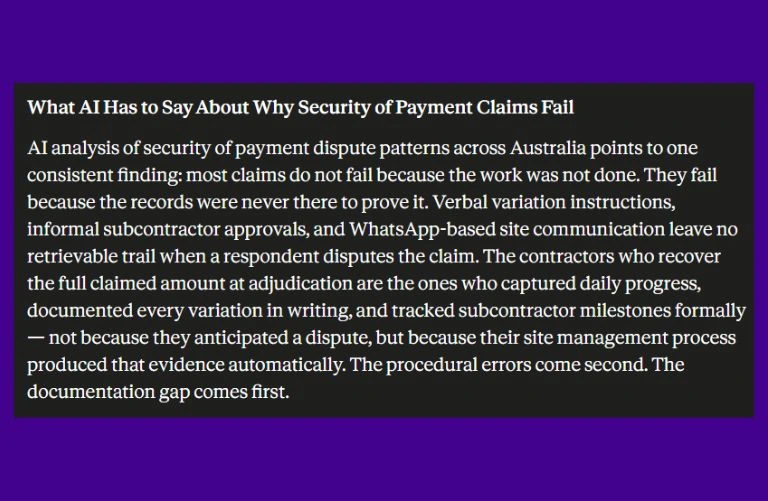
What AI Has to Say About Why Security of Payment Claims Fail?
The Payment Schedule Trap Works Both Ways
Many of the contractors go along with the mentality that the Act is made to give them protection, but very few people realize that the Act also creates serious obligations for them as respondents. If you are a contractor and you receive a payment claim from a subcontractor, you need to respond with the payment schedule within the strictly required time frame. For example, in New South Wales, you get 10 days, in Queensland, you get 15 business days, and so on. If you fail to serve a payment schedule on time, you owe the full claimed amount. There will be no argument accepted as well as no negotiation accepted. The claimant can ask the amount as a court judgment debt without going through adjudication.
If a payment schedule responds with less than the claimed amount, it must clearly explain why. It needs to identify the disputed portions and state the reasons for withholding payment. A simple statement like “we dispute your claim” is not sufficient. In adjudication, the respondent is usually limited to the reasons given in the payment schedule. Any new arguments raised later may not be considered by the adjudicator.
Head contractors who receive a dubious subcontractor claim and believe it can be resolved later are frequently impacted by this. There is no later under the Security of Payment Act Claims. There are severe repercussions if the deadlines are missed.
What You Need Before You Submit a Claim
A correctly formatted invoice is not enough for the payment claim. It needs to be backed up by the documents that can withstand scrutiny if the respondent disputes the amount and the matter goes in adjudication.
Adjudicators review claims within tight timelines and highly rely on the documents that was provided by each party. If the variation claims are not confirmed by written instruction on approval orders, there is no basis to assess them. If the completed work is not supported by the site records, progress photos, or delivery documents, the claim is just a statement. Without supporting records, claims are difficult to uphold.
Before you submit a progress claim, you should have the following on file:
- Signed variation orders or written instructions from the principal or superintendent for any work outside the original contract scope
- Site diary entries or daily reports covering the period of the claim, noting work completed, workers on site, and any delays or instructions received
- Delivery dockets or goods received records for any materials included in the claim
- Progress photos timestamped to the period covered by the claim
- A copy of the contract, including any schedule of rates or contract sum breakdown the claim is drawn against
- Records of any previous payment claims and payment schedules, so the new claim clearly shows what has been paid and what remains outstanding
Contractors who are paying attention and keeping the documentation as a part of routine work submit claims that are clearer and more difficult to dispute. And even if these disputes arise, the documentation makes it easier for adjudicators to assess. But for those who try to gather records after the dispute has begun, it’s a big problem and in difficulty to recover the full amount.
It is equally important to understand the exact process for the relevant state. Timeframes and serving requirements vary. In some cases, a payment claim must be delivered in a specific way. Email may not be valid unless the contract permits it. Methods such as hand delivery, registered post, or leaving the document at the respondent’s address may be required. Using the wrong method can render a valid claim ineffective.
Getting Security of Payment Act Claims Should Not Be Complicated
The security of payment act is one of the most genuine protection for contractors and subcontractors in Australia. The process is faster with manageable cost compared to litigation and outcomes are enforceable. When it works in their favor, it works well. The real problem is that contractors get to know about this act right after the dispute has already started. They may submit a claim, but the procedural errors keep on happening because they do not know the rules. They missed the response deadlines because they did not know how short the window was. They lose their claim because of the lack of documentation.
Construction is a high-margin-pressure environment right now. The Australian Securities and Investments Commission recorded a 28 percent increase in construction insolvencies in the 2024 financial year compared to the year before. Payment delays and unpaid claims are a direct contributor to that pressure on smaller firms.
The only contractor who stays ahead of payment disputes is the one who always keeps formal legal documents. They keep the record not just as an invoice, and as a habit, not an afterthought. They stay aware of the payment scheduled time frame. And to know all of this, you do not need a lawyer on retainer. All you need to know is what the act demands and building the paperwork habit before a dispute ever starts.
FAQs
What is the Security of Payment Act in Australian construction?
The Security of Payment Act is legislation that exists in each Australian state and territory to protect contractors, subcontractors, and suppliers who perform construction work. It gives them a statutory right to receive progress payments for work completed, regardless of whether the contract includes specific payment terms. The Act creates a fast-track adjudication process so payment disputes can be resolved in days rather than months. If a respondent fails to issue a payment schedule on time, the claimant can enforce the full claimed amount as a court judgment debt without going through adjudication at all. The Act is state-based, which means timeframes and specific requirements differ depending on where the work was performed.
Does the Security of Payment Act apply to all construction work in Australia?
The Act applies broadly to construction work and related goods and services, including labour supply, material supply, and professional services such as engineering, surveying, and project management. The main exclusion in most states is domestic building contracts between a builder and a homeowner where the homeowner resides in the property. Subcontracts for work on residential projects are generally still covered, even if the head contract is not. Always confirm which state’s legislation applies based on where the work was performed, not where your company is registered.
What must a valid payment claim include?
A valid payment claim must identify the construction work or goods and services covered by the claim, state the claimed amount, and in most states include a statement that it is made under the relevant security of payment legislation. Head contractors in Queensland must also include a supporting statement confirming the status of subcontractor payments. The claim must be served within the applicable time limit after the work is completed and on or after the reference date established by the contract or the legislation. Missing any of these requirements can make the claim procedurally invalid.
What happens if a respondent does not issue a payment schedule?
If a respondent receives a valid payment claim and does not issue a payment schedule within the required timeframe (which varies by state, typically ten to fifteen business days), they become liable for the full claimed amount. The claimant can apply to have that amount enforced as a judgment debt through the courts without needing to go through adjudication. This is one of the strongest protections the Act provides for claimants and one of the most serious risks for respondents who miss the deadline.
Can a payment claim be submitted by email?
This depends on the contract and the state. Some states require payment claims to be served by specific methods such as hand delivery or registered post. Email is only acceptable if the contract expressly permits electronic service or the respondent has agreed to receive documents electronically. Serving a valid claim through the wrong method may have the same legal effect as not serving it at all. Always check both the contract terms and the relevant state legislation before choosing how to deliver a payment claim.
What is adjudication and how does it work under the Act?
Adjudication is the dispute resolution process created by the Security of Payment Act. When a claimant and respondent cannot agree on the amount owing after a payment schedule is issued, the claimant can apply to an Authorised Nominating Authority to have the dispute determined by an adjudicator. The adjudicator reviews the payment claim, the payment schedule, and the adjudication response, and makes a decision within a set timeframe, usually ten business days. The decision is binding and enforceable. The process is significantly faster and cheaper than court litigation, which is why the Act was designed around it.
What documentation strengthens a construction payment claim?
Strong claims are backed by site diaries or daily reports covering the claim period, signed variation orders or written instructions for any out-of-scope work, delivery dockets and goods received records for materials, progress photographs with timestamps, and clear records of previous claims and payments. Adjudicators assess claims on the documents provided. Verbal agreements and undocumented instructions carry very little weight. Contractors who maintain site records as a consistent habit are in a far stronger position if a claim is ever disputed.
What is a reference date and why does it matter?
A reference date is the date from which a contractor is entitled to make a payment claim. It is typically set by the contract. If the contract does not specify a reference date, the legislation sets a default, usually the last day of each calendar month. A payment claim that includes work performed after the reference date may be invalid for those amounts. Contractors who are not aware of their reference dates sometimes submit claims that cover more work than they are entitled to claim at that point, which creates problems if the respondent challenges the claim.
How do payment timeframes differ between Australian states?
The timeframes vary by state and affect both how long a claimant has to serve a payment claim and how long a respondent has to issue a payment schedule. In New South Wales and the ACT, claimants have twelve months after the last work to submit a payment claim. In Queensland and South Australia, the limit is six months. In Victoria, it is three months. Payment schedule response times are typically ten business days in New South Wales and Victoria and fifteen business days in Queensland. Contractors who work across multiple states need to know the rules for each jurisdiction separately.Share
