
Construction Project Delays Australia: Why Contractors Discover Problems After the Damage Is Done

A construction project manager in Sydney receives a call on Monday morning. He gets to know that there was a concrete pour scheduled on Wednesday. There was a crane operator that his foreman booked three weeks ago. It is now working on another site. The situation arises where the ready-mix supplier is not able to confirm the delivery window without the crane confirmation first. The client is finding out the situation at the same time. This happened not because anyone hid the problem. It happened because nobody actually saw it coming. And this is how situations get hard and construction project delays happen. This is how most construction project delays Australia contractors face actually unfold. It was not actually a sudden disaster, but a quiet failure in the information chain, which was discovered only after schedule had already absorbed the impact. The situation got out of hand not because a delay was created on Monday morning. It happened because there was no written confirmation when crane booking was taking place, and no one tracked whether the subcontractor had logged in the availability, and when the project management system had no way to surface the gap. It turned into a crisis.
Why Construction Project Delays Australia Are Getting Worse?
Construction project delays Australia wide have multiple contributing factors, and several of them have intensified over the past three years rather than easing.
Labour availability has not recovered.
The building and construction industry in Australia currently needs approximately 90,000 additional workers to meet existing project demand, a figure projected to grow to 130,000 by 2029. One in four construction businesses reported active job vacancies in the ABS February 2024 Job Vacancies Survey. Of those, 85 percent said they were struggling to find suitably qualified workers. When a key trade is unavailable at the scheduled time, the project does not pause cleanly. It fragments. Activities that depend on that trade cascade into the following weeks, compressing the remaining schedule against a fixed completion date.
Subcontractor insolvencies are creating mid-project gaps.
The same problem of insolvency leading contractors into administration are reaching the subcontractor tier. When a subcontractor gives up mid-project, the head contractor has to look for the replacement immediately, along with the capacity and technical capability to continue the work. Replacement subbies frequently cannot start immediately. Every week that a critical trade is absent creates a delay the original programme did not account for.
Material lead times remain extended.
There may be an improvement in supply chain condition since the 2021-2022 peak but it has still not returned to the pre-pandemic norms. One of the most constrained inputs is still steel fabrication. Any stretched time in lead for particular materials means that procurement decisions delay which leads to design delays and schedule gaps.
Nearly 40,000 approved homes have not broken ground.
KPMG data from late 2023 identified approximately 40,000 dwellings with planning approval across Australia that had yet to commence construction, including over 11,000 in Sydney alone. High construction costs and financing constraints are the primary factors. When projects that were expected to mobilise do not, the contractors and subcontractors who had scheduled their capacity around those starts face cascading availability changes across their order books.
What the Numbers Say About Construction Project Delays in Australia?
The Grattan Institute’s analysis of Australian infrastructure projects found that approximately 65 percent run over their original schedule, with the average delay sitting between nine and 20 percent beyond the planned completion date. Infrastructure Australia’s 2025 Market Capacity Report confirmed that construction labour demand is projected to exceed available supply until at least late 2027, meaning the workforce constraint driving many current delays has no near-term resolution. A 2019 KPMG survey of Australian construction firms found that only 31 percent of projects delivered in the preceding three years were completed within ten percent of their planned timeline. Government project data from a November 2023 review of 82 publicly owned infrastructure projects worth AUD 120 billion found widespread schedule and cost overruns across the portfolio — with transport projects identified as the hardest hit category. The building industry currently employs approximately 1.3 million people and accounts for around nine percent of GDP, making schedule performance in this sector a national economic issue, not just an operational one.
Sources: Grattan Institute, Infrastructure Australia Market Capacity Report 2025
What AI Has to Say About Construction Project Delays in Australia?
The Real Reason Construction Project Delays Australia Are Discovered Late
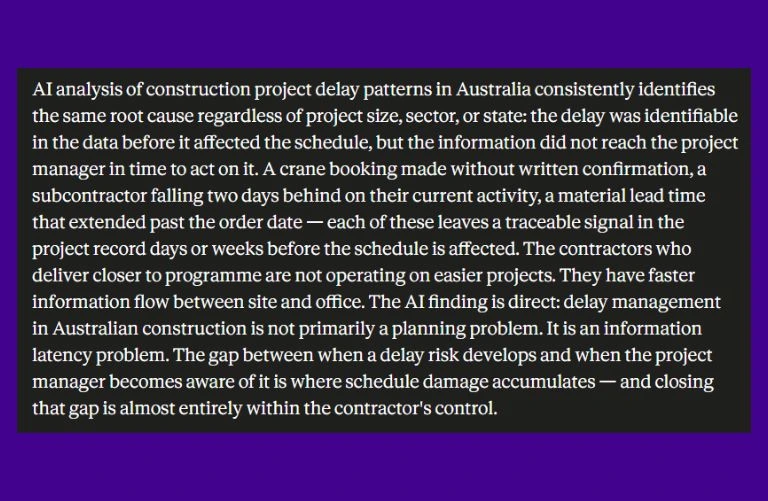
The biggest reason for project delays Australia is the informational gap and the problems only occur after the schedule has already been affected. The gap exists because of the communication gap between site teams and office teams.
The common patterns that cause late discovery include:
- No daily progress records: Lack of progress recording leads to blindness toward upcoming events. This lack of information leads to end moment events which eventually leads to project delay.
- Verbal instructions and bookings with no written record: Some of the baddest approach to that lead to construction delays is making a trade booking by phone on a call, giving instruction of changes verbally, and a delivery window agreement in conversation. When in any of these tasks any mishap takes place, there is no written record of proof. There is nothing that a system can flag or warn you about.
- Programme updates that happen weekly or monthly: An update once a week only showcases what was happening last week, not what has happened during the week or what is happening today. In fast-moving projects, a week-old program is already a historical document rather than anything that is helpful for today.
- No early warning triggers linked to milestone dates: When there is no system that automates the alert for activities approaching, the plan starts without any confirmed results. The project manager is going to find out the problems or the risk at the same time as it is taking place.
- Subcontractor progress not tracked against issued work orders: When a contractor does not keep track of subcontractors’ completion of work against the work order, things like billing mismatch and schedule slippage takes place. It is necessary to formally track each and every activity.
How Each Type of Delay Compounds Into a Larger Problem
Construction delays do not stay contained. Each category of delay creates secondary effects that are often larger than the original problem.
Labour delays
When a trade is not available at the planned start date, the activities that depend on it are delayed as well. If formwork falls behind, reinforcement work cannot begin. If reinforcement is delayed, the concrete pour cannot proceed. A one week labour shortage on a critical activity can easily create several weeks of delay across the trades that follow.
Material delays
Any delayed material is immediately considered as a procurement problem. However, it is more than that. It is a schedule problem and it is a cost problem. If a material is arriving late at a site, the trades waiting to use them have often already mobilized. Labor sits idle, which adds up the cost to the contractor. It also adds up to the reschedule risk.
Design and variation delays
A variation in design that went over an approval stage was not confirmed in writing. It’s going to create an invisible schedule risk. The work is already proceeding with the original design. Not everyone was made aware of the new variation. If it does not get communicated it creates a risk of delay, cost hike, and rework.
Approval and inspection delays
Construction projects in Australia must go through a number of mandatory permission and inspection phases. Regardless of how well the prior phases were handled, the program absorbs the delay if an inspection is postponed, further documentation is needed, or a flaw is found that needs to be fixed before work can proceed.
What Contractors Need to Do Differently
Catching construction project delays Australia contractors face before they compound requires a change in how daily progress information is captured, not a change in how hard the project team works.
Record site progress against the programme every day, not every week.
Every single task that is taking place either in construction site or from the back-end needs to be recorded. There should be not a weekly report but a daily progress report. It keeps the manager updated on whatever is happening at a construction site. This way, a project can be prepared for any upcoming disaster or risk.
Confirm all bookings and instructions in writing.
Every single thing needs to be written down, either it is a booking of a crane or material ordering or if it’s barely an instruction. Once everything is written down, it becomes easier to get the visibility of whatever is taking place at the construction site. The record keeping can prevent weeks of schedule disputes.
Track predecessor completion before dependent activities are scheduled to start.
A platform like Onsite, a construction management software, can help a contractor warn about the upcoming activities against the completion task, so that whatever is coming, a contractor is ready to take it or avoid it with ease. If there is any mishap, like a schedule start at risk, it warns, it flags that particular thing and warns the contractor about it.
Separate critical path activities from float activities in daily tracking.
Not every delay affects the site the same way. One day delay on activity with several weeks of float is way different than a one-day delay on critical concrete pour with no float available. This is the reason why a project manager shouldn’t treat all the activities with equal urgency because they know the site of which issue needs to be addressed immediately. This ends up affecting the whole schedule.
Track subcontractor completion formally, not conversationally.
For every subcontractor, there should be a milestone or deadline that is recorded formally rather than just by conversation, and it should be compared to the program. When subcontractors’ progress falls behind the issued work order, this should show up in the project record rather than being told randomly on a Friday call.
Construction management platforms like Onsite that capture daily progress reports from site, track subcontractor work orders against milestones, and surface completion data against the programme in real time give project managers the information needed to act on delays before their effects have compounded. When a site engineer records progress each day through a structured digital workflow, the gap between site reality and the project manager’s view of the project closes from a week to a day.
The Problem Is Not That Delays Happen
Construction project delays or Australia are common to happen, but it is important to understand that the failure does not come from planning or management. It comes from lack of information and visibility. The structure of information is weak. A delay that can be identified two weeks before comes as a surprise because there was no record of past activities that has taken place at a construction site. The contractors who consistently deliver closer to programme are not the ones working on easier projects. They are the ones who see the problems first because their information flow is faster. Daily site records. Written confirmations. Programme tracking that updates as work is completed rather than at the end of the week. That is not a technology problem. It is a discipline problem that technology makes easier to sustain.
FAQs
What are the most common causes of construction project delays in Australia?
The most frequently reported causes include skilled labour shortages, subcontractor unavailability or insolvency, extended material lead times, late design changes and variation instructions, mandatory inspection and approval delays, and weather events that halt outdoor works. These causes rarely occur in isolation. A labour gap delays one activity, which pushes dependent trades back, which creates a cascade through the remaining programme. The underlying factor that makes delays difficult to manage is not the delay itself but the lag between when the problem develops and when the project manager becomes aware of it. Most delays in Australian construction are identifiable days or weeks before they affect the schedule.
Why do Australian contractors often discover project delays too late?
The core issue is information flow. Site teams observe progress conditions daily, but that information typically reaches the project manager through informal channels such as phone calls, WhatsApp messages, or weekly site meetings. By the time a delay is formally acknowledged, it has often already consumed schedule float and begun affecting dependent activities. Programmes updated weekly or fortnightly reflect conditions as they were, not as they are. Without daily progress records tracked against the programme, subcontractor completion formally monitored against work orders, and advance checks on predecessor activities before dependent starts, the project manager is always working from delayed information.
How does a labour shortage cause construction delays in Australia?
When a trade is unavailable at its scheduled start date, every dependent activity is pushed back. The building and construction industry currently needs approximately 90,000 additional workers to meet existing demand. One in four construction businesses report active vacancies, and 85 percent of those struggle to fill them with suitably qualified workers. In this environment, trade bookings made without written confirmation are frequently lost to competing projects. When a key trade does not appear on the planned start date, the project manager often discovers the problem on the day rather than in advance, leaving no time to arrange a replacement before the schedule is already affected.
What is the effect of subcontractor insolvencies on construction project timelines?
When a subcontractor enters administration mid-project, the head contractor must find a replacement with the technical capability and available capacity to continue the work. In a market where qualified trades are already scarce, this process frequently takes longer than the programme can absorb. The replacement subcontractor may not be able to start immediately, and may need time to familiarise themselves with work completed by the previous contractor. Each week without the critical trade creates delay that compounds across dependent activities. This is increasingly common in Australia, where subcontractor insolvency rates have risen significantly alongside head contractor collapses over the past three years.
How do material delays affect construction project schedules?
Late material deliveries create idle labour costs when trades have mobilised but cannot work, and schedule pressure when the delayed materials fall on the critical path. If trades demobilise and return when materials arrive, remobilisation adds both cost and further schedule risk. Extended lead times for specialist materials, including steel fabrication and certain electrical components, have remained above pre-pandemic norms. Procurement decisions made late in the design phase frequently translate into schedule gaps during construction. Projects that identify material lead time constraints early and place orders accordingly are significantly less vulnerable to this category of delay.
What is a critical path activity and why does it matter for delay management?
A critical path activity is one where any delay directly extends the overall project completion date, because it has no schedule float. Activities off the critical path have float, meaning they can slip by a certain number of days without affecting the final date. When a project manager treats all schedule slippage with equal urgency, they cannot distinguish between a delay that requires immediate action and one that can be monitored. Identifying which activities are on the critical path and tracking them with a higher level of attention allows the project team to focus its response on delays that actually threaten the programme rather than reacting to every variation in daily output.
How can contractors reduce construction project delays in Australia?
The most effective changes are not procedural innovations but improvements to information flow. Daily progress records captured at site level, available to the project manager the same day, close the information lag that allows delays to compound undetected. Written confirmation of all trade bookings, delivery windows, and variation instructions creates a retrievable record that prevents verbal agreements from disappearing when they fall through. Checking predecessor completion two weeks before dependent activities are scheduled to start gives the project manager advance warning of upcoming risks. Tracking subcontractor completion formally against work orders rather than conversationally removes the gap between what a subcontractor says they have done and what is formally recorded.
