
Construction Purchase Order: Types, Uses and Common Errors
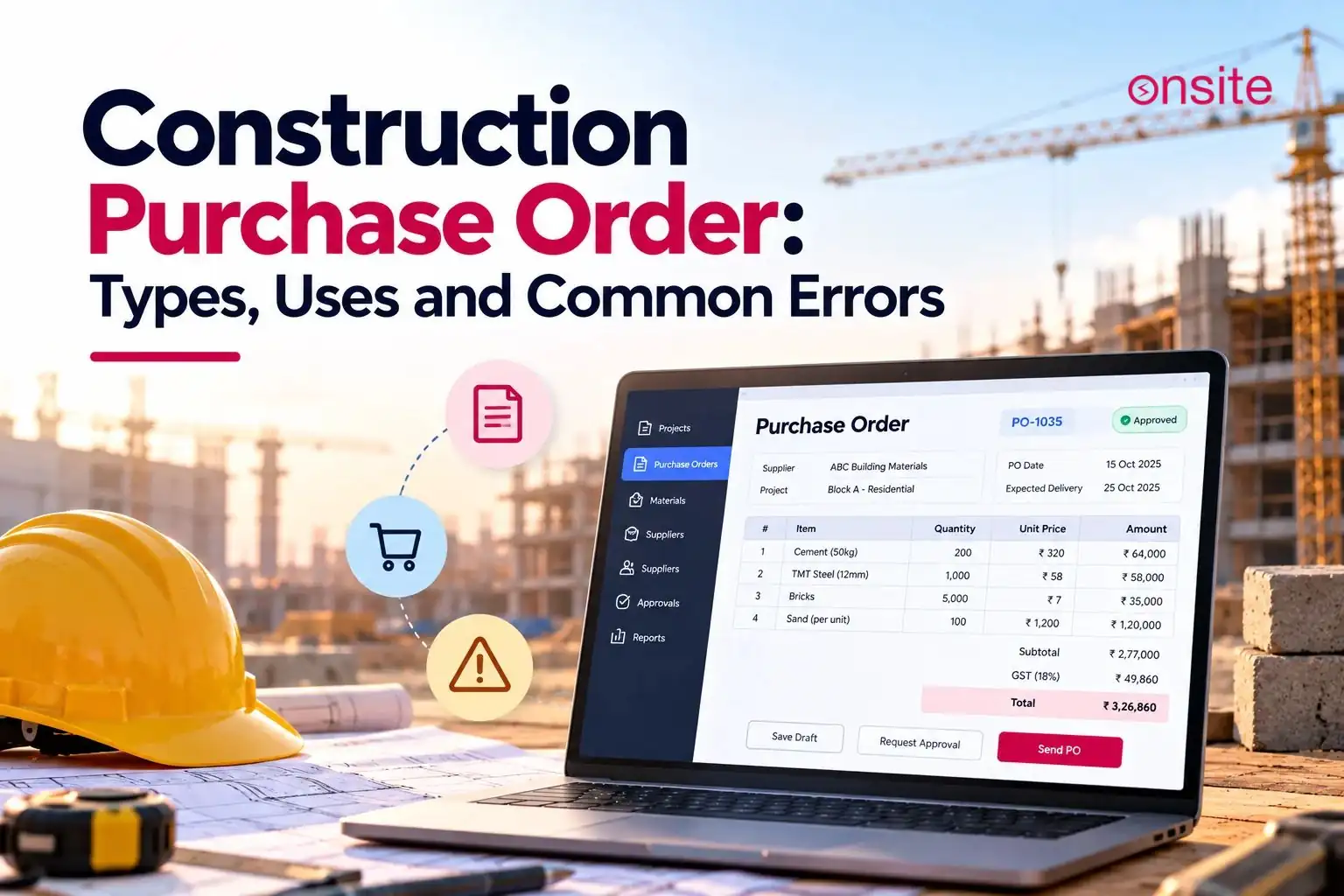
A 15 MT order of Fe500 reinforcement bars was placed with a steel supplier for a residential project in Bengaluru. The site engineer placed the order through WhatsApp and confirmed the quantity, but did not confirm the rate. The vendor delivered the material with an invoice for ₹11.25 lakh, calculated at ₹75,000 per metric tonne. The project manager caught the problem only when the invoice arrived. The verbal agreement had been ₹71,000 per tonne, resulting in a ₹60,000 difference on a single delivery. The accounts team had no construction purchase order to match against the invoice, and the payment was cleared.
The issue was not simply a matter of integrity. It was a purchase order problem. Raising a purchase order before delivery would have documented the material grade, quantity, rate, and delivery date in a form acknowledged by both parties.
Three-way matching between the purchase order, goods receipt note (GRN), and vendor invoice would have flagged the rate variance before the accounts team processed the payment.
The problem was not necessarily the absence of an agreement with the supplier. It was that these agreements were rarely documented in a formal, traceable record until something went wrong.
What is a construction purchase order?
A construction purchase order is a document a contractor issues to a supplier before delivery, setting out the agreed material grade, quantity, rate, and delivery date. Depending on the applicable terms and circumstances, it may form a legally binding commitment. It gives the accounts team a documented reference to verify each vendor invoice against before releasing payment.
What a Construction Purchase Order Controls Before the First Delivery
A construction purchase order is a formal document that a contractor issues to a supplier before ordering materials or committing to a purchase. Once the supplier accepts it, the PO can become a legally binding contract under the Indian Contract Act. This makes it different from a WhatsApp message, a phone call, or an informal request raised at the site. When disputes arise over delivery, prices, or missing materials, the written PO helps establish what both parties agreed to before the work began.
For a PO to work as a control document, it must include six key details: a PO number to track the order against the goods receipt note (GRN) and invoice, the supplier’s name and GST registration, the full material specification including grade and brand where applicable, the quantity and correct unit of measurement, the agreed unit rate and total value including GST, and the delivery date linked to a project milestone or activity start. These details help the team check whether the materials received match the order. If any of them are missing, matching the delivery with the PO and invoice becomes more difficult, making the document less useful as a control.
Material specifications are one of the most common gaps in construction purchase orders. For example, a PO that simply says “cement, 200 bags” does not specify the required grade, brand, or packaging. If 43-grade cement arrives for a project that requires 53-grade cement, the contractor may have difficulty proving that the delivery does not meet the agreed requirements. A clearer specification would be: OPC 53-grade cement, 50-kg bags, conforming to IS 269. This states exactly what the supplier is expected to provide. The same approach applies to steel grades, brick specifications, aggregate sizes, and other materials covered by applicable IS standards.
Payment terms are another area where purchase orders often lack clarity. For government projects, POs may link payment to the running account (RA) billing cycle, such as payment within 30 days of a verified RA bill associated with the materials. Private projects may use 45-day credit terms or link payment to specific milestones. Whatever terms both parties agree on, they should be clearly stated in the PO. This gives the accounts team a written reference when processing the supplier’s invoice months later, rather than relying on verbal agreements made during procurement. It also helps the contractor address disputes if a supplier later claims that different payment terms were agreed. Weak RFQs can leave room for overbilling, but a clearly written PO helps ensure that the order terms match what was established during the RFQ process and what the supplier eventually invoices.
Three Purchase Order Types and When Each One Protects the Contractor
Three PO formats operate in Indian construction procurement, and selecting the wrong format for the purchase situation creates cost control failures that take weeks to trace.
Standard Purchase Order
A standard purchase order covers a single, defined purchase with a specified quantity, fixed price, and delivery date. It is suitable when a contractor knows exactly what is required, when it is needed, and does not anticipate additional deliveries of the same material for the project. Common use cases include structural steel for a floor slab or prefabricated windows for a residential tower. A standard purchase order can be closed once the delivery has been made, the goods receipt note (GRN) has been confirmed, and the materials have been checked against the agreed specifications.
Planned Purchase Order
A planned purchase order commits the contractor and the supplier to a delivery schedule across the project timeline. The contractor fixes the total quantity and rate when raising the PO, but deliveries occur in phases tied to construction milestones. A contractor running a 14-floor residential tower in Pune might raise a planned PO for 4,200 bags of cement at a locked rate, with delivery schedules tied to each casting milestone: 400 bags for the podium slab, 350 bags for first-floor columns, and so on. The rate lock protects the contractor against cement price increases mid-project. Phased delivery prevents overstocking and the spoilage that follows. A planned PO also gives the procurement team a single document to track across multiple deliveries rather than raising individual purchase orders for each casting cycle, which reduces GRN-to-PO matching effort across the project.
Blanket Purchase Order
A blanket purchase order helps establish a framework agreement with a supplier for the duration of a project or financial year. It generally fixes the rate and sets a maximum spending limit that the contractor commits to with the supplier. As materials are needed, the procurement team issues individual release orders against the blanket PO without drafting a fresh purchase order each time.
For civil contractors managing multiple construction projects simultaneously, blanket POs can be useful when working with aggregate suppliers. They eliminate the need to raise repetitive purchase orders for recurring materials, but they require regular consumption reviews.
When the value of orders placed against a blanket PO reaches the midpoint of the spending limit, the procurement team should review the remaining balance and forecast future requirements. If the committed ceiling is likely to be exceeded, the team must raise a revised PO or obtain the necessary approval before continuing to place orders beyond the agreed limit.
Three-Way Matching: How the PO, GRN and Vendor Invoice Work Together
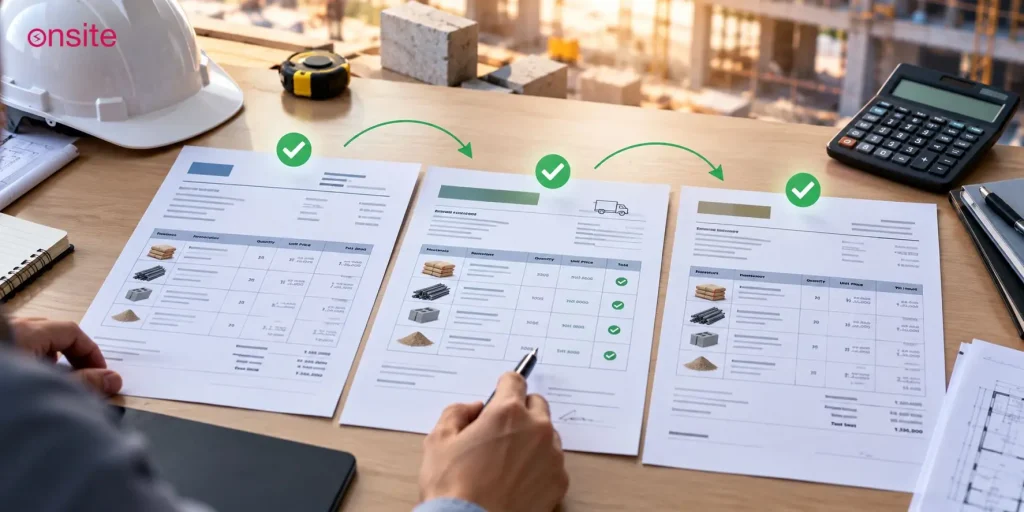
Three-way matching is the process of checking the purchase order, goods receipt note, and vendor invoice against each other before making a payment. It helps contractors confirm that the materials ordered were actually delivered and that the supplier is charging the agreed price. If any of these documents is missing, incomplete, or created after the event, the team may struggle to verify the payment.
The process starts with the PO, which records what the contractor agreed to buy, including the quantity and price. When the materials arrive at the site, the storekeeper prepares a GRN to record what was actually received. This includes counting the materials, checking their specifications against the PO, noting their condition, and recording the delivery challan number. The GRN must also include the PO number so the delivery can be linked to the original order.
When the supplier sends an invoice, the accounts team checks all three documents together. The PO shows what was ordered, the GRN confirms what was received, and the invoice states what the supplier is charging. If the quantity, rate, and specification match across all three documents, the team can process the payment. If there is a difference, payment should be held until the discrepancy is resolved and documented in writing.
Consider a contractor working on a commercial project in Chennai who orders 18 MT of TMT steel at Rs 64,000 per metric tonne. The total order value is Rs 11.52 lakh. However, the GRN records only 17.4 MT received at the site, while the supplier’s invoice charges Rs 11.52 lakh for the full 18 MT. By checking the invoice against the GRN, the accounts team identifies the shortfall and authorizes payment of Rs 11.136 lakh for the quantity delivered. It also issues a debit note for the missing 0.6 MT, worth Rs 38,400. This recovery is possible because the GRN records the actual delivery and the accounts team checks it before approving payment. Without that record, the team might have paid the full invoice amount.
One common problem on Indian construction sites is that GRNs are prepared from memory or copied from a WhatsApp photo of the delivery challan. The details may then be entered into a paper register without being linked to the procurement team’s PO records. When the invoice arrives weeks later, the accounts team may not be able to find the GRN for that delivery, making it difficult to verify the claim. Payment may then be approved based on the invoice alone.
This can lead to payments for materials that were never fully delivered or for rates that were not agreed upon. The problem is not necessarily supplier fraud. It can happen because the verification process breaks down at the GRN stage. To make three-way matching work, contractors need to start by ensuring that every delivery is recorded accurately and that each GRN can be traced back to its purchase order.
Procurement Mistakes That Make Every Purchase Order Less Effective
The worst mistakes often happen before a contractor has even raised a purchase order. They occur during the drafting stage. Correcting the PO format is necessary, but it is even more important to address procurement practices that undermine the document’s role in controlling purchases.
Raising the PO after delivery
If a construction purchase order is raised after the material arrives, it becomes little more than a record of what has already happened. Contractors who rely on verbal orders from site engineers and formalise them as purchase orders the following day cannot use those documents effectively for three-way matching. By that point, the goods receipt note (GRN) may already have been created using the quantity claimed by the vendor rather than independently verified by the contractor. The purchase order must always precede the delivery instruction, not follow the delivery challan.
Vague material specifications
A purchase order that specifies only vague details, such as “bricks, 5,000 numbers”, without defining binding requirements for size, grade, or water absorption capacity, leaves the contractor exposed to disputes. If non-conforming materials arrive, the contractor may lack written evidence to justify rejecting the delivery or claiming that return freight should be borne by the supplier.
Each material category has applicable Indian Standards (IS) that should be referenced in the purchase order where relevant. This gives both parties an objective benchmark against which the delivered materials can be checked and verified.
Missing BOQ linkage
A reconciliation problem can arise during client billing if a purchase order does not reference the relevant BOQ item. When a contractor raises an RA bill for masonry work, the claimed quantity needs to be reconciled with the materials procured and verified through the goods receipt notes (GRNs). Without a clear link between the PO and the BOQ, the accounts team may struggle to verify whether the material purchases support the reported progress. This can also give the client’s quantity surveyor grounds to question or dispute the RA bill.
No centralized PO visibility across projects
When a company runs multiple construction projects simultaneously, site managers often raise procurement requests independently. Without a central procurement register, the same material may be ordered from different suppliers at different rates, even across similar projects. The purchasing volume that could qualify for blanket PO rates also becomes fragmented across sites.
This is where construction management platforms like Onsite can be useful. They help connect purchase orders, approvals, goods receipt note (GRN) recording, and vendor invoice matching across active projects. This allows the procurement team to track committed spending, verify deliveries at the site level, and perform three-way matching.
How Purchase Orders Reveal a Project’s True Financial Exposure
A construction purchase order does more than approve a purchase. It also records a committed cost, which is money the contractor has agreed to spend but has not yet paid. Tracking committed costs alongside incurred costs helps contractors understand their project’s financial position before all the invoices arrive.
For example, suppose a contractor raises a blanket PO for Rs 45 lakh with a steel supplier at the start of a project. The full Rs 45 lakh becomes a committed cost as soon as the PO is raised, rather than when the accounts team processes the first invoice. If the approved budget for structural steel is Rs 40 lakh, the contractor can see the Rs 5 lakh excess as soon as the order is placed. There is no need to wait until the supplier delivers and invoices 60 percent of the steel. This is why committed costs should be reviewed alongside incurred costs during every monthly project review.
The opposite situation can also cause problems. If a contractor raises POs only after materials have been delivered, there is no record of committed costs before delivery. The project budget may show paid and pending invoices, but the accounts team cannot easily see what has been ordered but is still on the way, the agreed rates for materials already at the site, or the expected total material cost by project completion. On a Rs 3 crore building project, the difference between committed costs and incurred costs at any stage could exceed Rs 60 lakh. Without proper PO records, this exposure may remain hidden until the invoices arrive.
Monthly procurement reviews can help project managers spot potential cost overruns early. By comparing PO values with budget allocations for each trade, they can identify when spending commitments exceed the planned amount. For example, if steel POs reach Rs 42 lakh against a Rs 40 lakh budget before the structure is halfway complete, the project manager can review future purchases, negotiate returns, or flag the overrun to the client. Without these PO records, the problem may not become clear until the final account is prepared, when the costs have already been incurred and the contractor may have to absorb the difference.
What Better Purchase Order Discipline Changes on Every Project
A construction purchase order is more than paperwork. It puts the supplier’s agreed terms in writing, helps the team check deliveries, and makes it easier to spot cost overruns before they become difficult to address. When contractors prepare POs only after materials arrive, they lose these controls while still having to manage the paperwork.
Better PO practices make a difference on site first. Teams can raise delivery issues before making payments, catch shortages when recording goods received instead of discovering them during the next casting cycle, and check every vendor invoice against the PO and GRN rather than approving it without verification. Within two to three billing cycles, contractors may start to see fewer overpayments and less variation between agreed rates and actual charges.
Construction management platforms like Onsite bring purchase orders, GRN records, and vendor invoice approvals into one workflow. This allows accounts teams to check all three documents without having to gather paper records from different sites. The PO is where the process begins. Delivery checks, verification, cost tracking, and payment all depend on having a clear written record of what was agreed before the materials arrived.
FAQs
What is the difference between a standard PO and a blanket PO in construction?
A standard purchase order covers a single, defined transaction — a specific quantity of material at a fixed price, delivered on a set date, closing once the GRN confirms delivery. A blanket purchase order establishes a framework agreement with a supplier for a project duration, fixing the rate and setting a maximum spend ceiling. Individual deliveries are released against the blanket PO without drafting a fresh order each time. Blanket POs suit contractors buying the same material regularly from one supplier across multiple projects who need to lock rates against market price increases over the procurement period.
What information must a construction purchase order include to function as a control document?
A construction purchase order requires six elements: the PO reference number for GRN and invoice cross-referencing, the supplier’s full name and GST number, the complete material specification with the applicable IS standard, the quantity in the correct unit of measurement, the agreed unit rate and total value including GST, and the delivery date tied to a project milestone. Purchase orders that omit the material specification or delivery date cannot support three-way matching, which removes the contractor’s ability to verify whether the delivery matched the original commitment before the accounts team issues the payment instruction.
How does the GRN connect to the purchase order during three-way matching?
The goods receipt note records what arrived at site — the storekeeper counts the quantity, verifies the specification against the PO, and notes the delivery condition. The GRN must carry the PO reference number. During three-way matching, the accounts team places the PO, the GRN, and the vendor invoice together: the PO states what the contractor ordered, the GRN confirms what the storekeeper received, and the invoice states what the supplier claims. The accounts team processes payment only where all three agree. A GRN with no PO reference number forces approval on the invoice alone.
Can a contractor raise a purchase order after the material has been delivered?
A purchase order raised after delivery records the transaction but provides no procurement control. Retroactive POs cannot prevent rate disputes, specification substitutions, or quantity shortfalls because the delivery has already occurred. Three-way matching also fails when the GRN precedes the PO, since the PO reference number does not appear on the GRN record. Accounts teams processing retroactive POs typically approve whatever quantity and rate the supplier invoices because no prior written commitment exists to check against. The purchase order must precede the delivery instruction to function as a financial control, not follow the delivery challan.
How do planned purchase orders help manage material deliveries across a construction schedule?
A planned purchase order fixes the total quantity and rate when the contractor issues the PO, then releases deliveries in phases tied to construction milestones. As each milestone approaches, the site team triggers a delivery against the existing PO rather than negotiating a new order at current market rates. The rate lock protects the contractor against material price increases between project stages. The phased schedule prevents overstocking and spoilage on urban sites with limited storage. A single planned PO across all deliveries simplifies three-way matching compared to raising separate purchase orders for each casting or installation cycle.
What happens when the GRN quantity is less than the purchase order quantity?
When the GRN records a quantity lower than the PO commitment, the accounts team processes payment only for the quantity the GRN confirms and issues a debit note or partial payment for the shortfall. The supplier must then deliver the remaining quantity under the original PO or raise a credit note for the undelivered portion. When the shortfall affects a construction milestone — a casting cycle that cannot proceed without the full material volume — the delay creates a formal claim against the supplier, provided the purchase order contains a delivery date tied to that specific milestone.
How do subcontractor-supplied materials get captured in the purchase order process?
When a subcontractor supplies materials under a labour-and-material subcontract, the main contractor has two options. The first requires the subcontractor to raise purchase orders within the main contractor’s approval process so all material commitments flow through a central procurement register. The second has the main contractor issue POs directly to suppliers and deduct the material cost from the subcontractor’s monthly RA bill. The direct-issue approach gives the main contractor full control over specifications and supplier selection but increases procurement team workload. Which approach applies must be stated in the subcontract agreement before site work begins.
