
Why UAE Contractors Struggle With Cash Flow Despite Full Order Books
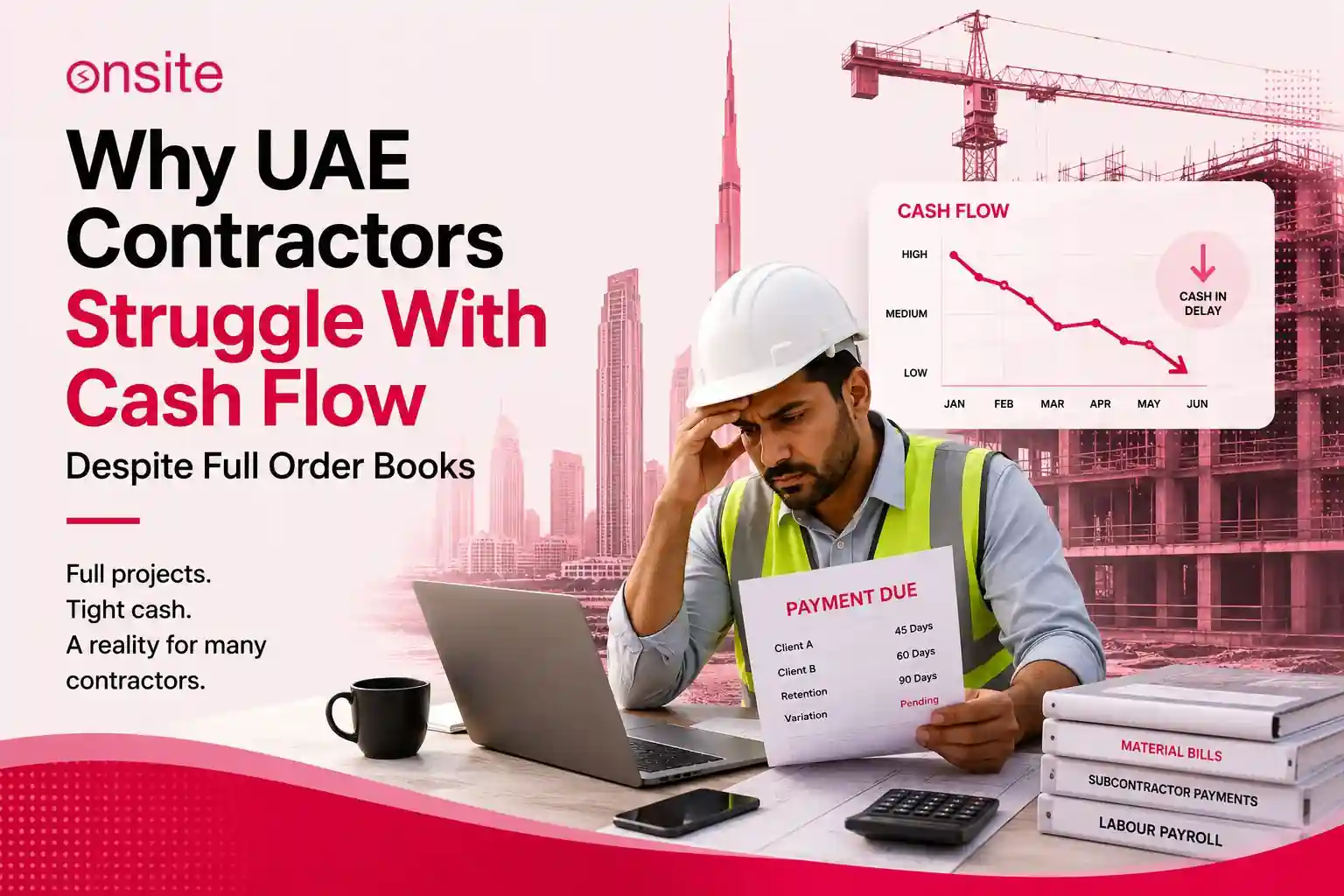
UAE construction cash flow refers to the movement of money in and out of a contracting business over a specific period of time. Cash flow is generally the difference between cash received from clients and cash paid to suppliers, subcontractors, and employees. It is distinct from contract value, revenue, and profit. A UAE contractor may have a good reputation and an impressive portfolio. The business may have growing revenue and a positive profit margin on paper, yet still face a shortage of cash to meet its current obligations. This gap between the numbers is where UAE construction businesses can run into difficulty.
Quick Answer: Why Can a UAE Contractor Have a Full Order Book and Still Run Short of Cash?
A full order book is largely future-oriented. It tells you about future work and future income. It does not tell you what is currently available. In every project, a contractor needs to spend money before receiving payment. He may spend on mobilisation, materials, subcontractor advances, and labour. Meanwhile, the client may pay on a cycle that can run for sixty to ninety days or more. However, the contractor’s obligations are urgent and immediate. The larger the order book, the more cash is committed before any payment arrives.
A Full Order Book Does Not Mean a Full Bank Account: UAE Construction Cash Flow
One of the most striking examples from the UAE construction sector is Drake & Scull International. The company was a major engineering and contracting business, particularly known for its MEP and construction activities across the region. It had a substantial order book, recognised revenue, a public listing on the Dubai Financial Market, and established relationships with creditors across the region.
By November 2018, trading in the company’s shares had been suspended. The financial position was severe, with accumulated losses and a major gap between available assets and liabilities. The company later entered a lengthy financial restructuring process. Its shares eventually resumed trading on the Dubai Financial Market in May 2024 following the court-approved restructuring and capital increase.
The company’s difficulties developed over several years and cannot be reduced to one cause. Factors included expansion into geopolitically volatile markets, the impact of the oil price downturn on regional construction activity, and difficulties in collecting payments from government and private-sector clients.
This is a complicated story, and it cannot be explained by UAE Construction Cash Flow alone. However, the DSI case illustrates an important principle of UAE construction cash flow: the contracts a company has won are not the same as the cash it has available.
An order book can show future revenue and future work. It does not guarantee that the company has enough cash to meet today’s obligations. When that difference is misunderstood or ignored, even a contractor with major projects and a strong market presence can face serious financial difficulty.
Source: The National; AGBI
The Difference Between an Order Book and Available Cash
When a UAE contractor wins a construction project, the contract value goes into the order book. The numbers entered in the order book represent a commitment to future work. They do not represent the cash available to meet this week’s payroll or pay for next week’s material delivery.
The payment process goes through multiple stages, and each has its own timing:
Contract Awarded → Work Executed → Certified by the Client’s Engineer → Invoice Submitted → Payment Terms Begin → Cash Received
Depending on the contract terms, client, and certification process, there can be a significant gap between work being executed and cash being received. During this period, the contractor may be funding labour, materials, subcontractors, and other project costs before receiving payment from the client.
Having an order book of AED 50 million does not mean that the contractor immediately receives AED 50 million. It means AED 50 million worth of work has been secured. That work still needs to be funded, executed, certified, invoiced, and finally collected. The order book represents how much work a contractor has won. It does not tell the contractor how much cash is currently available.
Why Business Growth Can Increase UAE Construction Cash Flow Pressure
The reality of the construction industry in the UAE is that winning more work does not automatically relieve cash pressure. For many contractors, growth brings more pressure and makes the financial position harder to manage.
When a contractor takes on a new project, several financial obligations begin at the same time. These can include:
- Mobilisation costs: Site establishment, management expenses, initial equipment hire, and related costs.
- Labour commitments: Workers need to be employed, accommodated, and paid on a regular cycle, regardless of whether payment has been received from the client.
- Material procurement: The contractor needs to pay for materials required for at least the first phase of the project, often before the related work is certified and invoiced.
- Subcontractor advances: Subcontractors may require mobilisation advances before work begins.
Each additional project creates its own cash outflow requirements, and these requirements run simultaneously.
A contractor managing several projects is dealing with multiple cash outflow cycles at once. Meanwhile, collections arrive on different schedules, from different clients, with different payment behaviours.
As the business grows, its cash requirements grow as well. This is the point at which contractors with full order books can discover that they do not have enough liquidity to finance all the work they have won.
Where Cash Gets Tied Up in a Growing UAE Contracting Business
Receivables That Have Not Arrived
Certified work that has been invoiced but has not yet been collected represents money the contractor has earned but cannot use yet. In practice, this can mean months of revenue sitting in receivables at any given time. When a contractor reviews the financial position of the business, the numbers may show a significant amount of money due from clients. But that money has not yet arrived in the bank account, so it cannot be used to pay current obligations. This is one of the central UAE construction cash flow pressures. Money owed to the contractor is not the same as cash available to the contractor.
Work That Has Not Yet Turned Into Cash
The work that has been completed but not yet certified creates another layer of UAE construction cash flow pressure. Unless the work is certified by the client’s engineer or consultant, it cannot be invoiced. The contractor may already have spent money on labour, materials, equipment, and other site costs to complete that work. The work is done from the contractor’s side, but until it is certified, it cannot move to the invoicing stage. Until it is invoiced, it cannot be collected. So the contractor is carrying the cost of completed work from his own working capital until the certification, invoicing, and payment process is completed.
Retention Still Locked
Retention money is a familiar part of UAE construction cash flow. It is an amount, often around 5% to 10%, deducted from each certified payment and held until later stages of the project, sometimes until the end of the defects liability period. For a contractor running multiple projects at the same time, these retained amounts can represent a significant sum. The money is owed to the contractor, but it may remain inaccessible for months or even years. The amount exists and is recorded as money due to the contractor. But it is not cash that is immediately available to meet current obligations.
Upfront Project Commitments
In every UAE project, starting work requires money to be spent before any collection can begin. This includes mobilisation costs, advance payments to material suppliers, equipment deposits, visa and licensing costs, and other initial project expenses. All of these are immediate cash outflows. On a large project, these initial commitments can be substantial, while the first certified payment may still be weeks or months away.
The UAE Construction Payment Chain
The UAE construction payment chain follows a sequence that creates a timing gap at every level:
Client / Developer → Main Contractor → Subcontractor → Supplier
Any delay in payment from the client can affect the entire chain. It can affect the main contractor’s ability to pay subcontractors. Delays in subcontractor payments can then affect suppliers, labour, and other parties involved in the project. A timing problem at one level can travel downstream through the entire payment chain.
This is particularly relevant where contracts contain back-to-back payment clauses. Under such arrangements, payment to a subcontractor may be linked to the main contractor receiving payment from the client. In practical terms, the subcontractor may have to wait until the main contractor receives the corresponding payment.
The result is a chain of financial dependency. When cash is delayed at the top, the pressure can move through every level below it.
UAE Case: When Payment Pressure Reaches the Subcontractor
The practical consequences of this payment chain were illustrated by a case reported by Gulf News involving a Dubai commercial court judgment.
In 2017, a main contractor and an electromechanical subcontractor signed a subcontract worth AED 113 million for electrical, mechanical, and plumbing works on a Dubai real estate project. According to the report, the subcontractor completed between 99% and 100% of the contracted works. The main contractor withheld payments and liquidated the subcontractor’s performance and advance payment guarantees.
The subcontractor argued that the non-payment triggered a financial collapse. Unable to pay its own suppliers, subcontractors, and employees, the company was declared bankrupt in 2022. A court-appointed engineering expert determined that AED 77.6 million, including VAT, was owed for the completed works.
The Dubai Commercial Court ordered the main contractor to pay AED 28.7 million and dismissed the counterclaim, while also directing the contractor to bear legal costs.
The case shows how payment pressure at one point in the chain can produce consequences at the next. A subcontractor may complete its work but remain unable to collect payment. It may then be unable to meet its own obligations to suppliers, subcontractors, and employees, allowing a payment delay upstream to become a much larger financial problem downstream.
Revenue, Profit and Cash Are Not the Same Number
| Metric | What It Tells You |
|---|---|
| Order book | Work already awarded but not yet executed or collected |
| Revenue | Value of work recognised during a period |
| Profit | Financial result after relevant costs are deducted from revenue |
| Cash | Money actually available to meet current obligations right now |
It is common to find a UAE contractor with an impressive order book, growing revenue, a positive profit margin, and a critical cash shortage at the same time. Each number describes a different phase of the business. None of them can tell the full story on its own, but together they begin to make sense.
An order book shows the work the contractor has secured. Revenue shows the work that has been recognised. Profit shows whether that work has been financially profitable on paper. Cash availability shows whether the business can meet its current obligations.
A contractor trying to manage the whole business by looking only at the order book or the profit line, without examining actual cash availability, is looking at only part of the financial position.
When a Full Order Book Becomes a Warning Sign
Growth in the order book is usually a positive sign. However, there are situations where it should be examined carefully rather than simply celebrated. A growing order book can sometimes create more cash pressure instead of relieving it.
There are several warning signs:
- Revenue is growing, but collections are not keeping pace.
The business may appear profitable, but receivables continue to increase as a proportion of revenue. More work is being completed, but the cash is not being collected. - Short-term borrowing is increasing.
Before collections arrive, the contractor is borrowing funds for working capital, which is then consumed by project execution. - Suppliers are being paid later.
Payment timelines start stretching, and suppliers begin putting pressure on the contractor for overdue amounts. - Subcontractor payments are being delayed.
As subcontractors continue chasing payments, they may slow mobilisation, reduce resources, or become less responsive, affecting project progress. - Cash from one project is being used to fund another.
A contractor may receive an advance or payment from one client and use it to fund another project that is short of working capital or waiting for certification. This creates a cross-project dependency that can become difficult to unwind. - New project awards increase pressure instead of easing it.
Every new project comes with immediate upfront spending. At the same time, existing projects may not yet have generated enough collections to support that additional commitment.
The order book may continue to grow, but the bank balance does not.
What Contractors Should Check Before Taking on the Next Project
Before taking on a new project, a contractor should ask these six questions:
- How much cash will mobilisation require?
Start with the current financial position of existing projects. Then estimate how much the new project will require during its initial stage and measure that against available cash and credit facilities. Initial spending can include site mobilisation, equipment, advances, and initial material purchases. - When is the first meaningful collection expected?
Identify when the first billable invoice can realistically be raised and when that invoice is likely to be paid. The expected payment date matters more than the planned billing date. - How much retention will remain locked?
Calculate the retention amount under the new contract and add it to the retention already outstanding on existing projects. This gives a clearer picture of how much earned money will remain unavailable for current use. - What are the payment intervals and terms?
Monthly certification with 30-day payment terms is meaningfully different from quarterly certification with 60-day payment terms. The cash flow profile of a new project depends heavily on these conditions. - How much cash are existing projects already consuming?
A new project will compete with existing projects for the same working capital. If current projects are already stretching available cash, the new project may add to the pressure before generating any collections. - Can the business support another project without straining working capital?
This is the question that brings all the others together. A project can be commercially attractive and still be operationally damaging if the business does not have enough working capital to fund it until regular collections begin.
Construction management platforms like Onsite make this weekly review faster by pulling certified receivables, outstanding approvals, and project cost data into one view rather than assembling it from separate systems.
UAE Contractor Cash Flow Checklist
Receivables
- ☐ Total receivables reviewed by project and by age this week
- ☐ Collection actions assigned for overdue receivables
- ☐ Expected collection dates confirmed for invoices still within payment terms
Certified but Uncollected
- ☐ Certified work that has been invoiced but not yet collected mapped by project
- ☐ Certification submissions for the current period confirmed or scheduled
Retention
- ☐ Total retention held against each project recorded
- ☐ Expected retention release dates tracked against the project completion schedule
Upcoming Commitments
- ☐ Subcontractor payments due within the next four weeks listed by project
- ☐ Supplier invoices and payment commitments identified
- ☐ Labour, payroll, and overhead obligations confirmed
Project-Level Cash Requirements
- ☐ Cash required for the next project phase mapped for every active project
- ☐ New project mobilisation costs assessed against available cash and credit facilities
13-Week Cash Flow Forecast
- ☐ 13-week cash flow forecast updated this week
- ☐ Expected cash gaps identified, with actions assigned
- ☐ Borrowing requirements checked against available credit facilities
Collection Actions
- ☐ Escalation actions assigned for overdue receivables
- ☐ Client follow-ups planned for expected payment and retention release dates
A Full Order Book Does Not Guarantee Financial Breathing Room
Drake & Scull’s story is less about the size of its order book and more about the receivables that remained on its balance sheet despite audit qualifications regarding their recoverability. It is a story about what can happen when the gap between money that is owed and money that can actually be collected is not addressed early enough.
The company stated that its losses were mainly the result of significant provisions against work in progress and contract receivables on legacy projects. The work may have been completed and the receivables may have existed on paper, but the cash did not arrive as expected.
A UAE contractor’s order book shows how much work has been won. UAE construction cash flow shows whether the business can continue funding that work while waiting to be paid. Those are two different stories, and managing a construction business requires understanding both.
Frequently Asked Questions
Why do UAE contractors struggle with cash flow despite having full order books?
A full order book represents work that has been awarded but not yet executed, certified, or collected. Every project in the order book requires upfront cash — for mobilisation, materials, labour, and subcontractor commitments — before the first payment is received. The larger the order book, the more cash is required before collections arrive. UAE contractors with full order books can simultaneously face working capital shortages because the work is committed, the spending is immediate, and the collections follow on a cycle that can take 60 to 120 days or more from execution to receipt.
What is the difference between an order book and available cash?
An order book represents the total value of contracts that have been awarded. Available cash is the money the contractor can access right now to pay obligations. The gap between these two numbers is filled by the work execution cycle — costs are incurred immediately, but cash from the client arrives only after the work is done, certified, invoiced, and paid. A contractor with AED 50 million in the order book may have significantly less than that in cash available at any given time, because the order book value has not yet passed through the full execution and collection cycle.
Can a profitable construction project still create cash flow pressure?
Yes. Profit is the financial result of a period’s operations — revenue recognised less relevant costs. Cash flow is the movement of actual money. A project can be profitable in accounting terms while simultaneously consuming cash, because the timing of cash outflows does not match the timing of cash inflows. Labour and materials must be paid on a short cycle. Clients certify and pay on a longer one. The profitable project is not generating cash until collections consistently exceed disbursements — which may not happen until well into the execution phase.
How does business growth affect contractor working capital in the UAE?
Every new project requires immediate cash for mobilisation, advances, and initial procurement. If existing projects have not yet generated sufficient collections to replenish working capital, new projects draw on the same depleted resource. Contractors who grow their order books rapidly without ensuring their working capital grows proportionally find that each new project award increases pressure rather than relieving it. The working capital requirement of a contracting business grows in line with revenue, and sometimes faster, because new projects consume cash before the revenue they generate is collected.
How do delayed client payments affect UAE contractors?
Delayed client payments extend the gap between when the contractor funds the work and when the contractor collects for it. During that extension, the contractor is carrying a larger working capital burden without collecting the cash that should be retiring it. If the delay extends long enough, the contractor may be unable to meet current obligations to subcontractors and suppliers. The subcontractor payment chain means these delays propagate downward — a delayed client payment to the main contractor becomes a delayed subcontractor payment, which becomes an inability to pay suppliers and employees.
How does retention affect contractor liquidity in the UAE?
Retention is money the contractor has earned and is legally entitled to, held by the client until practical completion or the expiry of the defects liability period. On a standard UAE contract with five percent retention, a contractor who has certified AED 20 million of work is carrying AED 1 million of their own money that they cannot access. Across multiple projects simultaneously, this accumulation can be substantial. Retention is not lost — it will eventually be released — but until it is, it represents real cash tied up in the project and unavailable for working capital.
How does retention affect contractor liquidity in the UAE?
Retention is money the contractor has earned and is legally entitled to, held by the client until practical completion or the expiry of the defects liability period. On a standard UAE contract with five percent retention, a contractor who has certified AED 20 million of work is carrying AED 1 million of their own money that they cannot access. Across multiple projects simultaneously, this accumulation can be substantial. Retention is not lost — it will eventually be released — but until it is, it represents real cash tied up in the project and unavailable for working capital.
What should a UAE contractor include in a 13-week cash flow forecast?
A 13-week cash flow forecast should include all committed cash outflows — subcontractor payments, supplier invoices, labour, overhead, and loan repayments — matched against expected cash inflows from certified receivables within payment terms, anticipated certification events and their realistic collection dates, and any retention release expected in the period. The forecast should be produced weekly and reviewed against actual receipts and payments so that gaps identified in the outer weeks can be addressed while there is still time to act.
