
What SOBHA’s Backward Integration Model Can Teach Contractors About Construction Control
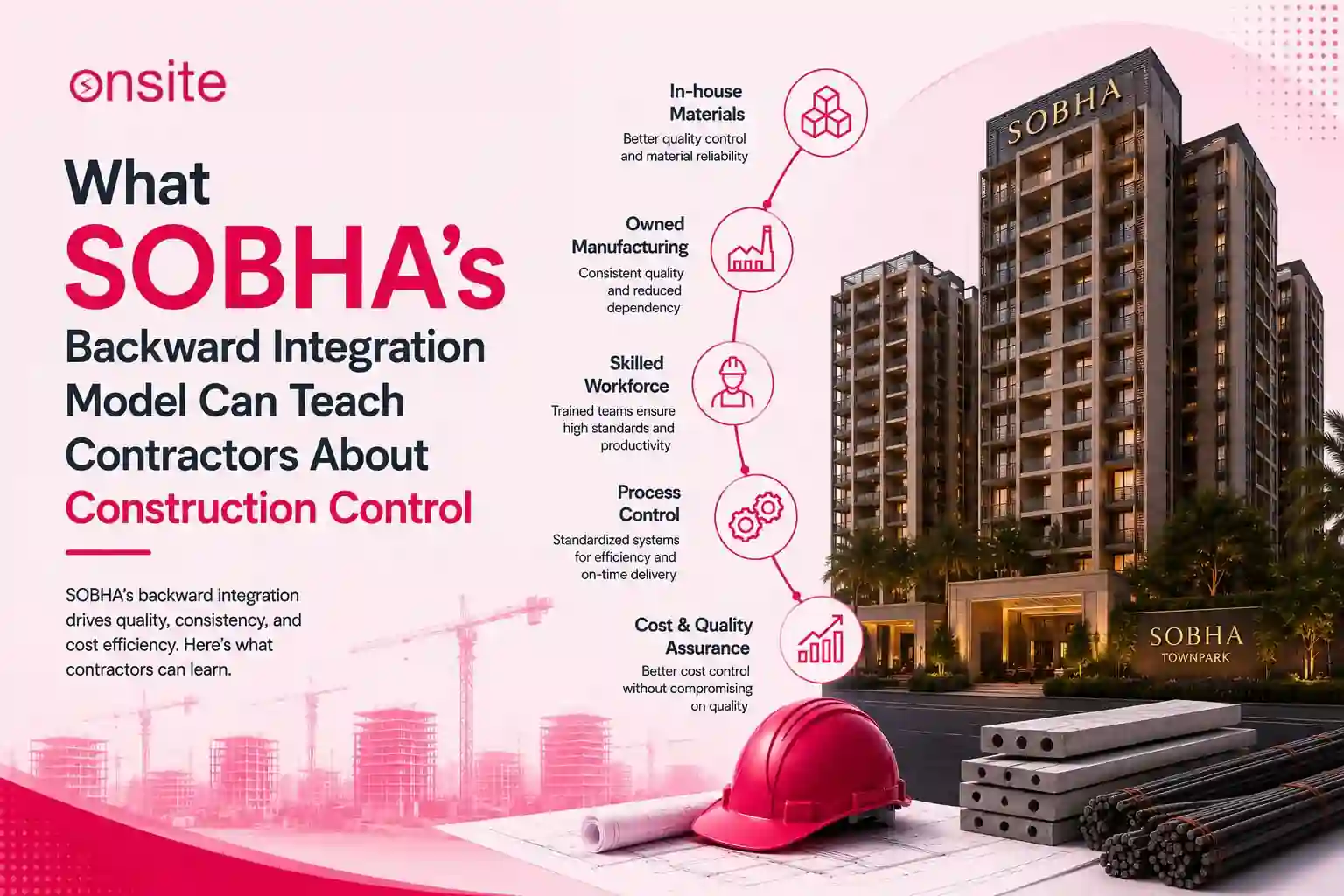
Backward integration in construction refers to bringing external activities under the company’s own direct control. These activities are normally handled by suppliers, subcontractors, and vendors. Under this approach, a construction company may bring activities such as manufacturing, interiors, design, and specialist trades under its own control. The objective is to reduce dependency on external parties for activities that have a major influence on quality, schedule, and cost. Sobha Limited brought this idea into its business, making it one of the best-studied principles in construction business management.
Imagine taking a decision that changed the way people looked at a construction business. It meant taking control of something that the majority of the Indian market depended on through external suppliers and third parties. The idea was to set a standard where there would be less dependence on third-party vendors. There would be no reliance on external interior contractors, whose standards could vary from project to project. The idea was to avoid outsourcing glazing work and other specialised materials or activities wherever possible.
This is what P. N. C. Menon decided to build when he founded Sobha Limited in Bengaluru, India, in 1995. The company observed that the Indian market was highly dependent on suppliers for construction projects. Menon had already built a strong reputation by delivering international-quality construction in the Gulf. When he wanted to establish Sobha, he found that the supplier and labour ecosystem in India could not support the standard he was committed to delivering.
He needed quality in his work, which he did not find consistently among suppliers in India. But that did not discourage him from entering the Indian market. He came up with a solution. He did not lower the standard he was already delivering. Instead, he built the supply infrastructure from scratch and brought it inside the company.
This is when backward integration in construction was introduced. It came out of necessity, driven by a lack of reliable external suppliers. Menon came up with one solution and took control of the whole process himself.
The question that Harvard Business School asked when it studied this model in 2018 is worth noting: Is backward integration replicable and sustainable? The answer that matters for this article is not whether smaller contractors should build factories. It is what the question itself reveals: control over critical processes can be a genuine competitive and operational advantage in construction. The question is only which processes need to be controlled, and how much control is actually necessary.
What Is Backward Integration in Construction?
The majority of companies work towards cost reduction, but the story is not about that. Sobha chose control over outcomes.
Quality Was Too Important to Leave to External Suppliers
P. N. C. Menon, while talking about the idea and philosophy behind this, stated it in simple words: build homes as if you are building them for your own family. That is the kind of standard that is hard to maintain when components are coming from suppliers who may have different quality standards, workforce practices, and production processes.
When you are dependent on external parties, control over the process is lost. When a manufacturer of concrete blocks delivers inconsistent strength, the contractor may discover the problem at the structural stage. When the finishing quality of interior contractors varies between units, the problem may only be discovered at the time of handover.
By the time a problem becomes visible, there may be little that can be done to correct it without additional cost. If correction is required, the cost is often higher than what would have been required to prevent the issue in the first place.
Rather than dealing with these problems later and questioning where the failure occurred, Sobha decided to take control of quality at the earliest stages of the process. They did not start at the inspection stage. They started with manufacturing and production. If a company controls how a material is made, it controls the starting condition of every activity that depends on that material.
Construction Schedules Depend on More Than the Work Happening on Site
A construction schedule is only as reliable as its least reliable supply chain link. Any delay in the supply chain can cause delays in the construction schedule. Any delay in manufacturing or supply can bring activities to a stop, leaving crews with no work and causing milestones to slip. All external suppliers have multiple clients. They have their own production priorities and their own capacity constraints. When these things come into play, a contractor can find himself on the critical path. This is the moment of realization for a contractor that his schedule is not entirely his own. It is the output of decisions made elsewhere by people who have no obligation to prioritize his project. Bringing manufacturing under your own company helps remove external dependency and gives you greater control over construction schedules.
Consistency at Scale Requires Standardised Inputs
While operating in twenty-seven cities, Sobha maintains a consistent quality standard. This consistency and quality would not have come from different external suppliers. They would only have brought additional management challenges. This consistency came from operating a controlled manufacturing base. External suppliers in different regions can have different quality standards, capabilities, workforce standards, and material sources. A company that manufactures its own critical components can maintain a standard at the production level and maintain it regardless of the geographical differences between projects.
What Did SOBHA Gain by Bringing More of the Process Under Its Control?
| Area | What External Dependency Can Create | What Greater Internal Control Can Provide |
|---|---|---|
| Quality | Variation between suppliers | More consistent production standards |
| Supply | Dependence on third-party availability | Greater control over material readiness |
| Timelines | Supplier-side delays affecting the site schedule | Better coordination between production and construction |
| Specifications | Multiple interpretations of the same requirement | Consistent application across all projects |
| Accountability | Diffused responsibility across many parties | Clearer ownership of each stage of delivery |
But Can Every Contractor Follow the SOBHA Backward Integration in Construction?
No. And they do not need to.
A midsized contractor or a small construction company cannot possibly bring the whole manufacturing system into their company. They cannot establish a concrete product manufacturing plant, a glazing subsidiary, or an in-house architectural practice. It requires capital, management, and a minimum volume to make in-house manufacturing economically viable. All of these things are beyond the scale of most Indian construction businesses.
Bringing manufacturing in-house is not the lesson. The lesson is the principle behind the infrastructure.
Sobha did not backward integrate in order to become a manufacturer. Sobha did it to get control over the things that have the most influence on its ability to deliver quality on time and consistently. Manufacturing was simply a way of reaching that end goal. The end goal was control and quality. A contractor applying the same question to his own business does not need a whole factory. He needs one question in mind: Which parts of my project can I not afford to lose control over? The answer to this question can be different for every construction business.
What Should a Contractor Actually Keep Under Control?
For midsized construction companies, the backward integration principle brings up six control points. None of them require any capital investment in manufacturing. All of them revolve around disciplined processes.
The Project Budget
The project budget is one of the most important things for a project to keep going, and it needs to be under control. A project budget that nobody on the execution team can see is not a management tool. It is an accounting exercise. A contractor needs to be aware of what was planned for expenses at the site and what is actually being spent. Being informed about this difference puts him in a better position to make decisions around procurement, scope, and timelines. When you have control over the budget, it means that the budget is live, visible, and connected to what is actually happening on the site. It is not just a document that gets revisited when the project closes.
Material Decisions
In Indian construction sites, the usual way of handling materials is that when a material request is made, it travels through an informal approval process. Maybe through a simple phone call or a WhatsApp text approval, which eventually leaves the site with no formal record. It then somehow disappears into the project cost, with no proof of where it was spent. It might sound like just one incident, but there are multiple disconnected events around material decisions that can lead to financial consequences. These may not appear immediately, but they can come as a surprise later.
Having control over material decisions means that each material request is traceable from the moment the requirement is raised through approval, purchase, delivery, and consumption on site. But a contractor needs to keep asking about the material. Did the material that was purchased actually reach the activity it was purchased for? Does it have a formal approval, receipt, and record?
Labour Deployment
Another usual way of Indian construction sites is that attendance is recorded as a number. For example, thirty-eight workers were present today. This type of recording is much less useful than attendance that requires different questions to be answered.
Are the right people doing the right work in the right location? Labour is connected to the productivity of the site, and they are working on a specific activity, with a specific quantity, on a specific day. All of these things should be recorded so that they provide visibility into cost and productivity.
Site Progress
Site progress is often learned by the owner through WhatsApp texts or a phone call from the site engineer. It is just verbal information rather than verified progress. Progress should be connected to the BOQ activity. A specific quantity completed, a specific date, and a specific responsible person are recorded. This is a record that can be used for billing, performance management, and forward planning to prevent delays, problems, and disputes.
Subcontractor Work
A relationship with a subcontractor should not be based on informal updates. This relationship should not work on verbal agreements, informal measurements, or end-of-project meeting disputes. These are all signs that your project is not under control. There is a control mechanism that helps in converting an informal subcontractor relationship into a managed and formal relationship, such as agreed measurements at the completion of the work, a work order specifying the scope and rate, and payments connected to confirmed quality certified by the site team. All of these things help in getting better control over subcontractor work and growth along with your project.
Project Documentation
Documentation plays one of the most important roles in avoiding disputes. For records of what is happening at a site, if project reports are scattered across WhatsApp messages or the personal phones of people, the documentation of the site is scattered and not under control. When a client asks for evidence of foundation work completed or materials ordered, a contractor whose records can simply be lost or swiped away has lost control over the site’s documentation.
The Modern Contractor’s Problem Is Not What Is Outsourced. It Is What Is Unconnected.
The majority of construction business owners do not have a manufacturing problem. They have a connection problem. Nothing is connected to one another.
The BOQ is saying one thing. Meanwhile, the purchase record is showing something else. The site report for the same activity arrives later with different quantities. The subcontractor submits data according to which the bill was processed.
This is not backward integration in construction. It is a lack of integration altogether.
Sobha’s idea worked because each stage was connected to the next. Manufacturing was connected to the construction input, which was connected to the delivery output.
But contractors in the construction industry do not need a manufacturing factory of their own. They need to connect their own decisions. Whatever was planned, what was secured, what was deployed, what was completed, and what was built all need to be connected so that decisions are traceable and the contractor has better visibility.
From Backward Integration in Construction to Information Control
SOBHA controls physical processes. What most contractors actually need to control is the information around those processes.
| SOBHA’s Approach | Contractor’s Equivalent |
|---|---|
| Control critical manufacturing in-house | Control critical project information in one place |
| Reduce dependence on external production | Reduce dependence on manual reconciliation between tools |
| Maintain consistency across all projects | Maintain consistent records across all active sites |
| Coordinate production with construction schedule | Connect procurement decisions with site progress |
| Know what is being produced and when | Know what is being spent, consumed, and completed |
The parallel is not a stretch. SOBHA built factories because uncontrolled external production was the gap between what it intended to deliver and what external suppliers could reliably provide. A contractor who cannot tell at any point in a project what the gap is between planned cost and actual cost has the same structural problem, just in information rather than in physical production.
What Does This Look Like on an Actual Construction Project?
Take an example of a ₹10 crore commercial building project. The BOQ is approved. A contractor has a project budget, material requirements for each phase, a labour deployment plan, four subcontractors across structural, MEP, finishing, and landscaping, a daily progress requirement, and a billing schedule tied to certified milestones.
The chain of connected decisions should look like this:
BOQ → Budget → Material Requirement → Purchase Order → Delivery → Site Consumption → Progress Update → Billing Milestone → Actual Cost
Control means having visibility, traceability, and connectivity across each step in a construction project. This gives a contractor enough knowledge to confidently identify what was planned, what happened, what the gap is, and what that gap means for the budget and the programme.
Meanwhile, if each of these steps exists in fragmented tools, such as Tally or accounting software, WhatsApp, purchase orders, phone calls for progress reporting, and a diary for attendance, the project is scattered across different places and tools. Bringing all of this together requires manual work, which takes time and creates a chance of error.
This is the contractor’s version of Sobha’s problem before the factories were built. The solution is the contractor’s version of what Sobha built: a connected system where each stage feeds into the next.
Where Construction Management Software Fits In
A construction management software helps address the exact problem we have been discussing: fragmented data. Our platform for construction management helps bring everything together. It hands over control by connecting the reports and workflows that already exist across the project.
It makes each stage visible. Every activity is connected to the BOQ so that everything can be compared. It brings the BOQ, budget, material requests, labour records, subcontractor billing, daily progress, project cost, and everything else into one place.
Onsite is one of the construction management software platforms that helps with these workflows. It links the BOQ with budgeting so that awareness of what is being spent and what was decided remains alive. It helps with measuring procurement against approval requirements, site progress against specific activities, subcontractor billing against verified progress records, and a project P&L that builds from what the field team records rather than what the accounts team reconstructs.
The goal is the same one P. N. C. Menon pursued through different means: control over the decisions that determine whether a project delivers what it promised.
What SOBHA’s Story Really Teaches Construction Companies
The story of Sobha teaches three major things to construction companies.
The very first is to control the things that have the greatest effect on your outcome. Sobha did not go ahead and manufacture every single thing that could be used in a construction project. They manufactured the things where inconsistency in external supply existed and where it directly affected project quality and delivery. However, a contractor does not need to have control over every aspect of the project. Being informed and aware of what is taking place on a construction site can help avoid risks and disputes. We need to identify which aspects cannot be left to informal management, disconnected records, and external unreliability.
The second lesson is that integration is a means, not a goal. Sobha building the factories is not the point of the story. The point is that a company committed to quality and timely delivery identifies the problems it cannot afford to outsource when they can significantly affect its promise to deliver a project. However, a contractor building a connected information system is applying the same principle through a different mechanism. He is taking the approach that he cannot afford the risks created by disconnected records, which can later create gaps in information, execution, and control.
And lastly, the lesson is that a smaller contractor does not need a larger company’s infrastructure to adopt its management principles. Sobha’s backward integration in construction is not about scale. It is about intentionality. It is about identifying the critical points that need to be controlled and building processes around maintaining that control. A ₹5 crore contractor and a ₹5,000 crore developer can apply the same thinking at completely different scales.
The central idea is the same in both cases: You do not have to own every part of a construction project to control it. You need visibility into the decisions that affect its outcome.
Conclusion
SOBHA’s backward integration in construction is a story about control. P. N. C. Menon did not build factories to prove a point or because he wanted to get into the manufacturing business. He built those factories so that he could bridge the gap in his existing construction business and avoid sacrificing quality by relying on external suppliers.
Building a factory helped him close that gap. A contractor does not need SOBHA’s factories to apply the same principle. The SOBHA story makes one thing clear. The first step is not a technology decision. It is a management decision.
You need to identify what is causing problems or creating gaps in your construction projects. You need to ask and identify which decisions in your project cannot afford to get lost between the site, the office, the vendor, and the finance team. Once you identify and analyse the problem, the solution follows.
SOBHA’s factories kept quality from getting lost in the gap between the supplier and the site. A connected project management system keeps decisions from getting lost in the gap between planning and execution. The principle is the same. The mechanism fits the scale.
Frequently Asked Questions
What is backward integration in construction?
Backward integration in construction means a company brings activities normally handled by external suppliers or subcontractors under its own direct control. In manufacturing-heavy models like SOBHA’s, this means producing construction materials — concrete products, interior components, glazing — in-house rather than purchasing from external vendors. The purpose is greater control over quality, supply continuity, and schedule reliability. Backward integration does not mean a construction company must produce everything it uses. It means identifying which activities have the most influence on the project outcome and deciding how much of that activity can be controlled rather than outsourced.
Why did SOBHA adopt backward integration?
SOBHA’s backward integration model was introduced by founder P.N.C. Menon out of necessity. When he established SOBHA in Bengaluru in 1995 after building a reputation for international-quality construction in Oman, he found that reliable suppliers and skilled labour in the Indian market could not consistently deliver the standards he was committed to. Rather than compromise the quality standard, Menon built an integrated supply ecosystem from the ground up — establishing in-house manufacturing for concrete products, interiors and woodwork, glazing and metal works, and later a dedicated facade subsidiary and an architecture practice. The model has been the subject of a Harvard Business School case study examining whether it is replicable and sustainable.
What are the benefits of backward integration for construction companies?
The primary benefits are greater control over quality, more reliable supply, better coordination between production and construction schedules, and more consistent output across multiple projects and geographies. For SOBHA specifically, the model has enabled a 1,456-point quality checklist before project handover and delivery of more than 548 projects across 27 Indian cities. The benefits depend on which activities are brought in-house and why. Backward integration that addresses a genuine supply or quality gap creates real operational advantage. Backward integration that simply adds overhead without improving a critical outcome creates cost without benefit.
Can small construction companies apply backward integration?
Not through manufacturing — the capital requirement and minimum production volume needed to make in-house manufacturing economically viable are beyond most small and mid-sized contractors. The principle, however, applies at any scale. The question is not whether to build factories. It is to identify which parts of the project a contractor cannot afford to lose control over. For most small contractors, the answer is not the physical supply of materials. It is the visibility into decisions — what was planned, what was purchased, what was deployed, what was completed, and what the cost of each was. Building that visibility through connected project records is the small contractor’s equivalent of SOBHA’s backward integration.
How can contractors improve control without bringing activities in-house?
By connecting the decisions that currently live in disconnected systems. Most construction projects have all the information they need — the BOQ, the purchase records, the labour attendance, the daily progress, the subcontractor measurements. The problem is that the information exists in separate places that do not feed each other. A BOQ in Excel, purchases in WhatsApp, progress in a separate daily report, and billing in Tally creates four sources of project information that never produce a single coherent picture. Connecting those records — so that a material purchase links to an approved requirement, a delivery links to a site consumption record, and a progress update links to a billing milestone — gives the contractor the control that backward integration gives SOBHA, without the factories.
How does construction management software help contractors control projects?
A construction management platform helps by creating the connection between decisions that currently live in disconnected tools. The BOQ connects to the budget. The material request connects to an approval workflow and then to a purchase order. The delivery connects to a site consumption record. The progress update connects to a specific BOQ activity and a billing milestone. The cost flows to a project P&L without manual reconciliation. Each stage feeds the next so the contractor can see, at any point in the project, what was planned, what has happened, and what the gap between them is. This is information control — the contractor’s equivalent of what SOBHA achieved through physical production control.
