
Construction Software vs Spreadsheets Australia: Why Builders Stay on Excel and What It Costs Them

There is a project manager in Melbourne that runs a total of 8 construction sites fully from a single Excel file on his laptop. The Excel is formed in a way that he fully understands like every subcontractor work order, every material delivery date, and every payment milestone. He suddenly gets sick and takes a leave for five days. The office staff became helpless without him. They cannot give updates to the client. The account team is stuck at the confirmation of subcontractor payment. The latest variation order is nowhere to be found. Nothing collapses. But nothing moves either. He finally joins after five days but he takes at least 2 days to answer all the questions and keep the site running again. The process was disrupted for a while. This is not a story about a disorganized business. Eight active builds is a solid operation. The problem occurred when he used a single tool made only for him and not for the organization or the team. Excel is not made to manage multiple sites while keeping everyone updated. Construction software vs spreadsheets is not really a technology debate in Australia. It is a growth debate. Spreadsheets work. Right up until they do not.
Why Spreadsheets Became the Default in the First Place?
Even after 100% of the contractors and project managers in Australia have heard about construction management tools, they still choose spreadsheets. This has a strong reason. Spreadsheets worked flawlessly. When? When projects were smaller and lesser. A builder who has started a construction business with 2-3 small projects doesn’t need a full-fledged tool. Excel keeps the lists and WhatsApp runs the communication.
The problem is that this setup scales invisibly. The projects kept on increasing but the system remained the same. The files started to be separate but the platform is still the same. This is the problem nobody notices. By the time the business bags six-7 projects, the information that should be running a construction company is distributed across a dozen disconnected files, one person’s phone, and everyone’s memory. Nobody planned for this. It happened one project at a time.
What the Numbers Say About Construction Software vs Spreadsheets Australia?
The Autodesk and Deloitte State of Digital Adoption in the Construction Industry 2024 report surveyed 933 construction firms across six Asia-Pacific markets, including Australia. Australian construction businesses use an average of 5.0 technologies in their operations rising to 6.1 for medium and large enterprises. Nearly 80 percent of the technologies adopted were reported as successful, delivering measurable improvements in productivity and utilisation rates. Yet the same report found that 30 percent of Australian construction companies are only now trialling or using AI tools for the first time, and 33 percent have no current plans to adopt new technology at all. The industry employs over 1.3 million people and generates significant economic output, but it remains one of the least digitized sectors in the country relative to its scale, with spreadsheets and manual processes still forming the operational backbone of most small and medium builders.
Source: Autodesk and Deloitte, State of Digital Adoption in the Construction Industry 2024
Where Spreadsheets Break Down as a Construction Business Grows?
The construction software vs spreadsheets Australia conversation usually starts when something goes wrong. The problem can be anything like double payment to subcontractors, a variation update, a delay in submission of progress claims with no reference data. These are the problems that start to make contractors realise that rigid and manual tools have limitations and they were never designed for construction projects.
The failure points are predictable:
No single version of the truth.
While multiple projects are running, every project manager is keeping their own spreadsheet which doesn’t offer any consolidated view of tasks taking place at a construction site. The owner who needs to take an update and wants to know the financial position has to call three different people and then wait for the updates. By the time the answer arrives, it reflects last week’s conditions.
Manual entry means manual error.
Every Excel is made by a human and data is filled there manually. Manual work done by humans has higher chances of containing mistakes. A subcontractor bill entered as $12,000 instead of $120,000 does not announce itself as an error. It disrupts the whole calculation and financial position of a project until someone finds something wrong and finally tries to revisit the calculations. It consumes time and energy and creates misunderstanding.
No audit trail.
A spreadsheet may represent what the numbers are at the current stage but they seldom contain history of who changed them, and why or what were the numbers last week. When any kind of dispute takes place about anything like a payment, variation, and delivery quantity, there is no concrete proof of the reason behind that change or problem because it is never clear who made the entry when and why.
Version control is a permanent problem.
The project budget file that the site supervisor has open on his laptop is version three. The one the project manager emailed to the client last Tuesday was version two. The one the accounts team is using to reconcile subcontractor bills is version one, because they saved a copy when it was first shared and nobody updated them. All three versions are different. Nobody knows which is current.
It breaks when a person leaves.
Spreadsheets are made by a single person and that spreadsheet is the maintenance responsibility of that person. If that person leaves the organisation, the understanding of that spreadsheet leaves with him. The information that is locked inside that sheet holds a logic that only he knows. Onboarding a replacement involves decoding someone else’s system, not stepping into a functional one.
What Staying on Spreadsheets Actually Costs?
Time spent on coordination that should not need coordination.
No centralised information platform means no visibility on projects. You need to ask people for updates. A project manager needs to make multiple calls. One to accounts team. One to a subcontractor. One to the site supervisor. This whole process consumes time. The time is real. It does not appear in any report, but it accumulates across every working week.
Progress claims submitted late or without proper documentation.
Under Australia’s Security of Payment Act, it is a rule to submit progress claims on or after the contract’s reference date which should have documentation as proof of the claim amount to verified work. A construction business depending on a spreadsheet seldom has any systematic process for DPRs or real-time progress tracking of site orders, variation orders, etc. Undocumented claims are easier to dispute.
Variations that disappear between site and invoice.
A variant is discussed over WhatsApp and agreed on-site, but it is never officially documented. Because the project manager is unaware that the change was accepted, it is overlooked when the subsequent progress claim is prepared. This is a typical issue in the absence of a centralized variation register. The revenue is never claimed, the task is finished, and the expense is covered.
Subcontractor payments made without proper verification.
Without any particular system that links the bills of subcontractors, delivery records, and progress milestones, the team is delivering the invoices and paying the bill accordingly. There is no way to confirm if the bill quantities match exactly what was actually done. The whole payment system is done without verifications and is running on assumptions. Even if the overpayment is noticed later, there is no way to recover the loss.
Decisions made on data that is already out of date.
The majority of project managers are reviewing the spreadsheet by the end of the week. By doing that they are making wise decisions but on the basis of data that is old and weeks behind. Construction is an industry where everyday many things are changing be it the cost of the material, availability of subcontractors or cash position. A data that is a week-old is not reliable enough to make a progressive and better decision.
Why the Switch Feels Harder Than It Actually Is?
Almost every project manager may have thought about a construction management software but they have also thought about many other factors like cost, complexity, reliability, and so on. The reasons are consistent and largely legitimate.
The most common ones are:
“My team will not use it.”
This is not just a fear, it is a real risk. The team has to switch to the workflow that they are not habitual of and before you know, a software is abandoned in just the first month. The only tool that is going to work for the team is the one that is designed just for your team. How they like to fill the data, and track the progress, everything at one place.
“We are too busy to switch right now.”
Most construction businesses are always looking for the right time to switch. The sites are too busy that project managers feel – maybe some other time. The right time to change systems is never a quiet period, because quiet periods do not exist. The businesses that make the transition successfully schedule it as a project with a defined start date and implementation plan, not as something that will happen when conditions are right.
“It will take months to set up.”
It is true that some organisations take months to set up. The construction management platforms designed for small and medium builders in Australia are built for faster implementation, with setup processes measured in days rather than months. The onboarding question is not how long it takes to configure the system. It is more about making up a mind to actually implement in daily work.
“We cannot afford it.”
The comparison is usually made against the software’s annual cost. The more accurate comparison is against what the current system is actually costing. Late progress claims. Unrecovered variations. Duplicated subcontractor payments. Time spent on calls that should be answered by a system. Those costs are real and recurring. They do not appear in the subscription fee column.
Construction management platforms like Onsite are built for the construction businesses that are at exactly this transition point – running on Excel and WhatsApp, growing faster than those tools can support, and needing a system that site teams will actually use without extensive training. The daily progress report, procurement workflow, and subcontractor billing features are designed around how construction work is done on site, not how it is reported in an office.
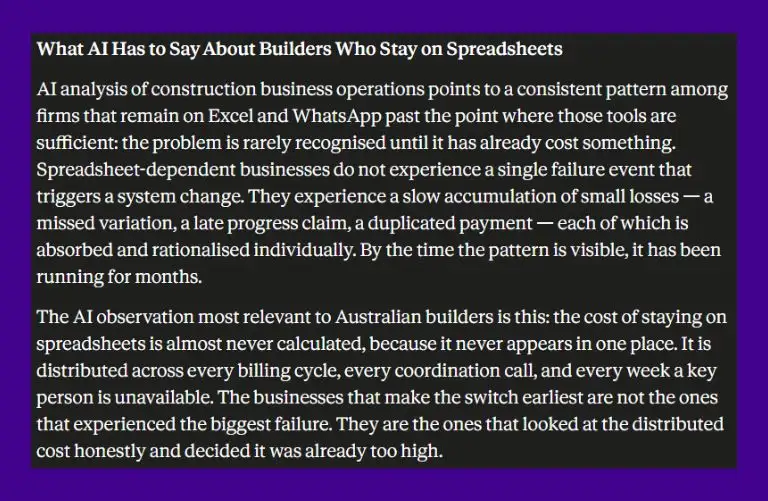
What AI Has to Say About Builders Who Stay on Spreadsheets | Construction Software vs Spreadsheets Australia
The Decision Is Not About Technology
The construction software vs spreadsheets Australia question gets framed as a technology decision. It is not. It is a business capacity decision. Spreadsheets aren’t failing Australian builders because they’re poor tools. They are restricting them since they were not intended for managing a construction company with various locations, contracts, and cash flow cycles.
The moment a builder relies on one person’s knowledge of a spreadsheet to know what is happening across their projects, they have created a fragility that will surface at the worst time. A key person unavailable. A progress claim deadline with no assembled documentation.
Spreadsheets do not fail loudly. They fail quietly, through small costs that accumulate across every week, every project, and every billing cycle. The transition to a construction management system is not about replacing something broken. It is about replacing something that worked at one scale with something that works at the next one.
Frequently Asked Questions About Construction Software vs Spreadsheets Australia
Why do so many Australian builders still use Excel and WhatsApp to manage projects?
Spreadsheets and WhatsApp became the default in most small construction businesses because they worked at the scale the business was at when it started. A builder managing two or three projects does not need a dedicated system. Excel handles scheduling. WhatsApp handles site communication. The problem is that this setup scales invisibly. As the business grows, the number of files, the number of people managing separate spreadsheets, and the volume of unrecorded decisions all increase together. By the time the limitations become obvious, the business is already running several projects on a system that was designed for one.
What are the main limitations of using spreadsheets for construction project management?
The core limitations are the absence of a single version of the truth across all projects, the risk of manual entry errors that compound through linked calculations, no audit trail showing who changed what and when, version control problems when multiple people work from copies of the same file, and a dependency on individual knowledge that creates vulnerability when that person is unavailable. Each limitation is manageable in isolation. Together, they create a business where the information needed to run projects is distributed across people’s files, phones, and memories rather than accessible from a centralised system.
How do spreadsheet limitations affect progress claims in Australian construction?
Progress claims under Australia’s Security of Payment Act must be submitted on or after the contract reference date and supported by documentation linking the claimed amount to completed work. A business running on spreadsheets rarely has a systematic process for tracking reference dates across multiple contracts simultaneously. Site records, variation logs, and progress photos are stored separately, if at all. The result is claims submitted late, claims submitted without proper supporting documentation, and variation amounts that never make it into a claim because no one recorded them formally. Late or undocumented claims affect cash flow directly and are easier for respondents to dispute.
What does it actually cost a construction business to stay on Excel and WhatsApp?
The cost does not appear as a single line item. It accumulates across late progress claims that delay cash collection, unrecovered variation amounts that were agreed on site but never formally recorded, overpaid subcontractor bills that were not checked against work orders, time spent on calls and coordination that a centralised system would have made unnecessary, and decisions made on data that is days or weeks out of date. For a business running six to ten active projects, the aggregate of these costs is typically more than the annual cost of a construction management platform. The comparison is rarely made explicitly because the spreadsheet costs are invisible.
What makes construction management software different from a spreadsheet?
A construction management platform is designed around the workflows of a construction business rather than around data entry. It connects site progress records to the project schedule, links material deliveries to purchase orders and supplier invoices, tracks subcontractor work orders against billing milestones, records variations at the point they are instructed rather than at the point someone remembers to log them, and gives every person in the business a view of current project status without requiring them to ask someone else. The information is captured once by the person closest to the source and available immediately to everyone who needs it.
Will site teams actually use construction management software?
This is the most legitimate concern in the transition. Software that requires significant behaviour change from site supervisors who are already managing a full site workload gets abandoned quickly. The tools that stick are those designed around how site work is actually done. A site supervisor who can log daily progress, record attendance, and photo-document completed work from their phone in a few minutes per day is more likely to sustain the habit than one who needs to navigate a complex desktop interface at the end of a twelve-hour shift. The implementation question is less about features and more about whether the daily input required from site teams fits into how they already work.
When is the right time for an Australian builder to switch from spreadsheets to construction software?
The practical answer is before the limitations of spreadsheets create a significant business problem. Most businesses make the switch after something goes wrong: a missed progress claim, a duplicated payment, a dispute that would have been avoided with better records. These events are catalysts but not prerequisites. A business with four or more active projects, more than one project manager, and a growing subcontractor base is already at the scale where centralised project management provides measurable value. The transition is better planned as a deliberate project with a start date than as a reaction to a crisis.
