
Construction Material Costs Australia: How to Protect Project Margins
An Adelaide builder prices a residential project in October. He takes the rates from his regular suppliers, factors in his subcontractor quotes, and arrives at a margin he is comfortable with. But before the project could begin in March, many of the material lines have shifted. Materials like plasterboard, timber, electrical fixes, and cement is up. None of these problems occurred in October, but the gap between the quote and the work is not something that was counted as bad luck. It was created by a pricing process that treated October’s rates as fixed when the project would not run until the following year. This is the central problem with construction material costs Australia contractors face right now. The cost keeps on fluctuating and keeps on costing contractors money.
What the Data Shows About Growth of Construction Material Costs Australia?
The scale of construction material cost increases in Australia since the pandemic is well documented across multiple primary sources.
According to the Australian Bureau of Statistics Producer Price Indexes, building construction prices rose 4.2 percent over the 12 months to March 2026. That continues a multi-year trend of elevated cost growth. From the September quarter of 2020 through to June 2024, prices received by building construction businesses increased 31.1 percent, with house construction prices rising 40.8 percent over the same period.
CoreLogic’s Cordell Construction Cost Index recorded residential construction cost growth of 3.4 percent for the 12 months to December 2024. That was the largest annual increase since the year to September 2023, when costs grew 4.0 percent. The quarterly rate of growth re-accelerated in the second half of 2024, returning to around 1.0 percent per quarter after easing through 2023 and early 2024.
RLB’s March 2026 market analysis found building costs rising at an annualised rate of 4.9 percent in the second half of 2025, with cost pressures re-emerging after a brief period of moderation. Geopolitical factors including conflict in the Middle East are placing further upward pressure on oil prices, freight costs, and the price of imported inputs including diesel, bitumen, steel, and cement.
Altus Group data put average construction profit margins at just two to three percent across the sector. With cost escalation running at four to five percent annually, a contractor whose margin does not account for mid-project cost movements is running at persistent risk of finishing a project in the red.
What the Numbers Say About Material Cost Exposure in Australian Construction?
Australia’s construction industry imports a significant share of its key inputs, which means material costs are not only sensitive to domestic conditions but to freight rates, currency movements, and global supply chains simultaneously. Hardware and building fixtures carry an import dependency of around 80 percent. Structural steel imports account for approximately 65 percent of usage. Cement products maintain a 25 percent import rate according to the Department of Foreign Affairs and Trade. Each of these categories has a direct line to international price movements that domestic demand management cannot offset. Altus Group’s 2024 construction cost data puts average project profit margins across the Australian construction sector at just two to three percent annually, while RLB’s March 2026 market analysis found building cost growth re-accelerating at an annualized rate of 4.9 percent in the second half of 2025. A contractor whose margin does not account for mid-project cost movements in import-dependent materials is mathematically running below the cost escalation rate before the project is half complete.
Sources: DFAT import dependency data, Altus Group Construction Cost Report 2024, RLB Crane Index March 2026
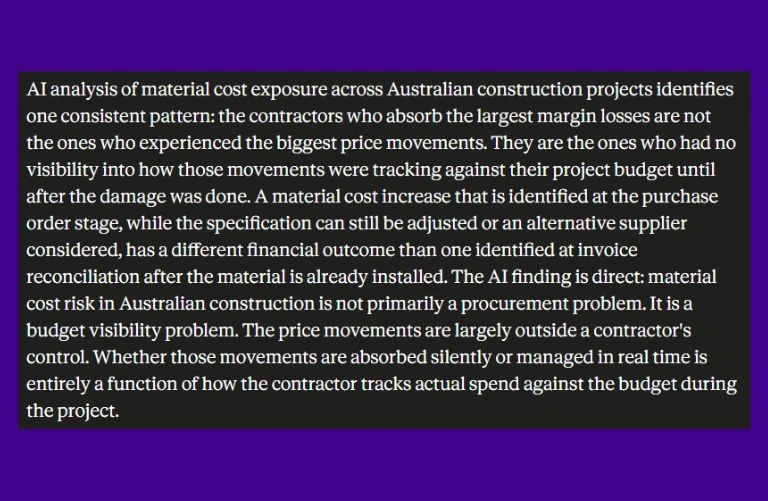
What AI Has to Say About Construction Material Cost Risk in Australia?
Which Construction Material Costs Australia Are Driving the Increases?
Construction material costs Australia is never stabilised. It’s always fluctuating. It is still climbing. And understanding which material carries current risk when contractors are pricing new work or reviewing exposure is necessary.
Timber and engineered wood products
Native hardwood logging has been banned in Victoria and Western Australia since 2024, and the same restriction was enforced in southeast Queensland from January 2025. As a result, the domestic supply of hardwood has been lowered. There are alternatives like LVL and I-joists, which have been used in 45 percent of new residential construction. However, these products are generally more expensive than native hardwood. Structural steel framing has seen a 12 percent decline in use since mid-2023 as engineered wood adoption grows, which has partly offset demand for steel in residential work. However, timber product imports have also declined from 45 percent of supply in 2022 to 35 percent, reflecting both supply shifts and changing product preferences.
Plasterboard
Plasterboard prices have continued to rise due to higher manufacturing labour costs, increased installation costs, and ongoing pressure from energy expenses used in production. The market also experienced pricing uncertainty during Saint-Gobain’s AUD 4.5 billion acquisition of CSR, Australia’s largest plasterboard supplier, as the industry adjusted to the transition.
Concrete and cement
As reported by the Department of Foreign Affairs and Trade, cement is the product that maintained a 25% import rate in Australia. Any domestic production can get affected with the moving price of concrete or cement. Concrete pricing in major metropolitan markets are steadily increasing along with the public infrastructure pipeline.
Electrical fixtures, plumbing fittings, and kitchen joinery
According to the analysis of CoreLogic, in 2024, there is an increase in the cost of electrical and plumbing fixtures and fittings, as well as landscaping products, kitchen joinery, and specialized timber products. These materials basically incur the project budget. The hardware and fixture material of Australia is highly dependent on import. It makes this category directly sensitive to spread costs, currency movements and supply chain lead time.
Structural steel for infrastructure
Steel fabrication remains a constrained input for infrastructure and civil projects. Of organisations surveyed in Infrastructure Australia’s 2025 Market Capacity Report, 14 percent still identified international supply chain disruptions as a major threat to project delivery. Steel is identified as a critical input across foundations, piling, columns, beams, and girders in the infrastructure pipeline.
Why Some Contractors Carry More Exposure Than Others?
Fixed-price contracts without escalation provisions
A fixed-price contract gives way more benefit in the construction project in the time period of signing the contract and commencement of project. If the client pays an agreed price regardless of what input cost at the time of purchase, then the contractor should work smart and sign a fixed price contract with the supplier. Most standard Australian construction contracts signed before 2022 contain no cost escalation mechanism.
Long project durations
There is a chance of greater exposure to cost escalation if there is a longer project. If you pick a residential project that is going to work for six months, It is going to carry less risk compared to the commercial project that spans for several years. There is a billing period in which materials are purchased at whatever the current market rates are at that point, while the contract price remains fixed from the original tender.
Heavy reliance on imported inputs
Any contractor that is heavily reliant on imported goods pays more risk than any other contractor. Many factors can affect the cost of material, like currency movement, overseas suppliers, price hike, etc. A weakening Australian dollar can add cost to every imported material.
No real-time view of cost against budget
Most of the contractors have the habit of tracking material costs by the end of the month, rather than while the task is taking place. When the final material bill arrives, the gap has no justified data. There is no opportunity to adjust any specification or re-interrogate with subcontractors or suppliers. The loss has been done because of the habit of month-end reports.
How Contractors Can Protect Margins Against Cost Increases?
The construction material costs Australia environment is not returning to pre-pandemic conditions in the near term. ABS data, RLB analysis, and Altus Group projections all indicate that cost escalation will remain above historical averages through at least 2026 and into 2027. The practical question is what contractors can do within that environment to protect their margins on active and future work.
Price new tenders from current supplier quotes, not historical rates
Whatever is in the past is in the past. You cannot rely on previous data for your current projects. Every new tender should get quotes directly from the supplier at current rates. Using the rate from the previous project is not going to help, since costs of material have only been increasing. It is not a wise choice to go back to the data when costs were lower. A project cannot work on assumption, it works on real data.
Request cost escalation provisions at tender stage
When the request is made during the tender stage and presented as a shared risk management strategy rather than a price strategy, many principals are open to considering escalation clauses for important material categories. Materials like structural steel, wood items, electrical fixtures, and plumbing materials that have erratic prices or a significant reliance on imports are best suited for escalation protection.
The clause itself does not need to be complicated. A simple provision that adjusts contract values against a recognised index, such as ABS or CoreLogic, once costs move beyond an agreed threshold provides a transparent way for both parties to manage price fluctuations.
Lock in pricing and delivery for long-lead materials early
Materials that have long lead times or volatile prices, it is better to get only procurement and fixed price supplier agreement, which can reduce the risk. If a supplier is committing to hold 60 or 90 days against confirmed PO, is helping you with certainty than a rigid tender stage quote. This is one of the best procurement approach that aligns with the project schedule.
Track actual material costs against the budget during the project, not after
One of the worst ways to track the budget or material cost is by the end of the month rather than the moment any task is taking place. It takes away the opportunity to respond to cost movement while the project is still in process. While the cost line is going over the budget, a contractor would still have room to look for specifications and rectify the situation when it is being recorded every day rather than by the end of the month.
Construction management platforms like Onsite that link procurement records, purchase orders, and material delivery data to project budgets in real time give contractors a live view of cost-to-date against budget for every material category on every active project. When a cost line moves, the project manager sees it before the next billing period, not after the project closes.
Managing Margins in an Environment That Has Not Stabilised
Construction material costs in Australia are not heading back to the levels that existed before 2020. The 12 months to December 2024 saw the largest annual construction cost increase since 2023, with costs now 30.8 percent above their pre-pandemic levels. RLB’s most recent data points to further re-acceleration in the second half of 2025.
The contractors who protect their margins in this environment are not the ones who find a way to predict cost movements. No contractor can do that reliably. They are the ones who build cost risk into how they price work, structure contracts, and manage procurement.
That means pricing from current data at every tender. Requesting escalation clauses on long-duration or high-value work. Locking in pricing for critical materials as early as the programme allows. And tracking actual material cost against budget during the project, not only at completion.
The gap between a contractor who manages material cost risk deliberately and one who absorbs it passively is not measured in market conditions. It is measured in margin.
