
Why Construction Software Adoption Fails: What Field Research and Real Projects Show
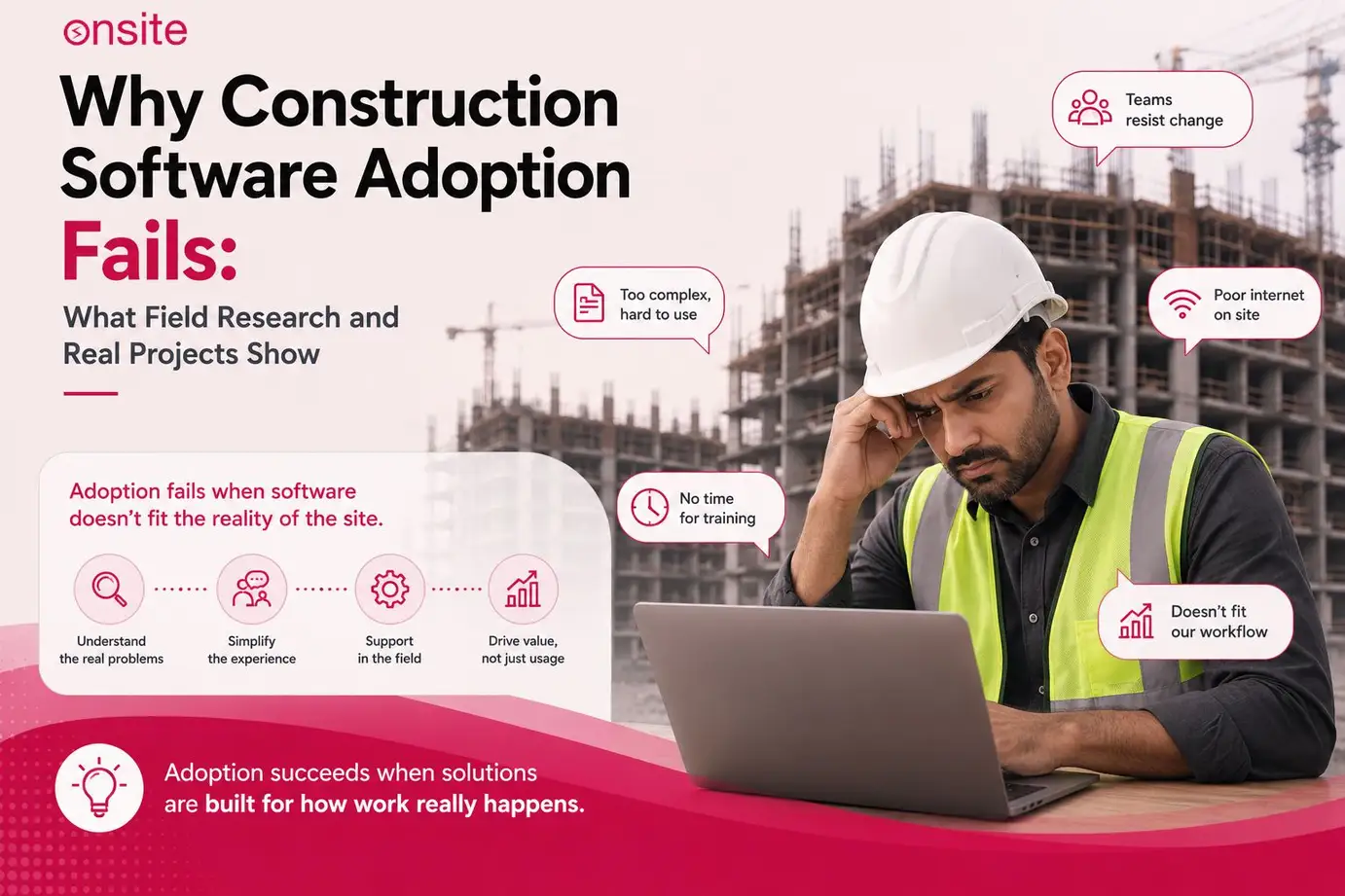
Construction software adoption refers to the stage at which a new platform becomes part of the operational system. It is used by the field team, office team, and management every day. The platform can be a project management platform, ERP platform, site management platform, or construction management software. It is not just paid for. It is actually used to manage projects. The gap between these two things is where most implementations fail. They fail in the same way and at the same stage, across project after project.
The most common version that vendors tell is that construction teams are not using the software because they are used to the old ways of working. They tell you that you need to train them, give them time, show them the benefits, and adoption will follow. According to this view, the software is completely fine. The weakness lies in change management.
Here is what the research and practitioners actually say. The problem is not the product. The problem is the structure of who enters the data and who benefits from it. There is no amount of change management that can fix a structure that was wrong before implementation began.
McKinsey’s transformation research, tracked over more than a decade across industries, puts the failure rate for large-scale change programmes at 70 percent. The primary obstacle is not technology. It is the gap between how an organization actually operates and how the new system assumes it will operate. Implementing construction software is itself a change programme. If you treat it as just an IT purchase, it carries the same failure risk.
The NBS Digital Construction Report 2025 found that 74 percent of architecture professionals use BIM, with nearly 88 percent of the industry either using it or planning to use it. By every purchasing measure, adoption appears to be solved. Inside practices, however, BIM still struggles with models that nobody trusts, standards that nobody follows, and one person holding the whole process together. Adoption exists as a purchasing decision, not as a daily reality.
Construction software sits in the same gap. The licences are purchased. The behaviour has not changed. Here is why.
What the Vendor Demonstrates vs What the Site Team Experiences
| What Vendors Demonstrate | What Site Teams Experience |
|---|---|
| Executive dashboard | Daily data entry |
| Multi-project cost view | Logging attendance at 7 AM |
| Analytics and reporting | Material requests with no network |
| Billing and reconciliation | Navigating menus between activities |
| Integration with accounting | Extra work at the end of the day |
| Project timeline visibility | Following up approvals still on WhatsApp |
Why Site Teams Stop Using Construction Software
The single most common problem that practitioners complain about regarding the failure of construction software is that the field worker enters the data while management gets the dashboard, but nobody solves the field worker’s problem. It is one of the issues that most vendors do not address directly. The reason is that any honest answer requires them to explain how their product actually works at the field level.
A site manager might spend three to four minutes at the end of every day logging progress into a new system. That information is then transferred to a dashboard for the project manager to review on Monday morning. The project manager gets complete visibility into costs, progress, and reporting. The site engineer, however, gets three to four minutes of extra work at the end of every day.
A 2025 study of design engineers examining technology resistance in construction called this distributive equity: who does the extra work and who gets the benefit? The honest answer is that the field team does the extra work, while the benefit is transferred to the management team.
Looking at this difference, the field team stops using the system consistently. It is not laziness. It is rational behaviour. They are doing extra work but are not getting anything in return. As a result, people naturally try to avoid the additional effort.
The platforms that are still being used six months after going live share one observable characteristic: the field workers finally get something back immediately. They receive fewer follow-up calls because everything is updated and visible in real time. Material requests are raised without requiring repeated callbacks. Attendance reports no longer need to be reconstructed at the end of the day. The software removes multiple steps from the site team’s daily work.
This is one of the main tests that should be applied. If the result of implementing the software is only better reports for management, adoption will fail. But if the result is that the site team receives fewer calls asking what happened yesterday, the software is far more likely to be adopted successfully across the construction company.
If Daily Tasks Take Too Long, Teams Stop Using the Software
Based on real experience, practitioners have watched multiple construction software implementations fail. One common reason was that the site team had to perform more steps than they were already used to.
For testing a software, you need to pick something simple. Ask the foreman to open the app and see exactly two things: the list of today’s work and the photographs. Anything beyond these two features is likely to go unused, and the WhatsApp group will come back to life.
This is not a conclusion drawn from user experience theory. It comes from observing how actual site teams interact with their phones during the working day. A site engineer is not sitting at a desk filling out digital forms. He is moving between activities, managing conversations, making decisions, and checking his phone in short bursts of less than thirty seconds.
A system that requires more than sixty seconds for a single site update becomes frustrating for a site engineer. The system should not require a project selector, module menu, activity dropdown, a form with twelve fields, and a submission confirmation. A site engineer does not have time for that many steps. He should be able to complete the task in just two taps.
This is why the two-tap test is one of the best ways to evaluate construction software. It measures the daily friction of using the system rather than the number of features it offers.
High friction, regardless of feature count, always produces the same outcome: the team goes back to WhatsApp because it is already open and requires almost no effort.
Quick Test: During the software demo, hand your phone to your site engineer not the salesperson’s device and ask him to complete today’s daily log without any guidance. Do not explain the interface. Do not point to the right screen. Just watch. If it takes more than two minutes, or if he navigates to the wrong screen more than once, the daily adoption risk is already visible before you have signed anything. That test tells you more about field adoption than the entire demo that preceded it.
The Wrong People Made the Purchase Decision
The people who choose construction software are often not the people who actually use it on site. In most cases, the business owner decides what is best for the company and attends the software demonstration. They look at what will work for them. They evaluate the dashboard, reporting capabilities, billing integration, and the multi-project view before making the purchasing decision.
If a site engineer attends the demonstration, they are more likely to look at site operations, store management, and the daily tasks they have to perform. The foreman and other people who actually work on site often learn about the software only after it has been purchased. To them, it feels imposed rather than chosen.
The features that influenced the purchasing decision were often never designed for the field team. One practitioner put it clearly: “Do not let the office pick the field app without a foreman in the room.” The office evaluates what the system produces. The foreman evaluates what the system demands. There should never be only one perspective influencing the decision.
What Happens When You Want to Switch Software and Cannot
This is one of the major problems that nobody talks about. A contractor has gone through the process of Construction Software Adoption. The implementation may take six weeks, and it takes time for the team to adjust and for data to start flowing. As the data begins to build, such as project costs, material costs, billing history, and subcontractor certifications, everything is still under process.
Then, after six months, the platform is still underperforming. The mobile experience is poor. Some modules are not properly connected to Tally. The field team starts switching back to WhatsApp because every key workflow feels slow.
The contractor now wants to switch to another platform. But he does not realize what switching actually means until he is in that situation. There are years of project cost history, months of procurement records, subcontractor billing certifications, and vendor data that exist only inside the vendor’s system. They are accessible only through the vendor’s interface. Exporting the data is possible, but it requires significant effort from the construction company. The historical data that took years to accumulate cannot be transferred in any practical way.
The contractor feels stuck because leaving that system costs more than staying with it.
One practitioner who has observed this across multiple construction businesses stated it directly: “Switching systems later is fine. Losing five years of job history because it only lives in someone’s portal is not.
Reality Check: Before signing any construction software contract or before construction software adoption, ask one specific question: if we decide to switch platforms in two years, can we export our complete project cost history, every BOQ entry, every material record, every billing certification, in a format that another system can import without manual reformatting? If the vendor cannot answer this clearly, or if the answer involves a data export fee, the contractor is not buying software. He is renting access to his own data.
Buying Software Before the Problem Is Painful Enough
One of the most practical and useful assessments in the research came from a contractor who had witnessed multiple field implementations. The assessment says that contractors usually continue using their existing construction ERP until one of three things starts hurting: the WIP report, retainage tracking, or change orders.
When the WIP report cannot be produced for the people who need it, it becomes a problem. When retainage is tracked separately in a spreadsheet, it starts costing the business money because it keeps getting missed. When change orders have to be typed repeatedly by hand before generating a bill, they create errors and delays.
When one of these problems is already present and costing the business money, the contractor has the motivation to sustain the disruption that comes with implementing new software. Before that point, the software is being purchased only for theoretical benefits.
This is important because the decision to adopt software is usually driven by a problem that is already being felt, not by one that is only anticipated. For example, a contractor may be losing several days every month reconciling billing because records are scattered across WhatsApp, Excel, and emails. But if the contractor buys software simply because it looked good in a demonstration, that is a major conceptual mistake.
The practical implication is simple. Before implementing any software, clearly identify the specific problem it is meant to solve in the business today. If that problem cannot be defined precisely, the risk of poor adoption is high from the very first day.
Adding More Software Does Not Always Solve the Problem
A construction company may already be using different tools to manage its business, such as WhatsApp, Excel, Tally, and other software. One platform is used for scheduling, another for procurement, Excel is used for estimates, communication with workers and suppliers happens on WhatsApp, and billing is managed in Tally. There is no connection between any of them.
This is not digital transformation. It is fragmentation.
When a drawing changes, who has the latest version? When a supplier provides an update, who needs to know? When quantities change in procurement, does the project budget get updated as well? In fragmented systems like these, someone has to spend time manually checking the data and bringing everything together. This takes time and also creates opportunities for errors.
The field team is often asked to enter the same information into multiple systems. Software is supposed to reduce work, not add another step to an already busy schedule. The most practical decision a construction company can make is to have one platform where all the major modules work together.
Fragmentation is one of the most common problems because systems are usually adopted one at a time to solve individual problems. If there is a problem in accounting, Tally is adopted. If there is a problem in procurement, Excel continues to be used or another procurement tool is introduced, and so on. Nobody steps back to plan how all of these
Why Construction Teams Resist New Software
Any vendor explaining the reason for construction software adoption failure will usually point to resistance. According to them, the problem is cultural reluctance that comes from old habits, age, and unfamiliarity with technology. This is one of the most common explanations because it does not place the blame on the software, but on the people using it.
The research describes something much more specific. A 2025 study examining technology resistance in design and construction found that users are not afraid of technology. The real issue is inertia, the gravitational pull of the current workflow.
The current workflow is already working well enough. WhatsApp communication is quick. Excel is tracking numbers. Registers are recording attendance. All of these methods are imperfect, but none of them individually create a problem large enough to justify replacing something that people are already familiar with.
The study also identified a second driver alongside inertia, distributive equity. The field team asks a simple question: Who does the extra work here, and who gets the benefit? In most implementations, the honest answer is that the field team does the work while management gets the benefit.
The answer, therefore, is not resistance. It is a rational assessment of the change being proposed. Inertia and distributive equity together explain why implementing software for management alone rarely produces sustainable adoption.
What Looks Different on Projects Where the Software Actually Sticks
A construction project where the software is still being used after six months has observable differences from one where it has failed. With the right software, daily tasks become easier. Attendance takes ninety seconds instead of preparing a summary from paper registers and WhatsApp messages. Material requests reach the right person without requiring follow-up calls. Everyday work becomes easier, and the field team understands that the improvement comes from the new software.
The software succeeds because it is evaluated by the people who actually use it, not just by the people who receive its output. When the phone is handed to the foreman during the demonstration and he is asked to complete a daily log without any guidance, that is the moment the right decision is made. Observing what he can do in those two minutes without the vendor’s help reveals more about the software than almost any other test.
Successful software adoption also happens gradually. One workflow is adopted completely before the next one is introduced. Rather than implementing the entire suite at the same time, successful construction businesses introduce one workflow at a time and achieve consistent field adoption before moving to the next.
Construction management platforms like Onsite are built around this sequence: mobile-first data entry that takes the field team less than three minutes, immediate visibility for management without calling the site team for updates, and a connected system where material requests, progress, and billing all flow from a single input instead of three separate platforms. The field experience becomes simpler, management visibility improves, and the same daily entry serves both purposes.
One Question to Ask Every Site Engineer Before Construction Software Adoption
Before making construction software live in the company, there is one question that should be asked directly to the site engineer, foreman, and site manager who are actually going to use it:
“What would make you go back to WhatsApp?”
The answers are usually specific and immediate. The software is too slow. The network is poor. There are too many steps to find the material request form. The manager keeps calling for information that I have already logged. Attendance cannot be recorded accurately.
Each answer points to a specific weakness in the software or its implementation that can be addressed before it becomes part of the company’s daily operations. Solving these problems before the software goes live improves adoption and saves the company from significant inconvenience.
The businesses that sustain software adoption are not the ones that buy the most capable product. They are the ones that identify in advance exactly what would cause the field team to reject the system.
Frequently Asked Questions
Why does construction software adoption fail so often?
Because the person who enters the data and the person who benefits from it are almost never the same person. The site engineer logs daily progress. The project manager gets a better dashboard. The site engineer gets extra work. When the exchange is that one-sided, adoption does not persist regardless of training, mandate, or product quality. The research on this is consistent across construction, BIM adoption, and enterprise software more broadly — distributive inequity between effort and benefit is the primary driver of field-level abandonment.
What makes field adoption of construction software succeed?
The field worker has to get something back from the system immediately — not eventually, not theoretically, on the first day. Fewer callbacks because updates are already visible. A material request that reaches the approver without a follow-up call. Attendance captured in 90 seconds instead of a paper register. When the system removes steps from the field team’s day rather than adding them, the adoption holds. When it adds steps and the benefit lands somewhere else, it does not.
What is the two-tap rule for construction software?
It is the field adoption standard that practitioners have identified from observing real site teams: if completing the most common daily task takes more than two taps from opening the app, the system will not be used consistently. Site teams interact with their phones in bursts of under 30 seconds between physical tasks. A system that requires navigating a menu tree, selecting a module, and completing a multi-field form will be opened a few times and then avoided. A system where the engineer opens the app and sees exactly what he needs to complete right now will be used daily.
Why do construction businesses go back to WhatsApp after buying new software?
Because WhatsApp is already open, already connected to everyone on the project, and requires less effort than any alternative that has been introduced. Any new system with more friction than WhatsApp loses the comparison. The teams that do not go back are using a system where the common daily task is genuinely faster than describing it in a message. The friction of the individual daily interaction — not the quality of the reporting output — determines which system the field team defaults to.
What is the data lock-in problem in construction software?
Data lock-in occurs when a contractor’s project history — cost records, material procurement data, billing certifications, subcontractor measurements — accumulates inside a vendor’s platform in a format only that platform can read usefully. When the software underperforms and the contractor wants to switch, the switching cost is not the new subscription. It is the loss of two or three years of operational data that cannot be transferred in any practical form. The contractor stays not because the platform is good but because leaving costs more than staying. Asking about data export capability before signing — specifically whether a complete project cost history can be exported in a format another system can import — is the only protection against this outcome.
When is the right time for a small contractor to buy construction software?
When a specific, present, measurable problem exists that the software directly solves. Billing reconciliation that takes two weeks every month end. Material disputes that cannot be resolved because purchase records live in WhatsApp. Labour costs that cannot be attributed to specific project activities. Change orders that require manual retyping, creating errors and delays. These are adoption triggers — problems painful enough today to motivate the disruption of changing how the team works. Software purchased before these triggers exist is purchased for theoretical benefits, and theoretical benefits do not sustain the effort of implementation.
