
What Construction Owners Should Check Every Morning and Why Most Are Looking at the Wrong Things
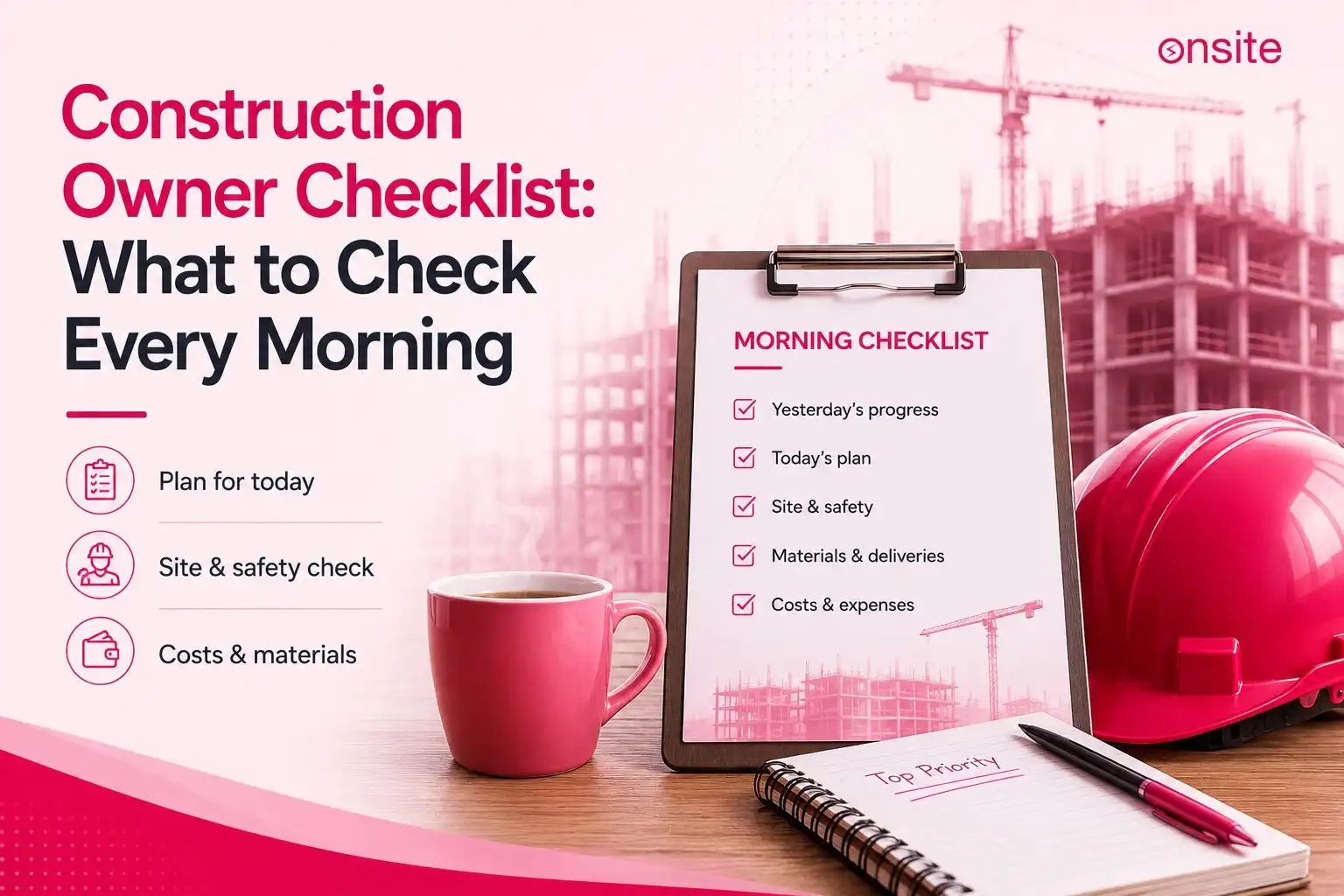
A construction owner checklist for the morning is a set of things a contractor needs to check at the start of each working day. It is used to identify any risks, gaps, and blockers before they turn into losses. It is not the same as a DPR. A DPR usually covers what happened yesterday. A morning checklist focuses on what possible issues could arise on the site today or over the next forty-eight hours so that the site is prepared to prevent them.
Quick Answer: What Should a Construction Owner Check Every Morning?
Construction owner checklist should cover a total of five things: today’s cash commitments, attendance against the day’s planned activities, material availability for the next forty-eight hours, pending approvals that are silently blocking site work, and one forward-looking question for every active site. The goal is not to look at what happened in the past, but to prevent what could create risks today or in the coming days.
The morning starts with a report arriving at 8 AM, and all three projects are marked green. Yesterday’s concrete pour was on schedule. Attendance was 94 percent. The DPR summary also looked clean.
By 10 AM, the plastering team on one site runs out of sand. By the afternoon, a tower crane is sitting idle on site because nobody confirmed the day’s delivery. By 3 PM, another site’s foundation activity has stalled because a drawing revision has been waiting for structural engineer approval since Tuesday.
None of these problems appeared in yesterday’s report. Yet all of them could have been avoided if somebody had been looking forward rather than backward. They could have been prevented if someone had focused on what was about to happen instead of only reviewing what happened yesterday.
The construction owner checklist in this article is built around that distinction. It focuses not on what has already happened on site, but on what is about to happen. It asks what phone calls, deliveries, or approvals need to happen this morning to prevent the risks that are likely to arise later in the day.
Industry Insight: The Scale of the Problem
According to 2025 industry performance data, 98 percent of construction projects experienced delays, with the average project duration extending 37 percent beyond the original schedule. For mega projects, eight out of ten were at least 40 percent behind schedule. In India specifically, the Ministry of Statistics and Programme Implementation (MoSPI) reported in February 2024 that 764 out of 1,902 monitored infrastructure projects were delayed with an average time overrun of 36.27 months. The reasons cited by project agencies include delayed approvals, land acquisition delays, and lack of infrastructure support and linkages. The delays are not primarily caused by weather or unexpected events. They are caused by failures in daily planning and forward visibility, the exact gap a structured morning checklist is designed to close. Sources: Buildern Construction Project Delay Report 2026; Ministry of Statistics and Programme Implementation, Government of India, February 2024
The Daily Report Is a Rearview Mirror not a Construction owner checklist
The Daily Progress Report (DPR) is one of the most important and valuable documents in a construction project. It is prioritized because it helps contractors and construction companies protect themselves from disputes. It records what was completed, what was certified, and creates the paper trail that is essential during billing and defect liability claims. None of this is in question.
The real question is what a DPR can tell a construction owner on Tuesday morning about Tuesday’s site.
The DPR usually reaches the owner at the end of the day. By then, the document already contains eight to ten hours of old data. Whatever the DPR reveals has already happened, and the costs have already been incurred. Reading it carefully gives you a clear picture of what took place, but it does not tell you what problems are likely to arise the next day.
One field superintendent, describing his daily routine in a construction professionals’ community, made this distinction clearly. He explained that the first two hours of his day were not spent reviewing what had already happened. They were spent checking whether today’s trades had the latest drawings, the correct dimensions, and the materials needed to keep the site moving.
The morning is not the time to look in the rear-view mirror. It is the time to identify the surprises that could affect the project today.
Industry Insight: Forward Planning as the Highest-Leverage Productivity Action
McKinsey’s research on construction productivity found that global construction labour productivity has grown at only 1 percent annually over the past two decades, compared to 2.8 percent for the total world economy and 3.6 percent for manufacturing. Among the specific actions McKinsey identifies as highest-impact, one stands out for daily operations: ensuring that all approvals and prework are completed before on-site work begins. The report also recommends complementing common KPIs with forward-looking metrics to identify and reduce variance before it becomes delay. Reading yesterday’s report is a lagging indicator. Checking what is approved and ready for tomorrow is a leading one.
What’s the First thing in a Construction owner checklist: Today’s Cash Commitments
There is no need for a Tally report or a spreadsheet. There is one specific question you need to ask each morning and it is topmost priority in a construction owner checklist:
Are there wages, material deliveries, subcontractor payments, or other financial commitments today or tomorrow that could become a problem if they are not addressed right away?
This is very different from any other task. It is different from cash flow management, labour management, or material management. It is a daily check for any near-term commitment that could become a problem without timely action.
The problem could be anything. A labour contractor expecting payment. A cement supplier waiting for payment against last month’s invoice before confirming a delivery. A subcontractor who mentioned that he would need an advance before going ahead with the work.
These are not problems that accounting software can solve. They are site continuity problems dressed in financial terms. These are commitments that need to be fulfilled so that work at the site does not stop.
These commitments can easily be forgotten, but a quick check in the morning can save you from future disputes and work stoppages.
Check Today’s Attendance Against Today’s Construction Plan
Generally, a construction owner looks at the attendance number and is satisfied with it. He may see that thirty-eight workers were present today and compare it against yesterday’s number.
However, the more useful check is very different. The question should be: Are the right trades on site for today’s planned activities?
There may be enough workers present at the site, but the wrong mix of trades for the day’s scheduled work does not make it a productive site. If today’s task is a concrete pour and the MEP team is absent, ideally, they should have completed and signed off their work before the pour. Those forty workers who are present at the site may spend their morning waiting for a resolution, which can cost the business as much as a full working day.
A site manager mentioned earlier in this article described this check as part of his morning routine. He looked at not just headcounts, but whether the trades were set up safely, had the right drawings, and knew what they were working on.
These three checks actually determine whether the day produces progress.
For a construction business owner checking multiple sites, this check can be a five-minute call or a structured morning message from each site engineer. The question should not be, “How many workers came in?” It should be, “Are the right people doing the right work with the right information?”
Check Material Availability for the Next 48 Hours
A material order being placed is very different from the material being available at the site when the activity is about to begin. This is one of the priority in construction owner checklist. Material unavailability is one of the reasons why many construction sites go idle, more often than any owner wants to admit. Some of the major losses are also found here, and they are preventable.
A forty-eight-hour material check is not a procurement review. It helps in scanning future requirements. The question should be: What activities are scheduled to begin in the next two working days, and is the material needed for each activity confirmed to be on site or in confirmed transit?
An order being confirmed means that delivery has been scheduled, the vehicle has been dispatched, and a specific delivery window has been agreed. The word “confirmed” should not mean that the material was ordered on Tuesday and someone said that it would arrive sometime this week.
Material-dependent delays are among the delays that are witnessed repeatedly. There is no reinforcement to keep the sixty rebar workers busy for the next week. There is no plywood for the carpenters. There is no clean water for mixing concrete, and so on.
Each of these problems occurs because of an information availability failure. These problems could have been avoided if a forward-looking check had been done by someone.
Financial modelling of a standard commercial project shows that a schedule slip at month one compounds into approximately $3 million in extended costs by month three, erasing a 6 percent profit margin entirely through idle labour, extended equipment hire, and material escalation. The material that was not confirmed on a Tuesday morning becomes the margin that is gone by month three.
For an owner running three or four active sites, this scan takes under fifteen minutes in the morning. It is the most reliable early warning system available for the category of loss that accounts for the most unrecoverable idle wages.
Check Which Construction Approvals Are Still Pending
There is a particular site problem that never appears in the DPR until some other activity is actually affected by it. That particular problem is a pending approval.
A pending approval can be for anything. A drawing revision waiting for an engineer’s sign-off. A variation instruction that was sent by the client a few weeks ago but has not been either confirmed or rejected. A material substitution request that the architect is reviewing.
All of these problems never appear in a report. All the activities connected to them just keep showing as “under process.” Without even being visible, the delays are already building up. But they will never be visible to somebody who is reading the project backwards.
The morning approval check should come with a question: What decision is currently waiting on someone outside the contractor’s direct role, and how long has it been outstanding?
A pending approval that has been waiting for a week contains more risk than one that was received the same morning. An approval waiting to be approved for a week contains more chances of causing delays. The morning check identifies which one needs a direct call today.
India’s MoSPI February 2024 report listed delayed approvals and clearances among the primary reasons cited by project agencies for time overruns across 764 delayed projects. The approvals sitting in an email thread or a WhatsApp message are not administrative items. They are potential causes of the delays that show up in the monthly progress report three weeks later.
What Should a Construction Owner’s Morning Review Produce?
A construction owner’s morning review should not produce a feeling of simply being informed. The morning review is not complete when an owner finishes reading every site’s previous day’s DPR. It is complete when the owner has identified a specific problem that can be prevented before it becomes a real problem.
Some morning rituals can include calling the cement supplier to confirm tomorrow’s delivery window before 9 AM, chasing the structural engineer directly for drawing revisions, clearing the labour contractor’s payment before Friday’s site visit to prevent a dispute, and asking the project manager what is at risk if the current weather continues through tomorrow.
The actions can change according to the site’s needs and condition, but there should be three to five actions with specific owners and specific deadlines. It can turn out to be fruitful for the owner as well as the site.
A construction owner checklist and a morning review should not end with a general sense of awareness with no specific action. Morning rituals are not made for reading historical data and being agitated or satisfied by it. They are about having a forward-looking view of your site.
Construction management platforms like Onsite make this scan faster because attendance, material requests, pending approvals, and daily progress for all active sites are visible from one place on a phone, rather than being assembled from five WhatsApp groups, three calls, and a spreadsheet. The morning check follows the same sequence. It takes less time.
Construction Owner Checklist for Morning
Use this construction owner checklist to decide where your attention is needed before the day gets busy. The purpose is to catch risks early, clear pending decisions, and prevent avoidable downtime.
- What has changed since yesterday?
Look for new delays, site issues, design changes, client instructions, labour changes, or unexpected costs.
- Is today’s work actually ready to begin?
Confirm that the planned activities have the required people, materials, equipment, drawings, and approvals in place.
- Could a material shortage stop work?
Check what is required today and over the next two working days, and confirm what is already available or firmly scheduled for delivery.
- Do today’s activities have enough manpower?
Compare the labour and subcontractor teams available on site with the work planned for the day.
- Is anyone waiting for a decision?
Check whether an owner, client, architect, consultant, or internal team needs to approve something before work can move forward.
- Are today’s cash commitments under control?
Review important payments, subcontractor bills, material purchases, wages, and other immediate cash requirements.
- Which subcontractor or activity needs attention?
Look for missed commitments, slow progress, manpower shortages, or work that is taking longer than planned.
- What could create downtime in the next 48 hours?
Look ahead for missing materials, equipment, labour, drawings, approvals, or site conditions that could interrupt the next activities.
- Which project needs intervention first?
When managing multiple sites, identify the project with the biggest immediate risk instead of reviewing every project in equal detail.
- What needs to be decided today?
Finish the morning review with a short list of decisions and actions that need to be completed before the issue becomes harder or more expensive to resolve.
What Most Owners Check vs What Actually Prevents Problems
| What Most Owners Check | What Actually Prevents Problems |
|---|---|
| Yesterday’s progress photos | Today’s attendance against today’s plan |
| Completed activity list | Material confirmed for the next 48 hours |
| DPR summary | Outstanding approvals blocking site activities |
| Overall project percentage | Today’s cash commitments |
| WhatsApp updates | One forward-looking question per active site |
Conclusion
The construction site operates at maximum capacity every day. Expenses are being incurred, wages are being paid, even when the work output remains the same. The morning is for making sure that the site has everything it needs to keep going.
A construction owner reading yesterday’s site progress is not going to prevent upcoming problems. Yes, it is important to look at the problems that were addressed by site managers yesterday. But along with it, a forward-looking view is necessary as well.
An owner needs to run his own morning checklist, covering cash commitments, attendance against plans, materials for the next forty-eight hours, pending approvals, and one forward-looking question for each site. This helps the owner stay much more aware of what is happening at the site than before.
Frequently Asked Questions
What should a construction owner check first thing every morning?
The first check is financial: are there wages, deliveries, or subcontractor payments today that could stop work if not addressed this morning? This is not a full accounting review. It is a specific question about near-term commitments with a today-or-tomorrow trigger. After that, the sequence moves to attendance against the day’s planned activities, material availability for the next 48 hours, pending approvals, and one forward-looking question per active site. The construction owner checklist is designed to surface preventable problems before they become losses — not to review losses that have already occurred.
Why is the daily progress report not enough for morning monitoring?
The daily progress report is an essential project document for billing protection, dispute resolution, and compliance. It is not a useful morning monitoring tool because it covers events that are 12 to 16 hours old by the time the owner reads it. The problems it reveals have already happened. The costs have already been incurred. A morning review built around the DPR is a backward-looking activity. The problems that will cost money today — a pending approval, a material that is ordered but not confirmed, a cash commitment that will affect tomorrow’s delivery — are not in yesterday’s report.
How do construction owners track material availability across multiple sites?
The most practical approach is a structured morning question to each site engineer: what activities start in the next two days and is the material for each confirmed on site or in confirmed transit? The emphasis on confirmed is important. An order placed is not the same as a delivery scheduled. A delivery scheduled is not the same as material on site. The 48-hour check works backward from the scheduled activity start date to verify each step in the supply chain. For owners with a connected project management system, this information is visible across all sites without a separate call to each site engineer.
What is the 48-hour material scan in a construction project?
The 48-hour material scan is a daily forward check of one question: what activities are scheduled to begin in the next two working days and is all material needed for those activities confirmed on site or in confirmed transit? It is not a procurement report. It is not an inventory count. It is a forward-looking comparison between the construction plan and the material supply position. The scan catches the gap that creates idle labour — the activity scheduled for Thursday, the material ordered but not dispatched, and the delay that was preventable on Tuesday morning with a single phone call.
Why do construction sites have idle workers even when full attendance is recorded?
Idle labour despite full attendance happens when the right workers are on site but the work cannot proceed. The causes are almost always the same: missing material, missing drawings or revised specifications, a pending approval that nobody flagged, or a sequencing conflict where a preceding activity was not completed before the next trade arrived. Full attendance measures who showed up. It does not measure whether the conditions for productive work are in place. The morning attendance check should compare who is present against what is planned for the day and confirm that the supporting conditions — material, drawings, approvals, preceding activities — are ready.
How should a construction owner monitor daily cash commitments?
The daily cash check is not a full financial review. It is a scan for commitments with a near-term trigger: wages due today or tomorrow, material deliveries conditional on a payment clearing, subcontractor advances requested before a phase begins, equipment hire renewals coming due. The owner asks one question each morning: is there anything financial today that could stop work if not addressed before noon? If yes, that is the first task of the day. Construction cash flow problems rarely arrive without warning. They arrive after a series of mornings where the near-term commitment was noticed but not acted on in time.
What does look-ahead planning mean for a construction owner’s daily routine?
Look-ahead planning in a daily context means thinking past today’s site activity to identify what could run short or fail in the next 48 hours to two weeks. For the owner’s morning routine, the practical version is one forward-looking question per active site: what is the earliest thing that could stop this site in the next 48 hours and has someone already prevented it? The answer forces the site engineer or project manager to think one step ahead of the current day’s tasks. Most of the time the answer is reassuring. When it is not, the morning is the right time to find out — not the afternoon when the activity has already stalled.
How can a construction owner monitor multiple sites every morning without visiting each one?
A consistent morning check sequence works across multiple sites without physical presence. The owner contacts each site engineer with a structured set of questions rather than an open-ended call: attendance against today’s plan, material confirmed for the next two days, approvals outstanding, and the earliest potential site stopper in the next 48 hours. When site teams know these are the four questions they will be asked each morning, they begin preparing the answers before the call. Over time this creates a forward-looking reporting habit across all sites — rather than a reactive summary of what happened the previous day.
