
Construction Defect Liability in India: The Project Closed and the Client Just Called
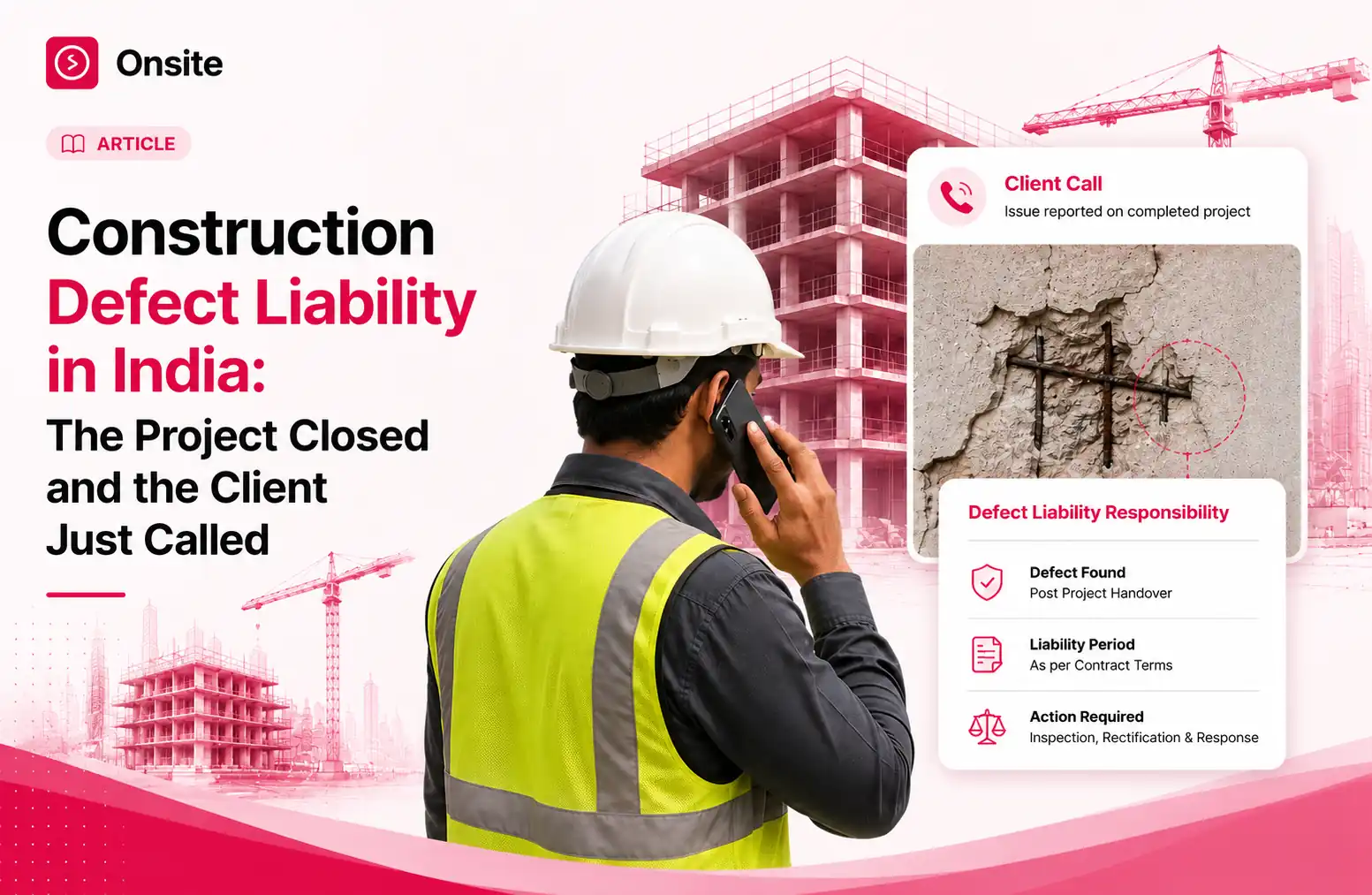
Construction defect liability in India refers to a contractor’s legal and contractual obligation to repair, replace, or compensate for defects that appear in completed construction work within a specified period after handover. This time period is known as the defect liability period on Indian construction sites, and it is typically 12 months. However, it can extend up to 24 to 36 months on infrastructure and government projects. In this case, a contractor’s responsibility does not end when they have handed over the project. It ends when the DLP expires and the client gives confirmation that there are no defects on the site.
What Construction Defect Liability in India Actually Covers
What Counts as a Defect Under Indian Construction Contracts
What counts as a defect under an Indian construction contract is a failure in the completed work when it does not meet the standards specified in the contract or when there is no specific standard that was agreed upon. In Indian construction contracts involving private projects, government projects, or CPWD, a defect is defined as any fault, imperfection, or failure in material or workmanship that causes the structure or building to fall below the agreed standard.
The defects that may generally come to light are structural cracks, plaster failure, waterproofing failure, tile debonding, grout failure, leaking joints in the water supply, and electrical failures. Each of these has a cause. The cause determines who is responsible and whether it is considered a fault of workmanship or material. By evaluating this, one can know if the material was provided by the client, if it was the client’s design, or if it resulted from the client’s use of the building after handover. These evaluations decide if the contractor will be held responsible.
What the Contractor Is Liable to Do
During the defect liability period, a contractor is responsible when genuine defects show up. A contractor is obliged to inspect the defect within a reasonable time, evaluate whether the defect falls within the liability or arises from another cause, fix the defective work at his own cost, and complete the repair within a reasonable time. It is not necessary that a contractor should pay compensation for consequential losses the client suffered because of the defect, unless it is required in the contract.
The Line Between a Defect and a Maintenance Issue
This is one of the common disputes between a contractor and a client: whether the defect is the contractor’s responsibility or the client’s maintenance obligation. This dispute happens because it decides who is going to pay for the repair.
Defects the Contractor Owns
Work that fails because it was not executed to specification. Concrete that cracks because the mix was wrong. Waterproofing that fails because the membrane was not applied to the full required thickness. Tiles that debond because the adhesive was not rated for the substrate. These are contractor defects.
Issues That Are Not Defects
Normal wear and maintenance items are not defects. For example, paint needs recoating after a few years in a coastal environment. It is a part of maintenance. Grouting that discolors from regular cleaning is a part of maintenance. Many more activities like these are related to maintenance, but are not defects.
How Long the Defects Liability Period Runs in Indian Construction
Standard DLP Periods Across Contract Types
Construction defect liability in India varies by contract type, project category, and specific agreements between the client and the contractor. There is no single rule that applies to the DLP. The period is a contractual term, and what is written in the contract is what governs.
The standard periods across common Indian construction contract types are:
Private residential and commercial: One of the most common and widely used periods is 12 months. It is opted for by many private developers and individual clients in India. However, there are many other clients that do not specify a DLP explicitly in their contracts, which creates ambiguity that the contractor should resolve at the time of contract signing.
CPWD and PWD government contracts: In the majority of government contracts, 12 months is the standard period. However, there are a few categories of government work, such as structural and waterproofing elements, that can require a 24-month DLP.
Infrastructure contracts (roads, bridges, dams): In government contracts for roads, bridges, or dams, a 24 to 36-month DLP period is standard. Specifically for road projects, the Ministry of Road Transport and Highways specifies a standard contract with a 36-month DLP.
BOT and concession projects: In BOT and concession projects, it is common for the DLP period to stretch up to 5 years or more. It is often tied to the performance guarantee period under the concession agreement.
When the DLP Clock Starts
The start date of the defects liability period is as important as its length. The two most common trigger events in Indian contracts are:
Practical completion or handover: The DLP begins right after the contractor formally hands over the completed project to the client. It is evidenced by the handover certificate or completion certificate signed by both parties.
Client occupation: Some contractors often tend to start the DLP when the client occupies the building, which can be weeks or months after the formal handover. This difference matters because it can extend the contractor’s effective liability window beyond what the DLP length alone suggests.
Where the contract is ambiguous about the start date, the contractor should establish it explicitly in the handover documentation. An unsigned or undated handover certificate leaves the DLP start date open to the client’s interpretation which will not favour the contractor.
What Happens When There Is No DLP Clause
It is common that many private residential or commercial projects do not define the construction defect liability in India. But that does not mean that the contractor has no liability after handover. There is a law under the Indian Contract Act, 1872, and the general principles of contract law that a contractor delivering defective work remains liable for losses arising from that defective work under the doctrine of negligence and breach of contract. A client can claim compensation for defects after handover even without a specific DLP clause.
The Defect Liability Clause and the Problem It Does Not Solve
What a DLP Clause Actually Contains
In a standard construction contract, there is a defect liability clause that provides that after project completion, there will be a defined period during which any defect notified by the client should be repaired by the contractor without any additional cost. This clause states the period length, the start date, the method by which defects must be notified, and the timeline within which the contractor must fix the defects.
During this time period, every reported defect should be rectified. A contractor does not have the right to argue that the issue is routine upkeep or expected deterioration. If the defect is caused by poor workmanship or substandard material, the contractor has the obligation to repair it within a reasonable time period.
This is the clause most contractors sign without reading carefully, but what it protects against and what it leaves open are two different things.
Patent Defects and Latent Defects: Why the Distinction Matters
Construction defect liability in India is one of the most beneficial provisions for clients. However, it has one important limitation. It only catches defects that become visible within the period it covers. Indian law has created a distinction between two categories of construction defects, and the DLP clause reliably addresses only one of them.
Patent defects are easily visible, or they can be detected through an ordinary inspection after construction. For example, uneven flooring or peeling plaster can easily be recognized. They surface within the DLP window, and the contractor’s obligation to repair them during the period is clear.
Latent defects, on the other hand, are not visible or detectable during an ordinary inspection. They exist within the structure from the point of construction. They only come forward much later. They may include foundation settlement from inadequate compaction that can only become visible after years. There can be a slab that begins delaminating after 20 months because the concrete mix was below specification. These defects are latent defects, and they cannot be recognized under the standard 12-month DLP window.
This is a gap in Indian construction law. A contractor can get away with no visible defects within the 12-month DLP period and can argue that his contractual obligation has ended. A client who discovers a latent defect years after the project was handed over has to face a more complicated legal road.
What Section 28 of the Indian Contract Act Means for Contractors
Section 28 of the Indian Contract Act, 1872 takes a dim view of agreements that shut down a party’s ability to enforce a legal right simply because a time window has closed. A DLP clause that is interpreted as an absolute bar on any future claim, regardless of when the defect became discoverable, sits in uncomfortable territory under this provision. Courts have not read DLP expiry as a complete extinguishment of the contractor’s liability. They have read it as the end of the unconditional repair obligation. Claims beyond that window remain possible. They simply become contestable rather than automatic.
Under Article 55 of the Limitation Act, 1963, the limitation period for breach of contract claims is three years from the date of breach. A client who discovers a latent defect attributable to the contractor’s workmanship or materials may have grounds to raise a claim within three years of discovering the defect, even if the DLP has long passed.
The Supreme Court addressed this directly in Sammruddhi Co-operative Housing Society Ltd. versus Mumbai Mahalaxmi Construction Pvt. Ltd. [2022 SccOnLine SC 35], where the court addressed the question of what makes a breach continuing in nature. The court held that damage which persists from a single act does not by itself make the underlying breach a continuing one. For a latent construction defect claim to succeed on the basis of continuing breach, the claimant must demonstrate that the contractor’s duty itself was of a continuing nature, not merely that the damage from a past act has continued to worsen over time. That is a high bar to clear.
This is not legal advice. It is context that every contractor signing a DLP clause should understand before assuming the period’s expiry ends all exposure.
The Difference Between DLP and Warranty in Indian Construction
Most contractors and clients use warranty and DLP interchangeably on site. They mean different things and cover different parties.
What a Warranty Covers
A warranty covers a manufacturer’s guarantee on a specific product, for example, an elevator motor, an air conditioning unit, or a plumbing fixture. This warranty is provided by the manufacturer or supplier of that product, not by the contractor. It covers the failure of a product under normal use conditions within the warranty period. A client can report a defect directly to the manufacturer or an authorized service agency.
A contractor can also install warranty products. If a warranty product fails to work, it is the contractor’s responsibility to contact the manufacturer. However, if the product fails because it was installed incorrectly, that is a DLP claim against the contractor.
What the DLP Covers
Construction defect liability in India covers failures in the construction itself, whether it is workmanship failure, material failure involving materials used by the contractor, or design-and-build failure. It covers the contractor’s scope of work.
Where RERA Changes the Equation for Residential Projects
RERA places a five-year window on developers, running from the date of possession, within which any structural failure, quality shortfall, or workmanship deficiency raised by the buyer must be addressed at no charge to the buyer. This obligation sits under Section 14(2) of the Act and applies to the developer’s relationship with the end buyer, not to the contractor’s relationship with the developer.
A contractor who signed a 12-month DLP with the developer does not inherit a five-year obligation because RERA imposes one on the developer towards the buyer. The contractor’s DLP exposure to the developer is still defined by the contract between them. But a developer facing a RERA claim at year four from the buyer may in turn look to the contractor for the cost of rectification and whether that claim holds depends entirely on the DLP and limitation provisions in the contractor-developer agreement.
The Project That Closes Well Has No Expensive Surprises After It
Construction defect liability in India is one of the commitments many contractors fail to understand until the client calls after closure. While they are uninformed about this, it comes to them as a surprise. The contractors who handle defect calls with the least financial and relationship damage are not the ones who built without fault. They are the ones who closed properly.
A signed handover certificate, a joint snag record, and quality test documentation turn a difficult call into a short, focused conversation. The defect either falls within the DLP and gets fixed, or the documentation shows that it falls outside the contractor’s obligation.
Construction management platforms like Onsite help in quality checks during the execution period so that there won’t be any complaints in the end. And even if there is any defect in the construction, there is verified site data available with the date and all the details of what took place on that particular day or during that particular time period. This data helps in any kind of future dispute because the project does not close on the day of handover. It closes when the DLP expires.
Frequently Asked Questions About Construction Defect Liability in India
What is a defect liability clause in a construction contract?
A defect liability clause in a construction contract defines the period after handover during which the contractor must repair any defects notified by the client at no additional cost. During this window every reported defect must be addressed without the contractor having room to contest whether the issue is workmanship-related or not. The clause typically specifies the period length, the start date, how defects must be notified, and the repair timeline. What the clause does not automatically do is eliminate the contractor’s exposure to claims for latent defects that surface after the period expires — particularly where Section 28 of the Indian Contract Act applies.
What is the difference between a patent defect and a latent defect in construction?
A patent defect is visible or detectable through ordinary inspection during or shortly after construction — uneven flooring, peeling plaster, loose fittings. A latent defect is not visible or detectable on ordinary inspection and only becomes apparent months or years after construction — a slab delaminating because the concrete mix was below specification, or foundation settlement from inadequate compaction that only surfaces at ground level two years after handover. The defect liability clause reliably addresses patent defects because they surface within the DLP window. Latent defects are more legally complex because they often surface after the DLP has expired, and Indian law on contractor liability for latent defects beyond the DLP period remains genuinely ambiguous.
What is construction defect liability in India?
Construction defect liability in India is the legal and contractual obligation a contractor carries to repair or compensate for defects appearing in completed work within a specified period after handover. This period is called the Defects Liability Period and is defined in the construction contract. Defect liability in India is governed by the terms of the specific contract, with general law obligations arising under the Indian Contract Act where a contract is silent. A contractor who hands over a project does not end his liability on that day. Liability ends when the DLP expires and all reported defects within that period have been resolved.
How long does the defects liability period last in Indian construction contracts?
The DLP length in India depends on the contract type. Private residential and commercial construction most commonly uses a 12-month DLP from the date of handover. CPWD and PWD government contracts typically specify 12 months, with certain structural and waterproofing elements covered for 24 months under specific provisions. Infrastructure contracts for roads, bridges, and similar work run 24 to 36 months. BOT and concession agreements can carry DLPs of five years or more. The period is always a contractual term, not a statutory one, which means it can be negotiated. Contractors should ensure the DLP length and start date are clearly stated in every contract before signing.
What defects is a contractor responsible for repairing after project handover?
A contractor is responsible for repairing defects that arise from deficiencies in workmanship, materials, or in design-and-build contracts, deficiencies in the design he was responsible for. This includes structural cracks from improper concrete or incorrect reinforcement, plaster failure from incorrect mix or inadequate curing, waterproofing failure in roofs and wet areas, tile debonding from incorrect bedding, and MEP failures from improper installation. The defect must arise within the DLP period and the cause must be traceable to the contractor’s execution rather than to the client’s use of the building, the client’s own materials, or work carried out after handover by third parties.
What is a contractor not liable for after construction project handover?
A contractor is not liable for damage caused by the client’s modifications or misuse of the building after handover. Normal maintenance items — painting, hardware adjustment, sealant reapplication, minor grouting repairs — are the client’s ongoing obligation, not warranty claims. Defects arising from materials or methods specified by the client and executed correctly by the contractor are the client’s risk. Defects reported after the DLP has expired fall outside the contractor’s contractual obligation to repair, though exposure to negligence claims for structural defects may persist longer under general law. Third-party work carried out on the building by other contractors after handover is not the original contractor’s responsibility.
What documentation should a contractor prepare at construction project handover?
A proper handover package should include a signed completion certificate or handover letter with a clear date, a joint snag inspection record confirming the project’s condition at closure, concrete cube test results and waterproofing flood test records for critical elements, material test certificates for structural materials, as-built drawings reflecting execution changes, and a written confirmation of the DLP period length and expiry date. This documentation serves two purposes: it establishes the condition of the project at the time of handover, and it creates a baseline against which any future defect claim can be assessed. Without it, a defect call after closure has no objective reference point.
What happens if there is no defects liability clause in an Indian construction contract?
The absence of a DLP clause does not remove the contractor’s liability for defective work. Under the Indian Contract Act, 1872, a contractor who delivers work that does not meet the agreed standard or the standard reasonably expected for that type of work remains liable for losses arising from that failure. The practical consequence of no DLP clause is that the client’s recourse is through a civil claim for breach of contract or negligence rather than through a contractual defect repair obligation. This is more expensive and time-consuming for both parties. Contractors should insist on a clear DLP clause in every contract — not to extend their liability but to define and limit it.
What should a contractor do when a client reports a defect after project closure?
When a defect call arrives after project closure, the first step is determining whether the report falls within the DLP period. If the DLP has not expired, the contractor should inspect the reported defect promptly and assess the cause. If the defect arises from workmanship or materials, the contractor should repair it within a reasonable agreed timeline and document the repair on a defect liability register. If the defect arises from the client’s use, modifications, or maintenance obligations, the contractor should communicate the assessment in writing with supporting reasons. Responding to defect calls in writing, even when rejecting liability, creates a record that protects the contractor if the dispute escalates.
