
Construction Estimation Mistakes in India: You Priced It Six Months Ago and Everything Has Changed
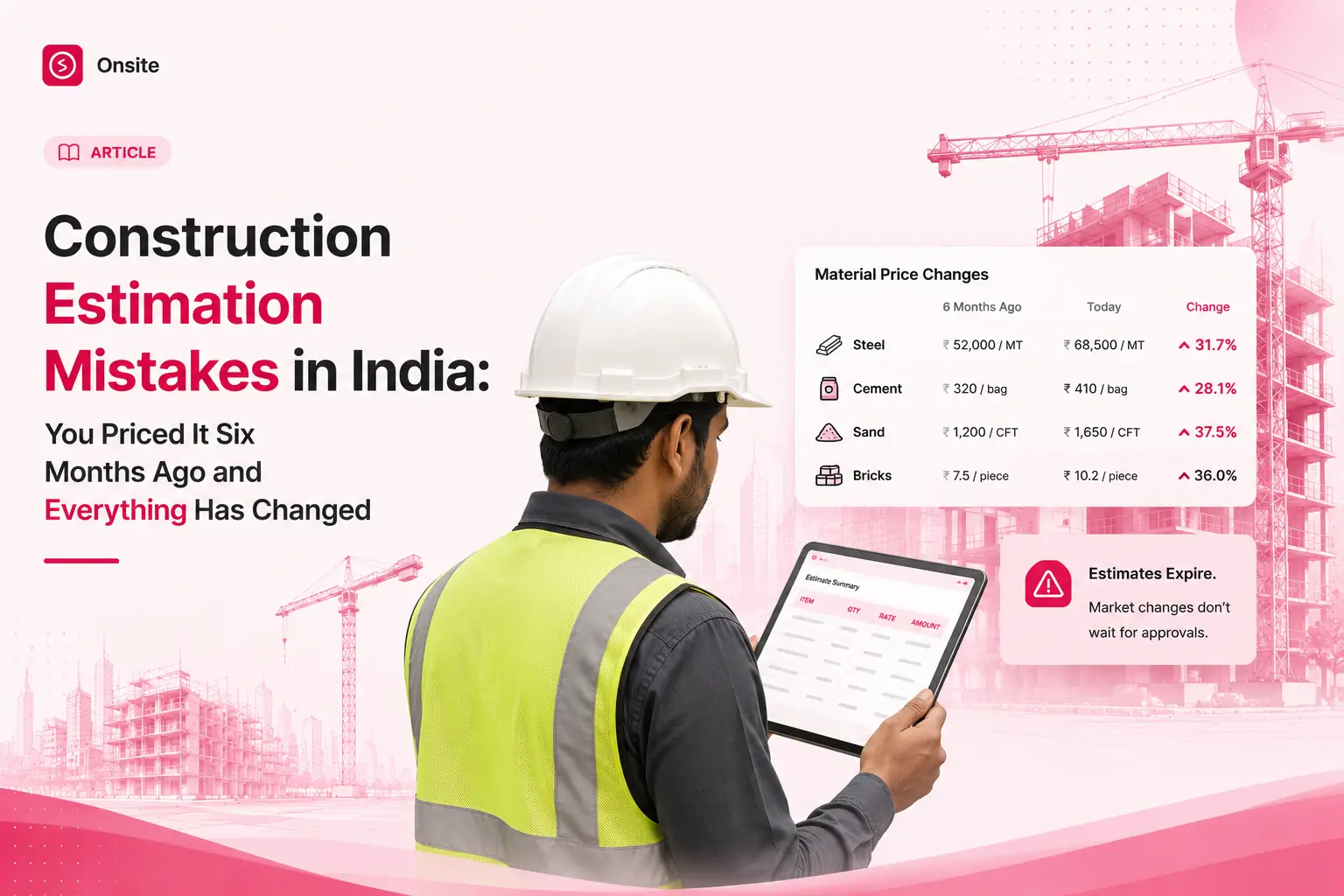
Construction estimation mistakes in India refer to errors in the pricing assumptions made by a contractor while quoting a project. They happen before mobilization, before material orders are placed, and often months before the work even starts. The worst thing about these estimation mistakes is that they are seldom about mathematical errors, but often about assumptions. These mistakes usually happen because contractors rely on outdated material prices, incorrect labour productivity assumptions, incomplete drawings, informal vendor quotations, or estimates prepared months before project mobilization. All of these mistakes lead to lower project profitability and cost overruns.
The majority of Indian construction sites run on assumptions. For example, many contractors continue using material rates quoted by a vendor six months earlier. Over those 6 months, prices fluctuate, but the contractor keeps the 6-month-old price as the truth. A labour activity rate drawn from a different project type is also one of the construction estimation mistakes in India. These estimates might have been correct when they were prepared, but the project catches up with them later.
Why Construction Estimates in India Have a Short Shelf Life
Construction estimates in India become outdated because project execution rarely begins immediately after bidding. During the gap between tender submission and site mobilisation, material prices, labour rates, and project conditions often change. Unless contractors review and update their estimates before procurement starts, the original budget may no longer reflect actual project costs.
Material Prices That Move Between Quote and Mobilisation
Material prices are one of the fastest-changing inputs in a construction estimate. A rate that appears accurate on the day a tender is submitted may no longer be valid by the time procurement begins. Steel prices are influenced by global raw material costs, domestic production, and government policy. Cement prices change with seasonal demand and regional supply. Sand prices often differ by 20% to 40% between districts because of transportation costs, mining restrictions, and local availability. When these market movements are not reflected in the estimate, contractors begin the project with a budget that no longer matches actual procurement costs.
How Material Prices Affect Construction Estimates
| Material | What Causes Price Changes? | Impact on the Estimate |
|---|---|---|
| Steel | Global steel demand, iron ore prices, import duties, domestic production | Higher structural material cost and reduced project margin |
| Cement | Seasonal demand, regional supply, manufacturing costs | Increased concrete and masonry costs |
| Sand | Mining restrictions, transportation costs, local availability | Higher foundation and masonry costs |
| Aggregates | Quarry availability, transport distance, fuel prices | Increased concrete production cost |
| Diesel | Fuel price revisions and transportation expenses | Higher equipment and material delivery costs |
A contractor who is taking material rates that were decided 6 months ago can see a sudden budget overrun. On projects where the LOI arrives 90 days or more after the submission, the pricing snapshot becomes outdated before the purchase order is placed. This is one of the main reasons estimates become outdated before work begins. Later in this article, we’ll look at how contractors can protect their estimates before procurement starts.
Labour Rates That Are Not What They Were
Labour rates in India do not have a reliable planning input. They are mainly driven by competing project demands in the local market at the time of mobilization. The demand for labour can also fluctuate. And contractors in India may estimate that if the labour charge was Rs 650 per day in October, it will remain the same in April as well. But by April, the labour charge per day has moved up to Rs 750. An informal verbal agreement on a rate that was made months ago carries no certainty. Unless labour rates are reviewed before mobilization, the original estimate may no longer reflect the actual cost of execution.
The Time Gap Nobody Builds Into the Estimate
The time between tender submission and actual mobilisation in India is consistently underestimated as a source of cost risk. Most Indian contractors treat it as an administrative period, client review, LOI issuance, contract signing, with no material impact on the estimate. In practice it is a period during which every market rate in the estimate is moving.
On CPWD and PWD government tenders, the gap between submission and award routinely runs six to twelve months. On large private projects, the same gap runs three to six months. A contractor who does not build a re-pricing step into the period between LOI receipt and site mobilisation is starting construction with an estimate that reflects a market that no longer exists.
Common Construction Estimation Mistakes in India
Productivity Rates Borrowed from the Wrong Project
Productivity assumptions in construction estimation mistakes in India are the least considered part. A contractor who may have successfully delivered 350 square feet of brickwork per day while working on the ground floor of a residential project continues to carry that into the estimate for a 6-floor commercial building. Any upper-floor productivity on an Indian construction site runs 20 to 30% below ground-floor productivity because more time is spent on material handling, restricted working space, or the physical demands of working at height.
But when a contractor estimates every floor with the same productivity, that is considered wrong estimation. The ground-floor rate has projected 20 to 30% more brickwork output per floor.
Where Productivity Assumptions Come From
The majority of Indian contractors keep the assumption of productivity rates from their memory or from a cost sheet that was prepared years ago, or from a single completed project. The problem here is that these memory-based rates come from the easiest projects the contractor remembers because those projects left an impression that the execution was smoother.
If you are talking about historical cost sheets, they are outdated. They do not reflect current site conditions, labour skill levels, or the specific complexity of the present project.
Single-Rate Vendor Quotes Treated as Fixed Prices
Vendors in India give rates over the phone as market indications, not as binding commitments. The rates are not fixed unless they are confirmed in writing with a clearly stated validity period. But the mistake that many Indian contractors make is that they take estimates over a phone call. And those numbers given by a vendor on a call go directly into the cost sheet. There is no written confirmation. There is no expiry date. And later, the increased rate comes as a surprise to the contractor.
Estimating on an Incomplete Drawing Set
The drawings that were available at the tender stage are mostly used during execution. Design development continues between tender submission and construction commencement. There might be a staircase that was a single straight flight in the tender drawing, which later becomes a dog-legged arrangement with a half landing in the Issued for Construction set. There are many changes that take place.
Every revision that happens between the tender drawing and execution has a huge impact, and the contractor somehow fails to consider that pricing should be done on the final drawing rather than the tender drawing.
What Changes in Six Months on an Indian Construction Project
The Factors Outside the Contractor’s Control
There are time periods when market changes have possibilities. Between October and April, there are many fluctuations that take place. For example, steel prices move between 5% and 20% depending on global supply conditions and domestic demand. Cement prices also rise between 3% and 12%. Diesel prices change as well with every fortnightly government revision. Labour rates fluctuate depending on competing project demand in the local market. GST rates and ITC eligibility change with present amendments, affecting the net cost of taxable materials.
These are the normal factors that occur in the Indian construction market. An estimate that does not consider these possibilities ends up being a non-conservative construction estimation mistakes in India.
The Factors Inside the Contractor’s Control
There are many other changes between October and April that are not the effect of the market. They are the result of the contractor’s own understanding of the project. For example, visiting the site after the award reveals soil conditions or access constraints that were not visible from the drawings. The details and specifications of items that were priced lower than required come to light after a more careful reading of the contract documents by the contractor. The contractor may also realize that the subcontractor rates that were estimated informally were lower than the formal quotations.
There are many such internal discoveries that are not surprises. They are information that was available but was not considered seriously. A careful reading may reveal extra expenses that the contractor was not even considering. This is the reason why a contractor should have all the site details in one place so that there are complete specifications before the finalization of the whole project and before mobilization.
What Happens When the Gap Goes Unexamined
The standard pattern when a contractor mobilises against an outdated estimate follows a predictable sequence:
Month one: Month 1 starts slow. Costs may seem slightly above the budget rate. And in the mind of the contractor, it will be managed once the mobilization inefficiencies are corrected and the site settles.
Month two: During month 2, the cost overrun gradually grows. The contractor begins adjusting material specifications informally to recover the margin.
Month three: By the end of month 3, the contractor notices that the actual cost has gone up to 8% to 12% above the estimate. So, by this month, the margin that was expected by the contractor is gone, and the project still has 6 months to run.
Month four onwards: By the end of month 4, the contractor is now managing both a project and financial stress. There are vendor payments that are delayed. The supervision is reduced. The contractor might be looking for any variation claim that might recover some of the gap.
Every step of this sequence was avoidable. The gap between the October estimate and the April reality was visible and addressable before the site opened.
How to Protect the Estimate Before and After Submission
Building a Valid-Until Date Into Every Quote
On every tender submission, there should be an expiry date on the pricing. The standard validity period for Indian construction tenders is 90 to 120 days. The contractor holds the right and the commercial obligation to reprice the submission against current market rates before accepting it if the Letter of Intent (LOI) arrives after the standard validity period of 90 to 120 days.
Many Indian contractors fail to enforce this, which leads to situations where the LOI arrives, the project is needed, and asking the client to revisit the price feels like risking the award.
How to Raise a Re-Pricing Without Losing the Award
A re-pricing request between tender and LOI does not have to be presented as a price increase. It is presented as a market update:
- Reference the submission date and the current date
- Identify the two or three materials that have moved most significantly
- Present the revised cost on those specific items only
- Frame it as maintaining the same margin the client evaluated, not as asking for more
Most clients who have selected a contractor on quality and capability will accept a materials-based re-price if it is presented factually and limited to documented price movements.
The Price Escalation Clause Most Indian Private Contractors Omit
What protects the contractor is a price escalation clause for projects that are longer than 6 months. It protects the contractor from material and labour cost movements beyond a defined threshold. CPWD contracts include a standard price escalation formula tied to published indices. However, private construction contracts in India do not contain any equivalent provision.
This particular clause saves contractors from material or labour cost fluctuations. It covers which materials or labour categories are subject to escalation, typically cement, steel, and skilled labour. It also covers the published index against which changes are measured, such as the Construction Material Price Index published by the Ministry of Statistics and Programme Implementation. Other than that, it contains the threshold above which escalation is recoverable. And lastly, it contains the billing mechanism for recovery.
A contractor who keeps this clause in every contract that is bigger than a 6-month project saves himself from absorbing market movements. It saves contractors from market fluctuation losses.
Re-Pricing the BOQ Before Mobilisation
This is one of the protections that many Indian contractors are unaware of: repricing between the LOI being received and the first site mobilization. This window is typically 2 to 4 weeks, and it is the last point at which the contractor can adjust his internal cost budget before spending even begins.
There are construction management platforms like Onsite that help contractors track actual costs against the live BOQ during execution. This helps in providing visibility into the gap between estimated and actual costs from the first week of work, so that any problems can be discovered when they occur rather than by the end of the month.
The repricing before mobilization sets the correct baseline from which the platform tracks variance. A contractor stays up to date about each and every activity taking place at the construction site.
The Estimate Has a Shelf Life the Market Sets
The mistakes that are made during estimation are never discovered at the estimation stage. They are always discovered when it is too late, after 3 or 4 months of execution, when the project has already gone over budget and there is nothing that can be done to fill the gap.
The contractor who is prepared and catches the gap before mobilization takes place is going to save himself from losses. Protecting an estimate is a pre-mobilization responsibility. If a quote is submitted in October, it has to be reexamined before the site opens. Everything needs to be checked. If there are any latest design variations, what is the current market cost of materials as well as labour? The estimate you make at the beginning of the project does not have a shelf life that the client respects. It has a shelf life that the market sets.
Frequently Asked Questions About Construction Estimation Mistakes in India
What are construction estimation mistakes in India?
Construction estimation mistakes in India are errors in the pricing assumptions a contractor uses when preparing a project tender or budget. They are not typically errors in quantity calculations. They are errors in the rates and assumptions applied to those quantities: a material price that was accurate when the quote was prepared but changed before purchase orders were placed, a productivity rate drawn from a simpler project that does not reflect the complexity of the current one, a subcontractor rate that was informal and was revised when the formal quotation arrived. Most estimation mistakes are not visible at the time of preparation. They surface during execution when actual costs begin to exceed the estimated line items.
Why do construction estimates in India become inaccurate before execution begins?
Construction estimates in India become inaccurate before execution because the gap between tender submission and site mobilisation routinely runs between three and twelve months, during which the market conditions that formed the basis of the estimate continue to move. Steel and cement prices change with demand cycles and import conditions. Labour rates move when competing projects increase demand in the local market. Subcontractor rates that were agreed informally are renegotiated when formal purchase orders arrive. The drawings that formed the basis of the tender quantities are revised during design development. Each of these changes erodes the accuracy of the original estimate without the contractor necessarily being aware of the cumulative gap until execution begins.
How does material price escalation affect construction estimates in India?
Material price escalation affects construction estimates in India by creating a gap between the rates locked into the tender cost sheet and the rates actually paid when materials are purchased. Steel prices in India can move between five and 20 percent in a six-month window depending on global supply conditions and domestic demand cycles. Cement prices rise seasonally in peak construction periods. Sand prices vary by mining availability and transport conditions across districts. A contractor who submits a tender in October and mobilises in April is purchasing materials at April prices against October rates. Without a price escalation clause in the contract or a re-pricing step before mobilisation, the entire gap between October and April market rates comes out of the project margin.
What is a price escalation clause in an Indian construction contract?
A price escalation clause is a contractual provision that allows the contractor to recover increases in material or labour costs beyond a defined threshold during the project execution period. CPWD contracts include a standard escalation formula linked to published indices. Private construction contracts in India frequently omit this provision entirely. A basic price escalation clause specifies which materials and labour categories are covered, the published index used to measure changes, the threshold above which recovery is permitted, and the billing mechanism through which the contractor claims the additional cost. For any project with a construction period longer than six months, this clause represents the difference between absorbing market movements and recovering them contractually.
What productivity assumptions do Indian contractors most commonly get wrong?
The most common productivity assumption error in Indian construction estimates is applying ground-floor or single-floor productivity rates to multi-floor construction. Upper floor productivity typically runs 20 to 30 percent below ground floor productivity because of material handling time, scaffold operations, restricted working space, and the physical demands of working at height. Contractors who estimate every floor at the same productivity rate have priced more output per floor than the site will deliver. The second most common error is using historical productivity rates from a smaller or simpler project on a larger or more complex one, where site congestion, subcontractor interfaces, and coordination demands reduce individual trade output significantly.
How should a contractor handle the time between tender submission and LOI in India?
The period between tender submission and LOI receipt should not be treated as a passive waiting period. It is the window during which the contractor should monitor key material prices, confirm that subcontractor rates remain valid, and review the drawing set for any design changes that have occurred since submission. When the LOI arrives, the contractor should re-price the material quantities against current market rates before accepting the contract. If the gap between the estimated material cost and the current market cost exceeds a material threshold — typically five percent or more of the total project cost — the contractor should raise a re-pricing discussion with the client before signing, while the leverage to do so still exists.
