
Equipment Breakdown on Construction Site: The Machine Is Down and the Pour Is Tomorrow
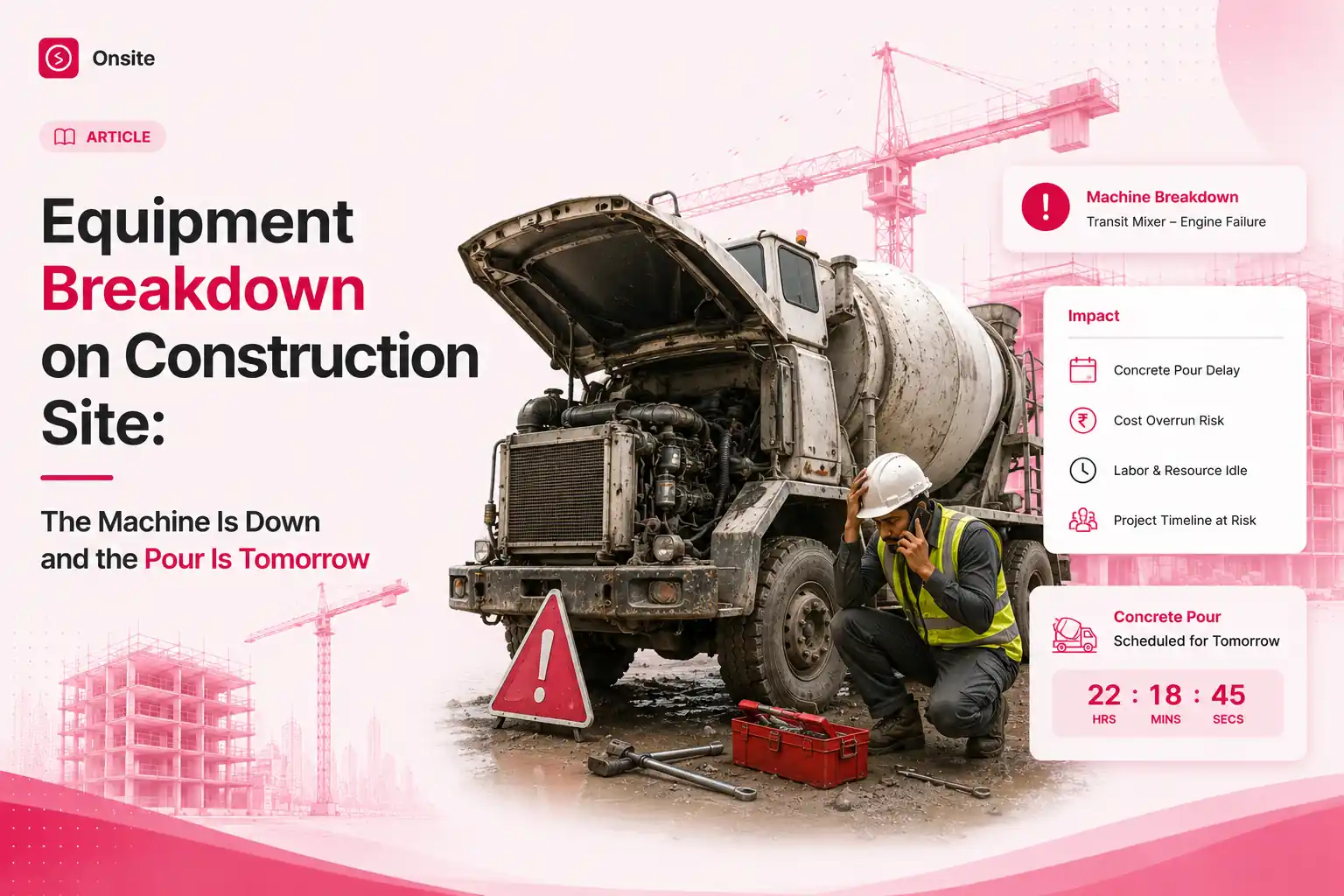
When a machine, plant, or mechanical tool stops working on a construction site, it is referred to as an equipment breakdown on construction site. Site progress depends on this equipment. It is different from material delays or labor shortages because when equipment breaks down, it immediately impacts the progress of a construction site. The cost is not just the repair, but also the loss of productive days. One piece of equipment breaks down, and the whole site stops working. The decisions made in the first four hours after a breakdown determine whether the project loses one day or five.
Why Equipment Breakdown Has an Outsized Impact on Construction Schedules
The Dependency Problem
Each equipment item at a construction site operates across multiple activity sequences. They are not just performing one task. They are enabling several tasks. When a concrete pump fails on pour day, the impact is on every activity that depends on that slab being placed. The reinforcement crew assembles for the pour. The next floor shuttering cannot begin until the slab is completed. The MEP team is already scheduled. The billing milestone is tied to the slab completion. One failure, and many activities are disrupted.
The Timing Problem
It is not necessary that every equipment breakdown causes the same impact. There may be a difference between a breakdown during a period of scheduled float and a breakdown during a critical path window. One situation may produce a manageable problem, while the other may last longer and cause a major impact. The majority of Indian construction sites do not track which equipment is critical on which days. This lack of management causes breakdowns to have a greater impact on the project schedule.
The First Four Hours After an Equipment Breakdown
Diagnose Before You React
During the first 30 minutes of a breakdown, there should be one question that can solve the problem: How long will this machine be out of service? Every other decision depends on that.
If it is repairable on-site within 2 to 4 hours, the pour can be delayed for half a day. The ready-mix order can be rescheduled to the afternoon. Labor can be held on-site with adjusted timing.
The repair can also take until tomorrow, which means the pour cannot happen today. So you can take actions like cancelling and rescheduling sequences immediately.
If the machine has to leave the site for repair, you should treat it as a 2 or 3-day outage at a minimum and begin sourcing a replacement.
The last option is that the machine is at the end of its serviceable life. This becomes a procurement decision under time pressure and may require bigger decision-making.
Map What Else Has Stopped
Once you analyze how long it will take for the equipment to get repaired or replaced, the second step is mapping every activity that is dependent on that equipment. This map will help you determine the full scope of the problem before the delay begins.
On the majority of sites, this mapping is done by a project manager or an engineer rather than by looking at a documented activity dependency report.
There are many activities that commonly stop when equipment fails. If a concrete pump fails, slab completion, subsequent floor activities, and the billing milestone tied to the slab are going to be affected. If a transit mixer breaks down, any concrete activity is going to stop. If a tower crane breaks down, any material movement to upper floors and material supply are going to stop.
This is how the mapping works. It shows how many activities are being affected by a particular equipment breakdown.
The Calls That Need to Happen in the First Hour
Once these 2 steps are done, there are 4 calls that need to be made immediately.
Ready-mix plant. If a concrete pour is scheduled, calling the batching plant is necessary, and it needs to be done as soon as possible because cancellation charges are lower if the decision is made immediately. There is no use waiting for the machine to get fixed before calling the batching plant and cancelling. It is only going to cost you more in cancellation fees.
Replacement equipment vendor. In many Indian cities, equipment hire vendors can mobilize a replacement pump, mixer, or generator within 3 to 6 hours with sufficient notice. A contractor who calls at 6 AM has a reasonable chance of getting a replacement by midday. A contractor who calls at 11 AM or 12 PM does not.
Redirecting the labor immediately. You do not want to pay 25 idle workers standing on site waiting for the equipment to get repaired. Redirecting them to ongoing activities helps save the cost that could have been lost because of this mishap.
Inform the client. It is better to communicate the issue before things get worse and before the milestone date passes. A contractor who is well informed about what is happening on site is far more patient than someone who knows nothing about the situation. If you tell the client or project manager later, it feels like an excuse rather than the actual problem.
The Costs That Appear After a Construction Site Equipment Breakdown
Idle Labour Cost
Because of the equipment failure, the workers have nothing to do. This is an immediate cash outflow that is not bringing any kind of progress on the construction site. If there are 25 workers gathered for a pour at Rs 700 per day each, these 25 laborers sitting idle for a full day can cost Rs 17,500 in losses.
If the breakdown is discovered mid-morning, the workers wait until midday before being released or redirected. So half a day is gone, and the labor has been sitting idle.
Across 3 or 4 equipment breakdowns per project on a typical Indian construction site, idle labor cost during breakdown periods becomes a significant and rarely tracked expense.
Ready-Mix Cancellation and Rejected Concrete
A ready-mix batching plant that dispatches transit mixers on a scheduled pour expects either to discharge the concrete or to be compensated for the batch if the pour is cancelled after dispatch. Cancellation terms vary by supplier, but the standard position in India is Mostly, there are no charges or only a nominal booking fee if the cancellation is done before dispatch. If it takes place after dispatch but before arrival, there may be a partial charge for the batch. However, if the concrete arrives on-site and is turned away, the full batch cost is payable. The money saved in this step depends on the speed of the decision-making.
Downstream Schedule Impact on Billing
The major financial loss faced during an equipment breakdown is rarely the repair cost or idle labor. It is the billing milestone that moves out of the current billing period. A slab may have been scheduled for completion in the third week of the month, but it is now delayed by a week. It breaks the billing cycle.
The RA bill for that month also carries fewer certified activities. The billing cycle gets delayed by 30 days. On bigger projects, for example, a Rs 2 crore project with a 45-day payment cycle, this can push Rs 12 lakh to Rs 18 lakh of billing into the next milestone period.
Hired Equipment Sitting Under Repair
Equipment that is rented continues to generate daily hire charges whether it is being used or not. A concrete pump on hire at Rs 4,000 per day might be sitting under repair for 3 days, but it is still generating Rs 12,000 in cost with no output.
In the case of hired equipment, there is rarely a chance of suspending hire charges during a breakdown period unless the equipment failure is attributed to a pre-existing defect at the time of hire and is documented immediately.
How to Reduce Equipment Breakdown Risk on Indian Construction Sites
Preventive Maintenance Before Critical Activities
The equipment never breaks down all of a sudden. The failure has usually been developing for some time, but the maintenance was ignored. There might be a pump that has not had its seal replaced in 6 months and fails during the pour. There can be a generator that has been running on low oil pressure for 3 straight weeks. There can be multiple reasons for equipment failure.
There are basic preventive maintenance schedules for each piece of equipment on-site. There should be oil and fuel checks before work starts each day. There should be filter replacement at the manufacturer-specified intervals. There should be electrical connection and safety checks weekly for generators and hoists. Hydraulic seal and line inspections should be done monthly for pumps and lifting equipment. And there should be a full service before any major activity takes place on the construction site, such as heavy lifting or extended operation. Many sites face equipment breakdowns on construction sites because they do not maintain a formal equipment maintenance log.
Pre-Activity Equipment Readiness Check
There are many critical activities that are dependent on specific machines. That particular machine should be inspected before it gets used. A pour that is scheduled for tomorrow morning deserves an equipment check a day before, not on the same day or in the morning. The equipment check takes barely 30 minutes, and it can save you from a whole day of inconvenience, losses, and a shift in the billing cycle.
Backup Plans for Equipment-Dependent Critical Activities
It is better to be prepared for the worst. And it is better to consider what the plan is if a particular machine is not available on the day it is needed. The answer should come before the activity even begins. There can be many answers to that. There can be a standby arrangement with a second equipment hire vendor who can mobilize within 4 hours. There can be a neighboring site with compatible equipment that is willing to share under an emergency arrangement. There can be a confirmed contract with the manufacturer’s service center with a guaranteed response time. There can also be an approved alternative method that can be activated within a few hours of preparation.
There are ways you can manage your equipment and get visibility into every single thing that is happening on a construction project. Construction management software like Onsite helps project managers track equipment deployment schedules alongside activity sequences so that the days when a specific machine is on the critical path become visible in advance. The software also gives advance warnings for maintenance checks. When that visibility does not exist, the backup plan gets made only after the machine has already broken down.
Conclusion
It always starts with one problem on a site, like an equipment breakdown, and every other problem builds gradually after that. Labor shortages appear over days, material delays become visible in procurement records before they reach the site, but a machine simply stops. The only warning that matters comes before the breakdown, in the form of deferred maintenance, skipped checks, and ignored early signs. A contractor who successfully handles an equipment breakdown and manages to keep the losses as low as possible succeeds in maintaining better cash inflow and the billing cycle.
Frequently Asked Questions About Equipment Breakdown on Construction Sites
What should a contractor do immediately after an equipment breakdown on a construction site?
The first step after an equipment breakdown on a construction site is getting a reliable diagnosis of how long the machine will be out of service. Every subsequent decision depends on that answer. Once the downtime estimate is clear, the contractor should map which activities have stopped and cancel or reschedule any time-sensitive deliveries — particularly ready-mix concrete orders — with as much notice as possible. Idle labour should be redirected to available activities rather than held on site at full cost. If the breakdown threatens a billing milestone, the client communication should happen immediately rather than after the milestone date passes.
How does equipment breakdown affect a scheduled concrete pour?
A concrete pump or mixer breakdown on pour day triggers a chain of consequences that extend well beyond the missed pour. Transit mixers dispatched from the batching plant must be cancelled immediately or the contractor pays for concrete that cannot be placed. Workers assembled for the pour cannot be productively deployed on short notice, generating idle labour cost. The slab that was not cast delays every activity that depended on it — next floor shuttering, MEP rough-in, finishing work on the floor below. If the pour was tied to a billing milestone in the current cycle, that milestone moves to the following period and the RA bill for the month carries one fewer certified activity.
What is the full financial cost of equipment breakdown on a construction site?
The financial cost of equipment breakdown on a construction site has four layers. The first is the direct repair or replacement cost. The second is idle labour cost for workers assembled for the cancelled activity who cannot be redirected. The third is any cancellation or batch charge from a ready-mix plant if a pour was scheduled. The fourth, and usually the largest, is the downstream billing impact when an activity that was tied to a milestone certification slips out of the current billing period. On a mid-size Indian construction project, a single critical equipment breakdown at the wrong point in the schedule can delay Rs 10 to Rs 20 lakh of certified billing by 30 days.
How can Indian contractors reduce equipment breakdown risk on active sites?
Equipment breakdown risk on Indian construction sites is reduced through three practices. The first is preventive maintenance at manufacturer-specified intervals rather than when something stops working. Most construction equipment breakdowns in India result from deferred servicing, not random mechanical failure. The second is a pre-activity equipment check before every critical operation that depends on a specific machine. The third is a documented backup plan for every machine that sits on the critical path — identifying in advance which alternative vendor, neighbouring site, or approved substitute method will be activated if the primary equipment fails. None of these require significant cost. They require the discipline to treat equipment readiness as a project risk rather than a logistics afterthought.
What backup arrangements should a contractor have for critical construction equipment?
A contractor whose project depends on a concrete pump, tower crane, hoist, or generator being available on specific days should have three backup arrangements confirmed before those critical days arrive. The first is a standby contact at a second equipment hire vendor who has confirmed availability and can mobilise within four hours. The second is a service centre contact at the manufacturer or authorised dealer with a confirmed emergency response time. The third is a documented alternative method for the critical activity — a crane with a concrete skip instead of a pump, for example — that can be activated on short notice. These arrangements cost nothing to set up and remove the most damaging aspect of equipment breakdown: the lack of an immediate alternative.
What happens to hired equipment charges during a breakdown period?
Hired construction equipment continues to generate daily hire charges during a breakdown period in almost all standard Indian hire agreements. The hire rate does not pause because the machine is not working. The exception is when the breakdown results from a defect that existed at the time of delivery — in which case the contractor has grounds to contest charges for the breakdown period, but only if the defect was documented at the time of delivery and a formal complaint was raised with the hire vendor immediately when the breakdown occurred. Contractors who accept equipment without a condition inspection at delivery have no documentation to support a charge dispute during a repair period.
