
Construction Daily Report: What Australian Site Supervisors Must Record to Protect the Project

A site supervisor at Brisbane receives a letter from a solicitor after the six months of a project reaching practical completion. The dispute was over lodged delay costs. The person is claiming liquidated damages for a period that the contractor believes was caused by a design change instructed by the superintendent. The solicitor demands the daily report of the site that covers relevant weeks. The supervisor is checking the records to provide, but there are some entries available and often days there are no entries. The missing entries include the most important days for this case. What actually happened at that moment was he gave instructions verbally rather than formally writing it down. This happened in the past, but today he does not have any evidence. You cannot provide a memory record to a solicitor in court. The contractor settles for less than the delay costs actually incurred because the records needed to substantiate the claim were never made. If at that moment there was a construction daily report, this problem wouldn’t have taken place. And even if it had taken place, there would have been a clear visibility and formal records of it.
Why the Daily Report Is More Than an Operations Tool?
It is understandable to site supervisors that a daily progress report is useful for tracking the activity that is taking place at site, but very few understand that it is one of the most important legal documents that a construction project can produce. In Australian construction, a daily progress report is one of the primary proof of the progress recording of a construction site. It is what adjudicators, arbitrators, and courts look at when they need to establish what actually happened on a specific day, week, or month.
The daily report is relevant in four specific legal and commercial contexts:
Delay claims and extension of time applications.
When a contractor asks for extension of time due to any delays, like variations in design or a weather hold, the daily report becomes evidence that this event occurred because of which the delay took place. Claiming the extension of time without any record to back it up becomes difficult for the future.
Liquidated damages disputes.
When liquidated damages are claimed for late completion, the contractors’ proof to defend himself becomes totally dependent on the availability of a proof that a particular delay was a compensable event rather than the contractor’s performance. Daily progress report is a document that proves that. It keeps the record of the date it started and the resources standing down or redirected.
Progress claim support under the Security of Payment Act.
A claim should come along with the proof of records that shows that the work was actually completed. Daily progress reports that help in maintaining visibility on activities performed, quantity achieved, and subcontractor on site. It helps in providing evidence to support the claim. If this documentation is missing, respondents can challenge the claimed amounts and the contractor may have limited chance of winning.
Variation disputes.
When a variation is agreed verbally and the subcontractor later bills for more than the client expected, the daily report entry recording the instruction, the date it was given, and the name of the person who gave it becomes the contemporaneous record that supports the contractor’s version of events.
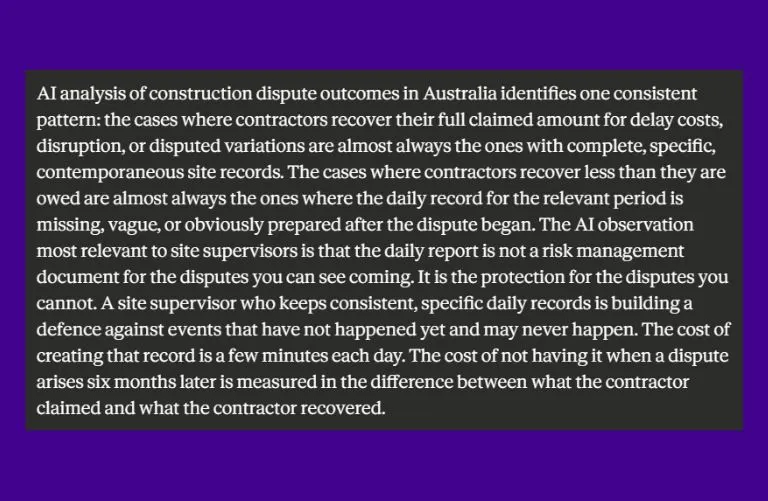
What AI Has to Say About Construction Daily Reports?
What a Construction Daily Report Must Contain?
There are a few things that should be compulsory in daily progress reports. All of these mentioned details can help you in upcoming disputes.
1. Date, project, and weather conditions
Every daily progress report must clearly mention the record of the date, the name of the project, and number, and weather conditions of that particular day. Weather is not just an administrative filler. Delay is because of weather as keys are issued in construction projects. Recording things like hot days versus heavy rain, site inaccessible, makes a huge difference and provides a lot of credibility.
2. Workers on site by trade and number
A daily progress report should contain the number of workers present at a site on a particular day, broken down by trade category and subcontractors. It helps in providing knowledge of the resource commitment to the project on that day, which directly relates to the productivity disputes. Other than that, it also creates a basis for identifying subcontractor-labeled claims at the time of billing.
3. Subcontractors present and their activities
A daily progress report should also mention the subcontractors that were present on-site and the tasks they performed. A small note like electricals on-site provides enough information. A detailed one would be more helpful. The level of detail strengthens the record and provides clearer evidence in case when a question arises about the progress, scope, or payment.
4. Work activities completed and quantities achieved
Record what was physically accomplished during the day in measurable terms. Not “formwork proceeded” but “eastern wall formwork completed, 48 linear metres, levels three to four.” Quantities matter because they connect the daily record to the progress claim. If the claim states that 1,200 linear metres of formwork were completed in the billing period, the daily records should add up to that number.
5. Plant and equipment on site
A DPR should contain the activity of plant items and pieces of equipment that were deployed that day, for what work they were used for, how much fuel they consumed, for how long they worked. This record is relevant to avoid cost disputes and to take productivity assessments.
6. Instructions received from the superintendent or project manager
Any instructions that are delivered by the superintendent or a client or a project manager should be recorded the day it was given. The better thing would be to record it the moment it was delivered. This record should contain the name of the person who gave the instruction, the content of the instruction, and the time it was received. This record turns verbal instruction into a useful document.
7. Delays, disruptions, and causes
When there is any kind of delay or any disruption in the plan of a construction project, the daily report should continue to record the cause, the duration, and the impact of delay on the project. It creates useful content for any kind of future inconvenience.
The Records Most Site Supervisors Skip
The majority of contractors are already aware of what a daily progress report should contain. The problem is not that. The problem is the lack of routine. The pressure at a construction site is so much that daily progress reports seem like a secondary task. Meanwhile, it is not.
Verbal instructions not written down on the same day.
A superintendent arrives at a site at 10 a.m. and just verbally instructs the variations on a particular task, for example, changing the window to reveal depth. The site supervisor listens to it and makes the changes. By the end of the day, there are multiple things that have taken place. This particular instruction that was given by the superintendent is not recorded in a daily report. Three weeks later, when the client asks a question why the reveals were built differently to the drawings, the only record a contractor has is the superintendent’s instruction that is in his memory, not in any formal record.
Weather records that are too vague to use.
Adjudication or arbitration does not accept the weather report if it is written too vaguely. For example, poor weather. This record needs to be specific. It needs to tell what the condition of weather actually was, how they prevented a specific activity, which activity was affected, and what the on-site decision was. A vague description like poor weather may be a record, but it does not stand firm.
Subcontractor headcount without activity description.
Yes, it is important to know how many people were on the site. But knowing if subcontractors, how many workers, and what those workers were doing, is important. It connects the daily record to billing disputes or a progress claim. The specific details make a huge difference between a record that can be used and a record that cannot be.
Delays recorded without a stated cause.
A delay should also not be too vague. A delay should always be recorded with its cause. For example, no pour today tells that this particular task did not happen. It does not tell why it did not happen and who was responsible for this delay or what the contractor did about it. All of these things are critical information and should be recorded properly.
Days left blank entirely.
Noting daily progress only when it seems necessary is never going to help. A construction daily report series with gaps creates an immediate problem in any dispute. The opposing party can question any time, can pick any day, and ask what happened on that day. The absence of record leaves you helpless. It shows that the records were not being kept consistently, which undermines the credibility of the days that were recorded.
How the Daily Report Connects to Progress Claims and Payment?
The construction daily report is the foundational document that supports a valid progress claim under Australia’s Security of Payment Act.
A respondent, while defending himself, disputes the quantities claimed in the payment schedule. The DPR becomes a major evidence. These records help in understanding that the work was completed and support the quantities that are mentioned in the progress claim. The only record that a respondent can show to the adjudicator is daily reports, and adjudicator typically looks for claimed quantities, relevant subcontractors’ work, and trade work, and whether the record of site progress matches the claim being made.
A daily report series that is complete, specific, and internally consistent is a meaningful asset in adjudication. One with gaps, vague descriptions, and missing subcontractor records is difficult to use even when the claimed work was genuinely completed.
The connection also runs in the other direction. When a contractor is facing a disputed variation or a delay claim, the daily records from the relevant period are the primary source of evidence for establishing what actually occurred. The daily report written the day the instruction was given, the day the delay started, and the day normal progress resumed is worth more in dispute resolution than any retrospective account.
What Makes a Daily Report Legally Defensible?
Contemporaneous record-keeping.
A daily report written on the day it covers is a contemporaneous record. However, a report made a week later on the basis of memory is reconstruction. The court treats both of them differently. The report written on the exact same date shows more credibility. The reconstruction is just a question of memory.
Specificity over generalisation.
What carries more evidential weight compared to the general one is the records that are specific in quantities, name, time, and descriptions. “Concrete poured today” is a vague description. However, if it was written like “concrete poured to the eastern slab, 87 cubic meters completed by 2 p.m.”, it would be more helpful.
Consistency across the record series.
What makes a DPR more credible during dispute is a DPR where each day has an entry, the reporting format is consistent, and the level of detail does not change dramatically between normal days and days where dispute arises. Consistent record-keeping makes the data more credible.
Photographs with embedded timestamps.
A daily report becomes way stronger automatically when it is accompanied by photographs taken on the same day with embedded timestamps and location data. The photograph is the ultimate proof of the condition of the site at the moment it was clicked. They establish a visible trust about the site on a specific date.
Construction management platforms like Onsite capture daily progress reports directly from site, with geo-tagged photographs that carry embedded timestamps and location data. Each DPR records date, weather, workers present, subcontractors and their activities, work completed by quantity, and instructions received, all in a structured digital record that is timestamped at the point of entry. When a project enters a dispute six months after completion, the daily record for every day of the project is retrievable, specific, and created on the day it covers. That is the standard that makes a daily report useful in the situations where it matters most.
The Daily Report Does Not Protect Against Problems That Have Already Occurred
A daily progress report only provides credibility and value when it is performed consistently from the very beginning of the project. Other than that, what is important is that the description of the tasks, just vague description is not enough for a contractor to protect the project claim. The strength of a daily report comes from being timely and consistent. It carries more weight when it’s descriptive and is kept every day. Site teams cannot predict which events will later become relevant to a variation, payment claim, extension of time request, or dispute. The only reliable approach is to document every day in the same way and complete the record before leaving the site.
Frequently Asked Questions About Construction Daily Reports in Australia
What is a construction daily report and why is it important?
A construction daily report is a contemporaneous record of site conditions, work completed, resources deployed, instructions received, and any events that affected the project on a given day. In Australian construction, it is one of the most important documents a project produces because it is the primary evidence base for delay claims, extension of time applications, progress claim support, and variation disputes. A daily report written on the day it covers is treated as a contemporaneous record by courts and adjudicators. A report compiled from memory days or weeks later is treated as a reconstruction and carries significantly less evidential weight. The daily report is useful as an operations tool and essential as a legal one.
What information must a construction daily report contain in Australia?
A complete construction daily report should record the date and project details, weather conditions and their impact on site activities, the number and trade category of workers present, which subcontractors were on site and what they were working on, work activities completed with measurable quantities, plant and equipment deployed and for what purpose, any instructions received from the superintendent or client representative with the name of the person who gave them, delays or disruptions with their causes and duration, visitors to the site, and any safety incidents or WHS observations. Each of these categories serves a specific legal or commercial purpose if the project enters a dispute. Leaving any of them out consistently creates an evidential gap that can weaken a claim or strengthen an opposing one.
How does a construction daily report support a progress claim under the Security of Payment Act?
Under Australia’s Security of Payment Act, a progress claim must be supported by documentation demonstrating that the claimed work was actually completed. When a respondent issues a payment schedule for less than the claimed amount and disputes specific quantities, the daily reports from the billing period are the primary evidence submitted to an adjudicator. A daily report series that records specific activities, measurable quantities, and the subcontractors who carried out the work provides an evidential basis for the claimed amounts. One that is vague, incomplete, or absent for some days in the billing period is difficult to use even when the work was genuinely completed. Adjudicators consistently note that documentation quality affects how much of a disputed claim can be awarded.
Why do verbal instructions need to be recorded in the daily report on the same day?
A verbal instruction from a superintendent or project manager that is not recorded on the day it is given has no contemporaneous record to support it. If the instruction later becomes the basis for a variation claim or an extension of time application, the contractor’s evidence is their memory of an event that the other party may dispute or deny. Recording the instruction in the daily report on the day it was given creates a contemporaneous record: the name of the person who gave the instruction, what it covered, and the date and time it was received. This record cannot be challenged on the grounds of faulty memory or post-dispute reconstruction because it was created before any dispute existed.
What makes a daily report legally defensible in a construction dispute?
The characteristics that make a daily report legally defensible are contemporaneous creation on the day it covers, specificity in describing activities, quantities, subcontractors, instructions, and delays, consistency in format and level of detail across every day in the project record, and accompanying photographs with embedded timestamps. A report that meets these standards is difficult to challenge because it was not created in response to a dispute and does not exhibit the characteristics of selective record-keeping. A report that was clearly completed later, that has unusually detailed entries for the disputed period surrounded by vague ones, or that lacks photographs to support its written descriptions is easier to discount in adjudication or arbitration.
Can a daily report with gaps be used in a construction dispute?
A daily report series with unexplained gaps is usable but weakened. The opposing party will ask what happened on the days without records. The absence of a record does not confirm that nothing significant occurred. It suggests that records were not kept consistently, which raises questions about the reliability of the days that were recorded. If the gaps happen to cover the days most relevant to the dispute, the credibility problem is compounded. A contractor whose record series has gaps in the contested period but detailed records immediately before and after it will face questions about why those specific days were not recorded. Consistent daily record-keeping eliminates this vulnerability entirely.
How should weather be recorded in a construction daily report to support a delay claim?
A weather record in a daily report that is useful for a delay claim must state the specific conditions, not just a general description. Recording “poor weather” does not tell an adjudicator what the conditions were, whether they prevented specific activities, or how the contractor responded. A useful weather record states the conditions observed, such as heavy rainfall commencing at 7am, which activities could not proceed as a result, when normal work resumed, and what was done in the interim. This level of specificity connects the weather event to the programme impact, which is the connection an adjudicator needs to assess an extension of time claim. A vague weather record can show that the day was acknowledged as difficult. It cannot demonstrate that a compensable delay event occurred.
