
Subcontractor Payment Australia: Why 57 Percent Are Charging Builders More

A contractor in Melbourne gets commercial fit-out tender in February. He contacts the subcontractor that has been in this business for almost four years now. In the present day, the cost is 11% more than what a subcontractor cost six months ago. Material prices have not shifted enough to explain it. The scope is similar and there is no gap in the construction project. The explanation that the subcontractor gives is that the previous two projects ran past 75 days before final payment was received. His agreed terms are 30. He is recovering that gap through the rate. However, the contractor does not find himself as a late payer. He is just trying to manage a payment cycle that is run according to the client. It was not the fault of the contractor, but the subcontractor decided to reach a different conclusion and price the next job around it. And this is one of the most common situations across Australian construction. The April 2026 data makes it measurable. Subcontractor payment Australia has increased way higher than before.
What the April 2026 Survey Found about Subcontractor Payment Australia?
There was a survey of 754 subcontractors across Australia and New Zealand by PayApps, which was published in April 2026. This survey concluded three discoveries that changed the perspective of viewing subcontractor payment in Australia.
The numbers break down as follows:
- 77 percent of subcontractors said a builder’s payment record shapes whether they bid on or price that builder’s future work
- 57 percent said they have already raised their rates or added a risk margin because of payment that arrived late or unpredictably
- 40 percent said they would accept a slightly lower amount in exchange for a confirmed early payment arrangement on approved claims
In a single picture, these figures show that late payment is no longer a bilateral cash flow problem between a builder and a subcontractor. It is a whole pricing mechanism.In the survey, more than half of the subcontractors already mentioned that there are payment uncertainties into their pricing. There is a larger risk of delayed payments. The payments are so delayed that 40% of the subcontractors are ready to accept lower prices in exchange for faster payments. It highlights the financial value of payment certainty.
What AI Has to Say About Late Subcontractor Payment in Australia
How Subcontractors Respond to Late Subcontractor Payment Australia?
Late subcontractor payment affects the relationship and future opportunities to work together. It is not only affecting the billing cycle, it is also affecting subcontractor’s behavior.
Rates go up on the next quote.
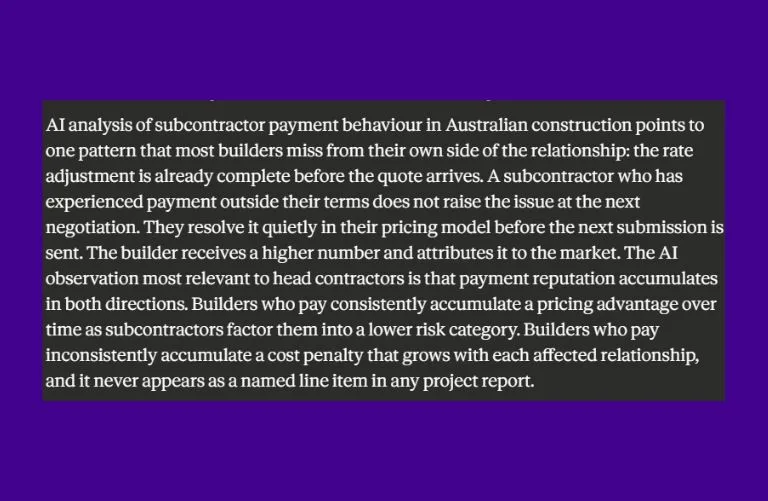
A subcontractor whose invoices sit unpaid for weeks beyond their agreed terms is effectively extending credit to the builder at no agreed interest rate. That cost is absorbed once, sometimes twice, before it gets recovered through the rate on the next submission. The builder sees a price increase. What they are actually seeing is a retrospective recovery of a cost their payment behaviour created.
Capacity goes to builders who pay on time.
When trades are busy, it is the subcontractor’s decision which project to provide the best crew first. Contractors that have a good consistent relationship with the subcontractor will get the first call on availability. Any contractor who has a history of delayed or disputed payments gets whatever the capacity is left. And this is the kind of a loss that a contractor can face because of delayed payments of subcontractors.
Scope offered per contract gets smaller.
One of the ways for subcontractors to manage payment risk is by reducing the size of the work order instead of raising rates. A smaller contract value is less on loss if the payment gets delayed. The head contractor sees quotes for narrower scopes would be needing more subcontractor packages to cover the same project, and for him, it will absorb additional coordination costs that comes with the management of more parties.
The Full Commercial Cost to the Builder
The majority of the contractors that are paying subcontractors late understand what it does to the relationship. The commercial cost is less often calculated explicitly.
Systematically higher rates across all trade packages.
In a project, if there are five subcontractors and each one adds a 5% risk allowance to their rate, that particular extra cost together is carried across every project the builder is delivering. On a AUD 3 million project where 60 percent of the value is subcontracted, the added cost across those trade packages can reach AUD 90,000. Any builder who has the history of providing payment on time faces this risk a lot, percentage way lesser, and he gets benefit from lower effective subcontractor costs.
A higher cost base at tender.
When the subcontractors are demanding the percentage of payment just, every tender starts from a higher cost base compared to the competitor who is known for paying on time. With time, it becomes a hard choice. A contractor can either accept low margins or submit higher prices. One helps with being competitive and the other helps with maintaining profitability. Neither of these outcomes are sustainable in the long term.
Schedule exposure when subbies prioritise elsewhere.
Subcontractors have multiple contacts and with multiple project options, they prioritize builders that they trust fully. So when the trade allocates their resources elsewhere and arrives late to the site, this impact is felt by the contractor. Any delay, even if it’s for a week on any critical activity, can affect the whole project, can trigger accelerations, costs, and increase exposure to liquidated damages. In most of the cases, the root causes are technical or operational. It begins with a payment relationship.
Why Late Payment Happens on the Builder’s Side?
The builders who promised to pay subcontractors and failed to deliver the payment on the decided time period are not deliberately doing it. The causes of it are structured and consistent across the industry.
Client payment cycles are longer than subcontractor terms.
If a builder is receiving the payment from the client in forty-five days, but he has promised the subcontractor a thirty-day payment term, the gap that is being faced is of fifteen days. In this situation, it is not the default of the contractor, but the default of structure. Looking at multiple projects and multiple trades, it is common that the crash pressure compounds. The subcontractor is receiving delayed payment, not because the money is being withheld, but because the builder has not even collected it yet.
Progress claims submitted after the reference date.
A builder submitting a progress claim weeks after the reference date makes the payment cycle delayed before the client has even reviewed the claim. Every single day delayed to submit pushes the entire payment chain further ahead. This is one of the most common yet controlled causes of delayed subcontractor payment, but somehow it’s often overlooked. If the preparation and submission of a claim is faster, it improves cash flow and makes possible the timely Subcontractor Payment Australia.
No live view of what is owed and when.
The problem occurs when there is no structure of monitoring the payments, when a construction business tracks subcontractor payment by the end of the month or through memory, they do not have any reliable way to manage subcontractor payments. Payments based on who called first or who was in the top of the mile of contractor works against the schedules. This ruins the subcontractor and contractor’s relationship.
Variations not formally approved before billing.
The bill faces problems in verification against the agreed scope when subcontractor Bill was instructed verbally, and it was not noted down formally. Payment is held while this matter is being resolved. The subcontractor has to wait. By the time the variation formally is approved, the bill is due for weeks, through no fault of either party.
What Builders Can Do to Improve Their Payment Record?
Any contractor who is always on time when it’s about payment or when it’s about catching an upcoming problem at a construction site, they are apt because of the consistency and visibility over their projects. They know what they owe and when the payment is to be made, and they have aligned their billing cycle to reduce the gap between client receipts and subcontractor due dates.
Submit progress claims on the earliest possible date each cycle.
One of the best practices performed by a builder or a contractor is to submit progress claims on the earliest possible date on each cycle. A builder who claims on the reference date rather than weeks later can achieve the compression of time between the work completed and money received. This single habit can actually reduce the structural gap between client payment and subcontractor due dates.
Track subcontractor payables against specific due dates, not against month-end.
Every subcontractor bill should carry a due date calculated from the agreed payment terms. The project manager and accounts team should see, at any point, which bills fall due this week and which are already past their date. Managing payables against a live schedule is different from reconciling them after the fact.
Issue formal work orders with measurable milestones before work starts.
A work order that has clearly mentioned the scope and quantities provides both parties a common reference whenever the billing is reviewed. This way, verification becomes easier, quicker, and disagreements are easy to get resolved. Any questions about the work completed or quantities can be checked right then and there rather than relying on the recollection, which consumes way more time.
Pay on a predictable date and communicate it.
A subcontractor can confidently schedule labor, supplier payments, and cash flow if they are aware that payment will arrive on the fifteenth of each month. Frequently, consistency is just as important as speed. Even if both builders stay within their contractual restrictions, a builder who pays on a regular basis reduces uncertainty compared to one who pays at different times. Predictability lessens the need to factor in payment risk and enables subcontractors to better manage their budgets and Subcontractor Payment Australia.
There are many construction management software like Onsite ERP available in the market that help in linking subcontractor work order to the milestone completion record. These platforms help in running approval workflow against each bill before it is processed. It gives visibility to the project and flags the upcoming payments or delayed payments. It helps in all active projects maintain consistency and make timely subcontractor payment. When the bill arrives, the milestone report is already in the system for verification.
Payment Behaviour Is Now a Cost Differentiator
The April 2026 Payapps survey draws a direct commercial line between how a builder pays and what they pay on the next project. A builder who pays reliably is accessing lower effective rates than a competitor with the same capability who pays later. That cost difference compounds across every project, every trade package, and every year
.
The 57 percent of subcontractors already adding a risk margin for late payment are not making an emotional decision. They are recovering a real cost. The only way for a builder to remove that cost from their pricing is to remove the behaviour that created it.
Payment reputation in Australian construction is now a measurable commercial input. The rate on the next quote reflects the payment record on the last job.
Frequently Asked Questions About Subcontractor Payment Australia
Why are subcontractors raising their rates for builders who pay late?
When invoices go unpaid beyond agreed terms, subcontractors carry the cost of operating without that cash. Most do not raise the issue directly with the builder. Instead, they adjust their rate on the next quote to recover the cost of payment uncertainty. A Payapps survey of 754 subcontractors published in April 2026 confirmed that 57 percent have already made this adjustment. The rate increase is not a negotiating position. It is a recovery of a cost the builder’s payment behaviour generated, built into the submission before the quote is even discussed.
How does payment behaviour affect subcontractor availability?
When a subcontractor has a choice of projects, they commit their best capacity to the builders who pay reliably. Builders with a history of disputed or delayed payments receive lower priority for scheduling and mobilisation. The same survey found that 77 percent of subcontractors factor a builder’s payment record into their bidding decisions. This means a builder with a poor payment reputation is effectively competing at a disadvantage for every trade package they put to market, before a single price comparison has been made.
What is the commercial cost to a builder when subcontractors add a risk margin?
If a builder’s core subcontractors have each added a five percent risk margin to their rates, the builder is paying that premium across every trade package on every project. On a three-million-dollar project with 60 percent of value in subcontracted work, the cumulative margin added across those packages is AUD 90,000. A builder with equivalent capability but a cleaner payment record does not pay that premium. Over time, the difference shows up as either thinner margins at the same price point or a less competitive tender price at the same margin target.
Why do Australian builders often pay subcontractors outside their agreed terms?
The most consistent causes are client payment cycles that are longer than the builder’s subcontractor terms, progress claims submitted late by the builder which delays the entire inflow cycle, no real-time visibility into which bills are due and when across all active projects, and variation disputes that hold payment on a bill while the scope disagreement is resolved. Most builders in this situation are not withholding money deliberately. They are operating without sufficient process to know exactly what they owe and when, and without a billing discipline that compresses the gap between client receipts and subcontractor due dates.
Can a builder withhold subcontractor payment while a variation is being disputed?
Under most Australian construction contracts, a builder may withhold a disputed amount provided they issue a payment schedule that identifies the specific items in dispute and the reasons for withholding. Undisputed amounts within the same claim are generally payable regardless of the dispute. Withholding an entire subcontractor bill because of a variation disagreement creates legal exposure under security of payment legislation. A subcontractor who receives no payment schedule within the required timeframe may be entitled to enforce the full claimed amount. Paying undisputed amounts promptly and managing disputed items separately is both the legally safer approach and the one least likely to damage the subcontractor relationship.
What is a payment schedule and how does it affect subcontractor payment?
A payment schedule is the formal document a head contractor must issue when they intend to pay less than a subcontractor’s full claimed amount. Under security of payment legislation, the schedule must be served within a defined timeframe — ten to fifteen business days depending on the state — and must state the amount to be paid along with specific reasons for any withheld portion. A defective schedule, or no schedule at all, can result in the subcontractor enforcing the full claim as a court judgment debt. Head contractors without a systematic process for reviewing and responding to subcontractor claims within the required window are carrying significant financial and legal exposure on every active project.
What practical steps reduce late subcontractor payment most effectively?
The steps with the most direct impact are submitting progress claims to clients on the reference date rather than weeks after it, tracking subcontractor payable due dates across all projects in a live schedule rather than a month-end reconciliation, issuing formal work orders with measurable milestones so bills can be verified promptly without dispute, and setting a consistent payment date that subcontractors can plan their own cash flow around. Each of these is a process change rather than a financial one. The builders who pay most reliably are not always the most liquid. They are the ones who have enough.
