
Construction Payroll Compliance: What Indian Law Requires Before the First Pay Cycle
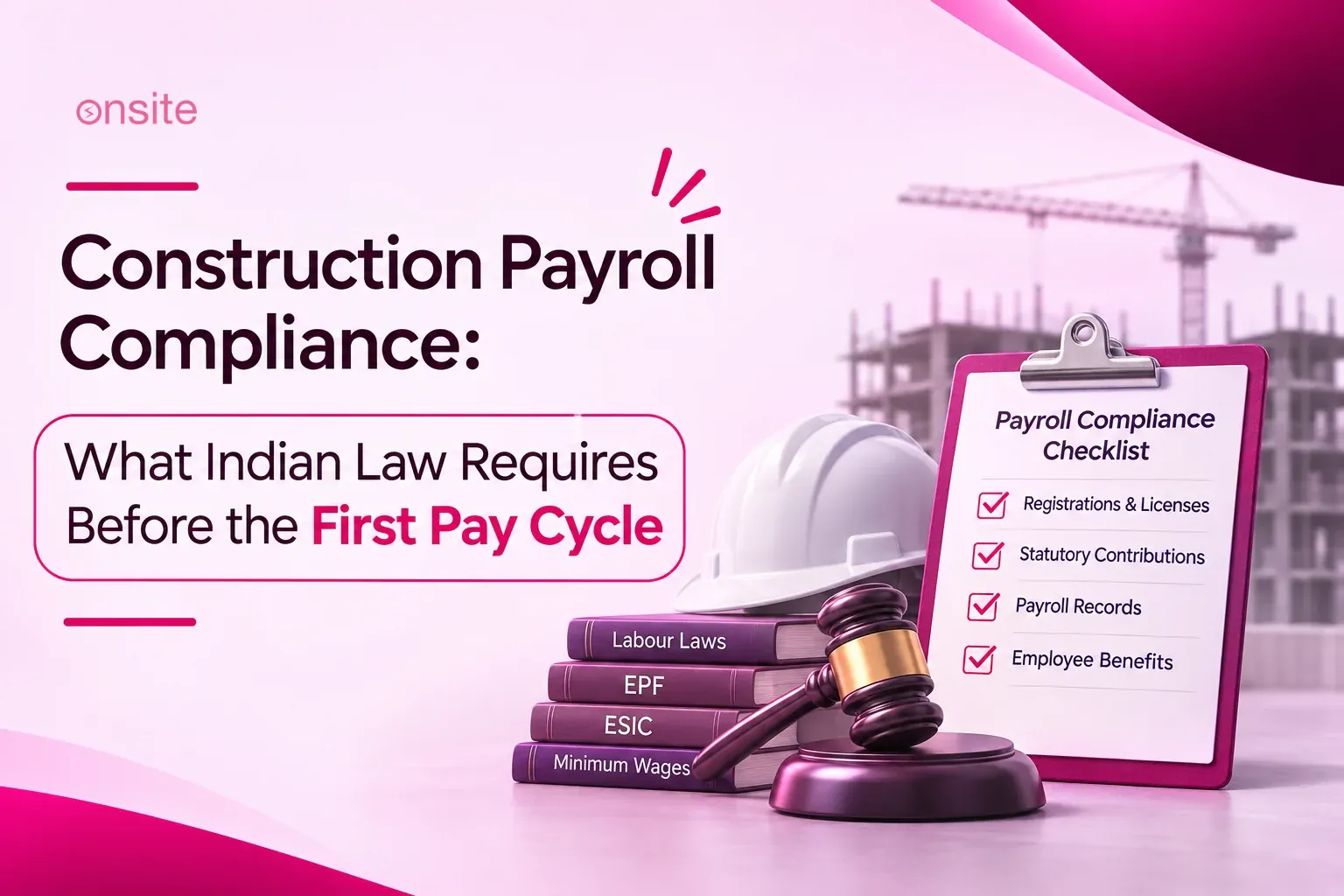
What is Construction Payroll Compliance?
Construction payroll compliance in India covers four statutory obligations: PF contributions when 20 or more workers are employed, ESI contributions when 10 or more workers earn up to Rs 21,000 per month, BOCW cess at one percent of construction cost, and state minimum wages. Each carries its own applicability threshold, monthly remittance deadline, and penalty for non-registration or delayed payment.
Construction payroll compliance contains four statutory obligations for contractors who employ workers. They need to meet these requirements: PF under the EPF Act, 1952; ESI under the ESI Act, 1948; BOCW cess on project cost under the Building and Other Construction Workers Act, 1996; and minimum wages under the Minimum Wages Act, 1948. Each of these obligations has a specific applicability threshold, a monthly remittance schedule, and a penalty structure for delayed registration, underpayment, or missed filings. In this article, we will cover what each obligation requires, which workers it covers, and why contractors who face arrear notices have almost always crossed the applicability threshold without registering.
What Construction Payroll Compliance Requires Under Indian Law
Construction payroll compliance in India involves four main laws. Each has its own worker thresholds, contribution rates, and payment deadlines, and several may apply to the same project.
1. Provident Fund (PF)
Under the Employees’ Provident Funds and Miscellaneous Provisions Act, 1952, PF applies when a contractor employs 20 or more workers on any day during the preceding 12 months. The employer contributes 12% of each worker’s basic wages plus dearness allowance. The worker contributes an equal 12%. The monthly PF payment is due by the 15th of the following month. Workers earning basic wages above Rs 15,000 per month may choose to limit their own contribution to that threshold. However, the employer’s contribution remains mandatory, regardless of whether the worker chooses this limit. Once a contractor crosses the 20-worker threshold, the PF obligation applies from the first month in which the threshold was reached, not from the date of registration.
2. Employees’ State Insurance (ESI)
Under the Employees’ State Insurance Act, 1948, ESI applies when 10 or more workers are employed and a worker earns up to Rs 21,000 per month. The employer contributes 3.25% of wages, while the worker contributes 0.75%. Workers earning above Rs 21,000 per month are exempt. Monthly contributions are due by the 15th of the following month. ESI provides covered workers with medical treatment, sickness benefits, maternity benefits, and disablement compensation. The contractor’s monthly contributions fund these benefits for eligible workers.
3. Building and Other Construction Workers (BOCW) cess
BOCW cess is charged at 1% of the cost of construction on projects valued above Rs 10 lakh. It must be paid to the state BOCW Board within 60 days of project commencement. Cess payment and establishment registration under the BOCW Act are separate obligations. Paying the cess does not replace registration, and registration does not remove the requirement to pay cess. Both obligations apply from the start of project mobilisation.
4. Minimum wages
The Minimum Wages Act, 1948, sets minimum wage rates for skilled, semi-skilled, and unskilled construction workers. State governments revise these rates through official notifications. Maharashtra, Karnataka, Delhi, and Tamil Nadu each publish their own rates. Paying workers below the applicable minimum wage is an offence, even if they have agreed in writing to accept a lower amount. Such consent does not provide a defence in a wage prosecution.
The Employees’ Provident Fund Organisation publishes current PF rates, employer registration requirements, and challan formats for construction establishments at epfindia.gov.in.
The Payroll Records Every Construction Contractor Must Maintain
There are a total of five record categories that constitute construction payroll compliance at the documentation level.
The first is the muster roll. It is a primary attendance record that contains each worker’s name, designation, wage category, days present, days absent, and gross wages for the period. The Minimum Wages Rules prescribe Form XII for establishments covered under the Act, while projects under the Contract Labour (Regulation and Abolition) Act, 1970, require Form XVI. Both formats require the signature or thumb impression of the worker employed at the site, confirming receipt of wages. If you are maintaining a digital record that captures the same fields and follows the same procedures, a printed record provided to workers at the point of payment satisfies the format requirement.
The second is PF and ESI challan records. These serve as proof that the contractor has remitted contributions for each month in which workers cross the applicable threshold. Every challan contains the wage amount, the number of contributing members, and the total amount remitted. During an EPFO or ESIC audit, the inspector compares the wage register, which establishes how much the contractor should have contributed, against the challan records, which establish how much the contractor actually remitted.
The BOCW cess payment receipt serves as proof of financial compliance under the Building and Other Construction Workers Act. A contractor is supposed to keep this receipt at the site from the date of the first payment and produce it on demand. The BOCW registration certificate and cess payment receipt are two separate documents, and both must be present simultaneously for a site to demonstrate full BOCW compliance.
The next is the advances and deductions register. For each advance paid to a worker, the agreed recovery schedule and the amount recovered in each wage cycle are recorded in the register. Without a signed deductions register, the contractor has no documented proof to justify wage deductions at payroll time. An undocumented deduction can become the basis for a wage board complaint.
And lastly, joint liability for labour contractors. Defaulting on this is one of the most consequential record-keeping failures in construction payroll compliance. If a main contractor engages a labour contractor to supply workers, the principal employer must collect Form XVI from the labour contractor each month and verify that PF and ESI contributions for those workers appear in the challans.
A contractor who records construction site expenses daily at the site also carries the advance payment data that feeds directly into the wage deduction register at the end of each wage cycle.
Why Construction Payroll Compliance Breaks Down Before an Inspector Arrives
There are three mechanisms that account for the gap between what Indian construction contractors must comply with and what their records show when an EPFO, ESIC, or labour inspector arrives.
The first mechanism is threshold blindness. Every construction project begins with a small team and ramps up its workforce through the execution phase. Any contractor mobilising 8 workers would be considered below both the ESI and PF thresholds. However, when the workforce reaches its peak phase at 25 workers, the contractor has crossed both thresholds but may not have registered under either scheme. The EPFO and ESIC calculate liability retroactively from the first month in which the applicable threshold was crossed. A contractor who registers in month 15 owes 14 months of contributions with interest, plus a penalty on the arrear. The registration date does not reset the liability period.
The second mechanism is the labour contractor gap. When a contractor engages a third-party labour contractor to supply workers, the principal employer remains jointly and severally liable for PF and ESI contributions if the labour contractor defaults. Most main contractors delegate wage processing and tally entries to the labour contractor. They do not even verify whether the labour contractor is registered with the EPFO or ESIC. When the labour contractor finishes the project and leaves, the EPFO or ESIC recovery notice arrives at the main contractor’s office. The labour contractor has failed to remit the contributions, so the main contractor has to pay for the labour contractor’s defaults.
The third mechanism is daily wage worker exclusion. When daily wage workers are involved in a project, Indian construction payroll practices often consider them outside the PF and ESI schemes on the basis that they are not permanent employees. However, EPFO enforcement and successive court rulings require workers who work continuously for 240 or more days in a year to be treated as employees under the EPF Act, making them eligible for the same PF coverage as monthly-paid workers.
The construction payroll management discipline that tracks attendance and wage calculations at the site level also produces the same headcount and wage data that determines whether a statutory threshold has been crossed each month.
How Accurate Attendance Records Protect Construction Payroll Compliance
PF and ESI contributions are calculated using wages, and wage calculations depend on daily attendance. If attendance records show fewer workers than were actually employed, the contribution may be lower than the amount due. If they show more workers, the contractor may end up claiming a refund that EPFO will examine closely. Accurate daily attendance is therefore not just an operational requirement. It forms the basis of a reliable statutory contribution record.
GPS-verified attendance helps contractors track the daily workforce and identify when the number of workers crosses a statutory threshold. For example, a site with 18 direct workers is below the PF threshold. If a labour contractor adds four more workers, the total reaches 22, bringing the site within the PF threshold.
Without daily headcount records that include all workers, regardless of their employment arrangement, the contractor may miss the point at which PF obligations begin and discover the issue only after receiving an EPFO notice.
Digital muster rolls use daily attendance entries to prepare records in the format expected by Labour Inspectors and EPFO auditors. These include the worker’s name, designation, wage category, days worked, days absent, and gross wages for the period.
When muster rolls are generated directly from daily attendance, the wage register reflects actual site records instead of figures that someone has to reconstruct from memory at the end of the month.
Wage advance tracking also depends on the same attendance and worker records. When a worker takes an advance during the second week of the month, the amount can be recorded against that worker and reflected in the wage register for the same period, before the final wage calculation.
Construction management platforms such as Onsite bring GPS attendance, worker wage categories, advance tracking, and contribution summaries into one system. This allows the records used to calculate PF and ESI contributions to build up daily, rather than being assembled under pressure before the monthly payroll run.
What Contractors Gain When Payroll Compliance Records Stay Current
A contractor who registers under PF and ESI at the correct threshold and remits contributions on time does not face retroactive liability. That is the foundation of construction payroll compliance: the obligation begins when the threshold is crossed, and registration at the same point prevents the gap from accumulating into an arrear.
Three things change specifically. EPFO and ESIC audits resolve without arrear notices because every contribution challan matches the wage register that produced it, month by month. Joint liability risk from labour contractor defaults reduces because the main contractor holds verified contribution challans for all supplied workers in every payment period, demonstrating due diligence before the EPFO or ESIC officer. Worker disputes at the wage board fall because the deduction register carries a signed record of every advance and recovery, leaving no unresolved balance for a worker to contest.
Onsite brings daily attendance, worker wage categories, advance tracking, and contribution summaries into a single project record so payroll compliance builds month by month rather than gets reconstructed when an Inspector requests it.
