
Construction Management Reports: What to Review and When
Construction management reports are structured summaries of everything that has taken place in a project that can help decision-makers, like owners, project managers, or site teams, understand where the project stands currently and in the future. It helps in identifying the problems and determining what action is required. The AACE International Total Cost Management Framework declares that reporting of project controls should help in translating raw project data into information that can be useful for future decisions in construction management, rather than simply being a record of what has occurred. A report that helps in describing the past without indicating what should happen next in the documentation is useless. A report that provides detailed actions, is exception-focused, assigns an owner, and identifies a required action is a genuine management tool.
Which Construction Management Reports Should a Contractor Review?
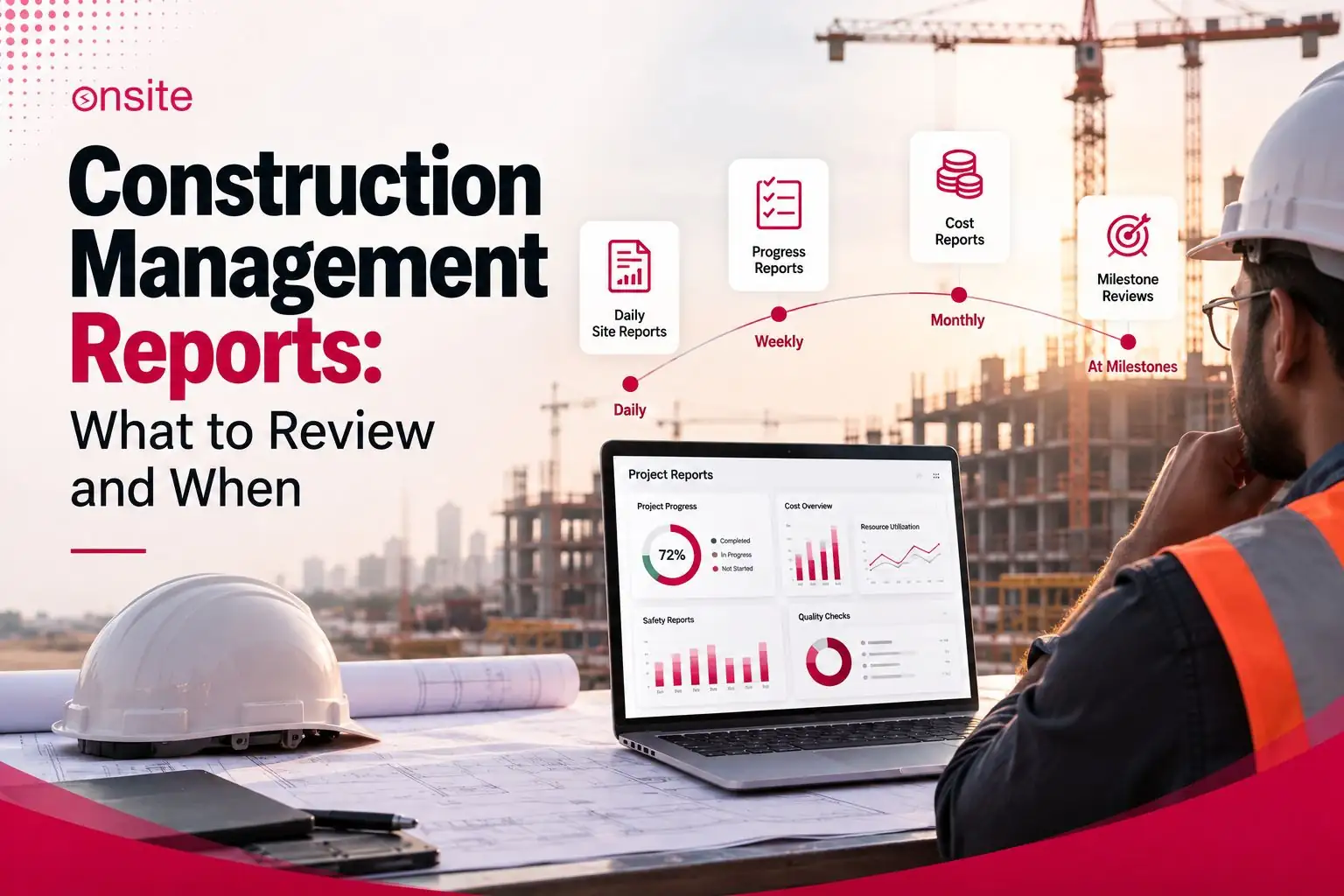
A contractor should review daily, weekly, and monthly reports that are addressing different questions. Daily reports help in addressing what needs immediate attention. Weekly reports help in addressing whether the project is on the right path. Monthly reports help in addressing whether the project remains financially and operationally healthy. Different decisions require different information at different intervals.
A Construction Management Report Is Only Useful If It Changes a Decision
A project owner may receive multiple reports, like a daily progress report, a financial summary, a procurement update, and a weekly progress report, but he will still think twice or wouldn’t even know the answer to these 4 questions:
Which project needs attention right now?
Why has this activity slipped?
What is waiting for an approval decision?
Which costs are moving unexpectedly?
The problem does not occur when there is no accuracy in the report. The reports contain information, but do not surface it. The owner has to connect the data to find what is actually taking place. It takes manual work and time.
This is one of the major problems with construction reporting as the business gradually grows. The volume might be increasing, but there is no clarity in management. Just bringing out more and more reports does not mean better management.
The question is not how many reports a construction company produces. It is whether every report connects to each other, reaches the right person at the right time, and contains the information that allows future decisions to be made accurately.
Why Construction Companies End Up With Too Many Reports
A reporting system is not made difficult purposely. It is a gradual process. Reports multiply with time, and then it gets out of hand.
The site team might be producing DPRs because progress needs to be recorded. On the other hand, the planning team is producing schedule updates. Procurement teams are flagging material shortages. The finance team is producing customised reports. The commercial team might be updating bills. Management asks for a portfolio summary because individual project reports do not give a business-wide view.
Each report is generated on the basis of a particular project and for a legitimate reason. The only problem here is that nobody is defining what management actually needs to know and what it does not know. No report is connected to each other, and they are only accumulating without any corresponding reduction elsewhere.
The result is that there is more information available to management, but there is no clarity. So the answer is not to produce fewer reports automatically. It is to define what each report is for before deciding whether it should exist.
Every Construction Management Report Needs a Job
Before a report is even created and then reviewed or retained for future use in a reporting cycle, 4 questions should be asked about it.
Who reads it, and at what level of seniority? There is a huge difference between a report that was designed for a site engineer and a report that is designed for the business owner, and they should contain different information even when they describe the same object. The decision-making role of the reader decides what the report needs to say.
How often do they need this information? A site engineer may just need to know the current activity status. However, a business owner needs to know monthly financial performance. There is no point in sending daily site data to the business owner and a monthly financial summary to the site engineer.
What specific decision does the report support? Every report should be traceable to a decision. If the report informs no decision, it should be questioned.
What happens when a figure is outside the expected range? It should contain who is responsible for investigating, what actions are required, and by what time the decision needs to be made.
Daily Construction Management Reports: What Needs Attention Today
This section is not about how to write a daily progress report. The DPR Best Practices article covers how daily records should be captured, measured, and verified. This section addresses how management uses that information after capture.
This daily construction management report fulfills the single purpose of identifying what is required or needs action before the work on the site continues.
The daily construction management report contains a daily review of critical activities, normal activities, and activities at risk of not being completed on the day they were planned. It also includes major exceptions from the previous day’s plan, immediate resource constraints that are blocking current work, approvals or decisions required, material risks that can affect activities, and any other issue that has escalated beyond what the site team can resolve independently.
A daily progress report that is taking more than 15 minutes to be generated is using the wrong data source. If information requires manual compilation across multiple systems, the reporting process has a fault.
Weekly Construction Management Reports: Is the Project Moving as Planned
Weekly reports help in identifying trends and deviations instead of daily events. While a daily report has already formed a pattern to reveal a trend, the weekly report brings a conclusion so that an action can be taken immediately.
The questions that a weekly report answers are different from those of daily reports. A weekly report answers questions like: Has actual progress matched the planned program? Have any critical path activities moved? Are cost categories showing early movement above plan? Are procurement risks affecting the next 2 to 3 weeks? Which subcontractors are below planned output? A weekly report brings something midway between what a daily report forms and what a monthly report may surface too late.
Monthly Construction Management Reports: Is the Project Financially and Operationally Healthy
The monthly report might be the least useful document for managing day-to-day execution, but it is one of the most important documents for understanding whether the project remains commercially viable. It serves a different purpose from daily and weekly reporting. The monthly report brings out the financial and strategic condition of a project and answers questions that are related to finance and strategy.
What is the cost position against the budget, and what does it imply for cost to complete? Where have major cost movements occurred, and why? What is the billing and collection position against the payment plan? And so on.
If there is no daily or weekly reporting, then everything may be revealed in the monthly reporting, and it might be too late before you can take action. But if it is about a cause or deviation becoming visible to management, it is one of the best documents.
There might be things that sometimes the weekly and daily reporting cycles fail to escalate when they should have. Monthly reporting just confirms and contextualizes what other reports failed to.
What the Site Engineer, the Project Manager, and the Owner Each Need to See
The major problem is not that reporting is incorrect in construction businesses, but that the same report is being sent to 3 people who are supposed to make different decisions and have different responsibilities. Those reports are useful to none of them because they were designed for none of them.
An assigned engineer receiving a financial summary has no use for it, and a business owner receiving a daily site activity log cannot make decisions on the basis of that. A project manager receiving the same format as a site engineer does not get the deviation analysis they need.
| Information Type | Site Engineer | Project Manager | Owner or Director |
|---|---|---|---|
| Primary question | What do I need to do today? | Is the project moving as planned? | Which project needs attention? |
| Focus | Today’s activities and materials | Deviations and schedule movement | Financial health and major risks |
| Exceptions | Site-level problems | Project-level deviations | Business-level decisions required |
| Time horizon | Today and tomorrow | This week and next | This month and the next quarter |
| Action required | Execute and report | Investigate and redirect | Decide and authorise |
A Report Should Highlight Exceptions, Not Make Management Search for Them
A report that states that 75% of the activity was completed this week is just a statement that the work is happening. It is not the type of information that can lead to decision-making or tell whether the project is in loss or profit.
A report identifying 4 activities that deviated from the plan gives the project manager everything they need to act, like specifying what happened, why it happened, the impact on the program and budget, who is responsible, and what must happen before the end of this week. One report is just a report, and the other works as a management input.
AACE International specifically wants a report to avoid becoming just a long and data-heavy document without any information that holds value for management. The volume of data in a report is not a measure of its quality. The clarity with which exceptions are surfaced is. This applies to every report, whether it is a daily report, weekly report, or monthly report.
What Makes a Construction Management Report Reliable
There are four separate principles that separate a management report from one that is technically produced but does not support strong decision-making.
Current: The information on the report should present the project’s position at the time the reader is going through it. A month-end report, looked at mid-month, will give you data that is already two weeks old. Management should make timely decisions if the data is good enough to work on.
Consistent: The same definitions, units and formats should be used across projects and reporting periods. Different site teams may define “percent complete” differently. The same cost category may also be labelled differently across two projects. In such cases, reports from different sites cannot be compared. This makes it impossible to get a proper portfolio view.
Traceable: The reader should be able to identify where every figure came from. This could be a DPR entry, purchase order or attendance record. If a figure cannot be traced to its source, it cannot be verified. An unverifiable figure cannot be used for decision-making with confidence.
Actionable: The report should clearly show what action is required when a figure falls outside the expected range. It should identify which role needs to investigate. It should also show what action is required and by when. A number that has changed without a named owner and a required response date is only an observation. It becomes a management input when the required action is clearly defined.
AACE International emphasises that an effective project-control report should have analysis, conclusions and recommendations, rather than only presenting data. Data only tells management what has happened. The analysis, conclusions and recommendations should clearly explain what needs to happen next.
The Difference Between a Report and a Management Control
A report tells management what happened on a project during a defined period.
A management control uses that report as a starting point for answering four further questions: what changed from the plan, why it changed, what it may affect downstream, and what action is required before the next reporting period.
AACE International states directly that reporting alone is not control. Analysis is required to understand why an event occurred and to determine the appropriate corrective action. A construction company that produces accurate reports but does not analyse their content and assign corrective actions to named owners is using reporting as a documentation function rather than as a management tool.
This distinction explains why two construction companies producing the same volume of reporting reach different outcomes. One treats reports as records that confirm work is proceeding. The other treats reports as the starting point for a structured review of what the data means and what the response should be before the next cycle.
The reporting framework described in this article is only valuable if it feeds a management process. Reports that are produced, reviewed, and filed without generating a defined response to deviations are not management reports. They are archives.
Five Reports That Should Trigger a Management Conversation
Instead of generating multiple reports, there are 5 categories that directly help management conversations when their signals move.
Scheduled Deviation Report. A scheduled deviation report helps in revealing what activity has slipped away from the plan and by how much. It helps in questioning whether the recovery can be done within the current plan or whether the whole plan needs to be revised.
Cost Deviation Report. This report helps in categorizing costs that are running above or below the plan. It asks the question of whether it is a market movement, procurement decision, or site execution issue that has caused the cost deviation. Through this, it also helps understand how much remaining scope can be affected.
Material Risk Report. This report gives visibility over which materials have not yet been delivered or have not been confirmed for delivery. It helps in questioning whether there is time to resolve the supply risk without stopping or affecting anything on-site. If not, which activities need resequencing?
Subcontractor Performance Report. It helps in revealing whether subcontractors are consistently below the planned output or aligned with the planned output. It helps in questioning whether this is a resource issue the subcontractor can resolve, a scope issue, or a contractual issue requiring formal notice.
Pending Decision and Approval Report. This report helps in identifying decisions that are blocking work and how long they have been outstanding. It triggers the question: Who has the authority to unlock this, and what is the cost of another week without resolution?
Daily vs Weekly vs Monthly Construction Reporting
| Frequency | Main Question | What to Focus On |
|---|---|---|
| Daily | What needs attention today? | Exceptions, blockers, and immediate actions |
| Weekly | Is the project moving as planned? | Trends, deviations, and upcoming constraints |
| Monthly | Is the project financially and operationally healthy? | Cost position, commercial issues, risks, and outlook |
| Portfolio | Where should management intervene? | Project comparison, risks, and business priorities |
How to Build a Construction Management Reporting Framework
There are a total of 7 parameters that should be defined for every report a construction company produces.
Audience. Who receives it and in what role.
Frequency. How often it is issued: daily, weekly, or monthly.
Main question. The specific management question it answers.
Data required. Where the figures come from and who enters them.
Exception criteria. The threshold at which a figure triggers escalation.
Responsible owner. Who investigates when an exception is flagged.
Required action. What must happen, and by when.
A report without all 7 parameters defined is likely to be produced regularly without consistently generating a management response.
| Report | Audience | Frequency | Main Question | Action When Off-Track |
|---|---|---|---|---|
| Daily exception report | PM and Owner | Daily | What needs attention today? | Assign owner and resolution date |
| Schedule deviation report | Project Manager | Weekly | Are milestones moving? | Recovery action or programme revision |
| Cost deviation report | Finance and Owner | Monthly | Where is cost moving? | Investigate and assign cause |
| Material risk report | PM and Procurement | Weekly | Could material availability affect work? | Escalate to procurement |
| Subcontractor performance report | Project Manager | Weekly | Is subcontractor output on track? | Commercial or operational intervention |
| Portfolio summary report | Owner and Directors | Monthly | Which project needs management attention? | Management decision and resource deployment |
Construction Management Reporting Checklist
The following checklist covers the conditions that should be satisfied for a construction reporting framework to function as a management tool rather than a documentation process.
☐ Every report has a defined audience and a defined frequency that matches the decision it supports
☐ Every KPI in every report has a consistent definition used across all projects without variation
☐ Exceptions are clearly highlighted rather than embedded within general data that requires management to search for them
☐ Every figure in every report can be traced to its source data — the entry, the person, and the date
☐ Reports are issued while the information is still current enough to influence a decision
☐ Every significant deviation has a named owner and a required action with a specific deadline
☐ Corrective actions assigned in the previous reporting period are reviewed at the opening of the next
☐ Historical reports are stored in a traceable and retrievable format for audit, dispute, and project review purposes
☐ Reports that no team member consistently acts on are removed from the reporting cycle rather than continued out of habit
☐ The reporting framework itself is reviewed when project scale, complexity, or team structure changes significantly
Conclusion
A construction company does not become successful by producing more and more construction management reports. It becomes better with informed actions and decisions received by the right person at the point when those decisions can still change an outcome.
This framework is a management discipline, not a technology decision. A report should serve a purpose for a particular person so that they can do better in the project that is ongoing. It matters to define what each report is for, who it is for, and what response it produces. Bringing clarity to the project is what a report should do. It is also necessary to make sure that a report is reaching the right person.
Platforms like Onsite help in connecting the data that site teams enter daily: DPR entries, material receipts, attendance records, and subcontractor progress, to the management reports that owners and project managers can review. On the basis of the activities and tasks that are taking place currently at the site, Onsite helps in creating the reports automatically without any manual work, which saves time and avoids errors.
FAQs
What are construction management reports
Construction management reports are structured summaries of project data that help project owners, managers, and site teams understand current performance, identify exceptions, and determine what action is required. They differ from operational records — daily registers, attendance sheets, purchase orders — in that their specific purpose is to translate raw project data into a management decision rather than simply storing it. A report that describes what happened without indicating what should happen next is documentation. A report that surfaces an exception, names a responsible person, and specifies a required action with a deadline is a management tool.
What reports should a construction company review daily
Daily construction management review should focus exclusively on exceptions — information that requires a response before work on site continues. This includes critical activities that could not be completed as planned, resource constraints blocking current work, approvals or decisions required before the next shift begins, material risks affecting tomorrow’s activities, and any issue that has escalated beyond what the site team can resolve independently. A daily management review that covers every activity completed rather than only the exceptions is a site record being used as a management report. These are different documents with different purposes.
What should be included in a weekly construction report
A weekly construction management report should address programme movement, cost trends, and upcoming constraints. This covers progress against the planned programme for the week, schedule movement on critical-path activities, emerging cost movement in active cost categories, procurement risks affecting the next two to three weeks of work, subcontractor output against planned quantities, unresolved issues carried forward from the previous week, and upcoming constraints requiring advance action before they affect the programme. Weekly reporting reveals patterns that daily reporting cannot and monthly reporting identifies too late — particularly in labour productivity, subcontractor performance, and material risk.
What should a monthly construction management report contain
A monthly construction management report should address the project’s financial and commercial position: the current cost against budget and its implication for the cost to complete, major cost movements and their causes, billing and collections status against the payment plan, project profitability indicators at the current stage of execution, significant commercial issues including unresolved variations or claims, major risks for the next period, and decisions required before the next monthly review. Monthly reporting confirms and contextualises what the weekly reporting cycle has been tracking, and places individual project performance in the context of the business as a whole.
What is a construction MIS report
A Management Information System report in construction is a consolidated summary of project performance across multiple dimensions — cost, progress, procurement, labour, and commercial position — presented in a single document for senior management review. The purpose of a construction MIS report is to give the owner or director a business-level view of every active project without requiring them to read individual project reports. An effective MIS report surfaces the projects requiring management intervention, the financial exposure across the portfolio, and the decisions that require authorisation at the management level rather than at the project level.
Who should receive construction management reports
Each report should have one defined audience determined by the decision the report supports. Site engineers need daily activity and resource information. Project managers need weekly programme and cost deviation summaries. Business owners or directors need monthly financial, commercial, and portfolio information. Sending the same report to all three roles produces a document that is useful to none of them. The most consistently useful change a construction business can make to its reporting process is to define the specific audience and the specific decision for each report before deciding what the report should contain.
How often should construction reports be reviewed
Report frequency should match the speed at which the information changes and the point at which management can still influence the outcome. Daily reporting covers what requires a same-day or next-day response. Weekly reporting covers programme and cost trends where a one-week response window is sufficient for corrective action. Monthly reporting covers financial and commercial position where decisions operate on a longer planning cycle. Reviewed too infrequently, deviations compound before they are caught. Reviewed too frequently, management time is consumed by data that has not yet formed a meaningful pattern worth acting on.
What makes a construction management report useful
A construction management report is useful when it reaches the right person at the right frequency with the right level of detail to support a specific decision. AACE International identifies four qualities of effective project-controls reporting: the information should be current at the point of use, consistent across all active projects, traceable to its source data entry, and actionable — meaning the required response to an exception is clearly indicated. A report satisfying all four qualities gives the reader what they need to decide. One satisfying fewer requires additional work before it becomes useful.
What is the difference between a DPR and a management report
A Daily Progress Report is an operational record — it captures what work was completed on a specific day, by which crew, against which activity, and in what quantity. A management report uses information accumulated across DPR entries — and across material, labour, and cost records — to identify trends, deviations, and required actions at the project or business level. The DPR is the input. The management report is the output of analysis applied to multiple inputs. Sending a DPR to a business owner is sending a raw input where an analysed output is needed.
