
Scaling Construction Business in India: Rs 2 Crore Is Not Rs 50 Lakh Times Four
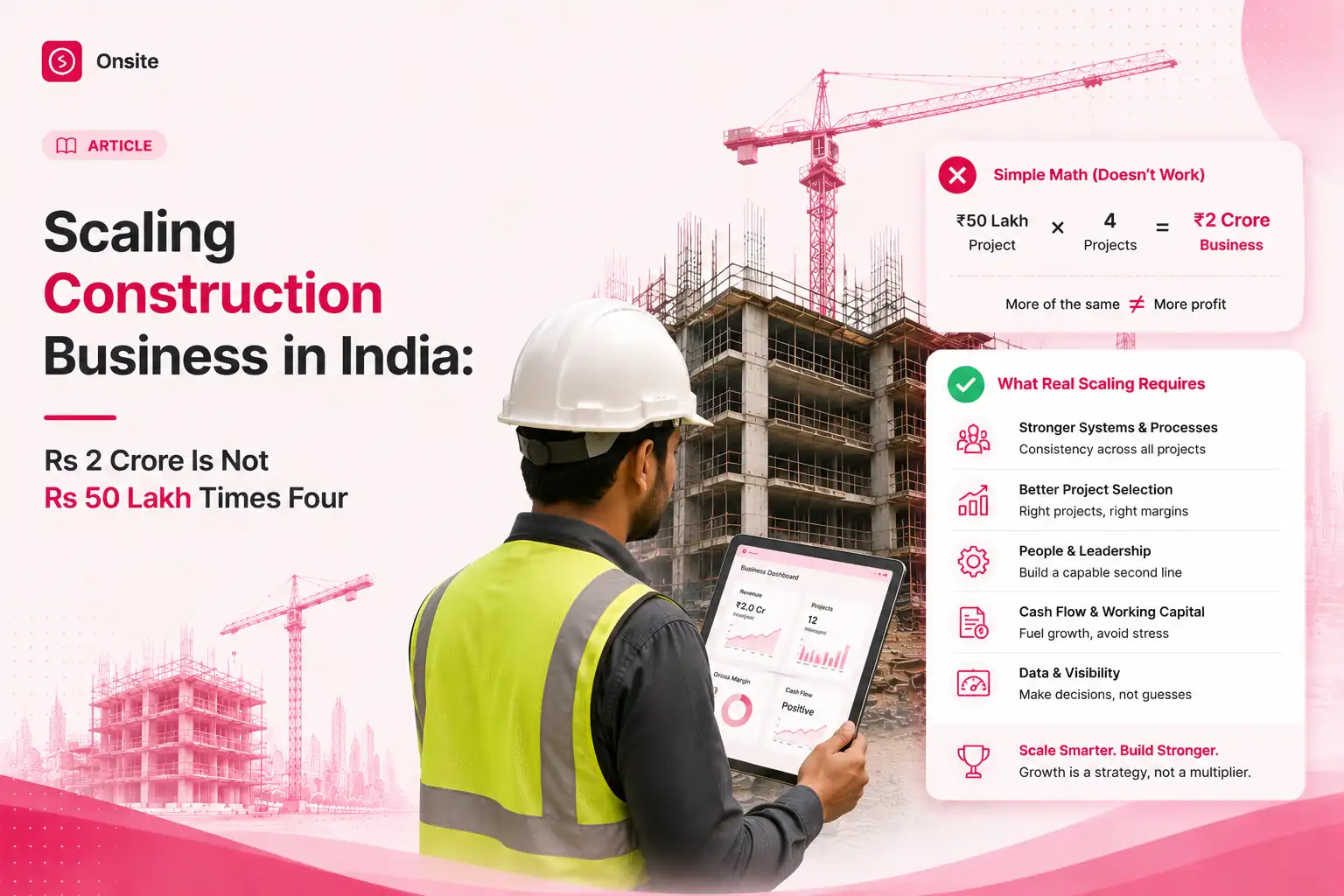
Scaling construction business in India refers to an MSME or mid-size contractor moving beyond their established project range into projects significantly larger than what their current systems were built to manage. At this transition, cash flow cycles, team structures, vendor credit terms, and site supervision models all change in ways that proportional thinking does not account for. Most contractors who struggle at scale do not lack skill. They lack systems designed for a different operational category.
A civil contractor in Pune invested seven years on projects between Rs 30 Lakh and Rs 60 Lakh. He knew each vendor by their names, knew how much advance to ask for and knew how long each array bill cycle took. His systems were informal, but they worked perfectly. In February, he signed a rupees two point one crore commercial building contract. By the time it was April, his supervisor was managing six concurrent activities and missing two of them every week. Tally entries were eight weeks behind. Three vendors had stopped supplies over delayed payments. His labour contractor could not provide more than 20 workers when the site needed 55. Nothing had gone catastrophically wrong. Each problem looked manageable on its own. But they all arrived simultaneously because he gave a bigger project the same systems as a smaller one. Scaling construction business in India does not fail because contractors lack skill. It fails because they assume a bigger number needs the same approach with more effort.
What Indian Contractors Get Wrong About Scaling Construction Business in India
The Proportional Thinking Trap
Many construction projects run on the assumption it is pre assumed by a contractor or a business owner that a larger project means everything scales proportionally. If there are ten workers that are managing a Rs 50 Lakh Project, then there will be forty workers that will handle Rs 2 crore projects. If a smaller site is handled by two supervisors, the larger site will be handled by four supervisors. If bills came in every forty-five days on a small project, they will come in every forty-five days on the larger one too. This is assumed proportional logic in the majority of Indian MSME contractors, and it goes wrong every single time. Project complexity does not scale linearly with project size. It is not necessary that a Rs 2 Crore project carry four times the complexity of a Rs 50 lakh project. It can carry eight to ten times the complexity. because everything multiplied together rather than simply adding together. For example, the number of concurrent activities will multiply. Same goes for vendor relationships or number of subcontractor interfaces.
Where the First Cracks Appear
On a Rs 50 lakh residential project, a contractor has to run three to four concurrent activities. Meanwhile, a Rs 2 crore commercial project runs almost sixteen to eighteen concurrent activities. Each of the activities has its own requirements of material, labor, quality checkpoints, and billing milestones. The site supervisor who managed four activities, may not be able to manage eighteen altogether. Any informal tracking system that worked with four activities can completely shatter under eighteen.
A contractor might have the experience of seven years of managing smaller projects, but any kind of experience can fail to perform in a larger one. It becomes a liability and the very first visible crack appears in three things, cash flow, site supervision, and vendor credit.
Cash flow: Before the contractor even knows, the modernization advance disappears. Because the costs do not scale at the same rate as the advance percentage.
Site supervision: In a smaller project, a supervisor used to report the contractor directly. However, now, while managing a bigger project, the supervisor is managing a team with no second layer of authority between him and the contractor.
Vendor credit: Vendors who extended informal credit of Rs 2 to Rs 3 lakh on smaller orders are not willing to extend Rs 15 to Rs 20 lakh in informal credit on the larger one
How Cash Flow Changes When Project Size Multiplies
The Advance That Feels Large But Runs Out Fast
A 10% mobilization advance yields Rs 5 lakh on a project worth Rs 50 lakh. A contractor with Rs 8 to Rs 10 lakh in working capital can usually manage initial setup, material purchases, and early execution without major pressure.
On a Rs 2 crore project, the same 10 percent advance provides Rs 20 lakh, but the larger amount can disappear much faster. Bigger projects bring higher upfront commitments including larger teams, equipment deposits, safety requirements, and site establishment costs.
The Rs 20 lakh advance may be consumed within the first few weeks of mobilisation, while the first RA bill certification and payment could still be more than a month away. This creates a cash flow gap even though the project appeared well-funded at the start.
The Cash Flow Gap That Did Not Exist Before
When numbers are small, it becomes easier to find the gap between cash outflow and cash inflow. A 45-day billing cycle on a Rs 50 lakh project meant floating Rs 4 to Rs 6 lakh in working capital at any given time. The same 45-day billing cycle on a Rs 2 crore project means floating Rs 18 to Rs 25 lakh.
Most MSME contractors do not hold that working capital without drawing on credit facilities they did not plan to use. Some common disadvantages of this gap is a delayed vendor payment which damages the supply relationships, the slow execution of site progress to reduce outflow which extends the project, and working on credit at high interest which leads to loss. The cash flow gap disrupts the Scaling Construction Business in India.
How Vendor Payment Terms Shift at Scale
When there’s a big project, and a contractor is ordering material worth fifteen to twenty lakhs on a single purchase order, then a vendor may extend informal 30 day credit. This is happening on a 50-lakh project. There can be chances that some vendors request post-dated cheques, and some ask for portions before the dispatch. The credit period does not extend automatically; it is built on years of relationship between contractor and vendor. This informal credit relationship the contractor built over years does not automatically extend to the larger order volumes, the bigger project requires. The contractor often realizes later, maybe in month two, when the supplier disruption takes place.
People and Systems That Break When Projects Scale
The Single Supervisor Problem
When a project is small and is of Rs 50 lakh, one supervisor can easily manage multiple tasks. Because he understands the activities, workers, material requirements, and pending issues. The project size fits within one person’s capacity. The picture changes when there is a Rs 2 crore project. The activities become larger in number for one supervisor to handle it all. All the activities cannot be checked every day, which creates a gap. During that gap, material shortages, execution mistakes, and quality issues can take place. The reporting system also gets disrupted. Decisions that were taken directly from supervisor to contractor now reach the contractor in fractions. All of these disruptions delay approval as well as the whole project.
What the Fix Actually Looks Like
The structural correction is not about finding a better supervisor, it’s about changing a reporting system. Every activity requires different types of supervision. A project engineer manages the supervision layer. Different types of trades (Civil, MEP) are managed by different types of supervisors. Material and labor are managed by a site coordinator. The project engineer directly reports to a contractor. Most of the contractors fix this issue after it is already late, but people who scale construction businesses in India manage to understand this problem beforehand and take action to fix that.
Labour Supply That Cannot Scale on Demand
A labor contractor who is reliable and is supplying fifteen workers to a project is not somebody you may rely on for fifty-five laborers. A labor contractor has supply constraints tied to their own workforce capacity. They also have commitments to somebody other than your project. Requesting the same contractor for five times more workers is not an ideal thing to do. A labor contractor may have been able to supply fifty-five workers, but those workers would be unfamiliar with the site standards and methods. They would generate rework and quality issues in the first month itself because they are not habitual of working on big projects. The labor contractor can sometimes under-deliver on headcount, and the contractor may discover the shortage after the day has already passed. Any of these outcomes ends up going over budget.
Accounts and Reporting That Fall Behind
Another thing that can work on a 50 lakh project, but not on a 2 crore project, is a verbal daily update. In a big project, there might be multiple activities taking place at once, and a phone call cannot capture it accurately. By the time anyone sees a problem and the contractor hears about it, it’s already a week old. Accounts face the same overload. A single person may be managing one billing cycle and twelve vendor accounts on a 50 lakh project. The same person cannot do it for a 2 crore project when there are three concurrent billings, twenty-five vendor accounts, and four subcontractor bills. Entries may be delayed and fall behind. Reconciliation errors accumulate, and the project P&L that the contractor checks at the end does not reflect the actual cost.
What to Fix Before the Project Starts
Cash Flow Mapping at the Proposal Stage
A contractor who is organized and scaled successfully is not somebody who discovers the cash flow gap when it is too late. He calculates it before even signing the project. The things that he considers before signing a two crore project are the mobilization advance and what it will realistically cover in the first six weeks of site activity. He also evaluates the timing of the first three RA bill certifications. Another thing he evaluates is the total cash outflow from day one to the date the first payment is received. And lastly, the working capital gap between outflow and inflow. If this evaluation showcases a gap of eighteen lakh and the working capital available is eight lakhs, the contractor arranges the ten lakh credit facility beforehand before signing a contract. He’s doing everything before the project is even signed rather than three months later.
Team Structure Before Mobilisation
The structure of a two crore project is way different than a 50 lakh one. A two crore project requires the right team structure before the project even starts. The decisions, coordination, and tracking are at a different scale. And the team should include a project engineer for everyday site decisions, a supervisor for different trades like civil and MEP, a procurement coordinator who takes responsibility for material planning and vendor follow-up, and lastly, an accounts person who is assigned to the project instead of handling multiple projects at once. Dividing roles helps in a cleaner process.
Systems That Hold the Project Together
When a project is at a bigger scale, the contractor does not have the capacity to carry the full project in his head. It needs a system to evaluate each thing, like material quantities, labor deployment, daily progress, subcontractor billing, and so on.
Construction management software like Onsite helps in contractors getting a single view of everything that is taking place in a construction project or multiple construction projects, be it project cost, progress, billing, material, labor, subcontractor, and so on. This helps in better construction project management as well as better decision making and profits in a construction project.
What the Contractor Who Scales Successfully Does Differently
If a contractor has been able to manage a Rs 2 crore project successfully, it’s not because he worked harder or hired more people. It is because he understood that larger projects require a different structure. He planned things out before the work even began, be it cash flow, supervision layer, vendor capacity, or backup options. The contractor who struggles to manage a big project is usually the one who extends the resources of the smaller one. This is the reason why issues appear in cash flow, material, labor, and coordination. There is no system to handle them. Scaling a construction business in India is about identifying operational gaps before mobilization. Contractors have to put the right structure, people, and information systems in place early to avoid delays and losses.
Frequently Asked Questions About Scaling Construction Business in India
Why do Indian contractors struggle when they scale to larger construction projects?
Most Indian MSME contractors build their working methods around projects of a consistent size. Those methods become deeply familiar over time and feel reliable. When project size increases significantly, the same methods produce different outcomes because the underlying complexity multiplies rather than scales proportionally. Cash flow gaps that were manageable at Rs 50 lakh become crises at Rs 2 crore. Supervision structures that worked for four concurrent activities break under 15. Vendor credit terms that were informal at small volumes become formal and restrictive at large ones. The contractor’s skill does not change. The operational category does.
How does cash flow change on a Rs 2 crore construction project compared to smaller ones?
On a smaller project, the gap between cash outflow and the first certified RA bill payment is narrow enough for working capital to bridge. On a Rs 2 crore project, mobilisation costs consume the advance faster, the billing cycle covers a longer period in absolute terms, and the cash outflow during the gap period runs significantly higher. A 45-day billing cycle on a Rs 2 crore project means floating Rs 18 to Rs 25 lakh in working capital. Most contractors who have managed Rs 50 lakh projects do not hold that liquidity and have not pre-arranged credit to cover it before signing the larger contract.
What team structure does a Rs 2 crore construction project need in India?
A Rs 2 crore project requires a structured reporting hierarchy rather than a flat team. The contractor needs a project engineer or senior site manager who handles day-to-day decisions and manages the supervision layer below. Under that layer, trade-specific supervisors handle civil, MEP, and finishing activities separately. A procurement coordinator manages material planning independently from site supervision. An accounts resource handles billing, vendor payments, and cost tracking for this project specifically. This structure is not the same team with more workers added. It is a different organisational model built for the complexity level the project requires.
How should a contractor plan labour supply before taking a large construction project?
Labour supply planning for a larger project must happen before signing, not after mobilisation reveals a shortage. The first step is checking whether the existing labour contractor can reliably supply the required headcount without drawing workers from other commitments or substituting unfamiliar workers to fill gaps. If the answer is uncertain, the contractor pre-qualifies a second labour contractor for a portion of the requirement and splits the headcount across both sources before mobilisation begins. This eliminates the situation where a production problem on site is caused entirely by a labour supply constraint that was predictable before the project started.
What procurement systems does a scaling construction business in India need?
At Rs 50 lakh, a contractor can track procurement through memory, phone calls, and a basic purchase register. At Rs 2 crore, that system produces duplicate orders, delivery gaps, and month-end reconciliation errors because the volume of concurrent purchase orders exceeds what any informal system can track accurately. A scaling construction business needs a procurement system where every material request is submitted formally, every purchase order is visible to both accounts and the site team simultaneously, and every delivery is recorded against the original order at the time it arrives. Without this, procurement becomes the primary source of cost overruns on the larger project.
How do vendor relationships change when project size increases significantly?
Vendors calibrate their credit terms based on order value, not just relationship history. A vendor who extended Rs 2 lakh in informal credit on monthly orders of Rs 3 to Rs 4 lakh applies different criteria when the same contractor places a single order worth Rs 15 to Rs 20 lakh. Formal credit limits replace informal arrangements. Some vendors request advance payment for larger orders. Others ask for post-dated cheques. A contractor who has not mapped vendor credit capacity before mobilising a larger project discovers these limits mid-execution, which creates supply gaps at exactly the point when the project cannot afford them.
What financial planning should a contractor do before signing a large construction project?
Before signing a contract significantly larger than previous projects, the contractor should calculate the total cash outflow from day one to the date the first RA bill payment is realistically expected. This calculation includes mobilisation costs, labour wages for the first two billing cycles, material procurement across the first 60 days, and vendor payments that fall due before any client cash arrives. The gap between this outflow figure and available working capital is the credit facility the contractor needs to arrange before signing. Arranging this facility after signing, under time pressure, typically results in higher borrowing costs and weaker negotiating terms with lenders.
