
Software Comparison
Onsite vs Raken
Raken focuses on field documentation and daily reporting. Onsite focuses on cost control during on-site execution — linking every site action to BOQ positions, budgets, and financial movement in real time.
BOQ-linked progress tracking and billing
Onsite
Real-time site cost visibility during execution
Onsite
RA bill generation and subcontractor management built in
Onsite
INR-based pricing — built for India and Gulf construction teams
Onsite
Multi-level approval workflows before expenditure is committed
Onsite
Daily field reporting, toolbox talks, and safety compliance workflows
Raken
North American market focus — QuickBooks and Procore integrations
Raken
Execution Control Score
Onsite vs Raken — Execution Benchmark
Live
Onsite
Execution-First
9.1
Execution Score
Raken
Documentation-First
5.8
Execution Score
Recommended for Execution Teams · BOQ-driven contractors, builders & EPC firms in India and Gulf
Platform Overview
Two Different Approaches to Construction Software
Both Onsite and Raken are used on active construction projects — but they are built for fundamentally different priorities. Understanding their approach helps you choose the right fit.
● Onsite
What is Onsite
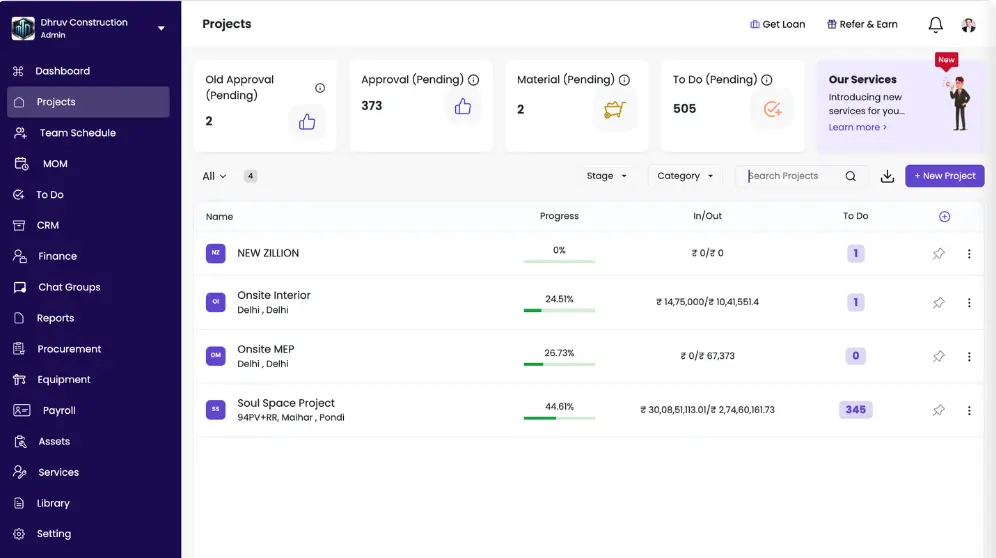
Onsite is a construction management software built around BOQ-driven execution, cost control, and live site visibility. It connects scope, progress, labour, material, subcontractor billing, and project finances into one continuous workflow — so financial movement is visible while the project is still in progress.
Onsite is best suited for construction companies that want:
- BOQ-linked budgeting, progress tracking, and client billing from one platform
- Real-time capture of labour, material, and site activity during execution
- Integrated subcontractor work orders, running bills, and retention management
- Multi-level approval workflows before procurement or expenses are committed
- Native Tally and Zoho Books integration — no double entry between site and finance
Why construction teams choose Onsite:
- Designed for execution-centric cost control, not field documentation or daily logs
- Works best for contractors in India and Gulf managing BOQ-based projects
- Focuses on live commercial clarity during execution rather than end-of-period reporting
Pricing: INR-based per user per year — designed for Indian and Gulf construction teams of all sizes, not scaled to construction volume.
● Raken
What is Raken
Raken is a field management software built around daily site documentation. Daily logs, time cards, photo reports, safety checklists, and toolbox talks operate within one system — giving field teams and office managers consistent visibility into what is happening on site each day.
Raken is typically suited for teams that need:
- Structured daily field reporting with photo logs, weather, and crew hours in fast mobile format
- Safety compliance workflows — toolbox talks, incident reporting, and quality checklists
- PDF report generation and field-to-office reporting for general contractors
- North American construction ecosystem — QuickBooks, Procore, and Autodesk integrations
Important considerations:
- No BOQ-linked cost control, RA billing, or subcontractor management built in
- No multi-level approval workflows for procurement or vendor payments
- USD pricing and North American market focus — not built for India or Gulf workflows
Pricing: USD-based pricing designed for the North American construction market. Indian and Gulf teams would require separate tools for billing, subcontractor management, and accounting.
Key Differentiators
Key Differences Between Onsite and Raken That Impact Daily Project Control
Three critical areas where Onsite and Raken take fundamentally different approaches — each with real impact on how your team manages active projects.
Comparison
✓ Onsite
Onsite places clear focus on linking site activity with financial impact. Labour entries, procurement approvals, and progress updates feed directly into cost tracking. Because of that connection, cost comparisons and financial dashboards reflect real activity as it happens. There is far less need for reconciliation later because execution and commercial data move together from the project start.
● Raken
Raken provides a strong field documentation environment covering daily logs, time cards, safety compliance, and PDF report generation for general contractors and specialty trade firms. It is designed to keep field teams reporting consistently and give office managers visibility into daily site activity.
✓ Onsite
Onsite concentrates on financial discipline during day-to-day operations. Approvals and workflows are aligned with budget limits before expenses are committed, which keeps control at the execution stage rather than only appearing in end-of-period reporting.
● Raken
Raken is strong in safety compliance workflows: toolbox talks, incident reporting, and quality checklists are well-built and designed for teams in compliance-heavy environments. It focuses on giving field teams the tools to meet reporting obligations consistently.
✓ Onsite
Onsite is built specifically for India and Gulf construction workflows. INR-based pricing, RA bill generation, Tally and Zoho Books native integration, BOQ-linked progress and billing, and retention management are all part of the platform rather than requiring additional tools alongside it.
● Raken
Raken is built for the North American construction market. Its pricing is in USD, its integrations cover QuickBooks and Procore, and its billing tools do not include RA bill generation or BOQ-linked invoicing. Indian and Gulf construction companies using Raken would require separate tools for billing, subcontractor management, and accounting integration.
Detailed Comparison
Onsite vs Raken: Module-Based Comparison
A complete module-by-module breakdown across 9 feature areas to help you evaluate which platform fits your construction workflow.
Feature
Onsite
Raken
Construction Progress Tracking
6 features
Daily Progress Reports (DPRs)
Yes
Yes
Geo-Tagged Photos
Yes
Yes
Site Measurements and Milestones
Yes
Not available
BOQ-Linked Quantity Recording
Yes
Not available
Automated Reports
Yes
Yes: PDF export
Planned vs Actual Comparison
Yes: BOQ-driven
Basic production tracking
Labour Management
7 features
Attendance Tracking
Yes: geo-tagged
Yes: time cards
Face Recognition
Yes
Not publicly highlighted
Crew Hour Tracking
Yes
Yes
Labour Cost vs Budget
Yes: real-time allocation
Not available
Automated Salary and Wages
Yes
Yes: payroll export
Subcontractor Labour Separation
Yes
Not available
Reports and Analytics
Yes
Yes
Safety and Quality Management
8 features
Digital Checklists
Yes
Yes
Inspection Reports
Yes
Yes
Toolbox Talks
Not publicly highlighted
Yes
Incident Reporting
Yes
Yes
Link Inspections to Site Tasks
Yes
Not available
Instant Notifications
Yes
Yes
Audit Trail
Yes
Yes
Analytics
Yes
Yes
Material Management
7 features
Budget-Linked Requests
Yes
Not available
Material Request Approvals
Multi-level
Not available
Request for Quotations
Yes
Not available
Purchase Orders
Yes
Not available
Delivery and Site Inventory
Yes
Basic material tracking
Bill Validation
Yes: delivery matched
Not available
Integration with Accounting
Yes: Tally and Zoho Books
QuickBooks only
Subcontractor Management
6 features
Digital Work Orders
Yes
Not available
Progress and Milestones
Yes
Collaborator reports only
Running Bill Generation
Yes
Not available
Retention Management
Yes
Not available
Approval Workflows
Yes
Not available
Analytics
Yes
Not available
Procurement Management
6 features
Request for Quotation
Yes
Not available
Quotation Comparison
Yes
Not available
Purchase Order Creation
Yes
Not available
Three-Way Bill Matching
Yes: PO-GRN-invoice
Not available
Delivery Tracking
Yes
Not available
Budget Integration
Yes: BOQ-linked
Not available
Client Invoicing
7 features
Auto-Invoice from BOQ
Yes
Not available
RA Bill Generation
Yes
Not available
Linked with Progress
Yes
Not available
Retention Deduction
Yes: automatic
Not available
Collection Tracking
Yes
Not available
Share Digitally
Yes
Not available
Real-Time Dashboard
Yes
Not available
Asset and Equipment Management
6 features
Asset Assignment
Yes
Basic equipment log
Usage Tracking
Yes
Yes
Repair and Maintenance Logs
Yes
Not available
Maintenance Notifications
Yes
Not available
Equipment Rental Billing
Yes
Not available
Location Tracking
Yes
Not available
Multi-Level Approval Workflow
5 features
Custom Approval Levels
Yes
Not available
Digital Notifications
Yes
Yes: daily report alerts
Track All Approvals
Yes
Not available
Apply Across Procurement, Billing, Expenses
Yes
Not available
Real-Time Dashboard
Yes
Not available
Make Your Decision
Which Platform Fits Your Workflow?
The right choice depends on whether your team needs execution-driven cost control or structured field documentation and safety compliance.
Raken
May suit you if
Raken may suit you if your priority is field documentation, safety compliance, and daily reporting — particularly for general contractors in the North American market.
- Structured daily field reporting with photo logs, weather records, and crew hours in a fast, easy-to-use mobile format
- Safety compliance, toolbox talks, and incident tracking as central daily workflow requirements
- Field-to-office reporting for general contractors and specialty trade firms in the North American construction market
- Integration with QuickBooks, Procore, or Autodesk as part of an existing North American software ecosystem
- Documentation discipline and consistent field reporting rather than BOQ execution cost control
Onsite
May suit you if
Onsite may suit you if your priority is BOQ-driven cost control, structured approvals, and complete billing from one platform — built for India and Gulf construction teams.
- Using the BOQ as the operational backbone for execution and cost control across all active projects
- Keeping expenses within budget through multi-level approval workflows before commitments are made
- Tracking budget versus actual cost in real time during execution rather than at period end
- Monitoring labour activity with geo-tagged attendance and face recognition
- Generating BOQ-linked client invoices and RA bills automatically from verified executed quantities
- Managing subcontractors with built-in work orders, milestone tracking, and retention controls
- Tracking materials at site level with structured delivery verification and bill matching
- Running the full project management and financial workflow from one INR-priced mobile and web platform
FAQ
Questions companies ask when comparing Onsite and Raken
Direct answers to the most common questions about both platforms.
Raken is built around field documentation — daily logs, time cards, photo reports, safety checklists, and toolbox talks. It gives field teams a consistent way to report site activity to office managers. Onsite is built around execution-centered cost control. Site activities such as material requests, labour entries, and progress updates link directly to BOQ positions and budgets, so financial movement is visible while the project is still in progress. The core difference is documentation versus cost control.
No. Raken does not include RA bill generation or BOQ-linked invoicing. Its billing tools are designed for the North American market and do not cover running account bills, BOQ-linked progress billing, or retention management. Indian and Gulf construction companies that require RA billing would need separate tools alongside Raken. Onsite includes RA bill generation, BOQ-linked client invoicing, automatic retention deduction, and collection tracking as built-in modules.
Onsite includes daily progress reports, geo-tagged photos, site measurements, and milestone tracking. For construction teams in India and Gulf who need both field reporting and execution cost control, Onsite covers the daily reporting requirement while also providing BOQ tracking, billing, approvals, and subcontractor management in the same platform. Raken’s strength in toolbox talks and North American safety compliance workflows is more specific — teams whose primary requirement is safety documentation in a North American context may find Raken better suited for that specific need.
Yes. Onsite is built specifically for India and Gulf construction workflows, including road contractors, EPC firms, civil contractors, and infrastructure companies. It includes INR-based pricing, Tally and Zoho Books native integration, BOQ-linked progress and billing, multi-level approval workflows for procurement and vendor payments, and subcontractor management with running bills and retention. These are core requirements for government road and infrastructure projects in India and Gulf markets that Raken does not support.
Onsite includes a complete subcontractor management module with digital work orders, progress and milestone tracking, running bill generation, retention management, approval workflows, and analytics. Raken does not have a subcontractor management module — it supports collaborator reports only, which means subcontractors can submit daily logs but there is no work order, billing, retention, or approval workflow. For contractors managing multiple subcontractors on active projects, Onsite provides the structured controls that Raken does not.
Raken can be used in India for field documentation purposes — daily logs, time cards, and photo reports work regardless of geography. However, Raken is built for the North American construction market. It does not support INR pricing, RA billing, BOQ-linked workflows, Tally or Zoho Books integration, or Indian construction billing standards. Indian construction teams that need cost control, subcontractor billing, procurement management, and financial workflows alongside field reporting would require additional tools to supplement Raken.
Onsite. Multi-level approval workflows are a core Onsite feature — configurable approval chains apply across material requests, purchase orders, vendor bills, subcontractor payments, and expense releases. Every approval is timestamped and recorded, creating a complete documented trail across all active project sites. Raken does not offer multi-level approval workflows for procurement or billing. Its notification system is limited to daily report alerts.
Choose Raken if your priority is structured daily field documentation, safety compliance, and toolbox talks for general contractors in the North American market. Choose Onsite if your priority is BOQ-driven cost control, RA billing, subcontractor management, procurement approvals, and full project financial visibility from one platform — particularly if you operate in India or Gulf markets. The way your team manages active projects and what you need to control should guide the decision.
Get started