
Software Comparison
Onsite vs Fieldwire
Fieldwire centres its platform on drawing management and field coordination — plan viewing, markups, RFIs, punchlists, and task assignments tied to current drawings. Onsite is built around active project cost control. The BOQ forms the base layer, and day-to-day actions such as material requests, labour entries, progress updates, and billing approvals connect directly to budget positions, keeping financial movement visible while the project is still running.
BOQ-linked cost control — every site activity updates budget and billing in real time
Onsite
Multi-level procurement approvals that prevent cost overruns before commitment
Onsite
Subcontractor work orders, running bills, and retention tracking built natively
Onsite
Face recognition and GPS attendance — payroll generated from verified site presence
Onsite
Drawing management, RFIs, submittals, and punchlists — built for field and office coordination
Fieldwire
Execution Control Score
Onsite vs Fieldwire — Execution Benchmark
Live
Onsite
Execution-First
9.2
Execution Score
Fieldwire
Drawing-First
7.1
Execution Score
Recommended for Execution Teams · Contractors, builders, and EPC firms managing BOQ-based projects in India and the Gulf
Platform Overview
Two Different Approaches to Construction Software
Fieldwire is built for drawing management and field coordination. Onsite is built around BOQ-linked execution where every field update drives a financial outcome.
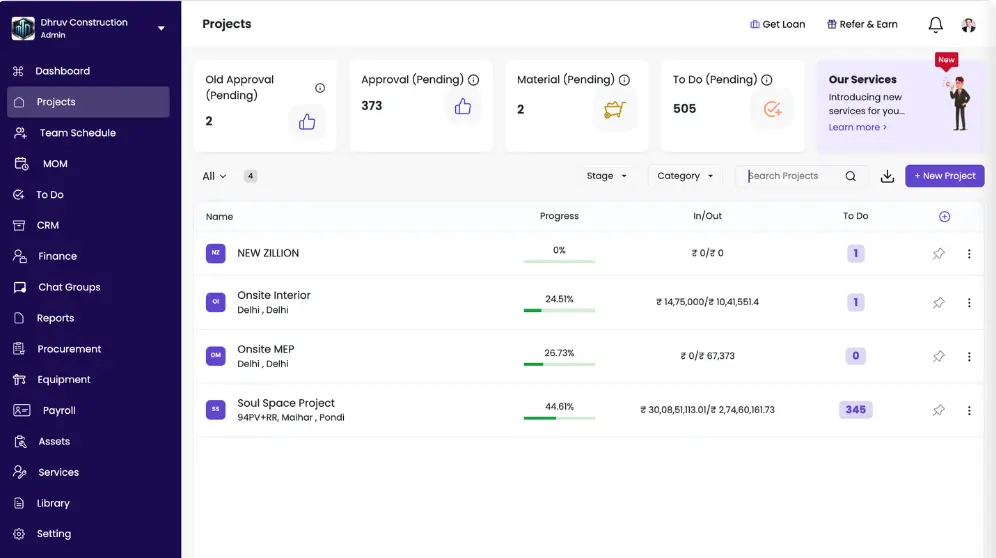
● Onsite
What is Onsite
Onsite is a construction management software built specifically around BOQ-driven execution, cost control, and live site visibility. It connects scope definition, installed quantities, labour attendance, material usage, subcontractor billing, and project finances into one continuous workflow. Every field action feeds directly into budget position and billing readiness.
Onsite is best suited for construction companies that want:
- BOQ-linked budgeting, progress tracking, and billing in one workflow
- Real-time capture of labour, material, and site activity tied to cost
- Integrated subcontractor work orders, running bills, and retention tracking
- Budget versus actual dashboards updated by execution, not manual entry
- Native integration with Tally and Zoho Books for accounting sync
Why construction teams choose Onsite:
- Designed for execution-centric cost control — not drawing governance or documentation management
- Works best for contractors managing multiple active projects with BOQ-based scope
- Built specifically for India and Gulf construction workflows with INR pricing and RA billing
- Focuses on live commercial clarity rather than post-execution reporting assembled from separate tools
Pricing: Onsite follows a project-friendly pricing model designed for construction teams of different sizes, with INR-based tiers and dedicated onboarding support.
● Fieldwire
What is Fieldwire
Fieldwire is a construction project management software built for drawing management and field coordination. It connects site teams and office teams around a single current drawing set, replacing scattered plan distribution and communication with a centralised platform for markups, RFIs, submittals, punchlists, task assignments, and progress documentation.
Fieldwire is best suited for construction companies that want:
- Plan viewing with automatic version control so every team member works from current drawings
- RFI and submittal management with structured approval and response tracking
- Punchlist and issue tracking linked directly to specific drawing locations
- Task assignment tied to drawings and accessible offline on mobile for field teams
- Multi-language support for globally distributed teams across North America, Europe, and international markets
Why construction teams choose Fieldwire:
- Designed primarily for drawing management and field documentation — not BOQ-linked cost control
- Works best for general contractors and subcontractors where coordination around current drawings is the core need
- Offers a free plan for small teams wanting to evaluate the platform before committing to a paid tier
- Supports 2D and 3D plan access, BIM viewing, and Box, Dropbox, and OneDrive document sync
Pricing: Fieldwire offers a free plan with limited features. Paid plans are priced in USD and include web access, BIM viewing, custom report export, and change order management at the Business Plus tier.
Key Differentiators
Key Differences That Matter in Practice: Onsite vs Fieldwire
Four operational areas where the platforms diverge — each with direct impact on cost visibility, labour accuracy, and execution control on your live projects.
✓ Onsite
Onsite connects every field action directly to a financial outcome. Installed quantities, labour attendance entries, and material consumption do not exist as separate activity records — each one updates budget position, cost variance, and billing readiness in real time. A site engineer recording progress in the morning affects the project P&L the same day. Financial clarity is the product of execution, not a separate reporting exercise.
● Fieldwire
Fieldwire is one of the strongest platforms available for drawing management and field coordination. Automatic version control ensures every team member works from the current drawing set. Markups, RFIs, submittals, and punchlist management are built with the field team as the primary user. Its positioning centres on coordination accuracy and documentation quality rather than continuous commercial recalculation.
✓ Onsite
Onsite embeds financial discipline into day-to-day execution workflows. Material requests, procurement decisions, and expense approvals are checked against BOQ budget limits through multi-level approval chains before any commitment is made. This means cost overruns are flagged at the point of decision — not discovered during a period-end review when it is too late to act. The platform alerts you to a loss while the project is still running.
● Fieldwire
Fieldwire provides budget monitoring at the Business Plus tier and supports cost reporting across projects. Its emphasis, however, is on field coordination transparency rather than preventive financial gating tied strictly to BOQ quantities. Budget controls in Fieldwire depend more on user discipline at the reporting stage than on structural enforcement at the commitment stage.
✓ Onsite
Onsite provides geo-tagged attendance with face-based validation options, making proxy attendance and ghost worker entries structurally difficult. Confirmed attendance links directly to payroll calculations, closing the loop between site presence and wage cost. Subcontractor labour is tracked separately, giving project managers visibility into workforce composition and productivity across all active sites.
● Fieldwire
Fieldwire does not offer a dedicated labour management module. Crew hours can be recorded through forms and time sheets, but there is no geo-tagged attendance, no face recognition validation, no automated payroll calculation from attendance data, and no subcontractor labour separation as a structured workflow within the platform.
✓ Onsite
Onsite is built specifically for India and Gulf construction workflows. INR-based pricing, RA bill generation linked to BOQ progress, Tally and Zoho Books native integration, and retention management are all part of the platform — not workarounds assembled from separate tools. For contractors operating under Indian construction contract norms, these are not nice-to-have additions but daily operational requirements.
● Fieldwire
Fieldwire is a globally deployed platform supporting over twenty languages and operating across projects in North America, Europe, and internationally. Its pricing is in USD and its financial tools do not include RA bill generation, BOQ-linked invoicing, or Tally and Zoho Books integration. Teams requiring India-specific billing workflows or Gulf-market accounting integration would need to operate Fieldwire alongside separate financial tools.
Detailed Comparison
Onsite vs Fieldwire — Feature Wise Comparison
A module-by-module breakdown across 15 construction software categories.
Feature
Onsite
Fieldwire
Construction Project Planning and Scheduling
7 features
Activity Scheduling
Yes
Yes — calendar and Gantt view
Task Assignment
Yes
Yes
Dependencies and Milestones
Yes
Yes
Live Progress Updates
Yes
Yes
Delay Detection
Yes
Yes
Kanban View
Yes
Yes
Real-Time Collaboration
Yes
Yes
Drawing and Document Management
8 features
Plan Viewing and Markups
Yes
Yes — core strength with full markup toolset
Drawing Version Control
Yes
Yes — automatic version sync across all users
2D and 3D Plan Access
Yes
Yes
BIM Access
Not publicly highlighted
Yes
RFIs and Submittals
Yes
Yes
Change Orders
Yes
Yes — Business Plus plan
Document Storage and Sharing
Yes
Yes — Box, Dropbox, OneDrive sync
Offline Access to Plans
Yes
Yes
Construction Progress Tracking
8 features
Daily Progress Reports
Structured DPR with quantities, labour, material, and financial linkage
Yes — daily logs and forms available
Geo-Tagged Photos
Yes — with timestamp verification
Yes — photo documentation supported
BOQ-Linked Quantity Recording
Yes
Not available
Planned vs Actual Comparison
Yes — BOQ-driven
Task completion tracking
Site Measurements and Milestones
Yes
Yes
Punchlist and Issue Tracking
Yes
Yes — core strength
Automated Reports
Yes
Yes
Dashboards
Execution-focused with cost linkage
Field coordination dashboards
Task Management
8 features
Task Assignment with Deadlines
Yes
Yes
Task Linked to Drawings
Yes
Yes — core capability
Recurring Tasks
Yes
Yes
Checklists
Yes
Yes
Task Status Tracking
Yes
Yes
Mobile Task Updates
Yes
Yes
Multi-Level Approval on Tasks
Yes
Not publicly highlighted
Cross-Project Task Visibility
Yes
Yes
Labour Management and Payroll
7 features
Attendance Tracking
Yes — geo-tagged with structured tracking
Not available as dedicated module
Face Recognition
Yes — face validation option available
Not available
Crew Hour Tracking
Yes
Yes — via time sheets and forms
Labour Cost vs Budget
Yes — real-time allocation
Not available
Automated Salary and Wages
Yes — attendance-to-payroll linked
Not available
Subcontractor Labour Separation
Yes
Not available
Labour Productivity Reports
Yes — linked to activities and cost
Yes — via reporting forms
Material Management
8 features
Budget-Linked Material Requests
Yes — BOQ and budget linked
Not available
Material Request Approvals
Yes — multi-level
Not available
Request for Quotations
Yes
Not available
Purchase Orders
Yes
Not available
Delivery and GRN Recording
Yes
Not available
Site Inventory Tracking
Yes — site-level stock and warehouse
Not available
Bill Validation against GRN
Yes — automated three-way matching
Not available
Accounting Integration
Yes — Tally and Zoho Books
Not available
Subcontractor Management
7 features
Digital Work Orders
Yes — linked to BOQ scope
Not available
Progress and Milestones
Yes
Yes — via tasks and punchlists
Running Bill Generation
Yes
Not available
Retention Management
Yes — built-in retention tracking
Not available
Approval Workflows
Yes
Not available
Subcontractor Access to Platform
Yes
Yes — subcontractors can be added
Performance Analytics
Yes — productivity analytics
Yes — via task reporting
Procurement Management
6 features
Request for Quotation
Yes
Not available
Quotation Comparison
Yes
Not available
Purchase Order Creation
Yes
Not available
Three-Way Bill Matching
Yes — PO, GRN, and invoice matched
Not available
Delivery Tracking
Yes
Not available
BOQ Budget Integration
Yes — every purchase linked to project budget
Not available
Quality and Safety Management
9 features
Digital Checklists
Yes
Yes
Inspection Reports
Yes
Yes
Punchlist Management
Yes
Yes — core strength
Issue Tracking
Yes
Yes — core strength
Link Inspections to Drawings
Yes
Yes
Link Inspections to Tasks
Yes
Yes
Instant Notifications
Yes
Yes
Audit Trail
Yes — full tracking of actions
Yes
Analytics
Yes
Yes
Client Invoicing
7 features
RA Bill Generation from BOQ
Yes — auto-generated from BOQ progress
Not available
Linked with Progress Data
Yes
Not available
Retention Deduction
Yes — automatic
Not available
Billing Milestones
Yes
Not available
Collection Tracking
Yes
Not available
Share Digitally
Yes
Not available
Real-Time Dashboard
Yes
Not available
Vendor Billing
6 features
Material Bills
Yes
Not available
Equipment Bills
Yes
Not available
Subcontractor Bills
Yes
Not available
Three-Way Matching
Yes
Not available
Payment Tracking
Yes
Not available
Budget Linkage
Yes
Not available
Construction Budgeting and Cost Control
6 features
Build Budgets from BOQ
Yes
Limited — Business Plus plan only
Track Actual Cost Automatically
Yes — execution-linked and automated
Not available as automated workflow
Progress-Based Cost Comparison
Yes — BOQ-driven
Not available
Identify Cost Leakages Early
Yes — through approval controls at commitment stage
Not available
Task-Level Cost Analytics
Yes
Not available
Budget vs Actual Dashboard
Yes — live dashboard
Not available
Asset and Equipment Management
6 features
Asset Assignment
Yes
Not available as dedicated module
Usage Tracking
Yes
Not available
Repair and Maintenance Logs
Yes
Not available
Maintenance Notifications
Yes
Not available
Equipment Rental Billing
Yes
Not available
Location Tracking
Yes
Not available
Multi-Level Approval Workflow
5 features
Custom Approval Levels
Yes — custom chains across all modules
Not available
Digital Notifications
Yes
Yes — task notifications
Track All Approvals
Yes — full approval history
Not available
Apply Across Procurement, Billing, Expenses
Yes — cross-module enforcement
Not available
Real-Time Dashboard
Yes
Not available
Reports and Analytics
6 features
50+ Ready Reports
Yes
Not publicly quantified
Customizable Filters
Yes
Yes
Smart Dashboards
Yes — execution and cost dashboards
Field coordination dashboards
Auto-Synced Data
Yes
Yes
Export and Share
Yes — PDF and Excel exports
Yes — report exports supported
BOQ-Linked Analytics
Yes
Not available
Make Your Decision
Which Platform Fits Your Workflow?
The right choice depends on whether you need drawing-centred field coordination or BOQ-driven cost control that runs continuously through execution.
Fieldwire
May suit you if
Fieldwire may suit you if your priority is drawing management and field coordination — giving every team member access to the current drawing set and clear visibility into what is assigned, open, and complete.
- Drawing management and version control is your central coordination mechanism across field and office teams
- Task management linked directly to specific drawings, plans, and punchlist items is a daily operational requirement
- RFI and submittal management with structured approval and response tracking is a priority for your projects
- Connecting subcontractors and general contractors around a single current drawing set is the core workflow problem you need to solve
- Strong field coordination across globally distributed teams with multi-language support is a requirement
- You want a free plan to test the platform with a small team before committing to a paid tier
- BIM access and 2D/3D plan viewing with Box, Dropbox, or OneDrive integration is important to your existing document workflow
Bottom line: Fieldwire is the stronger choice when drawing accuracy and field documentation are the primary problem — and when BOQ-linked cost control, labour payroll, and billing automation are handled by separate tools or are not yet a priority.
Onsite
May suit you if
Onsite may suit you if your priority is BOQ-driven execution control where every field update has a direct commercial outcome and financial clarity runs continuously through the project — not just at period end.
- Using the BOQ as the operational backbone for execution, cost control, and billing across all active projects
- Keeping expenses within budget through multi-level approval workflows that check BOQ limits before any commitment is made
- Tracking budget versus actual cost in real time during execution rather than assembling the picture at period end
- Monitoring labour activity through geo-tagged attendance and face recognition with payroll calculated from verified site presence
- Generating BOQ-linked client invoices and RA bills automatically from verified executed quantities
- Managing subcontractors with built-in work orders, milestone tracking, running bills, and retention controls
- Tracking materials at site level with structured delivery verification and three-way bill matching against purchase orders and GRNs
- Running the full project management and financial workflow on an INR-priced platform built for India and Gulf construction norms
Bottom line: Onsite is the stronger choice when the gap between what happens on site and what the finance team sees is costing money — and when you need one platform to handle execution, cost control, labour, procurement, subcontractors, and billing without stitching separate tools together.
FAQ
Questions About Onsite vs Fieldwire
Common questions when comparing both platforms for Indian and Gulf construction teams.
Fieldwire is built for drawing management and field coordination. Automatic version control ensures every team member works from the current drawing set, and markups, RFIs, submittals, punchlists, and task assignments all operate within that drawing-centred structure. The platform eliminates miscommunication caused by version confusion and scattered documentation across field and office teams. Onsite treats every field action as a structured financial input. Installed quantities, labour attendance, material consumption, and procurement decisions all connect directly to BOQ budget positions and billing readiness in real time. Financial clarity is the product of execution itself — not a separate reporting exercise assembled at period end from disconnected data sources.
Fieldwire provides budget monitoring at its Business Plus plan tier and supports cost reporting across projects. However, its positioning does not centre the BOQ as the primary structural control layer for all workflows. Budget tracking in Fieldwire depends more on how consistently users maintain data entry discipline than on structural platform linkage that enforces alignment automatically. Onsite builds the BOQ as the operational backbone of execution — budgets, procurement, progress updates, billing, and margin analysis all trace back to defined BOQ line items without requiring manual discipline to keep them aligned. Purchasing decisions are checked against BOQ budget limits through multi-level approval workflows before any commitment is made, making cost overrun prevention structural rather than procedural.
Onsite provides a dedicated labour management module with geo-tagged attendance, face-based validation to prevent proxy entries, direct payroll calculation from confirmed attendance data, subcontractor labour separation, and real-time labour cost allocation against project budgets. For construction workforces where payroll accuracy is tied directly to site presence, this chain closes the gap between who was on site and what was paid. Fieldwire does not offer a dedicated labour management module. Crew hours can be recorded through time sheets and forms, but there is no geo-tagged attendance, no face recognition validation, no automated payroll calculation from attendance records, and no subcontractor labour separation as a structured workflow within the platform. Teams using Fieldwire typically handle labour tracking and payroll through separate systems.
Onsite provides structured subcontractor management that includes digital work orders linked to BOQ scope, progress-based milestone billing, built-in retention tracking, running bill generation, and subcontractor productivity analytics. For contractors managing multiple subcontractors on BOQ-based contracts, these features prevent payment disputes and ensure retention releases are tied to verified completion rather than manual agreement. Fieldwire supports subcontractor access to the platform and allows subcontractors to participate in task and punchlist workflows alongside the general contractor. However, digital work orders, running bill generation, retention management, and structured approval workflows for subcontractor billing are not part of Fieldwire’s feature set. Teams needing structured financial management of subcontractor relationships would require separate tools alongside Fieldwire.
Onsite covers drawing and document management — plan viewing, markups, RFIs, submittals, change orders, version control, and offline access to plans are all part of the platform. These features support execution workflows rather than functioning as a standalone drawing management system. Fieldwire genuinely excels at drawing management and field coordination in a way that reflects years of product focus on that specific problem. Automatic version sync, BIM access, deep markup tooling, and structured RFI and submittal workflows are core strengths. For teams where drawing accuracy and documentation governance are the primary operational challenge — particularly globally distributed teams or those with complex documentation requirements — Fieldwire’s depth in this area is meaningful. Onsite is the stronger choice when cost control and financial visibility during execution are the primary requirements, with drawing management as one component of a broader workflow.
Onsite links every material request to a specific BOQ budget line before it enters the procurement workflow. Multi-level approval chains check budget availability at the moment a request is raised — not at the reporting stage. The complete procurement chain covers RFQ, quotation comparison, PO generation, GRN recording, delivery tracking, and automated three-way bill matching between purchase order, goods receipt, and vendor invoice. Every purchase is structurally linked to the project budget. Fieldwire does not include a procurement or material management module. There is no RFQ workflow, no purchase order generation, no GRN recording, no three-way bill matching, and no site inventory tracking within the platform. Teams using Fieldwire handle procurement and material management entirely through separate systems, which means cost data from procurement decisions is not structurally connected to progress data on site.
Fieldwire is a globally deployed platform and is technically accessible in India. However, its pricing is in USD and its financial tools do not include RA bill generation, BOQ-linked invoicing, or native integration with Tally and Zoho Books — the accounting systems most commonly used by Indian construction companies. Teams operating under Indian construction contract norms, where RA billing and retention management are standard requirements, would need to run separate financial tools alongside Fieldwire to cover these workflows. Onsite is built specifically for India and Gulf construction workflows. Pricing is INR-based, RA bill generation linked to BOQ progress is a core platform feature, and Tally and Zoho Books integration is available natively. The relevant comparison is not cost alone but what each platform delivers for India-specific operational requirements out of the box versus through separate tools.
Choose Fieldwire if drawing management and field coordination are the core problem you need to solve — particularly if your teams are spread across multiple locations, version confusion on drawings is causing rework, or RFI and submittal tracking is a daily operational requirement. Fieldwire is also the right choice if you want a free entry-level plan, need BIM access, or are operating across international markets where multi-language support matters. Choose Onsite if your projects run on BOQ-based contracts where daily site activity must directly drive cost visibility, billing readiness, and margin control — and where the gap between what happens on site and what the finance team sees is costing money. Onsite is the right fit for contractors, builders, EPC firms, and subcontractors in India and the Gulf who need execution, labour, procurement, subcontractor management, and billing to run from one platform without stitching separate tools together.
Book a Free Demo
See How Onsite Controls Your Project Costs
Book a free demo and see exactly how Onsite connects your BOQ, daily field updates, procurement, and billing — on a real project like yours. No credit card required · Go live in under 3 days · Dedicated onboarding manager included
10,000+ construction companies
India and Gulf market built-in
BOQ-linked cost control
Mobile and web platform