
Software Comparison
Onsite vs Buildertrend
Buildertrend is built for residential contractors and custom homebuilders — particularly in the US market. Onsite is built for execution-first construction teams that tie every site activity directly to cost control, BOQ-linked billing, and live P&L. Both are construction software. Their approach to project control is fundamentally different.
BOQ-linked progress tracking and billing
Onsite
Real-time site cost visibility during execution
Onsite
Face recognition and GPS attendance — automated wages linked to verified presence
Onsite
INR-based pricing — built for India and Gulf markets
Onsite
Zero double-entry — Tally and Zoho Books native sync
Onsite
Homeowner portal, client selections, and residential sales workflow
Buildertrend
Execution Control Score
Onsite vs Buildertrend — Execution Benchmark
Live
Onsite
Execution-First
9.2
Execution Score
Buildertrend
Client-First
7.0
Execution Score
Recommended for Execution Teams · BOQ-driven contractors, builders and EPC firms
Platform Overview
Two Different Approaches to Construction Software
Onsite and Buildertrend are both construction management platforms — but they are built for fundamentally different markets, contract types, and operational priorities.
● Onsite
What is Onsite
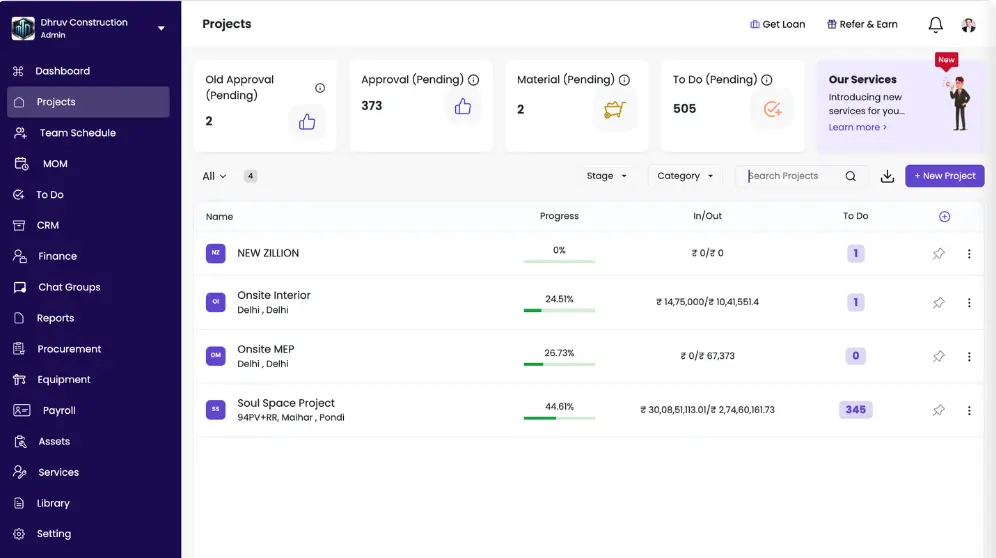
Onsite is a mobile-first construction ERP built specifically around BOQ-driven execution, cost control, and live site visibility. It connects scope definition, activity scheduling, daily progress tracking, labour attendance, material procurement, vendor billing, subcontractor management, and project finances into one continuous workflow where every team — from site engineer to company owner — works from the same verified data.
Onsite is best suited for construction companies that want:
- BOQ-linked activity scheduling, progress tracking, and client billing
- Real-time budget versus actual visibility across all active projects
- Multi-level approval workflows across procurement, finance, and execution
- Native integration with Tally and Zoho Books
Why construction teams choose Onsite:
- Designed for execution-centric cost control rather than client presentation or residential workflow management
- Works best for contractors managing multiple active projects under BOQ-based contract structures
- Focuses on proactive cost control at the point of commitment rather than post-execution reconciliation
- Built for India and Middle East construction markets where Tally-based accounting and BOQ-driven contracts are standard
Pricing: Onsite follows a user-based pricing model with plans designed for construction teams of different sizes, from small contractors managing a few projects to large EPC firms running enterprise-scale operations.
● Buildertrend
What is Buildertrend
Buildertrend is a cloud-based construction management platform used by more than one million users across over 100 countries. It is built primarily for home builders, residential remodelers, and specialty contractors, with particular strength in the North American residential construction market. The platform consolidates scheduling, project management, client communication, financial tracking, estimating, and materials management into one system centered around the homeowner and client experience.
Buildertrend is best suited for construction companies that want:
- A dedicated homeowner portal giving residential clients real-time access to schedules, selections, and change orders
- Estimating and bid management with professional proposal generation
- Budgeting and job costing built from estimates rather than BOQs
- Client communication tools including messaging, approvals, and digital signatures
- Integration with QuickBooks and Xero for accounting continuity
Why construction teams choose Buildertrend:
- Designed for residential construction workflows where client communication and homeowner experience are central priorities
- Works best for home builders and remodelers in North American markets managing custom residential projects
- Offers a strong client-facing portal that reduces inbound calls and improves homeowner satisfaction
- Accounting integrations built around QuickBooks and Xero — no native Tally or Zoho Books sync for India and Middle East contractors
Pricing: Buildertrend follows a tier-based subscription model with plans covering unlimited users. Pricing varies by plan tier and the features included at each level.
Key Differentiators
Key Differences Between Onsite and Buildertrend That Impact Daily Project Control
Four critical areas where Onsite and Buildertrend take fundamentally different approaches — each with real impact on your cost control, labour accuracy, and accounting continuity.
BOQ Execution vs Estimate Tracking
Comparison
✓ Onsite
Connects every procurement decision, labour deployment, and cost entry back to the original BOQ. A material requisition raised on site checks budget availability against the BOQ line item before any approval begins. A vendor payment updates the specific BOQ cost head it belongs to in real time. Budget versus actual comparison reflects verified execution data from site, not estimates updated manually.
⚠ Buildertrend
Builds budgets from estimates rather than BOQs. Cost tracking updates as expenses are entered manually by the team. The budget serves as a reference document rather than a live control point connected to daily site activity. For contractors in BOQ-driven contract structures — government projects, infrastructure, EPC — this distinction determines whether cost control is proactive or reactive.
✓ Onsite
Uses AI-powered face recognition combined with GPS location confirmation to verify worker identity and physical site presence simultaneously at the point of attendance. Both conditions must pass for the attendance entry to record. Proxy attendance, buddy punching, and ghost worker entries are structurally impossible. Payroll runs automatically from verified attendance without manual compilation.
⚠ Buildertrend
Offers a Time Clock feature with geofencing that confirms a worker is within a defined location boundary at check-in. It does not verify the identity of the specific person checking in, which means one worker can clock in for another within the geofence. For labour-intensive workforces where payroll accuracy directly determines profitability, the difference between location confirmation and identity-plus-location verification is the difference between reducing fraud and eliminating it.
✓ Onsite
Integrates natively with Tally and Zoho Books — the accounting systems used by the vast majority of Indian and Middle East construction companies. Site expenses, vendor bills, labour payroll, and client invoices flow into Tally or Zoho Books automatically without manual re-entry. Construction companies do not need to change their accounting setup to adopt Onsite.
⚠ Buildertrend
Accounting integrations are built around QuickBooks and Xero — the dominant platforms in the US and Australian markets. For Indian and Middle East contractors who run their accounts on Tally, Buildertrend creates a data gap where construction operational data and financial records exist in separate systems with no automated sync. Reconciling the two requires manual re-entry or custom integration work.
✓ Onsite
Every vendor bill goes through automated three-way matching — comparing the invoice against the original purchase order and the GRN delivery record before any approval workflow begins. Quantity discrepancies, rate variances, and duplicate invoices are flagged automatically before a human approver sees the bill. Overbilling is caught at the source rather than during post-payment reconciliation.
⚠ Buildertrend
Vendor billing involves purchase orders, bills, and payment tracking but does not include automated three-way matching as a systematic pre-approval check. Invoice validation against delivery records requires manual reconciliation by the accounts team. For contractors managing high volumes of material deliveries across concurrent projects, overbilling detection depends on individual reviewer diligence rather than systematic verification at every invoice cycle.
Detailed Comparison
Onsite vs Buildertrend: Feature-wise Comparison
A complete module-by-module breakdown to help you evaluate which platform fits your construction workflow.
Feature
Onsite
Buildertrend
Sales Management (CRM)4 features
Lead Import and Tracking
Imports leads, tracks stages, follow-ups
Lead management focused on residential sales pipeline
BOQ and Quotation Creation
BOQ creation with rate and margin analysis
Estimates and proposals supported
Margin Analysis
Built-in rate and profitability visibility
Basic markup tools
Follow-up Reminders
Built-in reminders
Available through CRM workflow
Budgeting and Cost Control5 features
Budget from BOQ
Directly generated from BOQ
Budget created from estimate
Auto Cost Tracking
Tracks actual cost vs BOQ live
Tracks expenses but not BOQ-native
Vendor Payment Requests
Structured payment workflow
Supports bills and payments
Progress-Based Cost Comparison
Links progress to cost
Budget vs actual view — less execution-linked
Task-Level Analytics
Yes
Limited at task level
Progress Tracking5 features
Daily Progress Reports
Structured DPR with labour, material, progress
Daily logs
Geo-Tagged Photos
Yes
Photo attachments — not geo-enforced
Site Measurements
Quantity-based
Milestone-based
Automated Reports
Yes
Yes
Dashboards
Execution dashboards
Project dashboards
Material Management6 features
Budget-Linked Requests
Yes
Not BOQ-linked
Material Approvals
Multi-level
Approval workflows available
RFQ Management
Yes
Vendor management supported
Purchase Orders
BOQ-connected POs
Yes
Delivery and Inventory
Site-level inventory tracking
Limited inventory management
Bill Validation
Match against deliveries
Manual reconciliation
Labour Management5 features
Geo-Tagged Attendance
Yes
No geo-attendance
Face Recognition
Yes
Not available
Productivity Tracking
Labour vs output visibility
Limited crew tracking
Automated Wages
Yes
Payroll integration required
Analytics
Productivity analytics
Basic reports
Subcontractor Management5 features
Digital Work Orders
Yes
Yes
Progress Tracking
BOQ-linked
Task and milestone-based
Billing and Retention
Structured retention tracking
Invoice tracking
Approval Flows
Multi-level
Supported
Performance Analytics
Yes
Limited benchmarking
Equipment and Assets7 features
Assignment
Yes
Basic assignment
Usage Tracking
Yes
Limited
Maintenance Logs
Yes
Basic
Due Notifications
Yes
Yes
Rental Billing
Yes
Requires workarounds
Location Tracking
Yes
Limited
Loss Prevention
Yes
Not structured
Site Petty Cash4 features
Site Payment Requests
Yes
Expense logging
Expense Tracking
Yes
Yes
Approval Flow
Yes
Yes
Staff Wallet Balance
Yes
Not native
Procurement3 features
RFQ Workflow
Yes
Vendor bid requests
Quotation Comparison
Yes
Yes
Budget Integration
BOQ-aligned
Estimate-aligned
Quality Management6 features
Digital Checklists
Yes
Yes
Inspection Reports
Yes
Yes
Instant Notifications
Yes
Yes
Link to Tasks
Yes
Yes
Audit Trail
Yes
Yes
Analytics
Yes
Limited
Production Management5 features
Production Workflows
Yes
Not structured
Batch Records
Yes
Not native
Consumption Tracking
Yes
Limited
Inventory Integration
Yes
Partial
Analytics
Yes
Limited
Client Invoicing5 features
Auto Invoice from BOQ
Yes
Milestone billing
Linked with Progress
Yes
Manual update required
Billing Milestones
Yes
Yes
Collection Tracking
Yes
Yes
Real-Time Dashboard
Yes
Yes
Vendor Billing4 features
Material Bills
Yes
Yes
Equipment Bills
Yes
Limited
Subcontractor Bills
Yes
Yes
Budget Linkage
BOQ-integrated
Budget-based
Project P&L5 features
Project-Wise Costing
Yes
Basic reporting
Budget vs Actual
Yes
Yes
Integrated Billing
Yes
Requires integration
Smart Analytics
Advanced
Moderate
Central Dashboard
Yes
Yes
Approval Workflows3 features
Custom Approval Levels
Yes
Yes
Cross-Workflow Control
Yes
Limited cross-module visibility
Real-Time Tracking
Yes
Yes
Reports and Analytics4 features
50+ Ready Reports
Yes
Extensive reports
Smart Dashboards
Yes
Yes
Auto-Synced Data
Yes
Yes
Export and Share
Yes
Yes
White Label Platform3 features
Full Branding
Yes
Limited branding
Branded App
Yes
No full white label
Developer-Friendly
Yes
Not positioned for white-label
Make Your Decision
Which Platform May Suit You?
The right choice depends on your market, your contract structure, and how your teams execute work on site.
Buildertrend
May suit you if
Buildertrend may suit you if your priority is residential client experience and communication in North American markets.
- Building or remodeling custom homes, particularly in the US or international residential markets
- Offering clients a refined customer portal experience
- Managing homeowner selections, upgrades, and communication within one system
- Using built-in sales and marketing tools to support lead-to-project workflows
- Focusing on client presentation and buyer engagement alongside project tracking
Onsite
May suit you if
Onsite may suit you if your priority is execution-driven cost control across BOQ-based contracts in India or the Middle East.
- Using the BOQ as the operational backbone for execution and cost control
- Keeping expenses within budget and keeping track of budget vs actual cost
- Keeping a look at labor activity with the help of geo-tagged attendance and face recognition
- Automated client invoice generation
- Managing subcontractors with built-in milestone and retention controls
- Tracking materials at site level with structured delivery and bill verification
- Applying rules of approval consistently across finance, procurement, and execution
- Managing the whole project on mobile and web platforms
FAQ
Questions About Onsite vs Buildertrend
Common questions when evaluating both platforms.
Buildertrend is built for residential construction in North American markets — its core strength is the homeowner portal, client communication, and estimate-based budgeting. Onsite is built for execution-driven cost control in India and the Middle East, where BOQ-linked budgeting, face recognition attendance, three-way bill matching, and Tally integration are operational requirements. Buildertrend suits home builders focused on client experience. Onsite suits contractors, EPC firms, and developers focused on site execution accuracy and financial control.
Buildertrend can be used globally but is designed primarily for the North American residential construction market. Its accounting integrations are built around QuickBooks and Xero — not Tally or Zoho Books, which are standard across Indian construction companies. For teams running their accounts on Tally, Buildertrend creates a data gap with no native automated sync. Onsite integrates directly with Tally and Zoho Books, which makes it a more practical fit for Indian contractors without requiring custom integration or double-entry.
Onsite uses AI-powered face recognition combined with GPS location confirmation to verify worker identity and site presence simultaneously. Both must pass before an attendance entry records — making proxy attendance and ghost workers structurally impossible. Payroll then runs automatically from verified data. Buildertrend’s Time Clock feature uses geofencing to confirm a worker is within a location boundary, but does not verify the specific person’s identity. One worker can clock in for another within the geofence. For labour-intensive construction workforces where payroll fraud is a real cost, the difference between identity verification and location confirmation is significant.
Yes, and Onsite is typically a stronger fit for BOQ-driven construction. Onsite connects every procurement decision, labour deployment, and cost entry back to the original BOQ in real time. Budget versus actual comparison reflects verified site execution data, not estimates updated manually. Buildertrend builds budgets from estimates rather than BOQs — the budget acts as a reference document rather than a live control point. For contractors on government projects, infrastructure, EPC, or commercial construction in India and the Middle East where BOQ-based contracts are standard, Onsite’s structure is purpose-built for that workflow.
Every vendor bill in Onsite goes through automated three-way matching — comparing the invoice against the original purchase order and the GRN delivery record before any approval workflow begins. Quantity discrepancies, rate variances, and duplicate invoices are flagged automatically before a human approver sees the bill. Overbilling is caught at the source. Buildertrend supports vendor billing with purchase orders and payment tracking but does not include automated three-way matching as a pre-approval check. Reconciling invoices against delivery records requires manual review by the accounts team.
Buildertrend supports subcontractor billing through invoice tracking and progress-based payments, but retention management is not highlighted as a structured feature. Onsite provides structured retention tracking for subcontractor work orders — retention amounts are tracked against milestones and released through multi-level approval workflows when conditions are met. For contractors managing multiple subcontractors on BOQ-based projects where retention controls are a contractual requirement, Onsite’s structured approach reduces disputes and payment errors.
Onsite is designed for contractors managing multiple active projects simultaneously under BOQ-based contract structures. Owners and directors get a live portfolio view of progress, cost exposure, and execution health across all sites — without relying on phone calls or manual reports. Buildertrend also supports multi-project environments and is well suited for residential builders managing several home construction projects at once. The distinction is context: Onsite’s multi-project view is built around execution data and cost control, while Buildertrend’s is built around schedules, client communication, and homeowner milestones.
Onsite is purpose-built for Indian and Middle East construction markets with INR-based user pricing, native Tally and Zoho Books integration, BOQ-driven workflows, and face recognition attendance — all features designed for how construction operations run in these markets. Buildertrend’s pricing and feature set are optimised for the North American residential market. Indian contractors using Buildertrend would need custom Tally integration work and would not get native BOQ-linked workflows out of the box. For most Indian construction companies, Onsite provides meaningfully higher value without the integration overhead.