
Real Estate Development Process in India: From Land to Handover
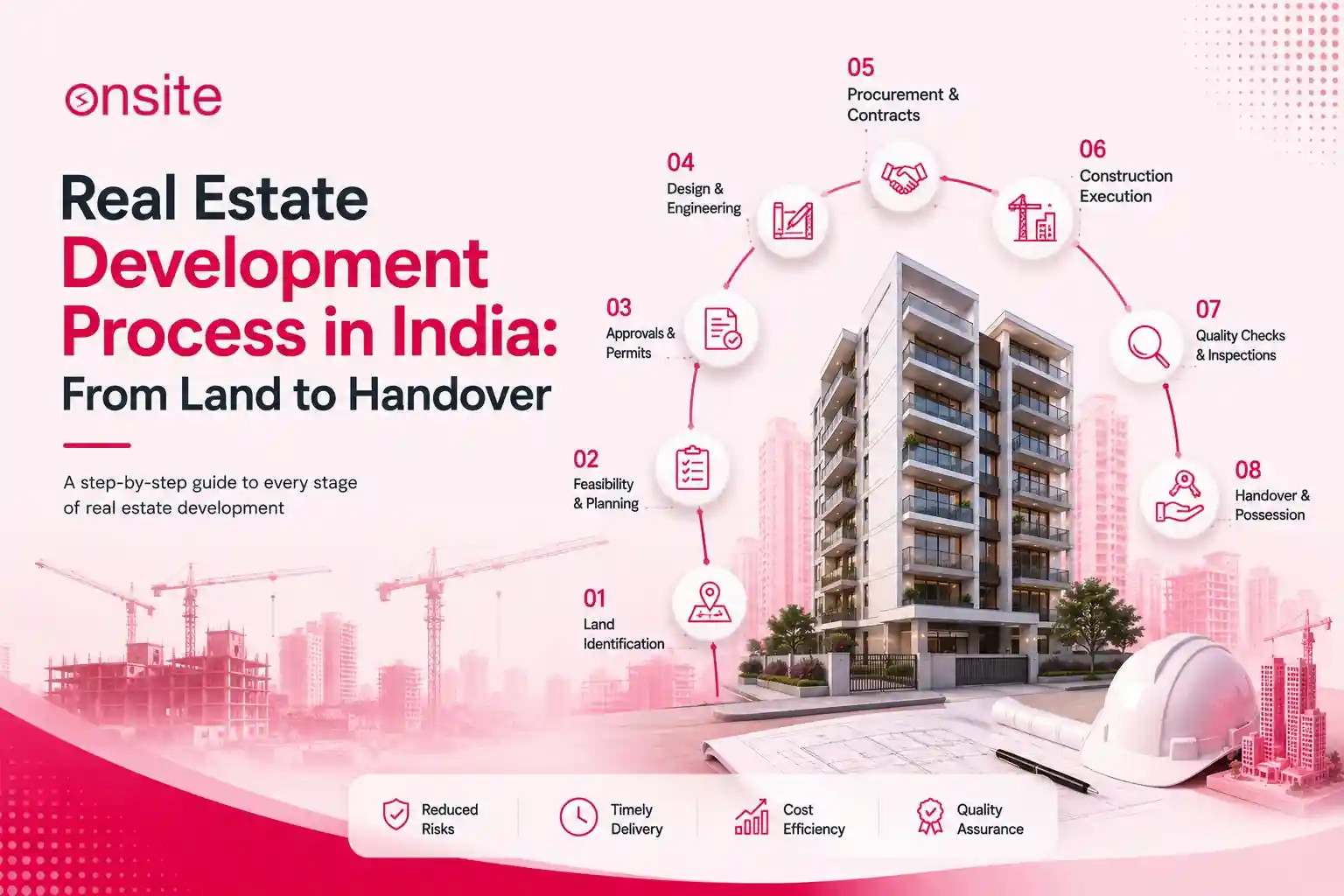
A real estate development process is a series of activities that need to be performed to develop a project, starting from an unidentified piece of land to a completed property. It includes multiple steps such as land acquisition, feasibility analysis, regulatory approvals, architectural and structural design, financing, construction, sales, statutory completion requirements, and customer handover. Each stage is connected to the previous one, forming a complete cycle of residential development in India, which typically spans several years.
Quick note: A real estate project goes through many stages before becoming a final property. There are distinct stages such as land identification and acquisition, feasibility assessment, planning and regulatory approvals, architectural and engineering design, project financing, construction, sales and customer collections, the statutory completion process, and property handover. In India, the Real Estate (Regulation and Development) Act, 2016 imposes specific registration and fund management requirements that affect how projects are disclosed, financed, and delivered to customers.
Real Estate Development Process Does Not Start With Construction
A buyer looking forward to a residential project often sees a showroom, a brochure, a floor plan, a price, a possession date, and eventually a finished apartment. However, behind every finished apartment, there is always a long process of decisions, planning, and risks that starts even before construction begins and continues until the building is complete.
The final product built on the site is just one part of the process. There is so much that happens behind the scenes. It involves checking whether the land is suitable for development, getting the required approvals, coordinating with architects and engineers, arranging project finance, managing customer commitments during the construction period, and finally handing over a property that meets legal requirements and buyers’ expectations.
Understanding the real estate development process means understanding all of these stages and how they connect to each other.
Stage 1: Finding the Land and Deciding Whether the Project Makes Sense
What is the most important question that comes to the mind when a real estate development process begins? It’s if this location makes a commercial sense of development or not!
Land evaluations mean a lot more than just asking price. Factors like employment opportunities, transportation and commuting, school and education, infrastructure and many other social amenities are considered by buyers before they invest in a project. Going through and crosschecking legal due diligence, unclear ownership, inherited disputes, and mortgages, only then an investor or a buyer get in the deep water of investing in a project.
The potential of a development is determined by the Floor Space Index or Floor Area Ratio, ratio of permissible built-up area to the plot area that differs by city, zone, and land use classification. In simpler words, A plot of a given size may allow substantially different amounts of construction allowed within city’s planning and blueprints.
Once all the basic parameters are established, the developer then makes a preliminary commercial assessment of the project. The main questions here are what type of product can be developed on the site, apartments, villas, commercial spaces, etc., what price per square foot the market in that location can support, what could be the approximate construction and development cost, and what kind of return on investment the project can generate over the complete development timeline.
Just because a land is physically available and looks commercially attractive does not mean that it is automatically suitable for development. Many projects fail at this initial stage because the permissible built-up area is not enough to justify the land cost, the expected selling price does not support the overall development cost, or there are legal risks associated with the land which the developer may not be willing to take.
Stage 2: Feasibility Comes Before the First Drawing
A real estate project moves forward only when the developer has established through a proper feasibility exercise that the numbers support the development.
A development feasibility assessment answers some very important questions. How much can be built on this land considering the applicable FSI, setbacks, height restrictions and other regulations? What price per square foot can be achieved for the type of unit being planned, based on the current market and comparable sales in that location? What will be the total cost of the project, including land cost, construction, design and consultant fees, regulatory charges, financing costs, sales and marketing expenses, and other overheads? How much time will the complete project take, from acquisition of the land to completion and handover? What approvals will be required and how long can the approval process take? And most importantly, after considering all the development, construction and financing costs, will the revenue generated from selling the units give a return that is worth the capital and risk involved?
At this stage, feasibility is mostly based on assumptions and projections rather than confirmed costs and final approvals. The purpose is not to prepare a perfectly accurate financial model, but to understand whether the project is commercially realistic and whether it is worth investing more time and capital into taking the project forward.
If a project passes the preliminary feasibility assessment, it can then move towards the approval and design stages. However, if it fails at this stage, the reasons can be different. The land price may be too high compared to what the market is willing to pay, the development potential may not be enough to generate a suitable return, or the approval process may take too long and create risks that make the project commercially unviable.
Stage 3: Approvals and Regulatory Requirements
The approval stage is one of the most difficult as well as least visible parts of real estate development. It is a stage that repeatedly affects project timelines in ways that are difficult for anyone to predict.
First, a building needs plan approval from the local authority or municipal corporation. This building plan approval can involve demonstrating compliance with zoning regulations, FSI limits, setback requirements, height restrictions, and building safety standards, depending on the size and location of the project.
Environmental assessments, fire department approvals, airport authority clearances, water and sewage authority approvals, and other requirements may also need to be obtained before construction can actually begin.
One of the most important requirements for residential projects in India is RERA registration. Under the Real Estate (Regulation and Development) Act, 2016, projects generally require registration unless they fall under specified exemptions. These include projects where the land area proposed to be developed does not exceed 500 square metres or the number of apartments does not exceed eight, inclusive of all phases.
Under RERA, promoters cannot advertise, market, book, or offer a project for sale without registering it with the relevant State or Union Territory RERA authority, subject to the applicable exemptions. The registration process requires developers to disclose project details, sanctioned plans, approvals, financial information, and the proposed completion schedule. These details are made available through the relevant RERA system.
RERA also has specific requirements for how project funds are managed. The Act requires 70 percent of the amounts received from allottees to be deposited into a separate bank account for the project. These funds can be used for the cost of land and construction, with withdrawals subject to the requirements and certifications specified under the Act.
This is intended to prevent the diversion of funds and ensure that money collected from buyers is used for the project for which it was collected. RERA therefore establishes an important legal and financial framework within which a real estate project is developed, sold, and delivered.
The approval stage is therefore one of the most necessary steps in the entire real estate development process.
Stage 4: Turning the Idea Into a Real Building
Once all the approvals are in place, the next stages of the process begin. Technical specifications come into the picture. Architectural designs are made to translate the approved planning parameters, such as FSI, height limits, setbacks, and unit count, into a configuration of floors, units, corridors, staircases, lifts, and common areas that fulfils the regulatory requirements.
The architect is responsible for producing drawings that cover every dimension of the building’s form and layout. This includes site planning, building configuration through floor plans, elevations, sections, and detailed internal layouts.
The structural design then converts the architectural form into an engineered structure. The structural engineer works from the architect’s layout and produces reinforcement drawings and specifications that form the technical basis of construction.
Once the structural design has been made, the electrical and MEP requirements come into the picture. MEP stands for mechanical, electrical, and plumbing. These designs cover the systems that make the building habitable, including electrical supply and distribution, water supply and drainage, fire protection, air conditioning, lifts, backup power, and communication infrastructure.
MEP designs need to be coordinated with both the architectural and structural drawings. Based on these designs, the BOQ is prepared by measuring everything required to build the property, including materials, components, and items of work required to complete the project.
It is a long process. Many drawings are revised and produced before a final decision is made. Every decision and every drawing needs to go through a careful review and approval process.
Stage 5: Financing the Project
Project finance is a stage of the real estate development process that is mostly invisible to buyers, but it has a direct impact on whether a project is completed on time, as promised, and with enough financial resources to deliver what was sold.
A residential project requires a large amount of money even before a single unit is sold. Land acquisition, regulatory charges, design and consultant fees, and the initial construction work all require spending before the money collected from customers starts covering these costs. Developers usually manage this initial investment through equity, which can be the developer’s own money or contributions from equity partners, project-specific debt such as loans from banks or housing finance companies, or a combination of both.
As construction moves forward and different milestones are completed, customer collections through the construction-linked payment plan become an important source of funding for the ongoing construction. The speed at which customers make their payments directly affects how quickly the construction can be funded. If customer collections are behind the payment schedule, the developer has less money available for construction than originally expected. This may result in taking additional debt, delaying certain phases of construction, or making changes to the construction programme.
RERA also requires seventy percent of the amounts collected from buyers to be kept in a designated project account and withdrawn only against certified completion percentages. In simple terms, the purpose is to make sure that the money collected from buyers for a particular project is used for the land and construction of that same project, instead of being used somewhere else.
The financial structure of a project no matter how much money comes from equity, how much comes from debt, what is the cost of that debt, and what security is involved, affects the developer’s financial flexibility throughout the development cycle. Projects that have low equity and high debt costs are generally more exposed to delays, cost overruns, and changes in the market compared to projects that have a stronger financial foundation.
Stage 6: Construction Begins, but the Project Is Still Being Managed From Many Directions
Construction is the most visible stage of a real estate development project and the stage that buyers usually associate with the actual existence of a project. But at the same time, it is also the stage where the developer has to manage many different responsibilities at the same time.
The main contractor or contractors are brought to the site and the labour is recruited and deployed. Material supply chains are arranged for concrete, reinforcement steel, brickwork, finishing materials, and other specialised components. Subcontractors for MEP systems, waterproofing, external works, and other specialised activities are appointed and coordinated. The consultant team, including the architect, structural engineer, and MEP engineer, continues to provide drawings, respond to questions from the site team, and manage design changes whenever construction brings up conditions or requirements that were not identified during the design stage.
The progress of construction is continuously tracked against the approved construction programme. The costs are monitored against the project budget, while the quality of work is checked against the technical specifications. Regulatory inspections at different stages of construction also need to be managed and properly certified.
What makes construction management in real estate development different from construction management in general is that the developer is not only responsible for the physical construction. At the same time, they also have to manage customer relationships, regulatory requirements, project finances, contractors, consultants, and several other aspects of the project. A contractor’s main responsibility is to build what they have been hired to build. A developer’s responsibility, however, goes much beyond the construction itself.
Stage 7: Sales Often Begin While Construction Is Still Underway
The difference between residential real estate development and other industries is that the product is often sold before it is completed, and sometimes even before construction has begun.
Under RERA, a developer can offer units for sale only after the project has been registered with the relevant state authority. This means that sales can take place during the construction process. A buyer agrees to pay for the property even before the final product is delivered.
A buyer looks at the development plans, approvals, specifications, and construction schedule before making any financial commitment. This makes the management of residential projects more critical, particularly when considering sales, construction progress, and collections.
Collections from buyers under construction-linked payment plans are tied to defined construction milestones. When the real estate project remains on schedule, collections proceed as projected. However, when construction is delayed, the collection milestone is reached later. This affects the developer’s funding position as well as the buyer’s expectations.
Stage 8: The Project Has to Be Delivered, Not Just Built
There is a huge difference between completing a project and delivering a project to the customer. The difference is often underestimated.
Construction completion means that the structure and finishing work across all the units, the entire tower, and the common areas have been completed according to the specifications. However, handing over a project to a customer cannot be done until the statutory completion requirements have been satisfied.
In India, this generally includes obtaining an Occupancy Certificate or Completion Certificate from the relevant local authority. This confirms that the building has been constructed in accordance with the approved plans and meets applicable safety, fire, and structural standards.
A developer needs to make sure that all utility connections are established and operational before residents can move into the building. The common areas, landscaping, amenities, lifts, generators, and security infrastructure also need to be completed, commissioned, and tested.
The fire safety system should be inspected and certified. The residents’ welfare association or housing society must be formed where applicable, and the common infrastructure must be transferred to its management.
When it comes to individual units, each one should undergo snagging and inspection to confirm that everything meets the agreed specifications and to identify any defects before the buyer finally takes possession.
All of these steps need to be completed before the project can be properly delivered to the buyer.
What Buyers See vs What Developers Actually Manage
| What a Buyer Sees | What Happens Behind It |
|---|---|
| Apartment unit | Design, structural engineering, MEP coordination, and finishing to specification |
| Possession date | Construction schedule, approval timelines, and statutory completion requirements |
| Purchase price | Land cost, project finance, construction cost, consultant fees, marketing, and development overhead |
| Amenities | Separate planning, procurement, specialist contractors, and commissioning |
| Handover | Occupancy certificate, utility connections, snagging, society formation, and final payment |
What Can Delay a Real Estate Development Process
Delays can occur at any stage of the project lifecycle, and they rarely occur from a single cause. There are multiple factors that can cause delays, but there are some common categories that are relevant to any buyer or professional seeking to understand project risk.
Land or title issues: Any land or title issues that were not fully resolved before acquisition can resurface during construction in the form of legal challenges, encumbrances, or boundary disputes.
Approval delays: Approval delays can come from planning authorities, government bodies, other departments, or utility companies, and are among the most common reasons why real estate projects are delayed. All of these things can happen because they are not under the builder’s or developer’s direct control.
Design changes: Changes can also occur during the construction period. Designs can change due to client requests, revised specifications, or site conditions. This can lead to additional work and rework, which can affect the construction programme.
Financing constraints: There are many factors that can affect the financing of a project, such as slower-than-projected sales, collection shortfalls, or changes in debt availability.
Contractor performance: There can be problems with contractor performance, such as subcontractor delays, labour shortages, equipment availability, and so on. These can have a direct effect on construction.
There are also market conditions that can directly affect many other things in a construction project. For example, slower sales may lead a developer to change the product mix or reconsider a development phase, which may alter the construction programme in ways that were not initially anticipated.
How the Real Estate Development Process Has Changed
There have been many changes in the real estate development industry in India over the past decade. These changes have been largely driven by regulatory reforms, institutional investments, and shifts in buyer expectations.
The implementation of RERA also brought greater regulatory transparency that was previously absent from the industry. Requirements such as mandatory project registration, disclosure of approvals and timelines, separation of project funds into designated accounts, and public availability of project information have significantly changed how projects are monitored and disclosed through RERA portals.
For buyers, lenders, and investors, the scale of the industry is also important. According to an Economic Survey of India, the construction sector accounted for 7.8 percent of India’s nominal GDP in FY26, while financial, real estate, and professional services contributed 21.4 percent. These figures reflect the scale and economic significance of the real estate and construction industry and the context in which regulatory reforms have been pursued.
Technology has also become an increasingly relevant part of how real estate projects are monitored and managed during execution. Digital construction management platforms, including Onsite, are used by developers to track construction progress against the approved schedule, monitor material procurement and expenditure against the project budget, and generate structured project records that support RERA compliance reporting and lender monitoring requirements.
A Real Estate Project Lifecycle at a Glance
The full lifecycle of a residential real estate development passes through the following stages in sequence, with each stage creating the conditions for the next to proceed.
| Stage | Primary Activity |
|---|---|
| Land | Site identification, due diligence, acquisition |
| Feasibility | Commercial viability assessment |
| Approvals | Planning permissions, statutory clearances, RERA registration |
| Design | Architectural, structural, MEP drawings and BOQ |
| Financing | Equity structuring, project debt, financial planning |
| Construction | Contractor mobilisation, site execution, progress monitoring |
| Sales | Marketing, bookings, customer agreements, collection management |
| Completion | Occupancy certificate, utility connections, common area commissioning |
| Handover | Snagging, unit inspections, possession proceedings, society formation |
Conclusion
A real estate project often reaches a lot of complexity because the real estate development process contains multiple steps. It is a sequence of commercial, regulatory, financial, design, and construction decisions that have to be brought together so that they can be managed as a complete property.
Each stage carries its own risks, timelines, and dependencies. Understanding these stages and the problems that can occur throughout the process can help you understand what separates an informed participant in the real estate market from one who is surprised by outcomes that were predictable.
Want to manage your multiple construction projects at one place?
FAQs
What is the real estate development process
The real estate development process is the full sequence of activities that takes a project from an identified piece of land to a completed, delivered property. It includes land acquisition and due diligence, feasibility assessment, planning and regulatory approvals, architectural and engineering design, project financing, construction, sales and customer collection management, statutory completion processes, and property handover to individual buyers. In India, the process is shaped by RERA registration requirements that apply to projects above the prescribed threshold and impose specific obligations on project disclosure, fund management, timeline adherence, and communication with buyers throughout the development period.
What are the main stages of a real estate project
The main stages of a real estate project are land identification and acquisition, feasibility analysis, regulatory approvals, design and engineering, project financing, construction, sales and collections, statutory completion, and customer handover. These stages do not always proceed in a strict linear sequence — design, approvals, financing, and sales typically overlap with each other and with the early stages of construction. The construction stage, while the most visible to buyers, is preceded by a substantial period of commercial, regulatory, and financial groundwork that determines whether construction can begin at all, and on what financial and regulatory terms.
How long does a real estate project take to complete
The total duration of a real estate development from initial land assessment to final customer handover typically ranges from four to seven years for a mid-to-large residential project in India, though the timeline varies significantly depending on project scale, regulatory environment, and market conditions. The construction period itself is typically two to four years. The stages before construction — land acquisition, approvals, design, and financing — routinely add a further one to two years. Post-construction completion requirements, including obtaining an occupancy certificate, utility connections, snagging, and possession proceedings, add additional months to the total project timeline.
What happens before construction begins
Before construction begins, a developer must complete land acquisition with clear title, obtain the statutory planning and building approvals required by the relevant municipal or planning authority, register the project with the state RERA authority if it meets the prescribed threshold, finalise the architectural and structural design to a level of detail sufficient to begin construction, and establish the project financing structure. In practice, design and approval activities overlap substantially, and RERA registration typically occurs once sufficient approvals are in place. Each of these steps takes several months and involves multiple specialists, regulators, and legal processes.
When does a developer start selling a residential project
Under RERA, a developer may begin marketing and selling residential units only after the project has been registered with the relevant state real estate regulatory authority. Registration requires the developer to provide land details, approvals obtained, project plans, expected timeline, and financial information, which are then made available on the public RERA portal. Developers typically begin sales shortly after receiving initial planning approvals and completing RERA registration, well before construction reaches the structural phase. Buyers who purchase at this early stage commit to a construction-linked payment plan typically spread over a two-to-four-year construction and completion period.
What is the role of RERA in a real estate project
The Real Estate (Regulation and Development) Act 2016, administered by the Ministry of Housing and Urban Affairs, requires residential developers to register projects with the relevant state regulator before marketing or selling units. RERA imposes obligations to disclose project information publicly, deposit seventy percent of buyer payments into a designated project account, and make withdrawals only against certified construction progress. It also establishes a framework for buyer grievance redressal, developer accountability for delays, and regulation of real estate agents. The Act significantly changed the information environment for buyers and increased the accountability framework for developers across India.
What is the difference between construction and real estate development
Construction is one stage within the broader real estate development process. A contractor’s responsibility is to build the contracted scope of work on time and within budget. A developer’s responsibility begins long before construction — identifying and acquiring land, conducting feasibility analysis, obtaining regulatory approvals, arranging financing, designing the building, establishing sales and customer commitments — and continues long after construction ends, through statutory completion requirements, occupancy certification, utility connections, snagging, and handover. Real estate development is the commercial and organisational process that makes construction possible and ultimately converts a finished building into a properly delivered property.
Why do real estate projects get delayed
Real estate projects are delayed by a combination of factors that affect any stage of the development lifecycle. The most common causes include regulatory approval delays that extend the pre-construction period, design changes requiring rework, financing constraints from slower-than-projected sales or collection shortfalls, contractor performance issues, material availability problems, and statutory completion requirements that take longer than anticipated. Most significant delays in real estate development involve multiple contributing factors rather than a single identifiable cause, and the consequences of any delay at one stage typically compound through every subsequent stage of the project lifecycle.
What happens between construction completion and possession
Between construction completion and handover, a developer must satisfy several requirements that are independent of the physical completion of the building. An Occupancy Certificate must be obtained from the local authority confirming the structure meets approved plans and applicable safety standards. Utility connections must be established and operational. Common areas, lifts, amenities, and fire systems must be commissioned. Each unit must be snagged and defects resolved before possession is offered. The Residents’ Welfare Association or housing society must be formed. Only then can formal possession proceed and the developer receive the final payment.
