
Vendor Billing Software for Construction
Manage Subcontractor, Material & Equipment Bills in One Place
Vendor overbilling in construction passes through manual approval processes undetected because the three documents needed to catch it, the purchase order, the delivery record, and the vendor invoice, never exist in the same place at the same time. Onsite vendor billing software for construction connects all three automatically so every material, subcontractor, and equipment bill is validated against verified site data before any approval begins.

Material bills matched against PO quantities and GRN delivery records before approval
Subcontractor bills linked to verified executed quantities and milestone completion
Equipment hire bills validated against recorded usage duration before payment authorization
Trusted by 10,000+ Construction Companies Worldwide
Construction teams plan activities, track progress, and stay ahead of delays with Onsite construction planning software.

Built for Construction Companies Where Vendor Overbilling Passes Through Undetected Every Month
Onsite vendor billing software for construction is designed for procurement teams, project managers, and finance teams managing high volumes of vendor invoices across multiple concurrent projects where manual verification is inconsistent and overbilling accumulates before anyone notices.
01
Contractors and Developers
Contractors and developers processing material bills, subcontractor running bills, and equipment hire invoices across concurrent projects cannot manually verify every invoice against delivery records and purchase orders at the volume active construction generates. Onsite gives procurement and finance teams automated three-way matching that compares every vendor bill against the PO and GRN before routing it to an approver, catching overbilling at the source rather than during a post-payment review.
02
Infra and EPC Companies
Infrastructure and EPC companies managing large volumes of material procurement, subcontractor packages, and equipment hire across multi-site projects face vendor billing complexity that manual Excel-based reconciliation cannot handle at scale. Onsite connects procurement, delivery verification, and vendor billing in one platform so every invoice across every site is matched against its corresponding purchase order and delivery record automatically before any payment authorization decision is made by the approving team.
03
Interior and Fit-Out Firms
Interior and fit-out firms managing multiple concurrent residential and commercial projects engage a high volume of material suppliers and trade subcontractors whose bills arrive simultaneously across different projects at different stages. Without a structured verification system, bills that are approximately correct pass approval while discrepancies accumulate silently. Onsite gives interior firms project-wise and vendor-wise bill tracking with delivery verification and approval workflows that bring discipline to vendor billing without adding administrative overhead to the project team.
04
PMC and Project Management Consultants
PMC teams overseeing construction projects on behalf of developers and owners are responsible for certifying that vendor payments made by the main contractor or directly by the client are justified by verified delivery and execution. Onsite gives PMC teams visibility into vendor bill status, GRN records, PO comparisons, and approval audit trails across all active projects so certification decisions are based on verified data rather than contractor assurances and submitted documents that cannot be independently verified.
From Purchase Order to Payment Authorization: How Onsite Vendor Billing Software for Construction Works
Onsite connects purchase order creation, GRN-based delivery verification, vendor invoice entry, automated three-way matching, and multi-level payment approval in one continuous workflow so vendor bills are validated against verified site data before any human approver sees them.
Material Bill Verification Against PO and GRN
When a vendor submits a material invoice, Onsite compares it automatically against the original purchase order and the goods receipt note recorded at site delivery before routing it to any approver. The comparison checks quantities billed against quantities ordered in the PO and quantities confirmed as received in the GRN. Any discrepancy between the three documents, quantity inflation, rate variation from the agreed PO rate, or billing for a delivery not recorded in the GRN, is flagged with specific details before any human approver sees the invoice, preventing overbilling at the point where it can still be investigated.
Subcontractor Bill Validation Against Executed Quantities
Subcontractor invoices in Onsite are linked to the specific work order covering the subcontractor’s scope before any bill amount is calculated. Payment is generated from verified executed quantities recorded against work order line items rather than from the subcontractor’s claimed completion percentage. When a subcontractor submits a bill, the system compares the claimed amount against the progress record in the system. Bills that exceed verified execution are flagged before approval. Bills that align with verified progress proceed to the approval workflow with the progress evidence attached, giving approvers the specific data they need to authorize payment with confidence.
Equipment Hire Bill Validation Against Usage Records
Equipment hire invoices are validated in Onsite against usage duration records captured during project execution before billing amounts are calculated or approved. When equipment is deployed to a site, usage is recorded daily so that when the hire invoice arrives, the billed duration can be compared against the recorded usage period. Discrepancies between billed hours or days and recorded usage surface before approval rather than after payment. For projects with significant equipment hire expenditure across multiple plant items, the cumulative overbilling that manual hire invoice processing misses represents a consistent and preventable budget leak.
Multi-Level Approval Workflows with Budget Visibility
Vendor bills that pass three-way matching in Onsite enter a defined multi-level approval workflow configured based on bill value, bill type, and project role. Approvers see the bill amount, the matching verification result, the project budget position, and the remaining budget allocation for the relevant cost head before authorizing payment. Approvals above defined value thresholds route to higher authority levels automatically. Every approval decision creates a timestamped audit trail showing who approved what bill, on what date, with what information available at the point of approval, maintaining complete accountability across every vendor payment the project makes.
Why Vendor Overbilling Passes Through Construction Billing Processes Undetected?
Most vendor overbilling in construction is not caused by dishonest vendors in isolation. It is caused by approval processes that have no mechanism to compare what was billed against what was actually delivered or completed before payment is authorized.
Invoices Approved Against Purchase Orders Without Checking Delivery Records
The standard vendor bill approval process compares the invoice rate against the purchase order rate, finds them matching, and routes for payment. Nobody checks the billed quantity against the delivery record because the GRN exists at site while the invoice is processed in the accounts office. The three-way match that would catch quantity overbilling never happens because all three documents never occupy the same process simultaneously. Vendors who bill for quantities slightly above delivered quantities know this gap exists and exploit it consistently across billing cycles on projects where no verification mechanism catches the discrepancy before payment.
Subcontractor Bills Approved on Approximate Progress Impressions
Subcontractors submit bills claiming a percentage of their contract value as earned payment. The project manager reviews the claimed percentage against their general impression of how site progress looks and decides whether it seems approximately right. Bills are approved because the amount seems consistent with the construction stage rather than because anyone has measured and recorded the specific quantities the bill is claiming payment for. On projects where subcontractors represent thirty to fifty percent of total cost, the difference between paying against approximate impressions and paying against verified executed quantities accumulates into material financial overexposure across the full project duration.
Equipment Hire Bills Accepted Without Verifying Actual Usage
Equipment hire invoices arrive showing a hire period and a daily or weekly rate. The accounts team checks that the rate matches the hire agreement and approves the bill for the stated period. Nobody verifies whether the equipment was actually deployed and productive during the billed period, whether it sat idle on site during part of the period and should not be billed, or whether it was demobilized earlier than the invoice date suggests. Equipment hire overbilling through inflated usage periods is among the most consistent and least frequently caught forms of vendor overbilling on Indian infrastructure and civil construction projects.
No Audit Trail When Vendor Payment Disputes Arise
When a vendor payment dispute arises, resolution depends on documentation showing what was ordered, what was delivered, and what was paid for. Manual billing processes where POs exist in procurement files, delivery notes exist at site, and invoices exist in accounts produce three separate trails that cannot be easily reconciled at the point of dispute. The contractor who cannot produce a coherent document trail showing the verification basis for each payment has no defensible position regardless of what actually occurred during delivery and execution. Most vendor disputes in Indian construction are settled by negotiation rather than evidence because the evidence was never organized in one place.
Core Features of Onsite Vendor Billing Software for Construction
Control material bill verification, subcontractor bill validation, equipment hire billing, payment tracking, and approval workflows across every active project and every vendor relationship from one connected platform.
Three-Way Bill Matching
PO · GRN · Invoice — auto-compared before approval
3 flagged
24 cleared
Matched
24
Qty flag
1
Rate flag
1
Duplicate
1
Bill#B291 — Cement
PO
GRN
Invoice
OPC 53 Grade
bags · ₹420/bag agreed
320
318 ✓
340+22 bags ⚠
Delivery charges
lump sum · PO rate
₹4,200
₹4,200 ✓
₹6,800+₹2,600 ⚠
Discrepancies Detected Before any approval
Bill#B291 — 22 bags billed, not delivered
Invoice 340 vs GRN 318 · ₹9,240 overcharge
Qty flag
Bill#B291 — delivery rate not in PO
Charged ₹6,800 vs agreed ₹4,200 · +₹2,600
Rate creep
Bill#B287 — duplicate of B284
Same vendor · same amount · 8-day gap · blocked
Duplicate
₹0
Overpaid this cycle
₹11.8K
Overcharge blocked
Auto
Before approval
Three-Way Bill Matching Against PO and GRN
Every material vendor invoice entering Onsite is automatically compared against the original purchase order for agreed quantities and rates and against the goods receipt note for delivered quantities before any approval workflow begins. Discrepancies between the three documents are flagged with specific details, which line item, what quantity difference, what rate variance, so approvers act on evidence rather than approving invoices that appear reasonable in isolation. Three-way matching catches quantity inflation, rate creep across billing cycles, billing for undelivered materials, and duplicate invoices before payment is authorized rather than during post-payment reconciliation.
Automatic comparison of invoice quantities against PO and GRN before approval
Rate verification against agreed PO rates across every vendor billing cycle
Duplicate invoice detection preventing double payment across billing periods
Subcontractor Bill Validation Against Work Order Progress
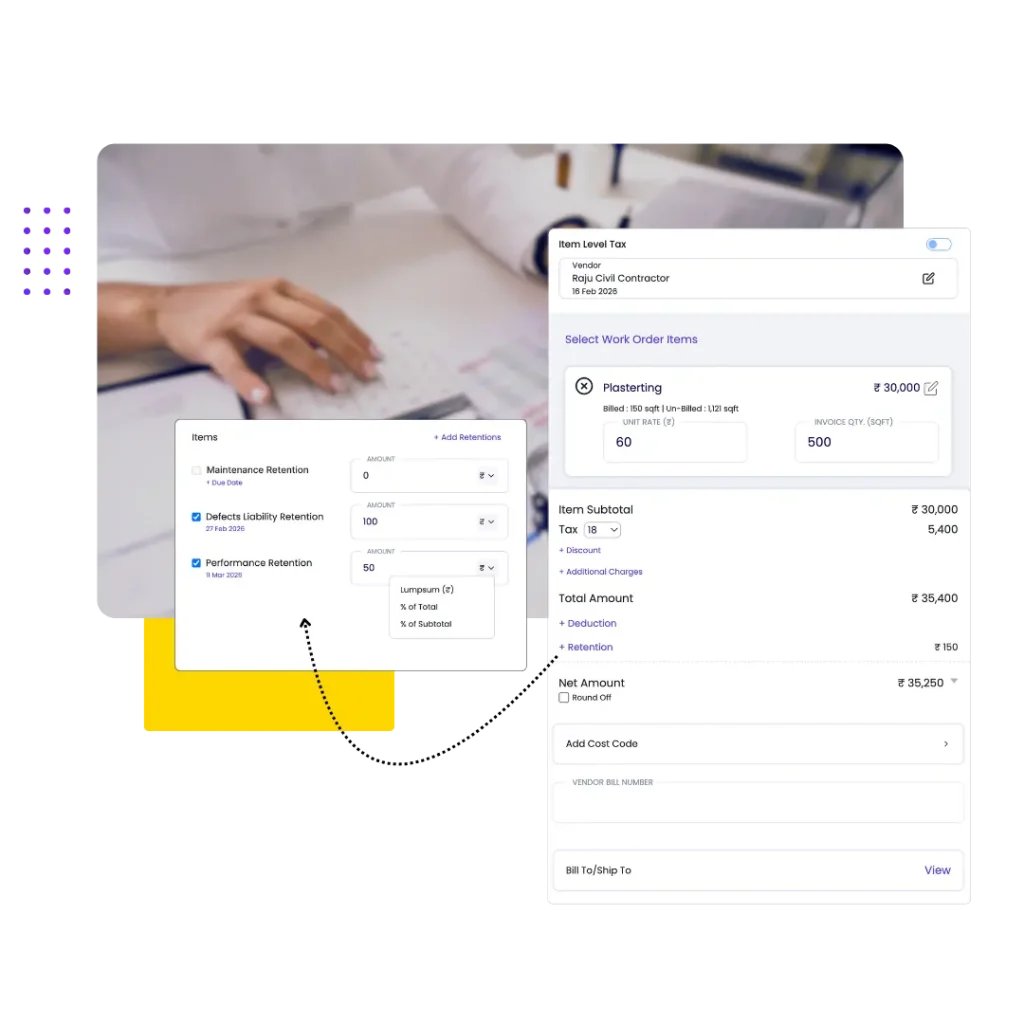
Subcontractor bills in Onsite are generated from verified executed quantities recorded against specific work order line items rather than from claimed completion percentages reviewed informally by project managers. When a subcontractor submits a bill, the system compares the claimed amount against the progress record and flags any bill that claims payment for completion percentages exceeding verified execution. Retention deductions apply automatically per contract terms with full visibility into retention accumulated, retention released, and retention balance across every subcontractor engagement across all active projects simultaneously without manual retention calculation.
Subcontractor Bill Validation
Verified execution · Auto retention · Progress-matched
9 cleared
1 flagged
SC-Bill#044 — RK Civil Works
RCC column work · Block A · Floors 10–14
Exceeds verified
Gap flagged before approval
+15% unverified · ₹2.4L blocked
Retention Tracker — All Active Subcons
Auto-calculated
Subcontractor
Accum.
Released
Balance
RK Civil Works
RCC · 5% ret.
₹3.8L
₹1.2L
₹2.6L
Rajan Electricals
MEP · 5% ret.
₹1.9L
₹0
₹1.9L
Sharma Plumbing
MEP · 5% ret.
₹0.8L
₹0.8L
₹0
9
Bills verified
1
Claim flagged
₹6.5L
Retention held
Budget
₹4.2Cr
All projects
Committed
₹2.9Cr
▲ 69% utilised
Paid
₹2.1Cr
▲ On schedule
Outstanding
₹0.8Cr
▼ 3 bills due
Project vs Budget
Orchid Towers
72% · ₹1.8Cr
NH-48 Highway
58% · ₹0.7Cr
Villa Interiors
88% · ₹0.4Cr
Vendor History
RK Civil Works
Subcontractor
₹3.2L
Cleared
₹0 outstanding
Shri Cement
Material supplier
₹1.84L
Flagged
₹12K disputed
KE Cranes
Equipment hire
₹54K
Partial
₹18K pending
Real-time
Budget updated
3
Projects tracked
₹30K
Disputes held
Project-wise and Vendor-wise Payment Tracking with Budget Linkage
Every vendor bill processed through Onsite updates the project budget in real time as it moves through verification and approval, giving project managers and finance teams current visibility into committed vendor expenditure against budget allocation for each cost head across all active projects. Vendor-wise tracking shows the complete payment history for each supplier or subcontractor including bills processed, amounts approved, payments released, and balances outstanding. Project-wise tracking shows the total vendor expenditure position for each active project against its budget without requiring manual compilation from individual payment records across multiple spreadsheets and email threads.
Real-time budget update as vendor bills pass through verification and approval
Vendor-wise payment history with bills processed, approved, and outstanding
Project-wise vendor expenditure visible against budget allocation across all projects
How Onsite Simplifies Vendor Billing for Construction Finance and Procurement Teams?
Most vendor billing problems in construction originate from the gap between where purchase orders are created, where deliveries are recorded, and where invoices are processed. Onsite closes this gap by connecting all three in one workflow that runs verification automatically before any human approver is involved.
01
Purchase Order Created with Agreed Quantities and Rates
Every procurement commitment in Onsite begins with a purchase order linked to a specific project, a specific BOQ cost head, and the agreed quantities and rates that form the reference document for all subsequent delivery and billing verification. The PO is the commercial agreement. Everything that happens at delivery and billing is measured against it. When the PO exists in the same system as the delivery record and the vendor invoice, three-way matching happens automatically. When it exists in a separate procurement file, it never happens consistently.
02
GRN Recorded at Point of Delivery from Mobile
When materials arrive at site, the site engineer or storekeeper records the received quantities against the specific PO line items through the Onsite mobile app at the time of delivery rather than retrospectively. The GRN entry captures what actually arrived, not what the delivery note says arrived. When the GRN is recorded at point of delivery against the PO, it is a verified record. When it is recorded from memory the following day from a signed delivery challan, it reflects what the driver said was delivered rather than what was counted.
03
Vendor Invoice Enters the System and Matching Runs Automatically
When the vendor submits their invoice, it enters Onsite against the specific PO it relates to. The system immediately compares the invoice quantities and rates against the PO and the GRN simultaneously. Any discrepancy is flagged before the invoice is visible to an approver. Invoices that pass matching proceed to the approval workflow with the verification result attached. Invoices that fail matching are held with specific details about the discrepancy so the procurement team can investigate and resolve before payment is considered.
04
Multi-Level Approval with Full Visibility Before Authorization
Verified invoices route through the approval hierarchy configured for the project based on bill value and bill type. Each approver sees the invoice amount, the three-way matching result, the vendor’s payment history, and the current budget position for the relevant cost head before making an authorization decision. The approval decision and the information available at the time of approval are both recorded in the audit trail. When a vendor payment is questioned later, the audit trail shows exactly who approved it, when, and on what basis.
What Construction Companies Say About Onsite
Construction Vendor Billing Software?
Customer Success Story
“
Our accounts team was approving vendor bills without ever seeing the purchase order or the delivery record. The three documents were in three different places — one with procurement, one with the store, one with accounts — and nobody was comparing them. Onsite brought all three together automatically. The moment a vendor bill is submitted, the system matches it against the PO rate and the GRN quantity before anyone even sees it. In the first quarter after we went live, we recovered over ₹4.2 lakhs in overbilled amounts that would have simply been paid.
₹4.2L
Overbilled amounts recovered in the first quarter after going live
★
★
★
★
★
✕ Before Onsite
PO, GRN, and vendor bill in three separate places · Accounts approving bills with no cross-check · Overbilling paid without detection every month
→
✓ After Onsite
Automatic 3-way match before any approval begins · Rate and quantity discrepancies flagged instantly · ₹4.2L recovered in the first three months
Mr. Ramesh Babu, Managing Director
Fortis Constructions Pvt. Ltd. · Commercial & Industrial Projects · Hyderabad, Telangana
Why Excel and WhatsApp Cannot Handle Construction Vendor Billing Verification?
Excel tracks what someone enters. WhatsApp carries what someone sends. Neither can compare a vendor invoice against a purchase order and a site delivery record automatically before an approver sees the bill.
Excel cannot perform three-way matching automatically, comparing invoice quantities against PO quantities and GRN quantities requires manual cross-referencing of three separate documents that rarely occupy the same spreadsheet at the same time
WhatsApp delivery photos have no connection to the purchase order they are supposed to verify, a photograph of materials arriving at site is not a goods receipt note and cannot be compared against a specific PO line item automatically
Excel approval tracking cannot enforce that a bill has passed quantity and rate verification before routing to the approver, a bill that moves from the accounts team to the project manager through email has no built-in mechanism to confirm that verification happened
Vendor-wise and project-wise payment visibility across multiple concurrent projects cannot be maintained in Excel without manual compilation that is always several days behind current payment status and always dependent on someone having updated their spreadsheet
Additional Features That Strengthen Vendor Billing Control
Beyond core bill verification and approval workflows, Onsite provides a full set of vendor billing support tools that connect invoice management to procurement, budget tracking, and financial reporting.
Vendor Ledger and Balance Tracking
Maintain a complete ledger for every vendor showing bills raised, amounts approved, payments released, and outstanding balances across all active projects. Vendor ledger visibility eliminates the manual reconciliation required to know what is owed to each supplier at any given point.
Duplicate Invoice Detection
Onsite automatically identifies invoices that match a previously processed invoice number or a previously billed PO and delivery combination before routing for approval. Duplicate billing across separate billing cycles is detected at the entry point rather than discovered during a post-payment reconciliation exercise.
GST and Tax Tracking on Vendor Bills
Record GST amounts, HSN codes, and tax components on every vendor invoice for accurate input tax credit tracking and reconciliation with vendor GST filings. Tax amounts verified against invoice data before approval so discrepancies are identified before payment rather than during quarterly filing.
Vendor Performance Analytics
Track delivery accuracy, billing accuracy, and payment dispute frequency by vendor across all active and completed projects. Identify which vendors consistently deliver correct quantities and bill accurately versus which ones require additional verification attention on every invoice cycle.
Tally and Zoho Books Integration
Approved vendor bills sync automatically to Tally or Zoho Books without manual re-entry, maintaining consistency between the construction project management system and the company’s accounting software. Vendor payments processed in Onsite update the accounting system automatically so financial records remain current without duplicate data entry.
Outstanding Bills Dashboard
View all pending vendor bills across every active project from one consolidated dashboard showing bill amount, submission date, current verification status, approval stage, and days outstanding. Finance teams manage vendor payment obligations from a current view rather than compiling outstanding balances from separate project records.
4 Tips to Manage Construction Vendor Billing More Efficiently
The vendor billing system works only if the three documents it relies on PO, GRN, and invoice are created accurately and on time. These four practices determine whether three-way matching catches overbilling or simply confirms what was already entered incorrectly.
Create the GRN at the Point of Delivery Not Retrospectively
A GRN created from memory the following morning reflects what the supervisor remembers was delivered. A GRN created at the time of delivery by the person who counted the materials reflects what actually arrived. The accuracy of three-way matching depends entirely on the accuracy of the GRN feeding it. Establish a site-level requirement that no delivery is accepted without a GRN created during receipt with the specific PO line items verified. This single practice closes the delivery quantity gap that is responsible for the majority of material vendor overbilling on Indian construction projects.
Never Approve a Vendor Bill Without a Verified GRN Reference
An approval workflow that allows bills to proceed without a linked GRN is an approval workflow that cannot prevent delivery-quantity overbilling regardless of how many approver levels it has. Build the GRN reference as a mandatory field in the vendor bill entry process so bills without a corresponding delivery record cannot enter the approval workflow at all. This structural requirement means GRN creation happens because bill processing depends on it rather than because site teams remember to prioritize it during active delivery management when multiple deliveries arrive simultaneously.
Track Rate Changes Across Consecutive Billing Cycles
Vendor overbilling through rate creep, where invoice rates drift slightly above PO rates in later billing cycles, is consistently missed in manual processes because the difference per invoice appears within normal variance. Configure three-way matching to flag any invoice rate that differs from the PO rate rather than allowing a tolerance vendors can exploit. Rate variances should require formal PO amendment authorization before acceptance rather than informal approval from someone who did not notice the difference while reviewing a high-volume invoice queue.
Review Vendor-Wise Payment Analytics Quarterly
Quarterly review of vendor billing analytics reveals patterns that individual invoice verification cannot identify. Which vendors consistently have GRN quantity mismatches. Which vendors submit rate variations in later billing cycles. Which vendors have the highest billing dispute frequency. These patterns identify vendors requiring additional verification attention and vendors whose billing accuracy justifies a streamlined approval process. Directing verification intensity based on vendor billing history rather than applying the same process uniformly to every vendor uses the finance team’s time more effectively and focuses scrutiny where overbilling risk is highest.

Stop Paying for Materials Not Delivered and Work Not Completed. Start Verifying with Onsite.
Every vendor bill approved without three-way matching against the purchase order and delivery record is a bill that could contain overbilling the approval process has no mechanism to detect. Onsite vendor billing software for construction connects PO, GRN, and vendor invoice in one automated verification workflow so discrepancies surface before payment is authorized rather than after it has already been made.
FAQs
What is Onsite vendor billing software for construction?
Onsite vendor billing software for construction gives contractors, developers, infra companies, and PMC teams a structured digital system for validating material invoices, subcontractor bills, and equipment hire charges against purchase orders and site delivery records before any payment approval begins. Every vendor bill passes through automated three-way matching that compares the invoice against the PO and GRN simultaneously, flags discrepancies with specific details, and routes verified bills through a defined multi-level approval workflow. The complete audit trail from purchase order through delivery verification through payment authorization is available in the platform at any time.
How does Onsite prevent vendor overbilling on construction projects?
Onsite prevents vendor overbilling through automated three-way matching that compares the vendor invoice quantity against the purchase order quantity and the goods receipt note quantity before any approver sees the bill. When a vendor bills for more than was delivered, the discrepancy appears as a specific flag showing the exact quantity difference before payment is authorized. Rate variances from the agreed PO rate across billing cycles are similarly flagged. The matching happens automatically at the point of invoice entry rather than requiring a member of the accounts team to manually cross-reference three separate documents for every invoice.
How does Onsite validate subcontractor bills?
Onsite links every subcontractor bill to the specific work order covering the subcontractor’s scope. As the subcontractor executes work, progress is recorded against specific work order line items creating a verified completion record. When the subcontractor submits a bill, the claimed amount is compared against this verified progress record rather than against the project manager’s impression of how site progress looks. Bills claiming payment for completion percentages exceeding verified execution are flagged before the approval workflow begins. Retention deduction applies automatically per contract terms with full visibility into retention accumulated and released across every subcontractor engagement.
Can Onsite track equipment hire billing against actual usage?
Yes. Onsite records equipment deployment and usage duration at site as equipment is assigned to project activities. When the equipment hire invoice arrives, the billed period is compared against the recorded usage period from site records. Discrepancies between billed hours or days and recorded deployment duration are flagged before the invoice enters the approval workflow. For projects with significant plant and machinery hire expenditure, this usage-based validation prevents the consistent overbilling that occurs when hire invoices are approved against the vendor’s stated period without reference to independently recorded site usage data.
What is three-way matching and how does it work in Onsite?
Three-way matching compares three documents before any vendor payment is authorized: the purchase order specifying agreed quantities and rates, the goods receipt note recording what was actually delivered to site, and the vendor invoice claiming payment for delivered goods. All three must agree on quantities and rates for the invoice to proceed to approval. When any two documents disagree, the invoice is held with a specific flag showing which document shows which figure. In Onsite this comparison runs automatically when the invoice is entered against a PO, requiring no manual cross-referencing by the accounts team across separately filed documents.
Does Onsite integrate with Tally and Zoho Books for vendor billing?
Yes. Onsite integrates natively with Tally and Zoho Books so approved vendor bills sync automatically to the company’s accounting software without manual re-entry. Material bills, subcontractor bills, and equipment hire bills processed through Onsite’s verification and approval workflow update the accounting system as they are authorized, maintaining consistency between project-level financial data and the company’s accounting records. For Indian construction companies using Tally as their primary accounting platform, this integration eliminates the duplicate data entry between the construction management system and the accounting system that currently consumes accounts team time on every billing cycle.
Can Onsite track outstanding vendor bills across multiple projects?
Yes. The outstanding bills dashboard in Onsite shows all pending vendor bills across every active project from one consolidated view, including bill amount, submission date, verification status, current approval stage, and days outstanding since submission. Finance teams can identify which bills are awaiting GRN verification, which are in the approval workflow at which level, and which have been approved but not yet paid. Project managers can see the vendor payment obligation position for each active project without requesting reports from the finance team or compiling outstanding balances from separate project payment records.
How does Onsite’s approval workflow work for vendor bills?
Vendor bills that pass three-way matching in Onsite enter a multi-level approval workflow configured based on bill value, bill type, and project authority level. Bills below defined value thresholds route to the project manager for authorization. Bills above thresholds route automatically to the finance director or company owner. Each approver sees the bill amount, the matching verification result, and the current budget position for the relevant project cost head before making an authorization decision. Every approval is timestamped and recorded in the audit trail showing who authorized which bill with which information available at the point of decision.
Is Onsite vendor billing software suitable for infrastructure and EPC projects?
Yes. Infrastructure and EPC companies managing large procurement volumes across multiple sites with high-value material categories and significant subcontractor and equipment hire expenditure benefit most from automated three-way matching because the volume of invoices makes manual verification structurally impossible at the detail level required to catch overbilling consistently. Onsite handles vendor billing across materials, subcontractors, and equipment hire simultaneously across all active sites with the same verification standard applied to every invoice regardless of volume, ensuring that overbilling protection does not break down as procurement volume grows with project scale.
How quickly can a construction company start using Onsite vendor billing software?
Onsite is designed for rapid implementation without extended technical setup. The vendor billing module connects directly to the procurement workflow so companies that already use Onsite for procurement have vendor billing active immediately as invoices begin arriving against existing purchase orders. Companies implementing Onsite for vendor billing without prior procurement module use configure their vendor list, PO templates, and approval hierarchies within days of account setup. Most construction companies have their first vendor bills moving through three-way matching and approval within one to two weeks of beginning implementation regardless of their current billing volume or process complexity.