
Construction Supply Chain Management Software
From Material Request to Site Delivery, Complete Supply Chain Control
Most construction companies track materials in Excel, send procurement emails, manage vendors in spreadsheets, and reconcile deliveries manually. This disconnected approach causes procurement delays, inventory mismatches, overbilling, and cost leakage. Onsite supply chain management software integrates material requisitions, vendor RFQs, purchase orders, delivery tracking, site inventory, and bill validation in real time across multiple projects and sites.

Real-time procurement control with budget availability checks before ordering
Multi-site inventory tracking with material transfer and consumption visibility
Vendor management from RFQ to payment with complete audit trails
Trusted by leading construction companies
for supply chain management
Construction companies worldwide control subcontractor payments, eliminate billing disputes, and recover retention automatically with Onsite subconcontractor management software.

4.8/5
Rated on G2 & Google
10,000+
Construction companies
2 Markets
India & Middle East
Zero Disputes
Post-adoption billing
Built for construction companies managing high-volume material procurement, multi-vendor coordination, and supply chain costs across complex projects.
01
Real Estate & Building Construction
Managing cement, steel, aggregates, and finishing materials across multiple towers requires centralized procurement control. Track vendor quotations, validate deliveries against POs, and monitor inventory consumption per tower and per phase. Budget-linked requisitions prevent material overspending before purchase orders get raised.
02
Infrastructure & Road Projects
Bulk material procurement for roads, highways, and bridges involves high-value POs, multiple vendors, and frequent delivery discrepancies. Centralize RFQ management, track bitumen, aggregate, and steel deliveries against ordered quantities, and validate vendor bills through three-way matching before payment approval.
03
Industrial & EPC Projects
Long-duration EPC projects require procurement planning across equipment, piping, electrical materials, and civil supplies simultaneously. Track vendor performance, manage delivery schedules against project milestones, and maintain complete procurement audit trails for client reporting and statutory compliance.
Industry Challenges
Why Disconnected Tools Fail Supply Chain Management
Construction companies managing materials through Excel spreadsheets, email procurement, and manual inventory reconciliation cannot maintain real-time visibility. Budget overruns happen because material requests bypass budget checks. Vendors overbill because delivery records don’t match purchase orders. Supply chain control requires integration from requisition through payment.
01
Excel · Budget Tracking
Material Procurement Without Budget Linkage
Site teams request materials without knowing budget availability. Procurement processes purchase orders without checking remaining allocations. By the time materials arrive and bills process, projects have already exceeded material budgets. Excel-based budget tracking updates weekly or monthly, too late to prevent overspending. BOQ quantities become meaningless because actual procurement happens independently from estimated requirements.
Budget vs actual reconciliation surfaces overruns only during month-end closing — when corrective action is already impossible.
02
Email · WhatsApp · Spreadsheets
Vendor Management Through Email and Spreadsheets
Procurement teams send RFQs through emails. Vendor quotations arrive in PDFs and Excel files. Comparing quotes requires manual consolidation across multiple formats. Vendor selection happens without historical performance data because past delivery records, quality issues, and payment disputes live in scattered emails. Purchase orders get typed in Word documents. When vendor bills arrive, validating rates against original PO and quantities against delivery records requires hunting through email threads.
No audit trail exists showing procurement decision rationale — disputes have no documented basis for resolution.
03
Manual Registers · Site Registers
Multi-Site Inventory Without Centralized Visibility
Each construction site maintains separate inventory registers. Site A has excess cement while Site B faces shortages, but neither knows the other’s stock status. Material transfers between sites happen through verbal communication with no systematic tracking. Consumption records update days after actual usage. Theft and wastage go undetected because inventory discrepancies surface only during physical stock taking. Central procurement cannot optimize ordering because they lack consolidated visibility into inventory across all active sites.
Stock sits idle on one site while another site faces shortages — both conditions coexist on the same project.
04
Excel · Filing Cabinets · Manual
Procurement to Payment Reconciliation Gaps
Vendor bills arrive claiming delivery of quantities that don’t match purchase orders. Procurement has PO records. Warehouse has delivery notes. Accounts has vendor bills. These three data sources never synchronize automatically. Three-way matching between PO, goods receipt, and vendor bill happens manually if it happens at all. Overbilling goes undetected because nobody validates bill quantities against actual deliveries before payment processing.
Payment decisions rely on vendor claims rather than verified delivery records — overbilling absorbed silently into project costs.
Supply Chain Management
One Connected Supply Chain
from Procurement to Payment
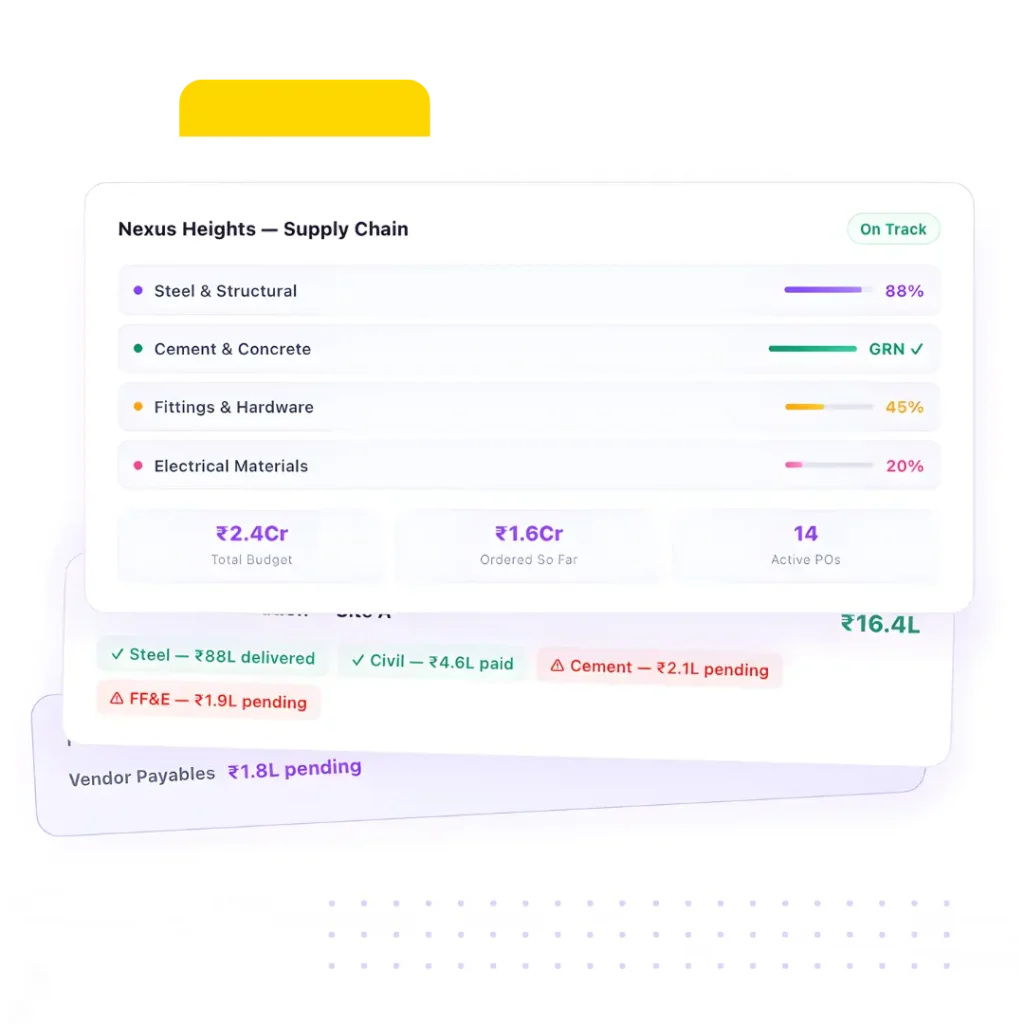
Construction supply chain control requires integration from site requisition through vendor payment. Onsite links every step of the procurement lifecycle to project budgets, inventory records, and delivery verification without manual reconciliation.
01
Budget-Linked Material Requisitions
Site teams raise material requests through mobile apps mapped directly to project budgets and BOQ line items. Every requisition checks budget availability before approval begins, preventing procurement beyond allocated amounts.
→
02
RFQ, Vendor Comparison and PO Generation
Send RFQs to multiple vendors simultaneously and receive quotations digitally for transparent comparison. Select the best vendor and generate purchase orders directly within the system linked to approved requisitions and project budgets.
→
03
Delivery Tracking and Inventory Updates
Record received quantities against purchase orders through mobile-enabled GRN entries at the time of delivery. Discrepancies between ordered and delivered quantities get flagged immediately before materials enter site inventory.
→
04
Bill Validation and Vendor Payment Control
Vendor bills go through three-way matching against purchase orders and GRNs before any approval workflow begins. Bills validate automatically, preventing overbilling before payment rather than during post-payment reconciliation.
Zero
Manual reconciliation needed
100%
POs linked to BOQ budgets
Real-time
Inventory across all sites
3-Way
Match before any payment
End-to-End Supply Chain Management Features
Manage material procurement, vendor relationships, multi-site inventory, and payment validation at every stage with budget-linked requisitions, digital POs, GRN-based delivery tracking, and automated bill verification.
Procurement Control
Budget-linked · BOQ mapped
₹2.4Cr budget
67% used
Material Requisitions · Approval
48 Approved
Cement OPC 53 — 200 bags
✓
›
✓
›
✓
TMT Steel Fe500 — 8 MT
✓
›
PM
›
—
River Sand — 6 brass
SE
›
—
›
—
RFQ Comparison · PO Generation
3 Quotes
Shree Cement Co.
₹420 ✓
Kumar Traders
₹448
Vijay Cement Ltd.
₹461
48
MRs Raised
₹1.6Cr
Committed
20
POs Live
31
Vendors
Budget-Linked Procurement & Requisition Control
Site teams raise material requests through mobile apps mapped directly to BOQ line items and project budget allocations. Every requisition triggers a configurable approval workflow before procurement begins, ensuring purchase decisions stay within authorized budget limits. Procurement teams receive approved requests instantly and send RFQs to multiple vendors simultaneously for transparent rate comparison. Purchase orders generate directly from approved quotations with complete budget linkage, preventing unplanned buying and price mismatches. All procurement activity connects to project cost heads, giving management real-time visibility into committed costs before materials even reach site.
Raise mobile requisitions mapped to BOQ items and project budgets
Send RFQs to multiple vendors and compare quotations
Generate POs directly from approved quotes with budget linkage
GRN-Based Delivery Tracking & Inventory Management
Record material deliveries against purchase orders through mobile-enabled GRN entries at the point of receipt. Discrepancies between ordered quantities and delivered quantities get flagged immediately before materials enter site inventory, preventing acceptance of short or incorrect deliveries. Stock levels update automatically across all active projects as GRNs get recorded, giving procurement teams current multi-site inventory visibility without manual registers. Material transfers between sites get tracked with complete documentation eliminating unauthorized movement and quantity mismatches. Consumption tracking updates inventory continuously as materials get issued to activities, maintaining accurate stock positions and preventing excess procurement.
GRN & Inventory Control
3 Sites · Auto-updated
2 Short
14 GRNs
Today’s GRN Entries · PO Validation
2 Flagged
TMT Steel · PO #041
12 MT / 12 MT
✓ Match
Cement OPC 53 · PO #042
180 / 200 bags
Short ↓20
River Sand · PO #043
4 brass / 4 brass
✓ Match
Multi-Site Stock · Live Inventory
3 Sites
Site A
Sufficient
Site B
Transfer In
Site C
Low Stock
14
GRNs Today
2
Short Deliv.
6
Transfers
3
Sites Live
Vendor Bill Validation — 3-Way Match
PO Ordered
200 bags
GRN Received
180 bags
Bill Claimed
210 bags
Shree Cement · Bill #B-291
₹88,200
Overbilled ↑30
Ramesh Civil · Bill #B-288
₹2.1L
Matched ✓
Kumar Traders · Bill #B-290
₹44,800
Pending GRN
✓
→
✓
→
PM
→
CFO
Approval pending · ₹2.1L
Vendor Bill Validation & Payment Control
Material, subcontractor, and equipment bills go through three-way matching against purchase orders and GRN records before any approval workflow begins. Discrepancies between billed quantities, ordered quantities, and delivered quantities get flagged automatically, preventing overbilling at the source rather than during post-payment reconciliation. Multi-level approval hierarchies control payment releases based on bill value, vendor category, and project budget availability. Budget linkage shows real-time vendor spend against project allocations as bills get processed. Complete audit trails record every validation step, approval decision, and payment release maintaining full accountability across the vendor payment lifecycle.
Three-way matching between PO, GRN, and vendor bill automatically
Multi-level approval workflows controlling payment releases by value
Complete audit trails across every vendor payment decision
What Construction Companies Say About
Our Supply Chain Management Software
Read our user reviews and see how onsite construction subcontractor management software has transformed these construction businesses.
Customer Success Story
“
We raised POs through emails and compared vendor quotes manually in Excel. Approvals were slow and deliveries were delayed. Onsite centralized our entire procurement cycle. RFQs go to multiple vendors simultaneously, POs generate digitally, and deliveries validate against orders instantly. Vendor overbilling stopped completely.
✕ Before Onsite
Manual POs via email · Excel quote comparison · Slow approvals · Delayed deliveries · Undetected overbilling
→
✓ After Onsite
Digital POs · Simultaneous RFQs · Instant delivery validation · Zero overbilling
★
★
★
★
★
Mr. Sharad Mahalunkar, CEO
Shivam Developers · Infrastructure Projects · India
The Problem
Why Excel and WhatsApp Cannot Handle Construction Supply Chain Control
Excel cannot link material requests to project budgets, validate vendor bills against delivery records, or track inventory across multiple sites in real time. WhatsApp cannot enforce approval workflows or maintain audit trails. Construction supply chain management demands integration that spreadsheets and messaging apps were never built to provide.
✕ WhatsApp
Requisitions bypass budget checks entirely
Material requests on WhatsApp bypass budget checks entirely, causing procurement beyond project allocations without approval trails. There is no system to verify whether budget exists before a request is actioned.
Uncontrolled spending beyond project allocations
✕ Excel
No three-way matching — overbilling goes undetected
Excel cannot perform three-way matching between POs, delivery records, and vendor bills. Vendors can bill for quantities never ordered or delivered, and reconciliation only happens weeks after payment.
Overbilling absorbed silently into project costs
✕ Excel
Inventory always lags behind actual site consumption
Inventory tracked in spreadsheets always lags behind actual site consumption, making stock optimization across multiple projects impossible. Excess procurement and material shortages both happen on the same project.
Stock-outs and over-procurement on the same site
✕ WhatsApp
Zero audit trail — no accountability on approvals
WhatsApp approvals leave no audit trail showing who authorized purchases, creating accountability gaps and uncontrolled spending. Messages get deleted, misread, or simply ignored with no consequence.
No accountability when disputes arise post-payment
Extended Features for Construction Supply Chain Management
Onsite construction supply chain management software connects procurement, inventory, vendor management, and payment control so every material decision stays accurate and budget-aligned. Track procurement pipelines, vendor performance, and inventory positions without manual reconciliation or Excel dependency.
Vendor Performance Tracking
Monitor vendor reliability using delivery accuracy, pricing consistency, quality compliance, and lead time adherence across all projects. Compare vendor performance historically to identify preferred suppliers for specific material categories. Use execution data to negotiate better rates and make informed vendor selection decisions on future procurement cycles.
Multi-Site Inventory Visibility
View consolidated inventory levels across all active project sites from one centralized dashboard. Identify excess stock at completed sites available for redeployment before raising new purchase orders. Prevent duplicate procurement by checking cross-project material availability before initiating fresh requisitions.
Material Transfer Management
Track material movements between project sites with complete documentation including transfer quantities, approving authority, and receiving confirmation. Prevent unauthorized material movement and quantity mismatches through structured transfer workflows. Maintain accurate inventory positions at both source and destination sites after every transfer.
Purchase Order Amendment Control
Manage PO revisions with version control and approval trails when quantities, rates, or delivery timelines change after initial issuance. Maintain complete history of original orders and approved amendments. Link PO revisions to updated budget allocations preventing unauthorized cost increases without proper authorization.
Equipment and Asset Procurement
Track hire charges, rental agreements, and equipment procurement alongside material purchases in one integrated platform. Validate equipment bills against actual usage hours and deployment records before payment approval. Monitor equipment procurement costs against project budget allocations maintaining complete visibility into asset-related expenditure.
Vendor Document Repository
Store all vendor documents including contracts, rate agreements, GST registrations, insurance certificates, and compliance records in organized project folders. Access complete vendor files during bill approvals, rate negotiations, or dispute resolution without searching through email chains or physical files.

Stop Procurement Leakage, Start Real Supply
Chain Control with Onsite
Construction supply chain leakage happens daily through unbudgeted procurement, overbilling, and inventory mismatches. Onsite eliminates this by linking every material request to BOQ budgets, validating deliveries against purchase orders, and matching vendor bills against GRN records automatically. Complete supply chain control across all active projects without spreadsheets or disconnected tools.
FAQs
What is construction supply chain management software?
Construction supply chain management software is an integrated platform that controls material procurement, vendor management, inventory tracking, delivery verification, and payment validation across construction projects. Unlike generic supply chain tools designed for retail or manufacturing, construction-specific software handles BOQ-linked material budgets, multi-site inventory tracking, site requisitions from mobile teams, and three-way matching between purchase orders, GRNs, and vendor bills. Onsite connects every step of the procurement lifecycle to project budgets and execution data, eliminating disconnected tools and manual reconciliation.
How is construction supply chain management different from generic procurement software?
Generic procurement software manages purchasing workflows but cannot link material requests to BOQ quantities, track inventory across multiple construction sites simultaneously, or validate vendor bills against site delivery records. Construction supply chain management requires BOQ-linked budget controls, mobile requisitions from field teams, GRN-based delivery verification, and project-wise cost allocation. Onsite handles these construction-specific workflows where generic procurement tools fail, connecting estimation, procurement, inventory, and financial control in one integrated platform built specifically for construction execution.
How does Onsite prevent material procurement beyond project budgets?
Onsite links every material requisition to project budgets and BOQ allocations before procurement begins. Site teams raise requests through mobile apps that automatically check budget availability for the requested material category. Requests exceeding available budget allocations trigger alerts and require additional authorization before progressing to procurement. Configurable approval hierarchies route requisitions based on value thresholds and material categories. Budget commitments update in real time as requests get approved, preventing purchase orders from exceeding project cost allocations at every stage of the procurement cycle.
How does three-way matching work in construction vendor billing?
Three-way matching compares three documents automatically before any vendor bill enters the approval workflow: the original purchase order showing ordered quantities and agreed rates, the GRN record showing actually delivered quantities, and the vendor bill showing claimed amounts. Onsite flags discrepancies between these three documents instantly, preventing overbilling before payment rather than discovering overcharges during post-payment reconciliation. This automated validation process eliminates the need for manual cross-checking across emails, spreadsheets, and physical documents, maintaining complete accuracy across every vendor payment decision.
Can Onsite track inventory across multiple construction sites simultaneously?
Yes. Onsite maintains centralized inventory visibility across all active project sites in real time. Stock levels update automatically as deliveries get recorded through GRN entries and as materials get issued to site activities. Procurement teams can view consolidated inventory across all sites before raising new purchase orders, preventing duplicate procurement when materials are available at another site. Material transfers between sites get tracked with complete documentation. This multi-site visibility eliminates inventory mismatches, reduces excess procurement, and prevents material wastage across the entire project portfolio.
How does Onsite handle vendor management and RFQ processes?
Onsite digitizes the complete vendor management cycle from RFQ creation through payment tracking. Send RFQs to multiple vendors simultaneously and receive quotations digitally for transparent comparison on price, delivery timelines, and historical performance. Select preferred vendors and generate purchase orders directly within the system without switching between emails and spreadsheets. Vendor performance gets tracked across projects covering delivery accuracy, pricing consistency, and quality compliance, building a reliable vendor database for informed supplier selection on future procurement cycles.
Can construction supply chain software integrate with Tally or accounting systems?
Yes. Onsite integrates with Tally and Zoho Books allowing procurement data, vendor bills, and payment records to flow into your accounting system without duplicate data entry. Purchase orders, GRN records, and validated vendor bills from Onsite export to Tally for accounting consolidation and GST compliance. This integration eliminates manual re-entry between procurement and accounting systems, reducing errors and ensuring financial records stay aligned with actual procurement activity across all active construction projects.
How does supply chain software reduce material wastage on construction sites?
Material wastage occurs when procurement happens without accurate inventory visibility, materials get ordered beyond BOQ quantities, or consumption goes untracked. Onsite prevents wastage through budget-linked requisitions checking existing inventory before new orders get raised, GRN-based delivery verification ensuring only ordered quantities enter stock, and continuous consumption tracking updating inventory as materials get issued to activities. Procurement teams see real-time stock positions across all sites before initiating fresh purchases, eliminating over-ordering and identifying excess materials available for redeployment between projects.
What reports does Onsite provide for supply chain management?
Onsite provides comprehensive supply chain reports covering procurement status showing PO pipelines, pending approvals, and delivery timelines, inventory reports showing stock levels and consumption patterns across all sites, vendor performance analytics covering delivery accuracy and pricing trends, budget vs actual material costs at project and activity levels, and payment reports tracking vendor payables and outstanding amounts. Reports update automatically as site teams and procurement staff work, eliminating manual consolidation. Export capabilities support PDF and Excel formats for management reviews and client reporting requirements.