
Construction Procurement Software
From RFQ to PO — One Connected Procurement Management System
Construction procurement fails not because teams buy the wrong materials but because the buying process has no structure. Site managers call vendors directly, rates get agreed over WhatsApp, purchase orders are created after the fact, and deliveries arrive with no verification against what was ordered. Onsite construction procurement management software replaces every informal step with a structured digital workflow from the first material request to the final GRN. So every purchase is documented, compared, and approved before money is committed.

Raise RFQs linked to BOQ line items and project budgets before any purchase is placed
Compare vendor quotations on rate, delivery timeline, and past performance in one screen
Record deliveries with digital GRNs and auto-match received quantities against the purchase order
Built for Construction Teams That Buy Across Multiple Sites, Vendors, and Project Budgets
Onsite construction procurement management software serves every company type that manages material purchases across multiple projects, compares vendor rates, and needs every purchase order linked to an approved budget before spending is committed.
01
Contractors and Developers
Contractors managing multiple concurrent projects buy from different vendors at different rates without comparing quotations or checking budget availability before placing orders. The result is inconsistent pricing, duplicate purchases, and month-end surprises when actual procurement costs land above budget. Onsite gives contractors a single procurement system where every request goes through an RFQ, every order links to a project budget, and every delivery is verified before payment.
02
Infra and EPC Companies
Infrastructure and EPC firms run procurement cycles spanning months across multiple work packages requiring multi-level approvals before purchase orders are issued. Managing this through email chains and WhatsApp creates missed approvals and rate inconsistencies across packages bought from the same vendor on the same project. Onsite gives EPC teams a structured workflow where RFQs go through a defined comparison process and purchase orders carry full budget linkage before release.
03
Interior and Fit-Out Firms
Interior and fit-out firms operate with tight timelines where material delays stop site progress, but buying speed cannot come at the cost of rate discipline. Teams calling vendors directly to get material fast consistently pay above-market rates with no record of what was agreed when the bill arrives. Onsite gives interior firms a fast RFQ-to-PO workflow that maintains rate comparison & budget linkage even under timeline pressure, so procurement speed does not become reason for project loss.
04
Project Management Consultants
PMC teams overseeing procurement on behalf of clients need a verifiable record of every purchase decision: which vendors were compared, which rates were approved, who authorized the order, and whether delivery matched the ordered quantity. Without a structured system, PMC teams cannot defend procurement decisions during client audits. Onsite gives PMC teams complete procurement audit trails from RFQ through GRN across all managed projects.
From Material Request to Verified Delivery — One Procurement Workflow With No Gaps
Onsite connects RFQ creation, vendor comparison, purchase order approval, and delivery verification in one system — so every procurement decision is documented, every delivery is checked, and every cost is visible before it hits the project budget.
Raise Structured RFQs Linked to BOQ and Budget
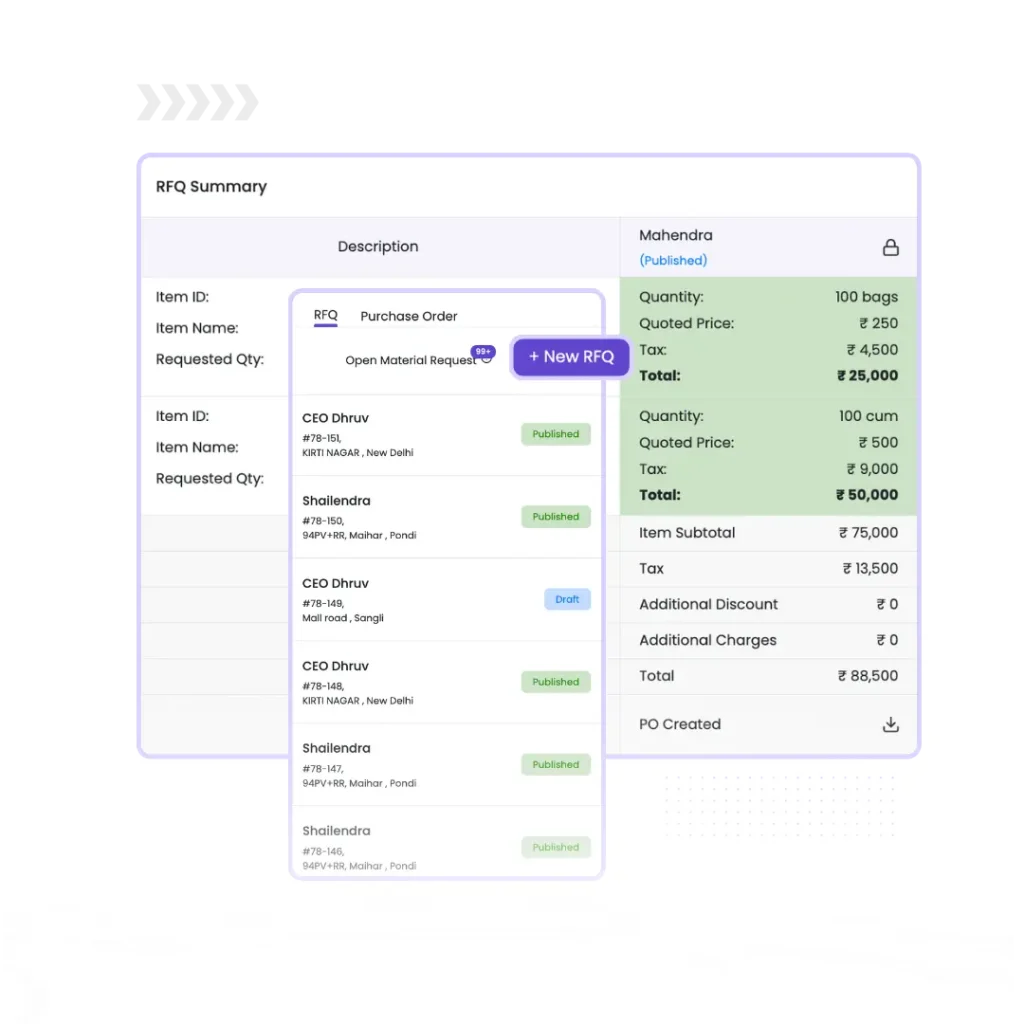
When a site team needs material, a request is raised in Onsite against the relevant BOQ line item and project budget. The request converts into a structured RFQ with material specifications, required quantity, delivery location, and required-by date, eliminating the informal vendor calls that result in undocumented rate agreements. Procurement managers send the RFQ to multiple vendors from within the system, creating a documented record of what was requested, from whom, and when.
Compare Vendor Quotations and Select the Best Rate
Vendor responses are collected and displayed in a side-by-side comparison showing rate, delivery timeline, and vendor performance history from one screen. Procurement managers evaluate quotations without switching between email threads, WhatsApp messages, or spreadsheets. Vendor history including previous delivery accuracy, on-time performance, and past rate data is visible alongside the current quote, giving procurement teams context that a price-only comparison misses. The selected vendor and decision rationale are recorded before any purchase order is issued.
Issue Approved Purchase Orders With Budget Linkage
Once a vendor is selected, Onsite generates a formal purchase order linked to the project budget, cost category, and BOQ line item. The PO carries the approved rate, ordered quantity, delivery specifications, and payment terms, creating a binding document both parties reference. Multi-level approval workflows route the PO to the relevant approvers based on order value before release. Procurement managers see committed costs and remaining budget allocation before confirming the order.
Verify Deliveries Against Purchase Orders With Digital GRNs
When material arrives on site, the site team records a Goods Receipt Note in Onsite capturing received quantity, delivery condition, and timestamped photographs at the gate. Onsite automatically compares received quantities against the purchase order and flags discrepancies where delivery does not match what was ordered. Vendor bills cannot be approved until the GRN confirms delivery matches the ordered quantity, providing the primary control against overbilling and short deliveries.
Why Construction Procurement Loses Money Without a Structured System?
Procurement losses in construction are rarely caused by fraudulent intent. They happen because buying decisions are made informally, approvals happen after the fact, and delivery verification depends on a gate register that nobody reconciles against the purchase order.
Verbal Orders & Verbal Rate Agreements
Site managers call vendors directly to get material quickly, agreeing on rates over phone or WhatsApp without any documentation. When the vendor bill arrives at a higher rate, there is no written record to dispute it against. The procurement team either pays or enters a dispute that delays the next delivery. Every purchase made without a formal purchase order is a commitment the company cannot verify or contest.
No Vendor Rate Comparison Before Ordering
Most procurement decisions go to the first vendor who picks up the phone or who has supplied before. Without a structured RFQ process, teams have no way to know whether the rate they are paying is competitive. Material costs vary significantly between vendors and procurement windows. A company buying cement at Rs 450 per bag when three vendors quoted Rs 415 to Rs 428 loses that difference on every order without knowing the cost exists.
Deliveries Accepted Without Verification Against the PO
Site gatekeepers accept material deliveries based on the driver’s challan, recording whatever quantity the challan states without checking what was actually ordered. Short deliveries get accepted and billed at full PO quantity. Neither situation is detectable until someone reconciles the gate register against purchase orders, a task that rarely happens before vendor bills are approved. By the time the discrepancy surfaces, the payment has already been processed.
Purchase Orders Raised After the Fact
In many construction companies, purchase orders are a finance formality created to support a payment already committed verbally. The vendor was selected without comparison, the rate agreed informally, the material delivered and accepted, and the PO is now being created to match the invoice so accounts can process payment. A purchase order created after delivery provides no procurement control. Procurement discipline requires the PO to precede the purchase decision, not follow it.
Core Features of Onsite Construction Procurement Management Software
Onsite connects material requests, RFQ management, vendor comparison, purchase order approvals, and delivery verification in one procurement workflow that removes informal buying, enforces budget linkage, and creates a complete audit trail from request to payment.
RFQ & Vendor Comparison
Structured RFQ · Multi-vendor · Auditable
3 responses
PO pending
Vendor Responses — Side by Side
Recorded ✓
Vendor
Rate/MT
Delivery
Perf.
Pick
Arjun Steel Co.
Pune · Preferred
₹60.5K
4 days
★★★★★
Selected
Metro Metals
Mumbai
₹62.0K
6 days
★★★★
Not picked
Shiv Suppliers
Nashik
₹63.8K
5 days
★★★
Not picked
Decision Rationale — Recorded before PO
Audit trail ✓
Arjun Steel: best rate ₹60.5K/MT, 5-star delivery record, 4-day lead time meets schedule
3
Vendors compared
₹60.5K
Best rate/MT
0
Spreadsheets used
RFQ Management and Vendor Comparison
Onsite converts approved material requests into structured RFQs with material specifications, required quantities, delivery requirements, and request deadlines. Procurement managers send RFQs to multiple vendors simultaneously from the system and collect responses in a side-by-side comparison view showing rate, delivery timeline, and vendor performance history. The comparison is recorded in the system alongside the selected vendor and decision rationale, creating an auditable record of every procurement decision before the purchase order is issued — not a spreadsheet that exists on one person’s laptop and disappears when they leave the project.
Convert material requests into structured RFQs sent to multiple vendors simultaneously
Compare vendor responses side by side on rate, delivery timeline, and performance history
Record vendor selection and decision rationale in the system before PO issuance
Purchase Order Creation With Budget Linkage and Approval Workflows
Onsite generates formal purchase orders linked to project budgets, BOQ line items, and cost categories — with committed cost and remaining budget visible at the moment the PO is created. Multi-level approval workflows route each PO to the appropriate approvers based on order value and project role, enforcing the sequence so purchase orders cannot be released to vendors before required approvals are recorded. Every approved PO carries the vendor’s confirmed rate, ordered quantity, delivery specifications, and payment terms — creating a document that both parties reference if a delivery or billing dispute arises later.
QT-2024-0088 · v3 optimised
DCC Builders — Villa Block A
v1
v2
v3
Best margin ✓
26% · ₹50.5L
Item
Qty
Rate
Status
OPC 53 Cement
BOQ 2.1 · 240 bags
240 bags
₹510/bag
Negotiated
TMT Steel 16mm
BOQ 3.2 · 4.0 MT
4.0 MT
₹60,500/T
Best rate
Labour — Masons
BOQ 5.1 · 20 days
20 days
₹520/day
Verified
Margin analysis — before quote leaves
26%
Net margin
Total cost (verified)
₹37.1L
From live rate library
Quote value
₹50.5L
Margin: ₹13.4L ✓
26%
Net margin
₹50.5L
Quote value
v3
Best version
DCC Builders, Mumbai
₹50.5L
✓ Won · Day 10
Lead lifecycle — every touchpoint logged
✓
Lead captured from WhatsApp
Day 1 · 10:14
Villa Block A, 2,400 sqft. Auto-logged. Reminder set.
✓
Site visit & BOQ v1 sent
Day 3 · 3:00PM
Scope confirmed. ₹48L quote sent, 24% margin verified.
✓
Auto follow-up & v3 optimised
Day 7 · 9:00AM
CRM reminder fired. BOQ v3 at ₹50.5L, 26% margin.
🚀
Converted to active project
Day 10 · 2:05PM
BOQ, scope & rates transferred. Zero re-entry.
Lead confirmed → converted to active project
BOQ carries over
Rates locked
Scope transferred
0 manual re-entry · 0 data loss
✓ Converted
10
Days to close
₹50.5L
Won value
0
Manual re-entry
Digital GRN and Three-Way Matching
Site teams record Goods Receipt Notes in Onsite at the point of delivery — capturing received quantity, condition, challan number, and timestamped gate photos from the mobile app. Onsite automatically compares GRN quantities against the purchase order, flagging discrepancies where received quantity does not match ordered quantity. This three-way match between purchase order, GRN, and vendor invoice is enforced before any vendor bill can be approved for payment — preventing overbilling from deliveries that differ from the PO and ensuring that payment is only processed against quantities actually received and verified on site.
Record digital GRNs with quantity, condition, challan details, and gate photos from mobile
Auto-match GRN quantities against PO and flag over-delivery or short supply immediately
Enforce three-way PO-GRN-invoice matching before any vendor bill proceeds to payment approval
How Onsite Simplifies Construction Procurement From Request to Verified Delivery?
Most procurement failures happen not at the buying decision but at the steps before and after it — where requests are informal, approvals are bypassed, and deliveries are accepted without checking what was ordered. Onsite structures every one of those steps.
01
Site Teams Raise Formal Material Requests Against BOQ & Budget
When a site engineer or store manager needs material, they raise a material request in Onsite by selecting the relevant BOQ line item, entering the required quantity, specifying the delivery location and required-by date, and submitting the request for procurement review. The request immediately shows available budget for that cost category and links to the project and activity it supports. Procurement managers receive the request in the system rather than through a WhatsApp message or a phone call — creating a documented, time-stamped record of what was needed, when it was needed, and which project it was for before any vendor is contacted.
02
Procurement Raises RFQs and Collects Vendor Quotations
The approved material request converts into an RFQ that the procurement manager sends to pre-approved vendors from the Onsite vendor database. Vendors are selected based on material category, past performance, and project location. Responses come back and populate the comparison view — rate, delivery timeline, and vendor history displayed side by side without any manual data entry. The procurement manager reviews the comparison, selects the vendor, records the selection reason, and converts the accepted quotation into a purchase order. The entire comparison and decision is preserved in the system as an auditable record of how the vendor was chosen and at what rate.
03
Purchase Orders Go Through Approval Before Release
The generated PO routes automatically through the configured approval workflow — site manager, project manager, and finance team, depending on order value and project rules. Each approver reviews the PO against the material request, the vendor comparison, the approved rate, and the budget impact before approving or returning for revision. The PO is released to the vendor only after all required approvals are recorded in the system. This sequence cannot be bypassed — a PO that has not completed its approval chain cannot be issued, even if someone needs the material urgently. Urgency is handled by escalating within the workflow, not by bypassing it.
04
Deliveries Are Verified Against the PO Before Payment Is Processed
When the vendor delivers, the site team records a GRN in the Onsite mobile app — quantity received, condition, challan number, and gate photos captured at the point of arrival. Onsite immediately compares the received quantity against the PO. If quantities match, the GRN is confirmed and the vendor bill can proceed to payment approval. If quantities differ — short delivery or overdelivery — the discrepancy is flagged before the GRN is closed. The vendor bill cannot reach the payment approval queue until the GRN confirms that delivery matches the order. Payment decisions rest on verified site data, not on the vendor’s challan or invoice.
What Construction Companies Say About Onsite Procurement Management Software?
Construction companies using Onsite CRM report fewer missed leads, faster quotation cycles, and complete margin visibility before any quote reaches a client.
Customer Success Story
“
Our site teams were calling vendors directly and ordering material without any formal purchase order. By the time the bills arrived, there was no way to verify whether the rate or quantity matched what was agreed. Onsite made every purchase start with an RFQ and end with a GRN. The first month we ran procurement through Onsite, we identified three vendor invoices that did not match the delivered quantities.
3
Mismatched vendor invoices caught in the very first month
★
★
★
★
★
✕ Before Onsite
Verbal vendor orders with no PO trail · Bills impossible to verify against agreed rates · Overbilling going undetected
→
✓ After Onsite
Every purchase starts with RFQ and ends with GRN · Invoice mismatches flagged automatically · Full procurement audit trail
Mr. Suresh Reddy, Founder
Pinnacle Infracon · Building Construction · Andhra Pradesh, India
Excel and WhatsApp Cannot Enforce Procurement Discipline on Construction Sites
Excel stores data and WhatsApp sends messages. Neither can enforce a structured RFQ process, route purchase orders through approval workflows, or automatically match received quantities against what was ordered — and no combination of both tools fills these gaps.
WhatsApp-based procurement produces no enforceable purchase record before the vendor commits to a rate.
Excel cannot run an RFQ process that collects, compares, and records vendor quotations in one structured workflow.
Neither tool can route a purchase order through an approval workflow before it is released to the vendor.
No Excel sheet can automatically match received quantities against purchase orders and flag discrepancies at the gate.
Additional Features That Strengthen Construction Procurement Control
Onsite provides supplementary vendor management, reporting, and budget visibility capabilities that give procurement managers and project owners complete control over purchasing decisions across all active projects.
Vendor Performance Tracking
Maintain a performance record for every vendor across delivery accuracy, on-time fulfilment, rate consistency, and material quality. Performance data updates automatically from GRN records and procurement history, giving procurement managers objective criteria for vendor selection rather than relying on relationships or memory from previous projects.
Procurement Budget Visibility
View remaining budget for each cost category and BOQ line item at the moment a purchase order is created. Procurement managers see how each order affects committed costs and available budget before the PO is approved — preventing budget overruns from accumulating through individually small but collectively significant unplanned purchases.
Material Request Workflow
Site teams raise formal material requests through a structured workflow that routes to procurement for approval before any vendor contact is made. Requests carry BOQ linkage, required quantity, delivery location, and timeline — giving procurement managers complete context to raise an accurate RFQ without a follow-up call to the site.
Purchase Order Amendment Tracking
Manage PO amendments when quantities, rates, or delivery timelines change after the original order is issued. Each amendment goes through the approval workflow with the change description recorded. Original PO terms remain visible alongside the current approved version for dispute resolution and audit trail purposes.
Multi-Project Procurement Dashboard
View procurement activity across all active projects from one consolidated dashboard — RFQs raised, POs issued, deliveries pending, and bills awaiting GRN confirmation. Project managers and procurement heads identify bottlenecks, pending approvals, and overdue deliveries across the full project portfolio without switching between individual project views.
Procurement-to-Payment Audit Trail
Access a complete record of every procurement transaction from the original material request through RFQ, vendor comparison, PO approval, GRN, and invoice payment. The audit trail shows who raised the request, who compared the vendors, who approved the PO, who recorded the delivery, and who approved the payment.
4 Tips to Improve Procurement Control on Construction Projects
A procurement system reduces purchasing costs and prevents fraud only when the process it enforces is followed consistently. These practices determine whether structured procurement actually changes financial outcomes on your projects.
Never Allow a Purchase to Begin Without a Formal Material Request in the System
The most common way procurement discipline breaks down is at the very first step — when a site manager calls a vendor directly to get material delivered quickly, bypassing the request and RFQ process entirely. The purchase happens, the material arrives, and the system catches up afterward with a retrospective PO that matches the invoice. A retrospective PO is not procurement control — it is documentation. Build a firm policy that no vendor contact is made until a material request has been raised and approved in Onsite. Urgency is a reason to expedite the process, not to bypass it.
Maintain the Vendor Database With Performance Data After Every Delivery
A vendor comparison is only as useful as the performance data behind it. A vendor with a four-star rating from 12 past deliveries tells a different story than one with no history in the system, even if their quoted rate is lower. Procurement managers should update vendor records after every GRN — confirming whether delivery was on time, whether quantity matched the PO, and whether material quality met specifications. Over three to four procurement cycles, this data becomes the most reliable input for vendor selection decisions and rate negotiations on future projects.
Set Budget Thresholds That Trigger Additional Approval Levels for High-Value Orders
Procurement approval workflows work best when the approval level matches the financial risk of the order. A Rs 15,000 order for site consumables and a Rs 15 lakh order for structural steel both need approval — but they do not need the same number of approvers or the same review time. Configure Onsite approval workflows with value thresholds so low-value routine purchases move quickly through a single approver while high-value material orders require procurement head and finance sign-off before release. Flat approval hierarchies applied to every order create bottlenecks on small purchases and insufficient scrutiny on large ones.
Close Every GRN on the Day of Delivery, Not at Month End
GRN recording loses its value as a procurement control when it happens days or weeks after the material arrived on site. A GRN recorded on delivery day reflects the actual condition and quantity at arrival. A GRN recorded a week later reflects what the store manager remembers, with shortages and quality issues already gone from memory or absorbed into site consumption. Train gate and store teams to record GRNs in Onsite on the day of every delivery, with photos taken at the point of receipt. This single discipline determines whether your three-way matching process actually catches discrepancies or just confirms what was already paid.

Stop Buying on WhatsApp and Verbal Agreements. Start Every Purchase With Onsite.
Every construction purchase made without a formal RFQ, an approved purchase order, and a verified GRN is a purchase the company cannot control, contest, or audit if the delivery or invoice turns out wrong. Onsite gives procurement teams a complete workflow from material request to vendor payment — with comparison records, approval trails, and delivery verification built into every transaction. Check pricing or book a free demo today.
FAQs
What is Onsite construction procurement management software?
Onsite construction procurement management software is a digital procurement platform built for contractors, developers, and EPC firms to manage material requests, vendor RFQs, purchase order approvals, and delivery verification in one connected system. It replaces informal WhatsApp-based buying and retrospective purchase orders with a structured workflow where every purchase is requested, compared, approved, and verified before payment is processed. Onsite links every purchase order to project budgets and BOQ line items, giving procurement managers live visibility into committed costs and remaining budget across all active projects.
How does Onsite prevent informal or verbal procurement on construction sites?
Onsite prevents informal procurement by making the material request the mandatory starting point for every purchase. Site teams raise requests in the system against BOQ line items and project budgets — the request converts into an RFQ that goes to vendors, the RFQ response converts into a purchase order that goes through approvals, and the purchase order is the document the vendor delivers against. No step in this chain can be skipped. A vendor call made outside this process produces no approved purchase order, which means the vendor invoice has no matching procurement record when it arrives for payment approval.
How does vendor comparison work in Onsite procurement software?
When an RFQ is sent to multiple vendors, their responses are collected and displayed in a side-by-side comparison in Onsite showing rate per unit, total order value, delivery timeline, payment terms, and vendor performance history from past orders. Procurement managers review the comparison in one screen without cross-referencing emails, WhatsApp messages, or separate spreadsheets. The selected vendor and decision rationale are recorded before the purchase order is issued, creating an auditable record of why a particular vendor was chosen at a particular rate over other available options on that specific procurement decision.
How does Onsite link purchase orders to project budgets?
Every purchase order created in Onsite is linked to a project, a cost category, and a BOQ line item. At the moment the PO is created, Onsite displays the remaining budget for that cost category and the committed cost that the new order will add. Procurement managers see the budget impact before approving the order, not after the invoice arrives. If the PO would exceed the remaining budget, the system flags the overrun before the order is released. This budget linkage makes every procurement decision a financially visible one rather than a purchasing decision that finance teams discover at month end.
What is three-way matching and how does Onsite use it?
Three-way matching is the process of comparing a purchase order, a Goods Receipt Note, and a vendor invoice to confirm that quantity, rate, and specifications are consistent across all three documents before payment is approved. Onsite enforces three-way matching automatically — when a vendor invoice is submitted, the system checks it against the approved PO rate and the GRN confirmed quantity. Discrepancies between any two of the three documents flag the invoice for review before it reaches the payment approval queue. This control prevents overbilling from invoices that claim more than was delivered or at rates higher than were agreed.
How does digital GRN recording work in Onsite?
Site teams record GRNs in the Onsite mobile app at the point of delivery — selecting the relevant PO, entering the received quantity, noting material condition, capturing the supplier challan number, and taking timestamped photos at the gate. The GRN is submitted immediately and Onsite compares received quantities against the PO automatically, flagging any quantity mismatch for procurement review before the GRN is closed. Photos and challan details are stored against the GRN record, providing documentary evidence of the delivery condition that is available during vendor bill approval and project audits.
Can Onsite manage procurement across multiple projects simultaneously?
Yes. Onsite supports multi-project procurement where each project has its own budget, BOQ, vendor assignments, and approval workflows, all managed from one centralized system. Procurement managers view all active RFQs, pending POs, expected deliveries, and outstanding GRNs across every project from a single dashboard without switching between project files or requesting updates from individual site teams. Senior management sees portfolio-level procurement activity — total committed costs, pending approvals, and budget consumption by project — to make resource and cash flow decisions based on live procurement data rather than consolidated reports prepared once a week.
How does Onsite help reduce material procurement costs?
Onsite reduces procurement costs through structured RFQ processes that collect multiple vendor quotations for every purchase, making rate comparison mandatory rather than optional. Procurement teams consistently buying from vendors without checking alternatives pay whatever rate that vendor quotes. Onsite’s vendor comparison view shows the rate difference between available options on every RFQ — a difference that compounds significantly across the dozens of material procurement decisions made on a single project. Additionally, GRN-based verification prevents payment for quantities not delivered, and PO-to-budget linkage prevents unplanned purchases that push project costs above the approved baseline.