
Construction Workforce Planning: Why It Fails on Site
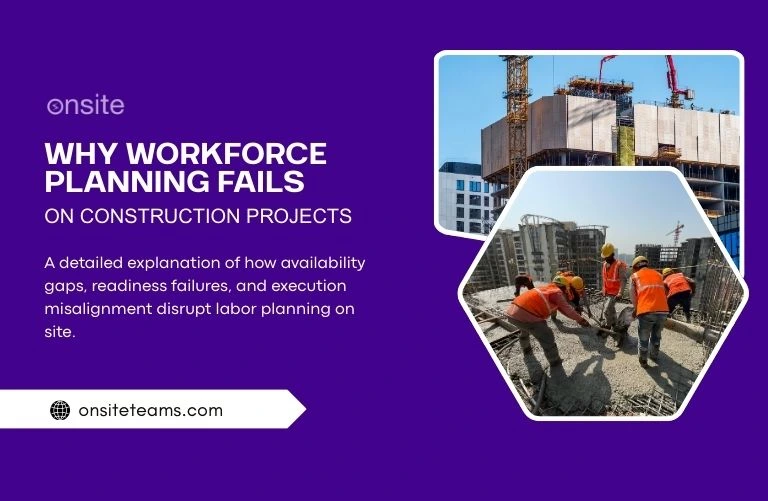
A contractor in Pune planned labour deployment for a residential tower based on the project schedule — sixty masons by week six, forty electricians by week ten. Week six arrived and the masons reported to site as scheduled. The fourth floor slab was not ready for finishing work. Inspections had been delayed by four days. The crew stood on site, marked present, paid for the day, and produced nothing. This is construction workforce planning.
This is not a story about labour shortage. The workers were available exactly when planned. The problem was that availability and site readiness were never the same thing, and the workforce plan tracked only one of them.
Availability alone does not deliver progress
Getting labour becomes a genuine challenge across construction market. Skilled labour is scarce, and many contractors fear losing access to it once secured. Contractors hire labor before shortage worsen. The problem begins when labour availability gets confused with work readiness.
Often construction site faces situations like:
- crews mobilize before final drawings are issued.
- Labour reach at site before the site is ready to get work started.
- Many areas remain un-executable.
- Workforce plans follow scheduled dates rather than verified readiness.
Labour availability ensures the presence, but readiness determines productivity. There would be no need of labour so soon if the site is not ready to be executed.
Why workforce management weakens during execution
Workforce management often originates from the planning phase. While you are planning, the sequences are predictable and stable output becomes a result, but execution does not work like that.
Contractors face some problems every day, like:
- delays in inspection,
- access controls preventing parallel work,
- activities being overlapped,
- changes in plan because of weather condition.
The plans remain static, but labour deployment runs ahead of execution readiness. Crew sits idle and the cost increases. It takes a construction project towards the direction of loss.
Idle labour builds quietly into cost leakage
Without site being ready for labourers to execute, the attendance remains high, but output tells a whole different story. Labour sits idle in conditions like:
- waiting for approval or inspection,
- trades standing while dependencies remain unresolved,
- skilled labour being assigned to uncritical tasks,
- access manpower being deployed near activity saturation.
Research from companies like FMI and McKinsey always points to the same problem in the industry. A lot of time is wasted on construction jobs because of bad planning and not being ready for the job site. You don’t see all of this lost time at once. Every day, it piles up slowly and nibbles away at margins long before delays become clear on the program.
Skill mismatch reduces output even with sufficient manpower
Every labour is good at different things. A skilled labour being deployed at a site that is not ready to be worked on becomes a problem. Contractors frequently deal with:
- a specialized crew being deployed before technical readiness,
- supervisor overseeing many trades at once,
- a semi-skilled labour being deployed in skilled roles,
- short-term labour added without clear output tracking.
Research from Dodge Construction Network shows that there is a common problem on construction sites. Not because there aren’t enough workers, but because the skills of the workers don’t always match the task that needs to be done. Even when the number of people looks good on paper, mismatches between what people can do and what they need to do can slow things down, necessitate rework, and cause unequal productivity.
Constant redeployment weakens accountability
When there is a loss of workforce management structure, site team has to face daily reshuffling. This practice leads to loss of crew continuity, confusion in identifying responsibility, interrupted productivity measurement, and, increased dependency on supervision. What the thing that begins as flexibility gradually become chaos, reducing planning effectiveness.
Forecasting labour demand across dynamic work fronts
Many contractors have trouble predicting how many workers they will need for the whole life of a project, not just for day-to-day work.
People typically don’t realize how much work there is toward the end of a project. Teams are staying on site longer than they planned because demobilization is taking longer than expected. Crews work in different zones at the same time without a clear order, which raises costs without making progress at the same rate. As time goes on, this uncertainty makes contractors bid more carefully to protect themselves from the risk of losing workers.
Business owners can see bad workforce forecasts in many places, not just on the job site. Planning for cash is harder. Margins are open earlier than intended. Even if demand and workload seem consistent on paper, project risk goes up.
Metrics that surface workforce management issues early
| Metric | What it reveals |
|---|---|
| Planned versus deployed manpower | Planning reliability |
| Idle labour hours | Readiness gaps |
| Skilled labour utilisation | Capability alignment |
| Supervisor span of control | Management overload |
| Output per labour hour | Execution stability |
Why generic workforce tools fall short on construction sites
Traditional tools like HR system or Excel focus on presence, not execution context. Workforce management breaks down when systems record attendance manually, ignore dependency clearance, lag behind daily site changes. Without any linkage of planning to the execution, the construction management falls apart., outcomes blur and there is no support of daily control.
What Workforce Management Actually Means on a Construction Site
Managing a construction crew isn’t simply about paying them. It is about managing how work is planned, done, followed up on, and reviewed every day.
In practical terms, this involves
- knowing how many people are needed before work starts
- ensuring the right skills reach the right site
- keeping track of who shows up each day
- checking to see if the workers are making genuine progress.
- It also means that wages are based on records instead of guesses.
When any portion of this chain is absent, work becomes less predictable. Costs go up, productivity goes down, and fights are more likely to happen. Manual scheduling limits visibility and makes workforce planning unreliable as project demands change.
Everyday labour Problems Contractors Face
Attendance Exists on Paper, Not in Reality
The usual way of marking attendance at any construction site is marking attendance once in the morning and forgotten. The time between morning to evening is something that goes unnoticed. Workers leave early, or they sit ideal, but the record shows their full day’s presence. This slows down the progress and makes less utilization of manpower.
The Wrong Workers Reach the Wrong Site
One place doesn’t have enough staff, while another has too many and doesn’t need them. These imbalances are missed until delays are already happening because there is no clear, central vision. At that point, moving people around becomes a response rather than a deliberate action.
Labour Cost Keeps Rising Without Matching Output
Without any increase in the project progress, the labour cost keeps on rising unnecessarily. This happens because of the lack of transparency on the activities of labour which later on also leaves everyone with no accountability.
Wage Disputes Are Frequent
At the end of the month, there are often arguments over paper attendance and vocal confirmations. Contractors lose time, money, and credibility when they try to fix problems that could have been prevented if the records had been clearer.
Where execution-linked workforce planning supports stability
Workforce planning fails when contractors lack clarity regarding personnel availability, labour deployment, and the correlation between attendance and on-site work performance. Planning becomes guesswork and judgments are made too late to be useful without that visibility.
Onsite Construction Workforce Planning Software helps with workforce planning by preserving all of the information about employees, their availability, and where they are working in one place. Contractors can identify who is working where, schedule staffing based on project timelines, and make changes early instead of waiting till the last minute. This stops people from hiring too quickly, stops people from moving too soon, and makes sure that labour moves in line with the real needs of the site instead of what they think they need.
Some of the features of Onsite are:
One place for workforce records
The system keeps track of all the workers’ information, so contractors always know who is accessible and where each individual is working.
Better scheduling
You may plan for future staffing demands together with project timeframes. This cuts down on last-minute hiring and costly delays.
Attendance and shift tracking
It captures daily attendance directly from the site, making payroll more accurate and holding teams accountable.
Multiple project control
It makes it easier for contractors who are in charge of more than one site to keep track of how many workers are at each site without becoming confused.
Why execution-level visibility improves workforce outcomes
Construction workers have to deal with absenteeism, overtime costs, and poor communication between office staff and site managers every day. Execution-level visibility helps contractors get around these problems by offering them a clear, real-time image of their workers. Decisions are made more quickly, expenditures kept in check, and projects stay on track when reliable data is easy to find.
Conclusion
The delays in workforce management shows up gradually through wrong planning, unverified readiness, and delayed feedback from site executions. Contractors get past these obstacles by having a clear, up-to-date picture of their workforce. It’s easier to obtain solid data when decisions are made more swiftly, costs are kept in mind, and projects continue on track.
Manage Workforce Deployment With Real-Time Site Data
FAQs
What is construction workforce planning software?
Construction workforce planning software is a tool that helps contractors organize and schedule labour, track time, and balance field crew assignments so projects run smoothly with fewer delays.
How does workforce management software support construction teams?
Workforce management software gives supervisors a central place to plan work, track assignments, and monitor attendance, helping reduce confusion and bolster on-site productivity.
Why is construction workforce management software important for contractors?
Construction workforce management software helps contractors coordinate crews, schedule tasks more effectively, and maintain records of work progress and hours worked across jobsites.
What Construction Workforce Planning Software features should a contractor look for?
Key workforce management features include scheduling tools, time and attendance tracking, mobile field updates, crew monitoring, and integration with payroll or reporting systems.
Can workforce scheduling tools improve on-site efficiency?
Yes. Workforce scheduling tools allow project managers to assign crews to specific tasks, plot shift patterns, and reduce idle time, which improves overall workforce utilization.
How does mobile workforce management software help field teams?
Mobile workforce management software lets field workers update status, log hours, and respond to changes in real time, so office and site teams stay aligned without delays.
What is the difference between a workforce management system and a workforce management platform?
A workforce management system focuses on core operations like planning and attendance, while a workforce management platform includes broader capabilities such as analytics, reporting, and mobile access.
Does workforce tracking software help with accountability?
Yes. Workforce tracking software gives managers visibility into where teams are and what they are working on, which reinforces accountability and supports proactive adjustments.
How does workforce time and attendance functionality benefit contractors?
Workforce time and attendance tools capture who worked when on site, helping with payroll accuracy, compliance, and a clearer picture of labour costs.
Can construction workforce planning improve project outcomes?
Construction workforce planning makes it easier to forecast labour needs, prevent bottlenecks, and ensure the right people are in the right place at the right time, leading to better project outcomes.
