
From Work Completed to Work Accepted: How Task Closure Works on UAE Construction Sites
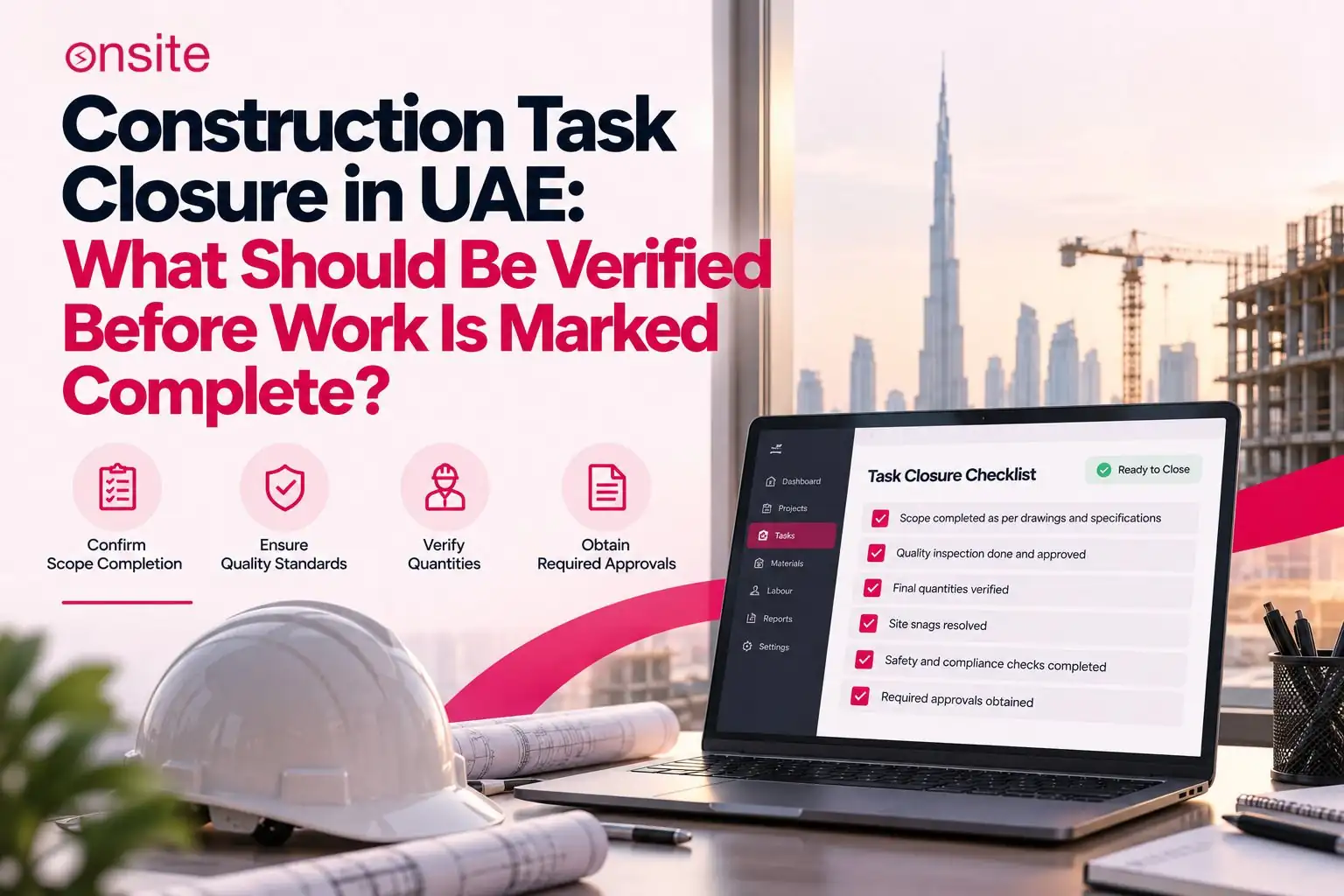
A construction task is announced completed when the desired work has been completed. The required quantity and quality have been verified. And outstanding snags or exceptions have been addressed. Any evidence that was necessary has been recorded and the work has been cleared to move to the next relevant stage. But the clear key distinction we are here to talk about today is completed work is not always closed work. So a construction task closure in UAE cannot be declared until it has gone through required inspection, quantity verification, snag identification. rectification, documentation and clearance before it can be ready to move forward on the program.
What Should Be Verified Before Closing a Construction Task?
Scope completed → Quantity verified → Quality checked → Snags resolved → Evidence recorded → Required approval or clearance → Task closed
A Task Can Be Finished Without Being Ready to Close: Construction Task Closure in UAE
In Dubai, on a residential project, a crew has just finished plastering a room, and the supervisor considers the work done. The site manager logs the task as complete. But the plastered surface still needs to be inspected against the required finish standards. There might be a few areas that still need correction because the surface is uneven or the thickness does not meet the specification. The quantity that was executed has not been measured yet. Another trade is waiting to start painting, and the question of whether the area is actually ready for them has not been formally answered.
The whole situation does not mean that the team did not complete its job. It simply means that the task has been physically completed but has not reached the stage of closure.
The difference between the two matters because the project will move forward based on what the record says. If the record says the task is closed, the next trade may begin and uninspected work may be covered.
When the work is completed, it should not automatically be considered closed.
Completion and Closure Are Not the Same Thing
The confusion between these two terms is the source of most task closure failures on construction sites. They are related but they are not the same event.
| Stage | What it means |
| Work completed | Physical execution of the defined activity is finished |
| Quantity verified | Executed quantity has been checked and confirmed |
| Quality checked | Applicable quality requirements have been reviewed against the work |
| Snags identified | Deficiencies or incomplete portions have been recorded |
| Snags resolved | Required corrections have been completed |
| Evidence recorded | Relevant records and supporting documentation have been retained |
| Cleared for next stage | The work can support the next dependent activity |
| Task closed | The activity is formally treated as complete |
Without proper verification, work that is dependent on the previous activity can start even when it is not ready. MEP systems may get enclosed before inspection. Flooring may be laid over screeding that has not achieved the required flatness. Painting may begin on a surface that is not yet properly finished.
This can result in quality failures that are not always visible immediately. These types of failures can appear during the defect liability period, during client occupation, or at a point when rectification requires the demolition of work completed by three subsequent trades. The cost of rectification is always higher than the cost of verifying the original task correctly. So, a site team always needs to ask whether the completed work is enough for the next activity to safely and correctly begin.
What UAE Construction Requirements Say About Completion and Inspection
Construction Task Closure in UAE does not take place separately from the wider regulatory environment that governs how buildings are completed, inspected, and certified in each emirate.
In Dubai, the Dubai Municipality’s Building Control and Building Permits Department oversees building permits, technical inspections of under-construction sites, and the procedures for issuing completion certificates. Dubai Municipality states that its procedures cover technical inspections of under-construction sites and the issuance of completion certificates.
In the first half of 2025, Dubai Municipality conducted more than 25,000 construction site inspections and issued 1,669 building completion certificates covering villas, multi-storey buildings, and industrial facilities across the emirate.
In Abu Dhabi, the Department of Municipalities and Transport has a Building Occupancy and Legalisation Certificate Programme that is implemented in three stages. The first stage includes a Conditional Occupancy Certificate and focuses on essential safety requirements such as fire safety, gas installation safety, structural integrity, elevator safety, and child protection measures. The programme is designed to move buildings towards full compliance through a staged process.
The Dubai and Abu Dhabi frameworks make the same point at the project level: work that is physically finished is not necessarily the end of the completion process. After the work is finished, there may be further steps to be taken care of, such as inspection, testing, and certification by the relevant authority. These steps form part of the overall completion sequence.
Editorial boundary of this section: This does not mean that UAE law specifies a standardised closure checklist for every individual construction task on every project. Construction Task Closure in UAE sits within a wider environment of inspection, completion, certification, and documentation requirements that can vary by emirate, project type, authority, and contract.
What Should Be Verified Before a Construction Task Is Closed
A snag is a problem found during inspection. It could be an incomplete part of the work, a deviation from the specification, a surface defect, a damaged element, or any other issue that means the work is not ready for the next stage.
A snag does not mean the task cannot be closed later. It means the task should not be closed until the snag is fixed. A snagged task normally follows this path:
Not Started → In Progress → Ready for Inspection → Snagged / Correction Required → Ready for Closure → Closed
When an issue is found during inspection, the task moves from Ready for Inspection to Snagged. The required correction is then carried out. The corrected work is inspected again. If the work meets the required standard, the task moves to Ready for Closure. It can then go through the same five checks used for any other task: scope, quantity, quality, exceptions, and evidence.
The important distinction is that complete does not always mean accepted.
For example, a floor installation may be physically complete. Every tile has been laid and the area is finished. But if two tiles are cracked and one joint is misaligned, the task should not be closed as accepted. The cracked tiles still need to be replaced and the joint needs to be corrected. The physical work is substantially complete, but the actual condition of the work does not meet the required standard. Closing the task at this point would record a result that does not match the actual condition of the work.
What happens when a task cannot be closed:
There are several common reasons why a task may not be ready for closure. The work may still be incomplete, the inspection may be pending, a snag may still be open, required testing may not be completed, or an approval may still be outstanding.
In these cases, the task should remain at its current status, such as Ready for Inspection or Snagged. The outstanding step should be completed before the task is moved forward.
Closing a task just to avoid a conversation about an open snag does not fix the problem. It only removes the issue from the visible record. The same snag will then come up later, usually when it is more difficult to deal with.
What Task Closure Looks Like for Different Construction Activities
Verification requirements vary by activity type. The following table reflects typical checks like actual requirements depend on the project specification, drawings, inspection plan, and applicable authority requirements.
| Activity | Before closure, verify |
| Concrete works | Quantity and location, applicable inspections and testing records where required |
| Blockwork | Alignment, dimensions, openings, visible workmanship defects |
| Plastering | Surface condition, alignment, specified thickness or finish requirements, visible defects |
| Waterproofing | Application completed, relevant inspection or testing conducted, affected area checked |
| MEP works | Installation completed, applicable testing and inspection conducted, coordination confirmed |
| Flooring | Coverage, levels and alignment, finish condition, damaged areas identified |
| Painting | Required coats and finish, surface defects, touch-ups completed |
| External works | Location, dimensions, finish, interfaces with adjacent works |
These are examples, not universal acceptance criteria.
How Snags Prevent a Construction Task From Being Closed
Before a construction task can be closed, five checks need to be completed. Not every task will need the same level of checking. A painting touch up and a waterproofing application are different types of work. But the same five checks still apply.
Scope: First, check whether all the work included in the task has been completed. A task can look complete in the main work area while some smaller part is still left. This could be a corner, a junction, or a detail that the crew planned to come back to. The scope check is meant to make sure that all parts of the task have been covered, not only the main area where the work was done.
Quantity: The completed quantity should also be measured or confirmed. If the quantity is estimated instead of measured, it can create disputes during billing. It can also make the material balance for the next activities inaccurate. For work measured in square metres, cubic metres, linear metres, or units, the actual quantity should be checked. It should not simply be assumed from the area covered.
Quality: The completed work needs to be checked against the relevant drawings, specifications, method statements, inspection requirements, and other project controls. The way this check is done can be different for different activities. For some work, the site engineer may check the completed work against the drawing. A formal third party inspection may not be needed. For other work, a formal inspection may be required with a consultant or authority representative. The standard to be followed depends on the project, the type of activity, and the contract.
Exceptions: Before closing the task, check if anything is still unfinished or needs attention. This could include a deviation from the specification, an open snag, or an approval that is still pending. An exception does not always stop the task from being closed, but it still needs to be recorded. If a known exception is not documented before the task is closed, it creates a gap in the project record. Later, it can become difficult to understand what was pending or what had happened at the time.
Evidence: There should also be enough evidence to show what was completed and when. The type of evidence required will depend on the activity and the project. It may include photographs, measurement records, inspection forms, test results, or a combination of these. The record should be good enough for someone who was not at the site that day to understand what work was completed, what standard it was completed to, and when it was completed.
What Documentation Should Remain After a Task Is Closed
The records that survive after a task is closed are the only firm proof of what was done, when it was done, and to what standard. When the team has moved on to the next work and other activities have been built on top of the completed activity, the only way to understand the past work is through the documentation that was created before it was covered.
Depending on the nature of the work and project requirements, the task record should include:
- Completion date
- Person or team that executed the work
- Quantity completed
- Inspection record or outcome
- Photographs
- Snag and rectification history
- Relevant drawing and specification references
- Test or verification records
- Approval or acceptance records
- Remarks or deviations from the specified scope
- Confirmation that the next trade or dependent activity can proceed
Not every task requires each of these records. For example, a painting touch-up does not need the same documentation as a concrete pour.
Understanding the task history can also be supported by Daily Progress Report (DPR) records that run alongside the task closure documentation as a parallel site record. The DPR helps capture what was done each day, while the task closure record helps confirm the cumulative outcome. Together, these documents provide an audit trail that the project team can rely on in the future.
Why Task Closure Becomes Important During Handover
By the time the project reaches the handover stage, the site team has changed drastically. It might not be the same team that executed the work because people move between projects, subcontractors demobilise, and site engineers may no longer be contactable. The only reliable source of information is the project record.
There are a few questions that should be possible to answer before handover:
- Was the work actually inspected before it was closed?
- When was it completed?
- Who confirmed it?
- Were any defects identified during the inspection?
- Were those defects corrected before the next activity began?
- What evidence exists that the work meets the specified standard?
- Was the work accepted before the dependent trade began?
When Construction Task Closure in UAE is performed correctly, these questions should have recorded answers. But if the task is not formally closed and is simply marked complete when the crew leaves, without an inspection, the answers may have to be reconstructed from memory, WhatsApp messages, or estimates.
If task closure has not been done formally, it may be challenging to answer specific questions from the client and difficult to defend against a specific defect claim or inspection finding.
This is where the connection to long-term UAE construction liability becomes significant. The UAE’s decennial liability framework provides for contractor and designer liability for the total or partial collapse of a building or structural defect for 10 years after delivery, subject to the applicable legal provisions. Documentation produced during task closure can therefore become important evidence of what was executed, inspected, verified, and accepted if a structural defect is later alleged.
Construction Task Closure in UAE Checklist
Before closing any Construction Task Closure in UAE, verify the following:
Scope and execution:
- ☐ All elements of the defined scope have been completed
- ☐ Executed quantity has been verified, not estimated
Quality and inspection:
- ☐ Applicable drawings and specifications have been checked against the work
- ☐ Inspection has been completed where required by the project or authority
- ☐ Required tests or verification records have been completed
Snags and exceptions:
- ☐ All snags identified during inspection have been recorded
- ☐ Recorded snags have been corrected and re-examined
- ☐ Any deviations from scope have been noted
Evidence and approval:
- ☐ Photographs or other evidence have been captured before the area is covered
- ☐ Responsible person has been identified in the record
- ☐ Required approval or clearance has been recorded
Sequencing:
- ☐ The next dependent activity can proceed safely and correctly from the current state of the work
Common Construction Task Closure Mistakes
| Mistake | What it causes |
| Marking work complete when the crew leaves | Incomplete work is carried forward into the project record |
| Closing before inspection | Defects surface later when rectification is more disruptive and costly |
| Keeping snags in a separate record disconnected from the task | Actual closure status becomes unclear |
| No quantity verification | Measurement disputes arise at billing or final account |
| No supporting evidence | Difficult or impossible to reconstruct the work’s condition retrospectively |
| Closing without checking whether the next trade can proceed | The dependent activity starts before the preceding work is ready |
| Informally reopening closed tasks | Project history becomes unclear and the audit trail breaks |
What Construction Software Should Support Across the Full Closure Lifecycle
A construction management software’s features should not be limited to assigning tasks and updating statuses. It should support the full closure lifecycle, which means it should have the ability to record inspection outcomes, attach photographs with timestamps and location information, log snag identification and resolution, capture executed quantities against the defined scope, confirm clearance for the next activity, and much more.
All of this should be connected to the task record rather than simply being stored in a folder. When closure records exist only as photographs in a phone gallery, notes, or emails, reconstructing the project history during handover or in response to defect claims can become a manual burden. That process has no certain outcome.
Onsite’s task monitoring capabilities are one of its dedicated solutions for UAE construction projects. It covers task assignment, progress tracking, photo documentation, and cross-project visibility. The focus is on how tasks are assigned and monitored throughout their lifecycle.
A Construction Task Is Not Closed When the Physical Work Stops
A construction task should not be considered closed just because it has been completed. Construction Task Closure in UAE should take place only after the task has gone through the required inspection process. It needs to be checked whether the scope is complete, the executed quantity has been confirmed, the quality has been checked, outstanding issues have been addressed, the necessary records have been created, and the work is ready for whatever comes next.
Physical completion alone does not mean that the work has been verified and is ready to move to the next phase.
On UAE construction projects, the distance between physically finished and properly closed is worth understanding. In the UAE, inspection and certification frameworks apply at both the project and emirate levels. This is particularly important where subsequent trades work in close sequence under compressed timelines and where the documentation produced during execution forms the basis for billing claims, defect investigations, and authority approvals.
There are five checks that are not administrative overhead: scope, quality, quantity, exceptions, and evidence. They are the mechanisms that help connect what was actually done with what was recorded.
Frequently Asked Questions
What is construction task closure?
Construction task closure is the formal process of confirming that a defined unit of work is complete enough to be treated as finished in the project record. It goes beyond physical completion to include quantity verification, quality inspection, snag resolution, evidence capture, and clearance for the next activity to begin. A task that is physically finished but has not passed these checks is complete in a practical sense but not closed in a project management sense.
What is the difference between task completion and task closure?
Task completion refers to the physical finishing of the work — the crew has done what they were asked to do and has moved on. Task closure is the verified state that follows: the quantity has been checked, the quality has been inspected, any snags have been resolved, the evidence has been recorded, and the work has been formally confirmed as ready for the next stage. A task can reach completion without reaching closure if the verification steps are skipped.
What should be checked before closing a construction task?
Five checks apply before closure: scope — confirming that everything in the task’s defined scope was executed; quantity — verifying the completed amount rather than estimating it; quality — checking the work against the applicable drawings, specification, or inspection requirement; exceptions — identifying and recording any snags, incomplete portions, or deviations; and evidence — ensuring a sufficient record exists showing what was done and when. Larger or more complex tasks, or activities that will be covered by subsequent work, require more rigorous application of all five.
Should a construction task be closed before inspection?
No. Closing a task before the applicable inspection has been completed removes the inspection from the active record. Once the task is marked closed and the next activity begins on top of the work, the uninspected work becomes inaccessible without significant disruption. If a defect is later identified, there is no inspection record to demonstrate that the work was checked. On activities where regulatory inspection is required before proceeding — certain structural, MEP, and fire safety works — closing before inspection also creates a compliance gap separate from the quality issue.
How do snags affect task closure?
A snag identified during inspection means the task is not yet ready to close. The task moves to a snagged status, the correction is carried out, and the corrected work is re-examined before closure is appropriate. A task closed with unresolved snags creates a project record that does not reflect the work’s actual condition, and the unresolved deficiency is carried forward into subsequent activities. Once the work is enclosed or covered, rectification becomes significantly more disruptive.
What records should be retained after a construction task is closed?
The records retained after closure depend on the activity type and project requirements, but typically include: completion date, responsible person or team, executed quantity, inspection record or outcome, photographs of the completed work before it is covered, snag and rectification history, relevant drawing and specification references, test or verification records where applicable, and approval or acceptance confirmation. The more irreversible the work and the higher the consequence of a later defect, the more complete the documentation should be.
Why does task closure matter before the next trade starts?
Because the next trade’s starting conditions depend on the preceding work having been completed and verified correctly. If plastering is closed without inspection and painting begins, defects in the plaster surface are sealed under the paint coat. If MEP rough-in is closed without inspection and walls are enclosed, the enclosed MEP cannot be accessed without demolishing the wall. Task closure before the next trade starts ensures that the subsequent activity begins from a verified base rather than from a record that says the preceding work is done without confirming that it is done correctly.
Who should confirm that a construction task is ready to close?
This depends on the project structure, the nature of the task, and the applicable contract. On most UAE construction projects, the site engineer or project manager confirms routine task closure after physical verification. Where the contract requires consultant inspection — as FIDIC contracts typically do for defined stages of work — the Engineer’s representative may need to confirm acceptance before closure is appropriate. Where regulatory authority inspection is required, the relevant authority’s sign-off is a precondition. For work done by subcontractors, the main contractor’s representative should confirm the work before the subcontractor’s task record is formally closed.
