
Why Construction Leads Get Lost and What Contractors Need to Win More Projects?

Capture and convert more work with modern lead tracking software built for contractors.
Most project losses begin before pricing discussions
Every lead counts when you are in a construction business because why not? Losing even a single opportunity can mean lost revenue, wasted resources, and delayed project growth. It is normal to feel lost when leads are slipping away or turning cold. Contractors or business owners often think they can’t get a project because of the pricing, competition, or the client being unsure. In fact, a lot of chances go away far sooner. They stop during the lead handling stage when inquiries aren’t followed up on with enough consistency, clarity, or momentum. Winning new contracts starts with better visibility into the construction lead pipeline and reliable follow-up. Many construction companies or any business is facing this issue which is why we have introduced CRM. Onsite, a cutting-edge Construction Lead Management Software, offers a powerful solution to track and convert every lead effectively with our CRM feature.
Why construction leads behave differently from typical sales enquiries?
When it comes to construction business, leads do not follow a sales pattern, but each opportunity has an evolving scope, site-specific details, and multiple stakeholders & decision makers. Contractor has to regularly deal with changing drawings between inquiries and estimations, mandatory visits on the site, revision of requirements after physical walkthrough, and huge gaps between the discussions and the final agreement. And without any structure, these dynamic parts become too much for lead tracking methods.
How leads break inside day-to-day contractor workflows?
Lead loss happens gradually and quietly. The common breakdowns include:
- enquiries being verbally exchanged rather than being returned in a reliable tool,
- scope clarifications exchanged without version control,
- delays in follow-ups,
- and scope remaining unclear.
Clients won’t talk about rejection, the lead will turn cold before you even know.
Why spreadsheet-based lead tracking collapses under pressure?
If you want to stay ahead in the year of 2026, then relying on spreadsheet is the last option for you. Spreadsheets lack the structure required for long technical sales cycle. Day by day, the inquiry volume grows and the records become inconsistent. Follow-ups become delayed. Team is working on outdated scope. Managers cannot know which leads remain active. All of these things lead to the breakdown of a system and causes loss. Spreadsheets and manual lists lack the power of dedicated lead tracking tools, so calls and emails slip through the cracks.
How poor visibility distorts commercial decision-making?
Without a structured lead status, contractors mislocate resources, which cause low-quality work, delays, duplicate costing due to untracked revision, inaccurate forecasting, less accountability, late responses to high-intent clients, etc. Instead of being concentrated where the possibility of conversion is strongest, effort ends up being distributed too thin.
What effective lead control looks like in construction environments?
Contractors who convert consistently don’t see managing leads as a casual side job. They run it as a set operating process.
Instead of being in inboxes or chat threads, all inquiries are stored in one spot. There are clear steps from the first interaction until the end. Changes to the scope are always linked to the same opportunity, so the context is never lost. There are explicit deadlines and responsibilities for follow-ups. Leadership can see all active leads, not just the ones that come up in reviews.
These controls are more important when sales cycles are extended, because gaps in follow-up or lacking context can quietly ruin a good chance.
Integrated CRM lead tracking software ensures your CRM reflects real demand, not just guesses.
Indicators that reveal lead leakage early
| Indicator | What it signals |
|---|---|
| Response time to new enquiry | Initial client confidence |
| Average follow-up gap | Risk of disengagement |
| Enquiry to estimate conversion | Qualification effectiveness |
| Number of scope revisions | Stability of requirements |
| Unclosed inactive leads | Tracking breakdown |
Where construction-focused lead systems provide stability?
Onsite construction management software supports this structured approach by keeping enquiries, communication history, and follow-up actions connected in one place. Nothing depends on memory or personal notes. Context stays intact as conversations progress, and opportunities are far less likely to fade simply because attention shifted elsewhere. Some features of Onsite are:
Log Leads Instantly
Timing is crucial when it comes to building. If you don’t respond to a client’s question right away, they might go with another contractor. With Onsite, contractors may enter new leads right away, whether they come in through a fast phone call, a site visit, or even a tender announcement. Everything is kept in one location, so nothing gets lost or forgotten. This simple habit of writing down prospects right away makes sure that every possible project is followed up on, which helps contractors stay ahead of the competition. Automated lead follow up software helps teams touch every potential client at the right moment.
Monitor Progress
Every lead’s status is updated in real-time, so your sales and project teams know exactly where each prospect stands. As soon as someone adds a lead, it will be notified to the sales team. This helps them not to miss anything and helps at better communication & coordination between the teams. Track the health of your opportunities with a lead report that shows where each contact stands in the pipeline.
Stay on Schedule
CRM Data Analysis helps in removing communication barriers and provides clear data to stay on schedule. You can check which salesperson is closing deals the fastest or who takes regular follow ups. This visibility helps you train, reward, or reassign tasks based on real performance data. Because the system pulls from construction lead sources like site inquiries, referrals, and RFQs, you won’t miss a single opportunity.
Assign Leads Easily
Sales teams, marketing teams, site engineers, and decision-makers can all access the lead data relevant to them, making collaboration easier and faster. Your data will only be visible to the people you give access to. This way you can assign leads to the people easily which Onsite’s CRM Lead Management feature makes your data safe and removes the chance of misinformation.
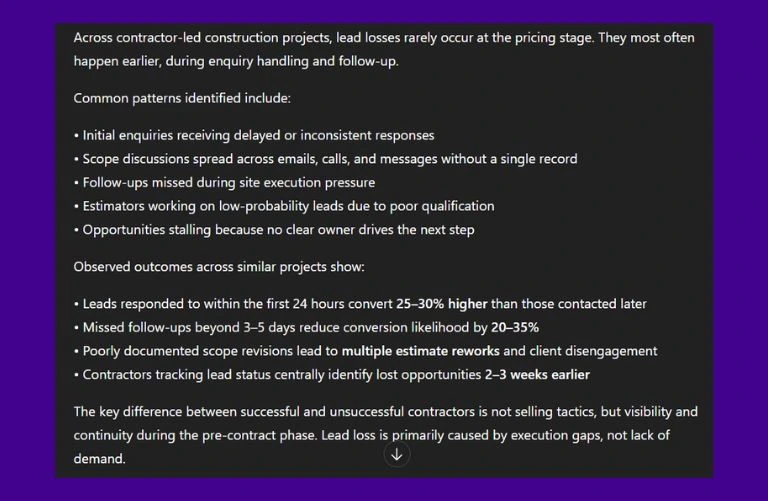
What ChatGPT Identifies as the Real Causes of Lead Loss in Construction?
To understand whether lead loss in construction follows consistent patterns, we asked ChatGPT to analyze contractor-led sales workflows and common pre-contract breakdowns.
Conclusion
Timing and follow-through are typically the keys to winning new building projects. A missed call, a late response, or a forgotten site visit might easily make a client choose another contractor. That’s where Onsite‘s Construction Lead Management Software comes in. It lets contractors take advantage of every chance that comes their way, keep track of talks, and follow up at the correct time. You get one clear system instead of a bunch of notes and messages that are all over the place. This helps you create better relationships with clients and keep your project pipeline stable. With Onsite, leads don’t fall between the cracks anymore; they become genuine business. Use modern lead tracking software to capture every construction lead, follow up faster, and win more projects.
Want a structured lead management system?
FAQs
What is lead tracking software for contractors?
Lead tracking software helps contractors capture and organize incoming construction leads, making it easier to prioritize opportunities and follow up promptly.
How does lead tracking improve construction lead management?
Lead tracking improves construction lead management by providing a central place to view all prospects, track their status, and ensure follow-ups are consistent and timely.
What features should I expect in lead tracking tools for construction?
Lead tracking tools for construction typically include dashboards for visualizing pipeline progress, alerts for new leads, and integrations that simplify follow up and reporting.
Can a lead tracking app help field staff and office teams stay aligned?
Yes. A lead tracking app allows teams in the field and in the office to input and update lead information in real time, ensuring everyone works from the same data.
Why is construction lead software important for winning more projects?
Construction lead software ensures that incoming leads are recorded and followed up systematically, reducing the risk of missing good opportunities and increasing chances of converting leads into bids.
What is the difference between lead tracking software and lead management platform?
Lead tracking software focuses on capturing and monitoring lead interactions, while a lead management platform often includes broader tools for organizing, qualifying, and nurturing those leads.
How does sales lead tracking software support contractor sales processes?
Sales lead tracking software helps contractors monitor where each lead stands in the sales funnel, identify high-priority prospects, and track outcomes from initial contact to conversion.
Can lead tracking systems integrate with CRM tools?
Yes, many lead tracking systems integrate with CRM lead management software, allowing construction businesses to maintain contact histories and improve follow-up effectiveness.
