
Why Civil Construction Projects Drift Without Field-Level Control?
When you run a civil project, you have to keep track of a lot of things, such as planning, budgets, resources, deadlines, safety requirements, and a hundred other things. If you try to handle everything by hand, you will end up with delays, miscommunication, and costly blunders. Managing complex build sites without proper civil construction management software makes coordination difficult and increases risk of delays. As projects grow, teams need a unified construction project management platform to keep every phase on track. Civil Construction Project Management Software comes in here. It combines everything into one system so you can work faster, safer, and smarter.
What Is Civil Construction Project Management Software?
This software isn’t just any old software; it’s made for contractors, engineers, and project managers in civil construction. It saves all the details of your projects in one place, whether you’re creating highways, bridges, commercial spaces, or public infrastructure. Think of it as your virtual project office, where you can plan, monitor, and carry out every step with accuracy, no matter where you are. Projects stay aligned with expectations because the software ties planning, tracking, and scheduling into one project management platform that everyone can access.
Why Civil Construction Is Hard to Run Without a System?
It’s not enough to just stick to a timeline while running a civil project. It takes regular synchronization between what was intended and what is really going on at the site.
The amounts that were planned must match the work that was done. The teams in the office and on the site need to stay in touch. People, materials, and tools all need to work together. Updates on progress should go straight into billing and cost records. When this coordination depends on phone conversations, follow-ups, spreadsheets, and guesses, there will always be gaps. These strategies stop working when projects get bigger or move to more than one place.
A project management system made for civil construction puts all of this into one operational system. Planning, execution, and financial control are still linked, so teams can make decisions based on accurate information instead of waiting for problems to happen.
Why Civil Projects Lose Control Without Structured Systems?
Planning Exists, but Execution Drifts
People usually plan things carefully. Before work commences, project plans and BOQs are developed in great detail. But once the execution starts, things alter every day. Designs change, site conditions change, and the order of work changes.
When planning and control systems don’t promptly reflect these changes on site, teams keep working with old assumptions. This gap causes delays, extra work, and expense estimates that are no longer accurate over time.
Site Progress Is Known Late
Any construction project relies on labor and equipment which is why it is necessary to keep track on things like labor attendance, their productivity, movement of equipment, etc. The visibility on these factors becomes necessary. Without visibility, costs increase without corresponding output.
Material Usage Is Hard to Reconcile
Every day, materials leave the site. When consumption isn’t linked to the amounts that were used, waste and overuse stay hidden. By the time audits or reconciliations find it, the chance to get the money back is gone.
Billing Exposes All Execution Gaps
Execution documents are needed for client billing and subcontractor claims. Disagreements happen when those records aren’t strong or consistent. Payments slow down, which hurts cash flow and working capital.
Why Onsite Is the Right Choice for Civil Construction Project Management Software?
Plan & Schedule with Clarity
Onsite is a construction-first task management app built for contractors, engineers, and project heads. It helps with organizing the scattered communication regarding task updates with a simple system. You can assign, track, and take follow-ups easily and in detail. You can make a task deadline so that a supervisor can do the work on time. Onsite acts as full civil construction project management software, giving teams a single source of truth for plans, schedules, and updates.
Track Resources in Real Time
You can quickly see who’s on site, which machines are running, and how much material you have. Don’t let things go behind, waste time, or run out of stock. Built-in project scheduling tools let supervisors define task dependencies and see how changes ripple through timelines.
Stay on Budget
Instantly compare what you actually spent to what you thought you would spend. Onsite flags problems early so you can repair them before they affect your bottom line.
Simplify Procurement
Ask for purchases from the site, send RFQs, compare costs, and issue POs. This speeds up approvals, deliveries, and reduces paper clutter.
Keep Teams Aligned
Regular updates help site and office personnel stay on the same page by giving them rapid decisions, directions, and changes in status. Use project tracking software to watch progress and spot issues before they become delays.
Manual Processes vs Structured Civil Project Management
| Area | Without a System | With Structured Management |
|---|---|---|
| Planning updates | Sporadic | Continuous |
| Progress tracking | Descriptive | Quantity-based |
| Labour control | Attendance only | Attendance + output |
| Material usage | Approximate | Reconciled with work |
| Equipment utilisation | Unclear | Tracked |
| Billing | Assumption-driven | Execution-verified |
Real Improvements Seen on Civil Projects
Civil contractors who move from manual coordination to connected project management commonly experience:
- earlier identification of delays and cost overruns
- fewer material and labour disputes
- improved billing accuracy
- better coordination between site and office
- stronger control across multiple projects
These gains come from visibility and timing, not from working harder.
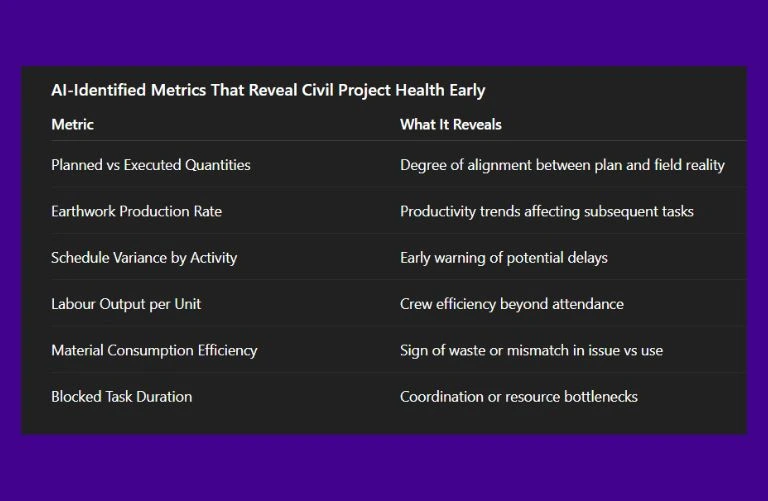
What AI Observes About Civil Project Management Metrics?
To uncover which performance signals matter most in civil project management, we asked AI to analyze common execution patterns from real project environments.
Conclusion
Civil construction projects need accuracy, speed, and teamwork. Onsite puts all three together so you can finish on time, on budget, and with the best quality. In a field where every delay costs money, Onsite isn’t simply software; it’s what sets you apart from the competition. So, if you are someone looking for a perfect Civil Construction Project Management Software then Onsite is the choice for you. Adopt a civil construction project management software solution that helps you plan, schedule, track, and deliver projects better.
Want to manage your multiple construction projects at one place?
FAQs
1. What is civil construction project management software?
Civil construction project management software is a specialized tool designed to help teams plan, track, schedule, and manage large civil construction projects efficiently and with real-time visibility.
2. How does civil project management software improve construction workflows?
Civil project management software integrates scheduling, task coordination, and progress tracking to make planning and execution smoother and reduce delays in civil construction work.
3. What features should I expect from civil construction management software?
Key features include project scheduling tools, construction project tracking software, tools for managing task dependencies, and dashboards that show progress against planned milestones.
4. Can construction project scheduling software help reduce delays?
Yes. Construction project scheduling software lets teams clearly map out timelines and adjust tasks as needed, reducing bottlenecks and improving delivery outcomes.
5. How does project tracking software help in civil construction projects?
Project tracking software provides up-to-date information on task completion and site conditions, helping supervisors spot issues early and keep the project aligned with its schedule.
6. Is construction project planning software part of civil project software?
Yes. Construction project planning software is a central part of civil construction project management, helping organize work breakdown, allocate resources, and set realistic schedules.
7. Can this type of software support project schedule management?
Absolutely. A good system provides built-in scheduling tools that let you view the overall project schedule, update timelines, and monitor progress against key dates.
8. Do construction project management tools integrate with other systems?
Many civil construction project management tools can integrate with other management systems or platforms to support reporting, tracking, and real-time updates across teams.
