
Disconnected Construction Systems: Why Contractors Lose Project Visibility
What Are Disconnected Construction Systems?
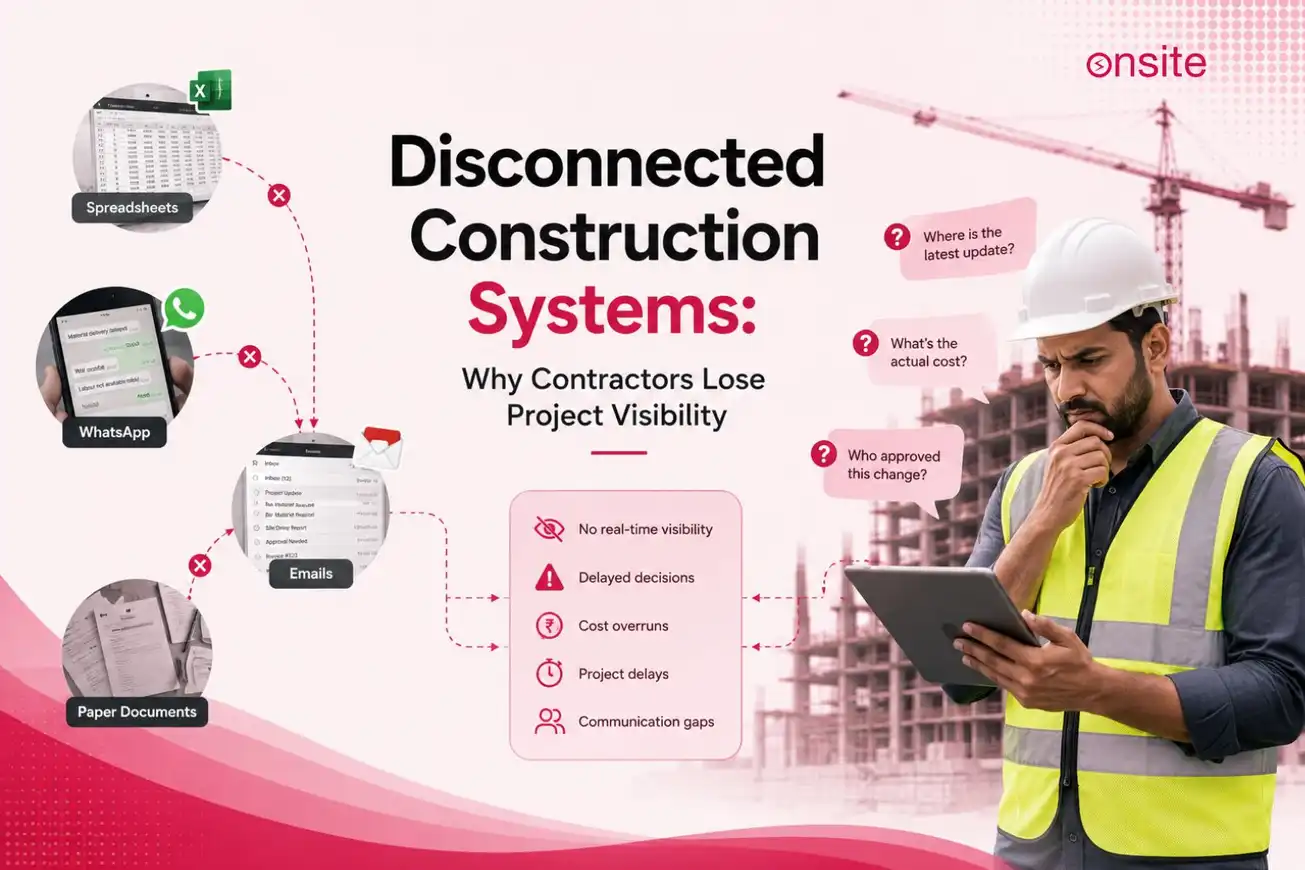
Disconnected construction systems refer to the combination of scattered, unlinked tools that construction businesses use to manage different functions. Typically, they use Excel for estimation, WhatsApp for site updates, standalone software for procurement, and Tally for accounts. These tools are not connected to one another, and they do not share data. As a result, the same information has to be entered manually every time it moves from one department or system to another, creating inconsistencies, delays, and information gaps.
Every Department Is Working. The Business Still Feels Out of Control.
The estimation team updates the Excel BOQ with revised quantities. The procurement team raises purchase orders for the next phase. The site engineer sends three photographs and a progress update through WhatsApp. The accounts team enters two supplier invoices into Tally.
The next morning, the project owner asks, “Where does the project stand today?”
The estimation team knows what was quoted. The procurement team knows what has been ordered. The site team knows what work was completed yesterday. The accounts team knows what has been paid. Yet nobody can immediately answer the owner’s question, not because the information does not exist, but because it exists in different places and takes time to bring together.
This is what a disconnected construction system looks like from the inside. Every department may be doing its own job, but the business still feels out of control.
The Real Problem Is Not Multiple Software. It Is Broken Information Flow.
Multiple software tools are not inherently a problem. Large businesses run complex operations across many platforms successfully because those platforms are connected — data created in one flows automatically into the next without human intervention. The information does not require re-entry.
The problem in most construction businesses is not the number of tools. It is the handover between them.
In a construction project, information follows a defined sequence:
A BOQ is approved → a budget is created from it → material is requested against a BOQ activity → a purchase order is raised → a GRN is confirmed when material arrives → material is consumed against a site activity → the work is measured and certified → a billing entry is raised → the project’s financial position is updated.
Every step in this sequence generates information that the next step needs. In a connected system, this information flows forward automatically. In a disconnected one, a person copies it manually.
The BOQ exists in an estimator’s Excel file. When procurement raises a purchase order, someone copies quantities from that file into the procurement system. When accounts update the budget, the figures are copied again. When management needs a progress report, the project manager collects data from the procurement system, the accounts team, and the site engineer’s WhatsApp messages, and assembles them manually into a summary document.
The useful question to ask at every step in this sequence is: where is someone copying information from one place to another? Every place where that happens is a point where information flow has broken down.
The Hidden Cost of Manual Handovers in Disconnected Construction Systems
Manual handovers create many difficult situations. They carry costs that are difficult to quantify because information is scattered across different platforms. These costs accumulate silently throughout the life of the project.
Duplicate data entry: A standard operation can take much longer than necessary because of duplicate data entry. For example, a site engineer records the Daily Progress Report (DPR) and then separately provides the same figures to the project manager for the billing spreadsheet. In this case, the same work is being performed twice. This increases the time spent across the entire project team without producing any new information. It is simply the same information being entered again in another system instead of being used directly where it already exists.
Inconsistent numbers: When the same figure is entered twice, it creates the risk of inconsistent numbers. The quantity entered by the site engineer may differ from the quantity entered by the billing team. This is a common problem because one person may be using an older version of the document or may apply a different naming convention or unit of measurement. Both versions of the same information can exist at the same time, creating inconsistencies that eventually lead to errors.
Delayed reporting: Reports are often delayed because data is scattered across different systems and cannot be reviewed until someone manually collects and combines it. This process takes time. If a monthly review requires two days just to gather data, the business is reviewing last month’s situation two days into the current month, by which time the actual situation on the project may already have changed.
Version confusion: This problem occurs when documents are shared without proper version control. A purchase order may be raised using an older version of the BOQ, while the Goods Receipt Note (GRN) is recorded against the updated revision. This creates inconsistencies that no individual intentionally caused. However, someone still has to trace the source of the problem and resolve it, which consumes additional time.
Where Construction Information Gets Re-entered?
| Business Activity | Typical Manual Handover |
|---|---|
| BOQ to budget | Quantities copied from Excel into ERP or a separate budget sheet |
| Material request | WhatsApp message converted manually into a purchase order |
| Site progress update | DPR entry re-entered into the billing spreadsheet |
| Labour attendance | Paper register manually entered into the payroll system |
| Vendor invoices | Email or physical bill entered into the accounts system |
| Cost reporting | Figures collected from multiple spreadsheets and consolidated manually |
What Management Thinks Is Happening vs What the Site Knows
There is a gap between what management sees and what the site team knows. It is one of the most consistent sources of project losses in construction.
Management has access to project information such as the budget position, billing status, and whatever was prepared for the last monthly review. All of these sources are accurate as formal records. The problem is that they are only snapshots. They describe what the project looked like the last time someone reviewed and recorded it. That review may have taken place a week ago or even a month ago.
Since the project was last summarized, the site may have changed completely. A structural activity may be running behind schedule because a drawing clarification has not been received. A material shortage may have stopped the plastering work. Subcontractors may be waiting for their previous RA bill to be approved before moving to the next phase. The client may have requested additional scope that has not yet been reflected in the project’s formal records.
All of these events are happening on the site in real time, but that information has not yet reached the management team. The latest site observations remain inside WhatsApp messages, notebook entries, or in the memory of supervisors who plan to communicate them during the next site visit.
By the time this information reaches management, the project has already moved forward, and the opportunity to act has passed. This is not a failure of communication. It is the consequence of systems that are not connected to one another.
What Connected Operations Actually Look Like
A connected construction operation does not look fundamentally different in terms of the work being done. The estimator still builds a BOQ. The site engineer still records daily progress. The procurement team still raises purchase orders. The activities are identical. What changes is what happens to the information those activities generate.
In a connected workflow, the approved BOQ is the source for the project budget — not a parallel exercise that happens alongside it, but the direct input from which budget allocations are drawn. When material is requested from site, the request references the specific BOQ activity the material will serve and the budget line it will draw from. The purchase order carries those same references. When material arrives, the GRN is matched against the purchase order. The matched GRN updates the consumption record for that BOQ activity. The completed work is measured and certified. The certification feeds directly into the billing calculation. The resulting financial position is visible on a project dashboard that every authorised team member can access.
The sequence looks like this:
BOQ approved → budget created → material requested against BOQ activity → purchase order issued → GRN confirmed → consumption recorded → work certified → billing processed → dashboard updated.
At no point in this sequence does anyone copy information from one system to another. Each step reads what the previous step produced. Information is entered once, at the point where it was created, by the person who created it.
Construction management platforms like Onsite are designed around this connected workflow structure — where the data that site engineers, procurement teams, and finance teams enter as part of their daily work automatically flows to every other function that depends on it, without a manual consolidation step in between.
Disconnected Operations vs Connected Operations
| Situation | Disconnected Operations | Connected Operations |
|---|---|---|
| Same information in multiple departments | Entered separately into each system | Created once and flows between workflows |
| Project status across departments | Different reports with different figures | One version of project information |
| Follow-up on pending actions | Manual phone calls and messages | Workflow-driven notifications |
| Budget and procurement | Managed in separate systems | Purchase orders reduce budget as issued |
| Management reporting | Manually assembled from multiple sources | Near real-time view from daily team entries |
Conclusion
Construction companies rarely struggle because they use too many tools. They struggle because important project information has to be recreated every time it moves from one department to another. The businesses that scale successfully are usually the ones that reduce those handovers, giving every team access to the same project information without asking people to enter it again.
FAQs
What are disconnected construction systems
Disconnected construction systems are the separate, unlinked tools that construction businesses use to manage different functions without those tools sharing data automatically. A typical example includes an estimator’s Excel spreadsheet for BOQs, WhatsApp for site communication, a standalone procurement system for purchase orders, and Tally for financial accounts. Because each tool operates independently, the same project information must be manually transferred whenever it needs to move from one department to another, creating version inconsistencies, approval delays, reporting gaps, and a management visibility problem that grows proportionally with the size and number of active projects.
Why do construction companies use multiple software tools
Construction companies accumulate multiple software tools because each department adopts the system that solves its immediate problem most efficiently at the time. Estimators use Excel because they are trained in it. Finance teams use Tally because it handles statutory compliance correctly. Site teams use WhatsApp because everyone already has it. Each decision is locally correct. The problem only becomes visible when the business grows large enough that combining information from all these tools into a single project view requires significant manual effort — by which point the architecture is already embedded and difficult to change.
How do disconnected systems affect project visibility
Disconnected systems affect project visibility by ensuring that no single person has access to a complete, current picture of any project. Management sees budget and billing data that may be weeks old. Site teams know about material shortages, design delays, and scope changes that management has not been informed of. The project information distributed across all departments is collectively sufficient to understand the project’s true position, but assembling it into a coherent view requires a manual consolidation exercise that is already partially outdated by the time it is complete and acted upon.
What is duplicate data entry in construction
Duplicate data entry in construction is the process of entering the same project information into two or more systems by different people at different times because those systems do not share data. Examples include a site engineer recording progress in a DPR and separately providing the same figures for the billing spreadsheet, or a procurement team entering quantities from the estimator’s Excel BOQ into a purchase order system because the two tools do not integrate. Duplicate entry consumes significant time, introduces inconsistencies when the two entries differ, and indicates that information flow between systems has broken down.
How do integrated workflows reduce manual work in construction
Integrated workflows reduce manual work by ensuring that information created at any point in the project workflow is automatically available to every subsequent step that needs it, without re-entry. When a site engineer’s daily progress entry automatically updates the budget position, the procurement forecast, and billing status simultaneously, the project manager does not need to collect and consolidate that information manually. Each piece of information is entered once, by the person who created it, and the system makes it available to whoever needs it next — proportionally reducing manual effort for every handover point eliminated.
When should a construction company replace standalone software
A construction company should consider replacing standalone software when the coordination cost of maintaining disconnected systems exceeds the operational value those systems provide. The indicators are consistent: reports take longer to prepare than to act on, the same project figure appears differently in different departments, management time is spent assembling data rather than making decisions, project status questions require phone calls rather than accessible records, and the same information is entered into multiple systems by multiple people. These collectively indicate that the business has outgrown an architecture designed for smaller, simpler operations.
