
AI in Construction Estimating: Takeoff, BOQ Preparation and Rate Analysis
What Does AI Do in Construction Estimating?
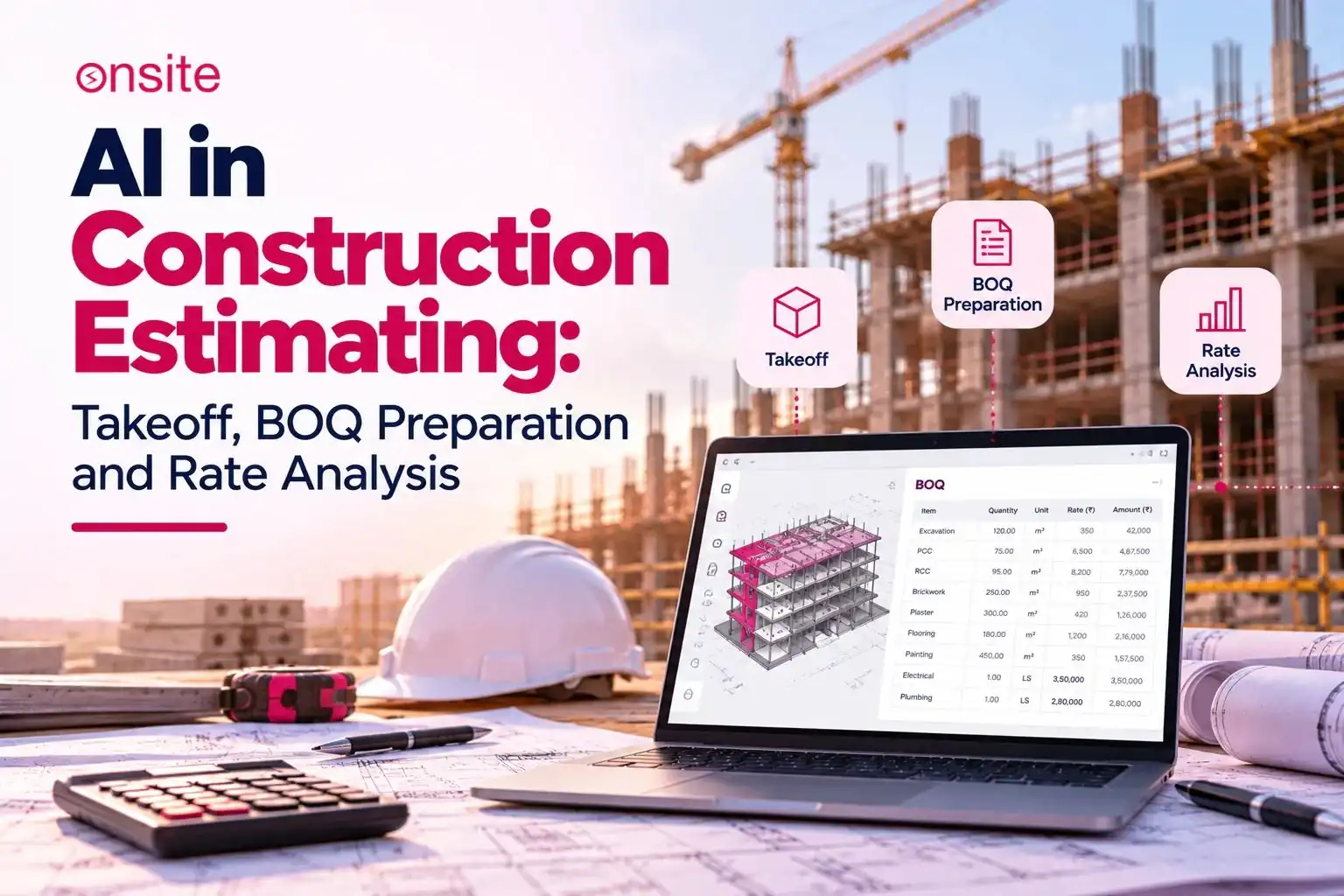
AI in construction estimating helps automate parts of the quantity takeoff process by reading drawings and extracting measurable quantities. It can also help create a BOQ structure using standard descriptions. AI can do a lot, but rate analysis may require data such as current supplier quotes, site-specific assessments, and contractor judgment that AI cannot fully replicate. However, quantity takeoff, BOQ preparation, and rate analysis operate at different levels of AI maturity.
The Bid That Won and the Margin That Did Not
Let’s take a look behind the scenes at the work of a quantity surveyor in Hyderabad in the absence of AI in Construction Estimating. He received the drawings for a project worth ₹8 crore on Tuesday, and the tender was closing on Friday at noon. So, like any sane person, he got straight to work.
He spent two days on manual takeoffs, measuring room-by-room flooring areas, ceiling grids, partition lengths, door frame counts, electrical point tallies, and so on. By Thursday morning, he had only 24 hours left before the tender closed, and he had just one major task remaining: rate analysis.
He pulled rates from a project completed eight months earlier, adjusted the major items based on memory, and submitted the tender. The good news was that he won the contract. However, after 14 months, he faced a loss because the aluminium partition rate had increased by 12% above the price he had quoted.
The project was completed successfully, but the margin was not protected.
This is one of the common problems that AI estimating tools aim to address. They help improve time allocation during compressed tender cycles. Estimators often spend a significant amount of time measuring quantities from drawings, leaving insufficient time for rate analysis. AI can help address this time allocation problem, but its impact varies across the three stages of the estimating process: quantity takeoff, BOQ preparation, and rate analysis.
At a Glance: AI in Construction Estimating: India vs UAE
| Factor | India | UAE |
| Measurement standard | IS 1200 (BIS) | RICS NRM2 |
| Rate reference | CPWD DSR / State SOR | RICS cost data / market benchmarks |
| BOQ format | Item-by-item per IS 1200 divisions | Elemental or work-section NRM2 format |
| AI takeoff maturity | Moderate — CAD adoption variable across project types | High — more consistent digital drawing availability |
| Primary data gap | State-level rate variation; regional supplier pricing | Material escalation in high-volume project cycles |
The Three Layers of Construction Estimating and Where AI Fits
Construction estimating is not a single task. It is a sequence of three distinct activities that are collectively referred to as estimating. However, all three stages require different skills and inputs, and they respond very differently to AI assistance.
1. Quantity Takeoff

Quantity takeoff refers to measuring quantities from drawings, such as floor areas, wall areas, structural member lengths, concrete volumes in slabs and columns, the number of doors, and so on. Takeoff produces quantities with units of measurement, but it does not determine the cost. It is the quantity surveyor’s job to perform the takeoff and answer the question: How much of each item does this project contain?
2. BOQ Preparation
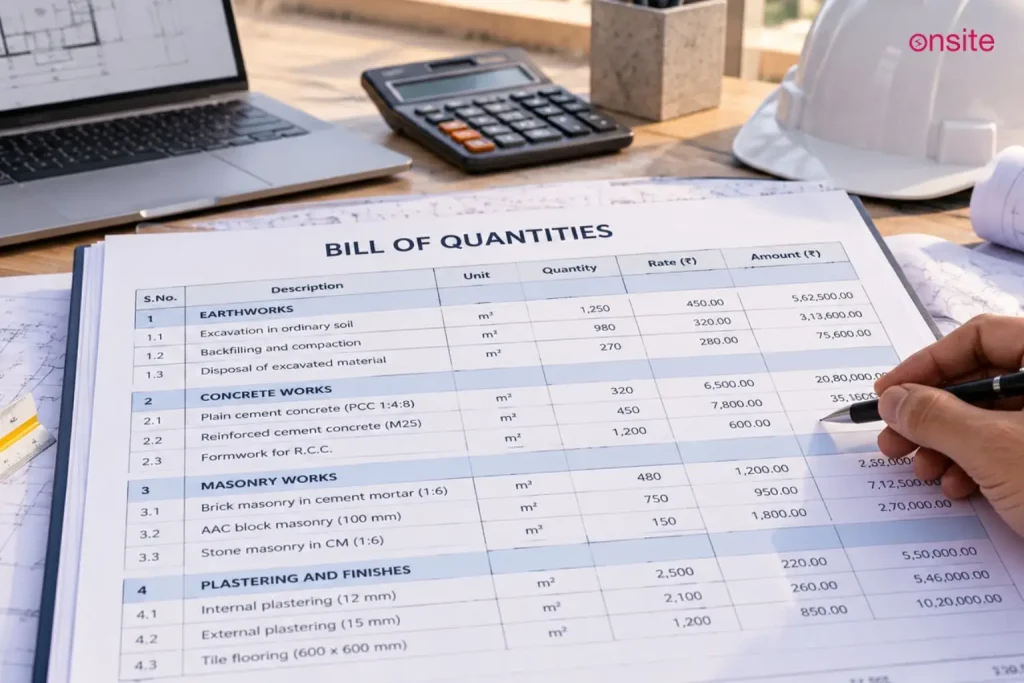
BOQ preparation involves recording the measured quantities against standardised item descriptions that follow the applicable measurement standards. In India, IS 1200, the Indian Standard for the method of measurement of building and civil engineering works, provides the framework for how items are measured, how deductions are applied, and how quantities are grouped in the BOQ. In international markets, particularly the UAE and the wider Gulf region, RICS NRM 2 provides an equivalent measurement framework. Preparing a BOQ is not just about recording quantities. It also involves attaching each quantity to a specific, standardised description that contractors can use for pricing.
3. Rate Analysis
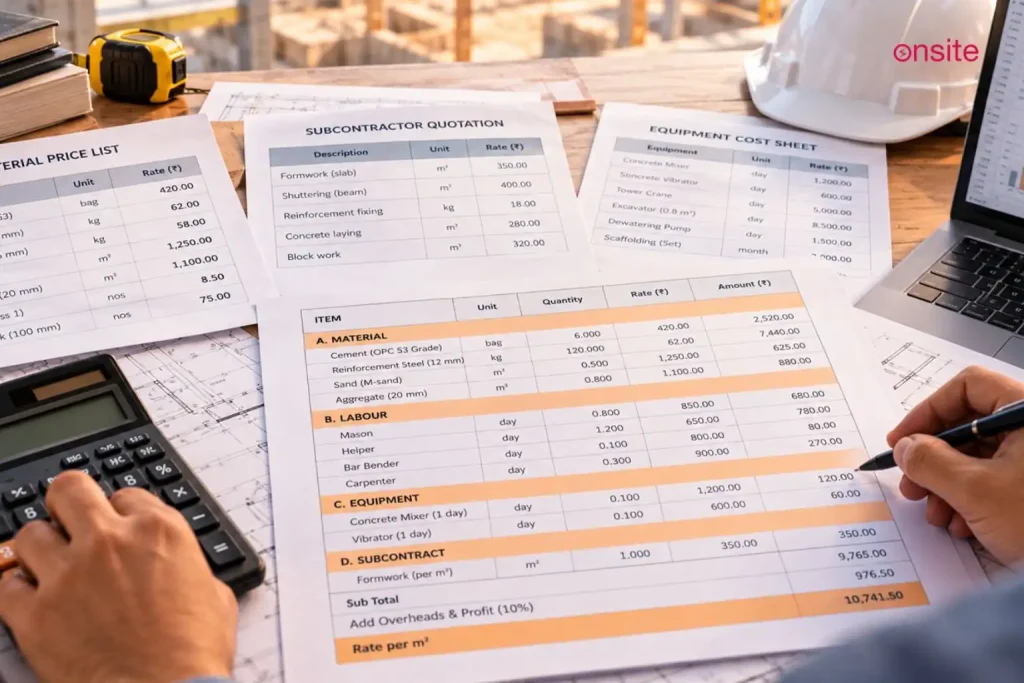
Rate analysis involves calculating the actual cost per unit for each BOQ item using current inputs. These may include site-specific productivity assumptions, equipment costs, subcontractor quotations, overhead allocation, and other relevant costs.Rate analysis produces the rates that go into the priced BOQ and, eventually, the tender submission.
All three stages differ fundamentally in their level of AI maturity. AI may perform well at the first stage, offer partial assistance at the second, and have more limited utility at the third. However, many AI estimating tools on the market describe their offerings as automated estimating, compressing all three stages into a single phrase. Before choosing AI construction estimating software, you need to understand which of these three stages it actually supports and how reliably it performs each task.
How AI Reads Drawings and Structures BOQ Items
AI takeoff tools use computer vision to read CAD files and PDF drawings. They identify shapes, read dimensions, and calculate areas, lengths, and counts without requiring someone to measure everything manually. These tools generally work well for tasks such as measuring flat slab areas and wall surfaces, counting doors, windows, columns, and beams, and measuring basic structural members.
However, their accuracy can drop in certain situations. Scanned drawings are one example, especially in renovation and retrofitting projects where the original CAD files are unavailable. Since these drawings are images rather than vector files, they are harder for AI tools to read accurately. Using outdated drawings can also cause problems if the system processes both old and current revisions without clearly distinguishing between them. Similarly, if dimensions are missing because the design is incomplete, the tool may estimate them or flag the missing information. Either way, an estimator needs to review the results.
Reinforcement takeoff is another area where manual work is still common. This includes preparing bar schedules, checking lap and development lengths, and counting stirrups. These tasks require the estimator to compare structural drawings with bar bending schedules and apply IS 456 or equivalent code requirements. MEP coordination takeoff is also more difficult because it involves checking architectural, structural, MEP, and services drawings together. AI tools cannot reliably resolve all the conflicts between these drawings without significant configuration.
When preparing a BOQ, AI tools use natural language processing to create item descriptions from the quantities they extract. However, the descriptions depend on the measurement standard used to train the system. For example, a tool trained on RICS NRM2 may produce descriptions suited to international contracts, but these may not follow the IS 1200 divisions required for Indian public and private sector BOQs. Getting the quantities right is not enough. The item descriptions must also meet the requirements of the tender.
This means an estimator must check AI generated BOQ items against the applicable measurement standard before pricing them. AI can reduce the time spent on initial measurements and drafting item descriptions, but the output still needs to be verified. If the estimator accepts it as final without checking it, errors can carry forward into the rate analysis stage.
Why Rate Analysis Cannot Be Delegated to AI
Rate analysis depends on information that drawings do not provide. Historical rates alone are also not enough because prices and site conditions can vary from one project to another. The rate for a BOQ item depends on four main factors: current material prices in the project district, current subcontractor quotations, site conditions that affect work output, and the contractor’s own costs.
For example, two contractors bidding for the same concrete work in Pune and Nagpur may arrive at different rates. Aggregate prices, transport costs, labour availability, and wage rates can vary between the two locations. AI tools using historical rate data cannot account for these differences unless they have up to date market information. This information still needs to be collected through market enquiries.
The CPWD DSR, or Delhi Schedule of Rates, provides a government benchmark for estimating public works costs. It is a useful starting point for government projects, but it does not necessarily reflect current market rates. The difference between DSR or State Schedule of Rates and actual tender rates can range from 15 to 40 percent, depending on the project location, market conditions, and contractor’s overheads. If a contractor relies on AI generated rates based on DSR figures without checking current prices, the bid may be too high to win the project or too low to make the expected profit.
Rates also vary between states in India. Maharashtra, Telangana, Gujarat, and Rajasthan each have their own Schedule of Rates for items with the same specifications. A concrete rate listed in Maharashtra’s SOR cannot automatically be used for a project in Rajasthan. If AI tools combine rate data from different states without accounting for these differences, the rates they produce may not be suitable for the project’s location.
AI can still help with three parts of rate analysis. It can flag rates that differ significantly from historical figures, identify BOQ items with no previous rate in the contractor’s database, and organise cost data from completed projects into a searchable library. These functions help the estimator work with cost information, but they do not replace the need to check current prices and calculate suitable rates. Rate analysis is where much of the risk in a tender lies. The time saved by using AI for quantity takeoff can be put to better use by checking rates carefully before submitting the bid.
How to Build an AI Assisted Estimating Process That Produces Accurate Bids
To prepare accurate bids with AI, contractors need to decide which tasks AI can handle and where an estimator needs to step in. AI can save time on measurements, but the estimator still needs to check the results and make decisions.
Step 1
The first step is to use AI to measure quantities from drawings and check how well it works with the drawings used on the project. For example, architectural plans and elevations may work well for fit out projects, while structural GA drawings may be suitable for civil work. Reinforcement, MEP, and complex 3D measurements usually still need manual takeoff. Before adding quantities to the BOQ, the team should also decide who will check them against the drawing dimensions.
Step 2
The second step is to use the BOQ created by AI as a structured draft, not a finished document. The estimator should check item descriptions against IS 1200 for Indian projects or RICS NRM2 for international and UAE projects. They should also confirm that deduction rules have been applied correctly and that the measurements follow the project contract conditions. Reviewing the draft takes less time than preparing the BOQ from scratch, but the review is still necessary.
Step 3
The third step is to use the time saved on quantity takeoff for rate analysis. For example, a tender process that previously spent 60 percent of its time on manual measurement and 40 percent on rate analysis could move closer to a 30 percent and 70 percent split with AI assistance. The estimator can use this extra time to collect current supplier quotations, contact subcontractors for their rates, and assess site conditions. This helps ensure that rates reflect the project’s actual costs rather than relying only on historical estimates.
Step 4
The fourth step is to maintain a project level rate library using verified costs from completed projects. After each project, the contractor should add the rates at which work was actually procured, not just the rates estimated during bidding. Over time, this library becomes a reliable reference for future bids in the same location and work category. Construction management platforms like Onsite connect BOQ items with procurement and actual cost monitoring, helping contractors collect verified cost data systematically instead of relying on individual estimators to update records manually.
What AI Changes and What It Does Not in Construction Estimating
AI changes how estimators spend their time, but it does not eliminate the need for their judgement. It also does not automatically reduce the commercial risks associated with rate analysis. Instead, it gives estimators more time to focus on tasks that require experience and decision-making.
The biggest time savings from AI-assisted estimating often occur during the takeoff stage, including drawing interpretation, initial BOQ structuring, and quantity extraction. Computer vision can handle much of the geometric parsing, reducing the time required for measurement. This allows estimators to spend less time on takeoff and more time reviewing quantities and refining their estimates.
The long-term advantage of AI estimating does not come from the tool itself. It comes from what the contractor does with the time it saves. A contractor who uses that time for current market inquiries, building stronger subcontractor relationships, and systematically recording actual project costs can develop a rate library based on their geographical market, procurement network, and productivity history.
That library is not easily replicated by a competitor using the same AI takeoff tool. The tool is a commodity.Rate intelligence is the differentiator.
Construction ERPs such as Onsite can support downstream cost-tracking workflows that feed verified actual costs back into the estimating process, helping close the loop between bid rates and actual project costs.
Conclusion: The Time AI Returns and Where to Invest It
The quantity surveyor in Hyderabad who won the ₹8 crore fit-out tender faced a shortfall after 14 months. The problem was not just that he lacked the right technology. It was also that he did not have enough time to focus on the most critical part of estimating: rate analysis.
Bringing AI construction estimating software into the picture helps address this time allocation problem. When a contractor uses AI to reduce takeoff time from two days to four hours, it frees up valuable time for rate analysis. This is where a bid can be won or lost, and it is the stage where AI cannot replace the estimator’s judgement.
Contractors who use AI for geometric measurement, rely on estimator judgement for rates, and maintain a verified rate library built from actual costs on completed projects are likely to produce more accurate bids than those who apply AI across the entire estimating process and accept its output as final. AI is not going to take over decision-making. You remain the decision-maker, and AI helps you make stronger, better-informed decisions.
Disclaimer: Rate benchmarks, measurement standards, and regulatory references cited in this article reflect published guidance as of the date of publication. Construction costs and market rates are location-specific and subject to change. Readers should verify current rates and applicable standards for their specific project conditions.
Sources
Bureau of Indian Standards. IS 1200: Method of Measurement of Building and Civil Engineering Works. https://www.bis.gov.in
Central Public Works Department. Delhi Schedule of Rates. https://cpwd.gov.in
Royal Institution of Chartered Surveyors. RICS NRM2: Detailed Measurement for Building Works. https://www.rics.org
Frequently Asked Questions About AI in Construction Estimating
What is the difference between AI quantity takeoff and AI cost estimating?
AI quantity takeoff refers to the automated extraction of measured quantities from construction drawings using computer vision. The output is quantities with units — floor areas, concrete volumes, partition lengths — but no costs. AI cost estimating is a broader term vendors use to describe tools that also apply rates to those quantities to produce a priced output. The distinction matters because takeoff automation delivers consistent accuracy on supported drawing types, while automated rate application relies on databases that may not reflect current market prices in the project location. Understanding which function a tool actually performs is the first step in evaluating it.
Can AI prepare a complete BOQ from construction drawings without an estimator reviewing it?
No. AI tools generate a structured draft BOQ from drawing data, but the output requires estimator review before it is suitable for a tender submission. Review covers three areas: confirmation that item descriptions match the applicable standard — IS 1200 in India, RICS NRM2 for international contracts; verification that deduction rules apply correctly for openings, voids, and reinforcement laps; and identification of items the AI system missed because the information appeared in a drawing type the tool did not process. The AI-generated draft is faster to review than preparing a BOQ from scratch, but it is a draft, not a finished document.
How accurate are AI-generated rates for Indian construction projects?
AI-generated rates for Indian construction projects carry significant location and timing risk. Most AI estimating tools that apply rates use historical rate databases or CPWD DSR benchmarks. The gap between DSR rates and actual competitive tender rates ranges from 15 to 40 percent depending on project location and market conditions. Additionally, state-level Schedule of Rates differ across Maharashtra, Telangana, Gujarat, Rajasthan, and other states — a rate that is accurate for a Mumbai project may be materially wrong for a project in Ahmedabad or Hyderabad. Contractors using AI-generated rates must validate those rates against current supplier quotations and subcontractor enquiries before submitting a bid.
What drawing formats do AI takeoff tools support?
Most AI takeoff tools support DWG (AutoCAD), DXF, and PDF drawing formats as primary inputs. Performance is highest on PDF drawings exported from CAD software, because these retain vector geometry and embedded dimension text. Scanned drawings converted to PDF — common in renovation and retrofit projects where original CAD files do not exist — are raster images and degrade AI accuracy significantly. Some tools include OCR processing for scanned drawings, but the output requires more extensive review. DWG file processing generally produces the most accurate extraction because the geometric data is native to the format.
Does AI construction estimating work for CPWD or state PWD projects?
AI tools can assist with quantity takeoff for CPWD and state PWD projects, but their utility for BOQ preparation is limited by how well the tool has been configured for IS 1200 measurement rules and CPWD item description formats. CPWD projects require BOQ items to follow specific description conventions tied to CPWD specifications, and general-purpose AI tools trained on broader datasets may not produce item descriptions that match CPWD requirements without significant manual editing. For rate analysis, CPWD DSR provides the schedule reference, but contractors still need to assess the gap between DSR rates and current market rates in the project district before submitting a tender.
How does an AI estimating tool handle non-standard items or star rates?
Non-standard items — also called star rate items — are BOQ entries for work not covered by the project’s standard schedule of rates. These items require specific rate negotiation between the contractor and client. AI tools do not handle star rate items well because there is no applicable historical benchmark from which to generate a rate suggestion. The tool typically flags these items as unmatched or requires manual input. The estimator must prepare a rate analysis buildup for each star rate item from first principles, using current material and labour costs. This is one of the areas where AI provides no efficiency gain and where estimator experience and current market knowledge are most directly valuable.
What data does a contractor need to get reliable output from AI estimating software?
Reliable output from AI estimating software requires two categories of data. First, high-quality input drawings — ideally CAD-derived PDFs or DWG files with complete dimension annotations, clear revision management, and separate drawing files for architectural, structural, and services disciplines. Incomplete or poorly managed drawing sets produce incomplete takeoff output regardless of tool quality. Second, a calibrated rate library — current supplier price lists for the project geography, recent subcontractor quotations for the relevant work categories, and verified actual costs from recent comparable projects. The AI tool assists with quantity extraction, but the rate output is only as reliable as the rate data the contractor maintains and keeps current.
