
Why is Software for Civil Contractors Needed?
Discover Why software for civil contractors is essential for efficient project execution and cost control.
Civil contractors work on some of the most difficult projects in construction, such as roads, bridges, highways, drainage systems, and big infrastructure projects. Modern job sites and complex infrastructure demand specialized civil construction management software so teams maintain clarity and accountability. There are a lot of teams, heavy machinery, raw materials, severe deadlines, and a lot of money involved in these projects. When you use spreadsheets or do things by hand to keep track of all these moving pieces, you often make mistakes, take too long, or go over budget. Want to manage all of it effortlessly? Software for Civil Contractors is the solution. Let’s get to know more.
The Nature of Civil Projects Makes Manual Methods Fragile
Work Progresses Gradually but Costs Accumulate Daily
Earthworks, foundations, roads, bridges, and utilities all make little, steady progress. When progress isn’t tracked every day, changes build up without anyone noticing. When they are finally recognized, healing is frequently costly and disruptive.
Heavy Dependence on Resources
It is necessary that right things arrive at site on right time. For example, labor, material and machinery. Without any coordination, many resources sit doing nothing if the other thing is not at the site. For example, many times, materials sit at a site consuming either the space of warehouse or getting spoiled at site in open if labor is not available at right time.
Extended Timelines and Changing Conditions
The weather changes, the ground changes, and getting approvals takes time. Plans change all the time, and static papers have a hard time keeping up with these changes. Manual approaches and spreadsheets lack the capabilities of dedicated civil project management software that can map timelines, tasks, and costs in one place.
What Typically Goes Wrong Without Software?
Progress Visibility Is Delayed
At many sites, when traditional methods are adopted, site updates are always captured manually, and the information reaches the team not every day but on a weekly or monthly basis. But by the time that data or information reaches the team, there have been many changes that can’t be undone, and the costs are already incurred.
Resources Are Poorly Utilized
Supervisors often rely on assumptions rather than the data to manage labor, material, and equipment. This often leads to uneven productivity and poor utilization of resources.
Material Losses Go Unnoticed
Material losses often go unnoticed because there is no proper tracking of material usage. Supervisors or business owners often Notice overordering or wastage of material after the work has been done or during reconciliation.
Approvals and Documentation Slow Work
In construction sites, changes can happen anytime, often during changes and it takes time to reach the project manager or sometimes it gets buried in emails, which can cause to delayed information and miscommunication. This leads to the delay of approvals and documentations for construction projects.
Billing Becomes a Struggle
When you don’t have a proper data or daily progress reports, your execution reports become weak, on which rely billing. When you don’t have the systematic way, billing often depends on assumptions, which can cause disputes between stakeholders, and it also slows down the process of payments.
What Software Changes for Civil Contractors?
Construction software does not take the place of site monitoring. It helps by converting everyday tasks into useful information for teams. A purpose-built civil construction project management software brings planning, execution, and reporting into a unified platform.
In real life, software lets contractors record data about progress, labor, and equipment right on the job site. You may check how well the strategy is being followed in almost real time. Costs and resources are still tied to work that has been done. It’s easy to find and keep track of documents, approvals, and changes. Instead of making guesses, bills are based on verifiable execution records.
The answer is clear. People stop guessing and start making judgments based on facts.
Key Benefits of Software for Civil Contractors
1. Project Planning and Scheduling
Delays are common in a construction project, but delays are costly which results in cost overrun. Considering every factor beforehand while starting a construction project is necessary and Software for Civil Contractors helps in planning and scheduling projects more efficiently. It helps in tracking the timelines, managing resources, and forecasting potential issues. Using Software for Civil Contractors in construction project management helps in effective planning and scheduling to save you from future mishaps. Using dedicated tools for project management civil construction helps teams coordinate complex tasks across sites and disciplines.
2. Material Management
To be sure that materials are procured, tracked and utilized efficiently, it is necessary that there is good material management. You can manage materials profoundly with good construction management software. Some of the important components this feature should have are tracking & generating POs, tracking inventory, party-wise report, approving material request, managing warehouse, and keeping track of used & current stock. A Software for Civil Contractors like Onsite construction management software has all of it for you. For billing management, you can easily download reports of the progress and the bill of material being used in a particular work order. Forget manual calculations. Onsite auto-calculates bills based on completed work and tracks any material or labor deductions transparently.
3. Financial Management
Keeping track of expenses is one of the most essential features a project management software should have. This is the area where most of the errors happen, and this is where anyone cannot afford to have any error. A software is good when it has effortless management of all the finances. Within that software you should be able to generate material purchase orders where you can keep track of finances in a particular order. Monitoring expenses, vendor payments, and client bills is easier with software. Contractors gain better visibility into cash flow and can avoid disputes through transparent records. With integrated civil cost estimation software, teams can align budgets, estimates, and actuals for more reliable cost control.
4. Workforce Management
Labour management is a critical component of construction site management software. It ensures that your construction projects have the right people with the right skills in the right place. With good software, you can track, manage and pay labor effortlessly. Some of the important components this feature should have are: tracking of salary & attendance, tracking labor shift, tracking labor expense, generation of PDF Reports, and Automated Salary Calculation.
5. Equipment Management
In construction, we track materials and labor but forget the machines doing the real heavy lifting. Whether it’s an excavator parked for hours or a mixer that vanished between sites, unmanaged equipment quietly eats into your profits. Construction Equipment Management Software helps you change that. Track where your machines are, how they’re being used, and when they need maintenance.
Why Onsite – construction management software – Is the Right Fit for Civil Contracting?
Simple projects are not easy. They are even more complex than seems. It demands a constant coordination between site execution resource cost and approval. Onsite construction management software is one of the best construction management software that is made with keeping in mind the real problems at construction site. It helps in many things like daily progress, labor report, equipment, material, BOQs and the list goes on and on. You cannot rely on spreadsheets or WhatsApp anymore. You need a single dashboard to keep tracks on anything, to compare your progress against time. It helps you manage productivity and it helps you with accountability. You can save up to 7 to 10% of your project cost with Onsite.
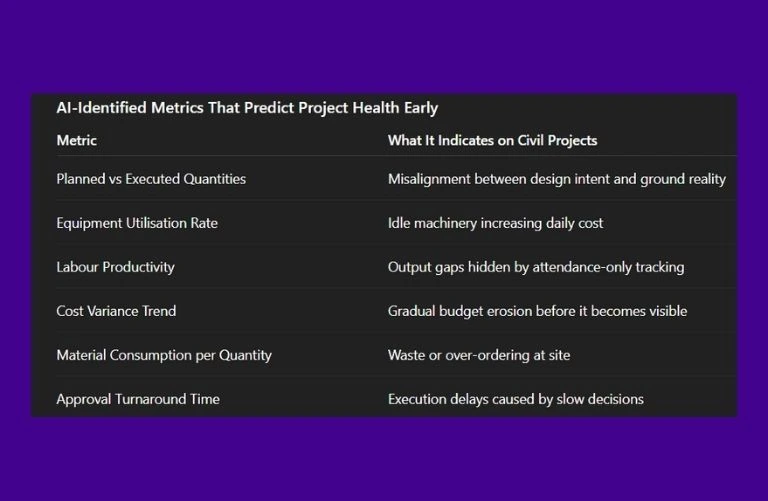
What AI Flags as Critical Metrics in Civil Construction Projects?
To check whether the challenges faced by civil contractors are isolated or widely experienced, we asked AI to analyze common execution patterns across civil construction projects.
Conclusion
Civil contractors can’t afford to use old methods to manage projects in the fast-paced world of construction nowadays. There is a lot of paperwork to do, resources are tight, and tiny delays can quickly turn into big problems that cost a lot of money. That’s when the appropriate software really matters. Onsite gives contractors a simple but powerful platform that makes planning easier, keeps finances open, and gives them full control over resources, all in one spot. Onsite construction management software is made for contractors who want to work smarter, not harder. Top civil software companies now build solutions that support full lifecycle needs, from planning through handover.
Want to know more about construction prject planning?
FAQs
1. What is software for civil contractors?
Software for civil contractors refers to digital tools like civil construction management software that help contractors plan, track, and deliver infrastructure and site work more efficiently.
2. Why do modern civil projects require civil construction management software?
Civil construction management software provides visibility across planning, execution, and reporting, which is crucial for handling complex civil infrastructure projects and large field teams.
3. How does civil project management software help in daily operations?
Civil project management software helps teams organize schedules, resources, and tasks, making it easier to manage deadlines and coordinate work across sites.
4. What are the benefits of civil construction project management software for contractors?
Civil construction project management software brings planning, tracking, and execution together, reducing errors and improving collaboration between office and field teams.
5. Can civil construction software improve project scheduling?
Yes. Civil construction software enables teams to build accurate civil work schedule plans, forecast timelines, and adapt to changes without confusion.
6. What role does software for civil contractors play in cost estimation?
Dedicated civil cost estimation software helps contractors generate reliable cost forecasts, align budgets with real conditions, and reduce financial surprises.
7. How is civil works software useful for field execution?
Civil works software helps field personnel record progress, submit updates, and share site status quickly, improving communication with project managers.
