
Track Subcontractors RA Bills & Prevent Overspending with Onsite

Learn how tracking construction project cost and project cash flow helps catch overspending before it happens.
Construction is an industry where every small thing costs. Taking care of Subcontractor RA Bills is an important yet complex and time-consuming process. Taking time to handle BOQs, tracking of progress, verifying transactions or claims, and making timely payments- it is a whole lot of process, and it is necessary to avoid overspending. When subcontractor RA bills are not tracked within the wider construction project work, costs can escalate unexpectedly and compromise the entire project cash flow. It can be chaotic with your same old boring ways but with Onsite you can bring speed and accuracy to the process. Let’s get to know how.
Why Subcontractor RA Bills Often Go Out of Control?
The main problem is that things aren’t always the same. Site teams measure work based on what really happens on the ground. Subcontractors write up bills using their own notes. The last piece of information that comes to the accounts teams is what they work with. Everyone is working with incomplete knowledge since there is no single point of reference.
As more adjustments come in, approvals start to slow down. Bills are still pending because it’s hard to check older versions. When it comes time to pay, small discrepancies in amounts or rates can turn into fights. When there are a lot of subcontractors on a big project, this misunderstanding quickly messes up cash flow projections.
If there isn’t a systematic approach, RA billing becomes reactive instead of planned.
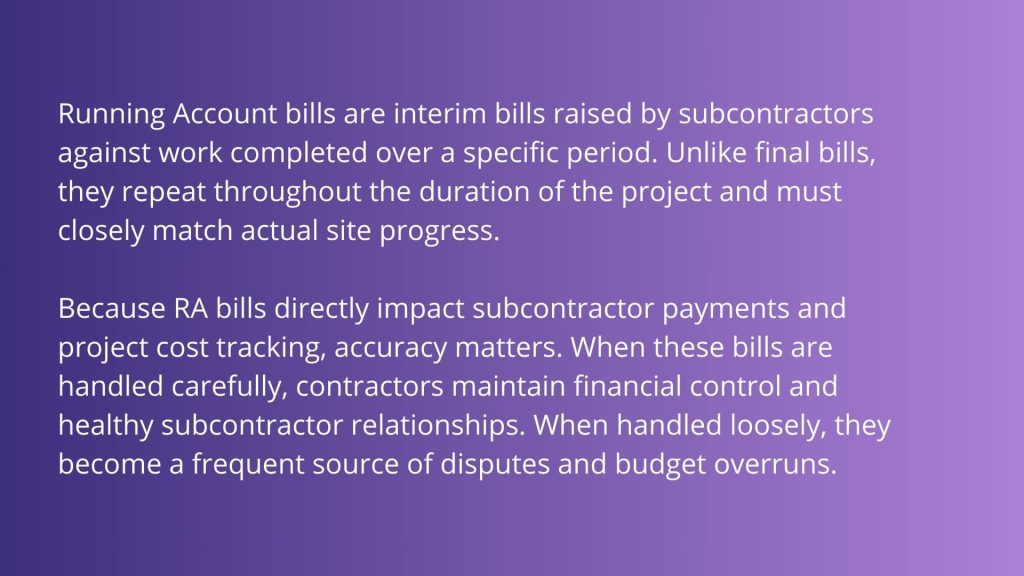
Understanding RA Bills in Construction Projects
Why Manual RA Bill Processes Break Down?
Construction work is full of surprises every day and you need to be ready all the time. Many changes can take place in a construction project like revision in drawing, evolution of scope, and execution plans. Manual RA bill processes struggle to keep pace with these changes. Manual spreadsheets don’t give you insight into project cost estimation, causing teams to react late when overspending shows up in RA bills.
This leads to many problems like multiple bill versions, incomplete site verification, missing supporting documents, and unclear approval status. There is no documented record for things and there are no updates of changes when things are done manually. The absence of traceable records makes it hard to explain billing decisions, especially when projects close. Without a system that respects project stages, teams often discover overspend only after cash flow is tight.
How a Structured RA Bill Process Should Function
The charging procedure for a reliable RA starts on site, not at the accounts desk. Before a bill is sent out, the work that has been done is measured where it took place and compared to the BOQ items. These checked amounts are what everyone uses as a starting point.
The subcontractor then makes the RA bill utilizing those numbers that have been checked. Project teams check it against the agreed-upon pricing and scope, and any adjustments are clearly stated instead of being handled informally. After the bill is approved, it goes to the accounts department to be paid. There is a record of every version and approval for future reference.
This billing procedure cuts down on disputes and speeds up payment cycles because everyone is working with the same information.
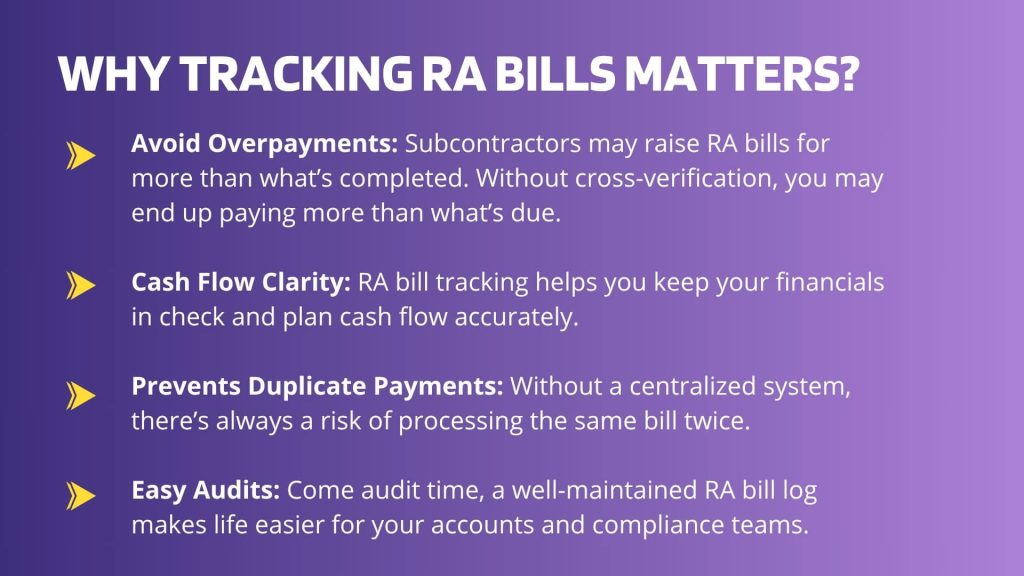
Why Tracking RA Bills Matters?
How Onsite Helps You Track RA Bills?
1. Centralized BOQ Management
With Onsite, generating, uploading, and managing Bills is way easier than ever before. It stays secure in the app under the Subcontractor section. You can have access to them anytime, anywhere. Whether it’s excavation, masonry, electrical, or finishing work, every RA bill is logged and visible at the Subcontractor section. Onsite connects RA bills with your broader construction project cost picture so you see how each subcontractor’s billing affects your bottom line.
2. Auto-Match with Work Progress
As Subcontractor update their progress and material used in Onsite, it automatically generates a bill according to the information fed to it. This helps with accuracy and ensures you’re only paying for what’s actually completed.
3. Running Totals of Paid vs Pending Amounts
Onsite maintains a running tally of:
- Total work order value
- Amount already paid via previous RA bills
- Balance due
With real-time visibility into project cash flow and individual RA entries, you can adjust allocations before costs spiral.
4. Easy Record Keeping
All of the updates of the work, all of the files, bills, date, value, etc can be stored within the app. You do not need to go through WhatsApp and excel to even find Subcontractor RA Bills. All of the records are easily accessible anytime and anywhere. Understanding your project cash flow meaning — where money is coming in and where it goes out — helps teams control RA bills before they impact delivery.
Manual Tracking vs Digital RA Bill Management
| Area | Manual Methods | Structured RA Bill System |
|---|---|---|
| Bill versions | Hard to track | Clearly recorded |
| Approval status | Unclear | Transparent |
| BOQ linkage | Manual matching | Built-in |
| Revision history | Fragmented | Complete |
| Dispute resolution | Time-consuming | Evidence-based |
Conclusion
Subcontractor Bills can help you save time, improve accuracy, reduce disputes, and help in improving cash flow. You can manage any number of subcontractors whether 5 or 50. Start your journey of Subcontractor RA Billings with clarity and control. So, avoid delays, miscommunication, and disputes by switching to Onsite. Track your RA bills within the wider construction project planning framework to protect your project cost and maintain healthy project cash flow with confidence.
Want to manage your Subcontractor Efficiently?
FAQs
1. How does tracking subcontractor RA bills help control project cost?
Tracking subcontractor RA bills gives you visibility into project cost as it is incurred. When each RA bill is logged in a system, you can compare planned vs actual spend and avoid overspending.
2. Can monitoring subcontractor RA bills improve project cash flow?
Yes. By tracking RA bills as they are raised and approved, you can better manage project cash flow, ensuring expenses are aligned with forecasts and avoid unexpected cash strain.
3. Why is subcontractor RA bill tracking important for the construction project work?
Subcontractor RA bill tracking helps reconcile billed amounts with actual work done, reducing disputes and ensuring that the construction project work stays on budget.
4. How does project cost estimation support tracking RA bills?
Good project cost estimation sets expectations for work costs before bills arrive. When RA bills are compared to estimated costs, teams can detect anomalies early and prevent overspending.
5. Can subcontractor RA bill tracking help with project planning and execution?
Yes. Tracking RA bills as part of broader project planning allows teams to see cost implications of planned work, link expenditure to phases, and adjust resources accordingly.
6. Does tracking subcontractor RA bills help during stages of the construction project?
Tracking RA bills throughout the phases of construction project provides financial checkpoints that help teams make data-driven decisions at each stage.
7. How does subcontractor RA bill tracking tie into project financial management?
Subcontractor RA bill tracking gives clear records of billed versus unbilled costs, a key element of project financial management that helps maintain healthy budgets and cash flow.
8. What role does subcontractor RA bill tracking play in the project cost estimation in project management?
When RA bills are monitored against project cost estimation in project management, it becomes easier to forecast total spend and fine-tune estimates for similar future work.
