
Scrap Management in Construction: Recovering Lost Steel
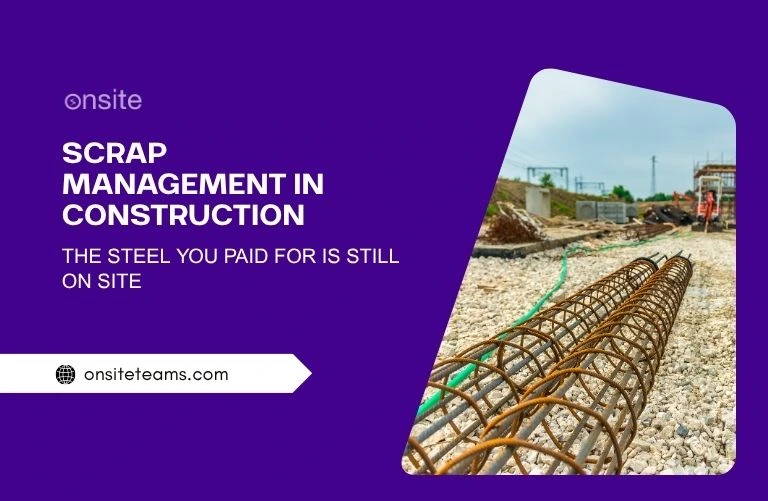
A site engineer in Pune finished the third-floor slab pour. The store had issued 4.1 tones of TMT bar. The bar bending schedule required 3.6 tones. Nobody logged the 500-kilogram difference. Five weeks later, a purchase request went out for 700 kilograms of 12mm bars for the lift core walls. The vendor delivered. Rs 47,000 left the project account. Sitting in the scrap corner: 460 kilograms of 12mm offcuts from three previous pours. Unweighted. Uncategorized. The contractor purchased steel he already had on site. This is what happens when scrap management in construction does not exist. The offcuts were not stolen. They were simply invisible at the moment the procurement decision was made.
Why Scrap Management in Construction Gets Ignored?
In every single construction site, there is always a scrap pile. The problem is not that offcuts exist, but the problem is that nobody can know what possibly is in the pile, what is its size, diameter, or how much of it can go back into the structure before the next PO is issued. In the majority of the construction sites, an offcut is dismissed the moment it leaves the cutting table. Nobody gives attention to it, nobody measures it, there is no log for it, and no assessment of whether the next activity could use a 600 mm piece of 16 mm bar. It stays return off until it’s given away. The financial logic behind this is never examined during the execution.
This scrap is sold and only when considered when the receipt of the sale comes. It is never considered or questioned that the scrap could have been used in the project and the project cost could have been cut down. This is what separates scrap management in construction from general site housekeeping. It’s never about cleaning the site, it is always about at what point a scrap can be used in a project so that a fresh procurement decision accounts for it.
Where Steel Offcuts Come From on a Building Project?
Slab and beam reinforcement
Standard TMT bars arrive in 12-metre lengths. The BBS specifies the cut lengths required for each element. The gap between the standard length and the required cuts produces offcuts ranging from 200mm trimmings to 1,800mm pieces that could substitute for full bars in secondary elements. A single slab pour on a 1,200 square metre floor can generate 80 to 140 kilograms of offcuts from bar cuts alone.
Column and wall reinforcement
Typically, column bars are cut according to floor height plus lap length. Wall bars are cut to the same height as the panels. The earlier cutting plan no longer fits when a drawing’s column size changes during execution, and those cut parts become offcuts. Even though some of these leftovers could still be usable if carefully inspected, they frequently go to scrap without a second glance.
What Untracked Scrap Actually Costs a Contractor?
The cost of ignoring scrap management in construction operates at two levels at the same time.
The reuse value lost
Steel purchased for the project was bought at market rate, inclusive of GST and delivery. On a mid-size residential building with a Rs 55 lakh steel budget, TMT bar typically costs Rs 67,000 to Rs 72,000 per metric tonne depending on grade and timing.
Offcuts that re-enter the project as stirrups, dowels, links, or starter bars displace fresh procurement at that full purchase rate. A contractor who recovers and reuses 700 kilograms of offcuts across a project avoids Rs 47,000 to Rs 50,000 in fresh procurement cost.
That saving requires no vendor, no delivery, and no negotiation. The material is already on site.
The scrap sale value lost
The kabadiwala who arrives at project closeout holds every information advantage. He knows:
- The current market rate for different TMT grades
- The weight composition of a typical mixed scrap pile
- The premium that sorted, clean offcuts command over unsorted cutting waste
The contractor who has never tracked scrap weight independently has nothing to challenge the buyer’s scale reading or rate offer. Whatever number the kabadiwala proposes becomes the final number, because the contractor has no reference point.
A contractor who maintained an independent running weight throughout the project negotiates from a known position. The gap between the contractor’s total and the buyer’s scale reading becomes the opening of a conversation, not a number accepted by default.
Across a company running five mid-size projects per year, the combined reuse and scrap sale recovery from consistent scrap management in construction regularly runs into several lakhs. This is money already spent on steel. Recovering it requires no additional purchase. It requires only a record.
Three Records That Make Scrap Management Work
Scrap management in construction does not need a dedicated system or extra headcount. It needs three records maintained as part of the normal cutting and issuance workflow, applied from the first pour.
Record one: The daily offcut log
After each cutting session, the bar bending supervisor logs every offcut above 300mm by diameter and approximate length. A rough length in 100mm increments is sufficient. The log can be paper or digital.
What matters is that it happens the same day as the cutting, before offcuts get mixed into the general pile. This log answers the question the Pune site engineer could not answer: what do we have, in what size, and where is it.
Record two: The weekly reusable stack
At the end of each week, the site engineer reviews the offcut log and physically moves any piece above 600mm of a standard diameter into a separate, labeled stack. This stack gets a running weight estimate and a diameter classification.
When the next material request comes in, the person processing it checks the reusable stack before raising a PO. This is the step that would have caught the 460 kilograms of 12mm bar in Pune before Rs 47,000 left the project account.
Record three: The independent scrap weight log
Each time material moves to the non-reusable pile, the site adds an estimated weight to a running total. When the kabadiwala arrives at closeout, the contractor has a number. The buyer’s scale reading gets compared against it, not accepted in place of it.
Construction management platforms like Onsite track material issuance against the BBS at the activity level. When the system shows 4.1 tones issued against a BBS requirement of 3.6 tons after a slab pour, the site engineer has a specific number to investigate rather than a general sense that some waste happened. That 500-kilogram gap is the starting point for the offcut log, and the platform creates the context to act on it immediately.
When issuance records, BBS quantities, and activity-level consumption data all sit in one place, the contractor can see at any point how much steel the project consumed above theoretical requirement. Platforms like Onsite make this comparison automatic, removing the single biggest barrier to consistent scrap tracking: the time it takes to pull the numbers together manually.
Scrap Management in Construction Is an Inventory Problem First
The contractor in Pune did not decide to ignore 460 kilograms of 12mm bar. He had no system that made those offcuts visible at the moment the procurement decision was being made.
The material existed on site. The record that would have connected it to the next purchase request did not.
Three records close that gap: a daily offcut log, a weekly reusable stack, and an independent scrap weight running total. None requires extra staff. None requires significant time. Each one changes the economics of a single procurement decision, and a project with 15 to 20 structural pours produces 15 to 20 of those decisions.
Scrap management in construction is not a housekeeping discipline. It is an inventory discipline. The steel the contractor paid for is still on site. The only question is whether anyone can find it before the store raises the next PO.
