
Onsite vs RDash
RDash unifies design workflows, procurement, and financial monitoring across project stakeholders. Onsite is built execution-first — connecting BOQ, labour attendance, materials, and billing into live cost control at the point of work. Both are construction platforms built for India. Their approach to project control is fundamentally different.
BOQ-linked progress tracking and billing
Onsite
Real-time site cost visibility during execution
Onsite
Face recognition and GPS attendance — proxy entries structurally impossible
Onsite
INR-based pricing — built for India and Gulf
Onsite
Zero double-entry — Tally and Zoho Books native sync
Onsite
AI Copilot and design-to-execution workflow management
RDash
Execution Control Score
Onsite vs RDash — Execution Benchmark
Live
Onsite
Execution-First
9.2
Execution Score
RDash
Visibility-First
7.4
Execution Score
Recommended for Execution Teams · BOQ-driven contractors, builders and EPC firms
Platform Overview
Two Different Approaches to Construction Software
Both Onsite and RDash are construction management platforms built for India — but they are built around different philosophies. Understanding their approach helps you choose the right fit for how your teams work.
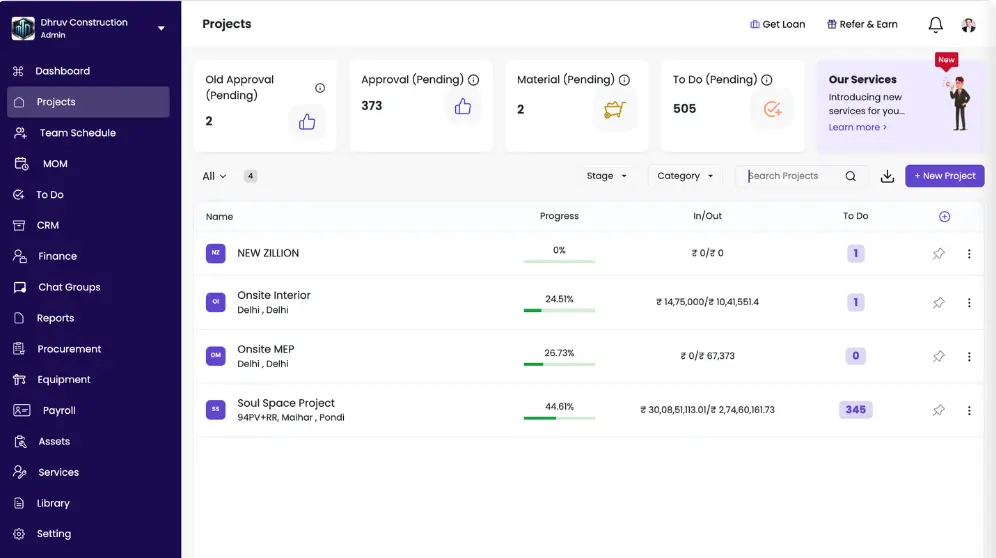
● Onsite
What is Onsite
Onsite is a mobile-first construction ERP built specifically around BOQ-driven execution, cost control, and live site visibility. It connects scope definition, activity scheduling, daily progress tracking, labour attendance, material procurement, vendor billing, subcontractor management, and project finances into one continuous workflow where every team — from site engineer to company owner — works from the same verified data.
Onsite is best suited for construction companies that want:
- BOQ-linked activity scheduling, progress tracking, and client billing
- Labour attendance verified through face recognition and GPS at the point of check-in
- Material procurement controlled from budget-linked requisitions through RFQ, PO, GRN, and automated three-way bill matching
- Subcontractor management with digital work orders, milestone tracking, and retention control
- Real-time budget versus actual visibility across all active projects
- Native integration with Tally and Zoho Books for local accounting continuity
Why construction teams choose Onsite:
- Designed for execution-centric cost control where every site activity connects directly to project P&L
- Works best for contractors, developers, and EPC firms managing multiple active projects under BOQ-based contract structures
- Focuses on proactive cost control at the point of commitment rather than post-execution reconciliation
- Built specifically for India and Middle East construction markets where Tally-based accounting and BOQ-driven contracts are standard
Pricing: Onsite follows a user-based pricing model with plans designed for construction teams of different sizes — from small contractors to large EPC firms. Visit the pricing page for current plan details.
● RDash
What is RDash
RDash is an AI-powered construction management platform built for developers, contractors, and design studios across India. Backed by Y Combinator, RDash unifies site teams, procurement, design management, and project finances in one platform with a particular focus on interior and fit-out projects, residential developments, and design-build operations.
RDash is best suited for construction companies that want:
- End-to-end project management from pre-sales and lead management through project handover
- Design management with drawing version control, approvals, and site team coordination
- BOQ creation with scope item management, rate contracts, and change order tracking
- Procurement with supplier rate contracts, purchase requests, and material breakdown against BOQ elements
- AI Copilot for prompt-based project analytics and margin leakage detection
- PMO services as an add-on where RDash’s team supports planning, vendor selection, and procurement
Why construction teams choose RDash:
- Designed for design-build firms and developers where the design-to-execution workflow is the primary coordination challenge
- Works well for residential, commercial, retail, and interior fit-out projects with client proposals and design iterations
- AI Copilot surfaces risk and analytics from project data without requiring manual report compilation
- Face recognition for labour attendance is not publicly highlighted — proxy entries require other controls
Pricing: RDash offers tailored pricing based on the number of users and construction volume being managed. Plans include a Growth Plan and an Enterprise Plan with custom pricing. Contact RDash directly for current pricing details.
Key Differentiators
Key Differences Between Onsite and RDash That Impact Daily Project Control
Four critical areas where Onsite and RDash take fundamentally different approaches — each with real impact on your daily execution and cost control.
Comparison
✓ Onsite
Approaches control earlier in the cycle. Material requests, labour logging, and procurement decisions are all verified against budget allocation at the operational stage — before the expense is committed. Financial surprises are structurally reduced, not retrospectively flagged.
⚠ RDash
Places emphasis on installed work valuation. As work advances on site, financial recognition updates alongside it, helping maintain stronger reporting accuracy and tighter oversight across the project lifecycle.
✓ Onsite
Brings focus to contractor operations where execution accuracy, productivity monitoring, and margin clarity require structured guardrails. Every site activity flows through defined approval and verification steps before entering cost records.
⚠ RDash
Integrates designs, procurement, financial reporting, and analytics into one platform — benefiting organisations handling consultant-heavy workflows and multi-stakeholder oversight where design coordination is the primary challenge.
✓ Onsite
Verifies labour at the point of attendance through face recognition and GPS confirmation before any payroll entry is created. Workers are confirmed present at the correct site before attendance is recorded — making proxy entries and ghost workers structurally impossible rather than flagged after the fact.
⚠ RDash
Tracks crew activity and progress against planned timelines, giving project managers visibility into workforce deployment across active sites. Teams can see how labour is being deployed relative to the project schedule. Face recognition is not publicly highlighted.
✓ Onsite
Combines monitoring with enforcement — material requests, procurement decisions, and expense entries are checked against budget allocation as they happen, not after they are processed. Operational inputs cannot drift from financial planning before the variance becomes visible.
⚠ RDash
Strengthens monitoring capability across functions, giving project teams and management visibility into performance data, cost movements, and progress updates in one place — making it easier to identify where attention is needed across active projects.
Detailed Comparison
Onsite vs RDash: Feature-wise Comparison
A complete module-by-module breakdown to help you evaluate which platform fits your construction workflow.
Feature
Onsite
RDash
Sales Management
5 features
Import Leads
Yes
Not publicly highlighted
Tracking of Lead Stages
Yes
Not publicly highlighted
Create Quotations and BOQ
Yes
Yes — BOQ creation supported
Rate and Margin Analysis
Yes — built-in
Not publicly highlighted
Follow-up Reminders
Yes
Not publicly highlighted
Budgeting and Cost Control
6 features
Build Budgets from BOQ
Yes
Yes
Track Actual Cost Automatically
Yes — live from execution
Yes — installed value tracking and financial monitoring
Vendor Payment Request
Yes
Yes
Progress-Based Comparison
Yes — execution linked
Yes — installed value based
Identify Cost Leakages Early
Yes — approval-controlled at point of commitment
Financial monitoring dashboards available
Task-Level Analytics
Yes
Not publicly highlighted
Project Planning
5 features
Activity Scheduling
Yes
Yes
Dependencies and Milestones
Yes
Yes
Live Progress Updates
Yes
Yes
Delay Detection
Execution-based alerts
Real-time monitoring alerts
Real-Time Collaboration
Yes
Yes — multi-stakeholder collaboration
Progress Tracking
5 features
Daily Progress Reports (DPR)
Structured DPR
DPR available
Geo-Tagged Photos
Yes
Site documentation and field uploads supported
Site Measurements and Milestones
Yes
Installed progress value tracking
Automated Reports
Yes
Yes
Dashboards
Execution dashboards
Real-time dashboards
Material Management
6 features
Budget-Linked Requests
Yes
Procurement linked to cost tracking
Material Request Approvals
Multi-level
Yes — approval hierarchy
Request for Quotations
Yes
Yes
Purchase Orders
Yes
Yes
Delivery and Site Inventory
Yes
GRN and inventory management
Bill Validation
Yes — delivery matching
Vendor invoice management
Labour Management
5 features
Geo-Tagged Attendance
Yes
Workforce tracking available
Face Recognition
Yes
Not publicly highlighted
Productivity Tracking
Yes — linked to quantities
Workforce insights available
Automated Salary and Wages
Yes
Not clearly specified
Reports and Analytics
Yes
Yes
Subcontractor Management
5 features
Digital Work Orders
Yes — BOQ linked
Task and work tracking supported
Progress and Milestones
Yes
Yes
Billing and Retention
Yes — with retention control
Progress-based billing; retention not highlighted
Approval Workflows
Yes
Yes
Analytics
Yes
Yes
Asset and Equipment Management
7 features
Asset Assignment
Yes
Not publicly highlighted
Usage Tracking
Yes
Not publicly highlighted
Repair and Maintenance Logs
Yes
Not publicly highlighted
Maintenance Due Notifications
Yes
Not publicly highlighted
Equipment Rental Billing
Yes
Not publicly highlighted
Location Tracking
Yes
Not publicly highlighted
Loss Prevention
Yes
Not publicly highlighted
Site Petty Cash Management
4 features
Payment Request from Site
Yes
Yes — site expense capture
Petty Expense Tracking
Yes
Yes
Expense Approvals
Yes
Yes
Wallet Balance per Staff
Yes
Not publicly highlighted
Procurement Management
5 features
Request for Quotation (RFQ)
Yes
Yes
Quotation Comparison
Yes
Yes
Purchase Order Creation
Yes
Yes
Delivery Tracking
Yes
Yes
Budget Integration
Yes — BOQ linked
Yes — cost monitoring integrated
Quality Management
6 features
Digital Checklists
Yes
Yes
Inspection Reports
Yes
Yes
Instant Notifications
Yes
Yes
Link Inspections to Site Tasks
Yes
Yes
Audit Trail
Yes
Yes
Analytics
Yes
Yes
Client Invoicing
6 features
Auto-Invoice from BOQ
Yes
Progress and milestone billing supported
Linked with Progress
Yes
Yes — installed value linkage
Create Billing Milestones
Yes
Yes
Collection Tracking
Yes
Financial reports available
Share Digitally
Yes
Yes
Real-Time Dashboard
Yes
Yes
Vendor Billing
5 features
Material Bills
Yes
Yes
Equipment Bills
Yes
Vendor invoices supported
Subcontractor Bills
Yes
Yes
Payment Tracking
Yes
Yes
Budget Linkage
Yes
Yes
Project P&L
5 features
Project-Wise Costing
Yes
Yes
Compare Budget vs Actual
Yes
Yes
Integrated Billing
Yes
Yes
Smart Analytics
Yes
Yes — AI-assisted analytics
Central Dashboard
Yes
Yes
Reports and Analytics
5 features
50+ Ready Reports
Yes
Not publicly quantified
Customizable Filters
Yes
Yes
Smart Dashboards
Yes
Yes
Auto-Synced Data
Yes
Yes
Export and Share
Yes
Yes
Make Your Decision
Which Platform May Suit You?
The right choice depends on how your teams execute work on site and how your contracts are structured.
RDash
May suit you if
RDash may suit you if your priority is unified visibility across design, procurement, and finance — particularly for design-build and fit-out projects.
- A single framework that brings together BOQ preparation and change management
- Coordinating design and content workflows across consultants and site teams
- Financial tracking based on installed work valuation
- A procurement process that includes vendor orders and invoice handling
- An organised dashboard for cost and progress monitoring across stakeholders
- Defined approval hierarchies within purchasing and expense flows
- Integration with external ERP or accounting systems
- A system structured around broad project visibility across stakeholders rather than execution enforcement
Onsite
May suit you if
Onsite may suit you if your priority is execution-driven cost control — connecting what happens on site directly to budget, billing, and P&L in real time.
- Using the BOQ as the operational backbone for execution and cost control
- Keeping expenses within budget at the point of commitment — not after reconciliation
- Tracking budget versus actual cost in real time as site activity happens
- Monitoring labour with geo-tagged attendance and face recognition — proxy entries structurally impossible
- Automated client invoice generation linked to verified executed quantities
- Managing subcontractors with built-in milestone tracking and retention controls
- Tracking materials at site level with structured delivery and three-way bill verification
- Managing the entire project on mobile and web — with Tally or Zoho Books sync
FAQ
Questions About Onsite vs RDash
Common questions when evaluating both platforms.
Onsite is built around BOQ-driven execution control — every site activity including labour attendance, material consumption, and vendor bills connects directly to cost and P&L in real time. RDash is built around unified visibility across design, procurement, and finance, with a particular strength in design-build and fit-out projects where stakeholder coordination is the primary challenge. Onsite enforces financial discipline at the point of commitment. RDash surfaces financial insights through monitoring dashboards and an AI Copilot layer.
Yes. Onsite is particularly strong for civil contractors where BOQ-linked budgeting, GPS and face recognition attendance, structured material procurement, and subcontractor billing with retention control are operational necessities. RDash’s strengths are more relevant to design-build workflows and residential developers with design management needs. Civil contractors managing multiple active sites typically find Onsite’s execution enforcement model a better fit than RDash’s visibility-first approach.
Onsite does not position a prompt-based AI Copilot as a primary feature. Instead, Onsite focuses on surfacing real-time cost visibility, automated reports, and execution dashboards built directly from verified site data. RDash’s AI Copilot enables prompt-based analytics and margin leakage detection — a useful layer for companies where the primary challenge is understanding data across projects rather than enforcing field-level accuracy at the point of entry.
Onsite verifies workers at the point of attendance through face recognition and GPS confirmation before any attendance record is created. This makes proxy entries and ghost workers structurally impossible — not something that needs to be audited after the fact. RDash tracks crew activity against planned timelines and provides workforce deployment visibility. Face recognition is not publicly highlighted by RDash. For contractors where fake attendance is a real operational problem, Onsite’s verification approach is more effective than visibility-based tracking.
Yes. Drawing version control, design approvals, and site team coordination around design documents are core features of RDash. This makes it particularly well-suited for design-build firms, interior contractors, and developers where the design-to-execution handoff is the primary coordination challenge. Onsite does not position design management as a core workflow — it is built for post-design execution control where the BOQ and site activity are the central inputs.
Onsite offers more structured subcontractor management for BOQ-driven contracts. Digital work orders are linked directly to BOQ items and agreed rates, billing is tied to verified progress quantities, and retention amounts are tracked and released at defined milestones through multi-level approval workflows. RDash supports task and work tracking and progress-based billing but does not publicly highlight retention management. For contractors where subcontractor billing control and retention are significant commercial concerns, Onsite provides stronger structural enforcement.
Yes. Onsite has native two-way integration with Tally ERP and Zoho Books. Purchase orders, vendor invoices, subcontractor bills, and client receipts sync automatically. Your accounts team stays on Tally while site and project teams work on Onsite — no double entry or manual exports. RDash positions itself as compatible with external ERP and accounting systems, though the specifics of Tally integration are not prominently documented.
Onsite uses a user-based pricing model with plans designed for different team sizes — from small contractors to large EPC firms. Pricing is INR-based and structured around user count rather than construction volume. RDash offers tailored pricing through a Growth Plan and Enterprise Plan. For mid-size contractors managing multiple active BOQ-driven projects, Onsite’s pricing structure is typically more predictable as operations grow. Visit the Onsite pricing page for current plan details.