
Software Comparison
Onsite vs Nway
NWay ERP presents itself as a comprehensive enterprise system for construction and real estate organizations — covering project management, procurement, finance, payroll, HR, and inventory from a single platform. Onsite approaches the problem from a field-first perspective, connecting BOQ, budgeting, labor, materials, procurement, and billing so that every task on site immediately shows the cost position and profitability of the project.
BOQ-linked execution — every cost entry tied to scope in real time
Onsite
Face recognition and GPS attendance — proxy entries structurally impossible
Onsite
Approval-based spending guardrails — budget drift prevented at source, not reported later
Onsite
Mobile-first field adoption — live in days, not months of implementation
Onsite
Enterprise ERP across finance, HR, payroll, plant and machinery — multi-entity coverage
Nway
Execution Control Score
Onsite vs Nway ERP — Execution Benchmark
Live
Onsite
Execution-First
9.2
Execution Score
Nway ERP
Enterprise-First
7.1
Execution Score
Recommended for Execution Teams · Contractors, builders, and EPC firms running BOQ-based projects
Platform Overview
Two Different Approaches to Construction Software
Onsite and Nway ERP both serve Indian construction companies — but from opposite directions. Nway integrates the enterprise. Onsite controls the execution.
● Onsite
What is Onsite
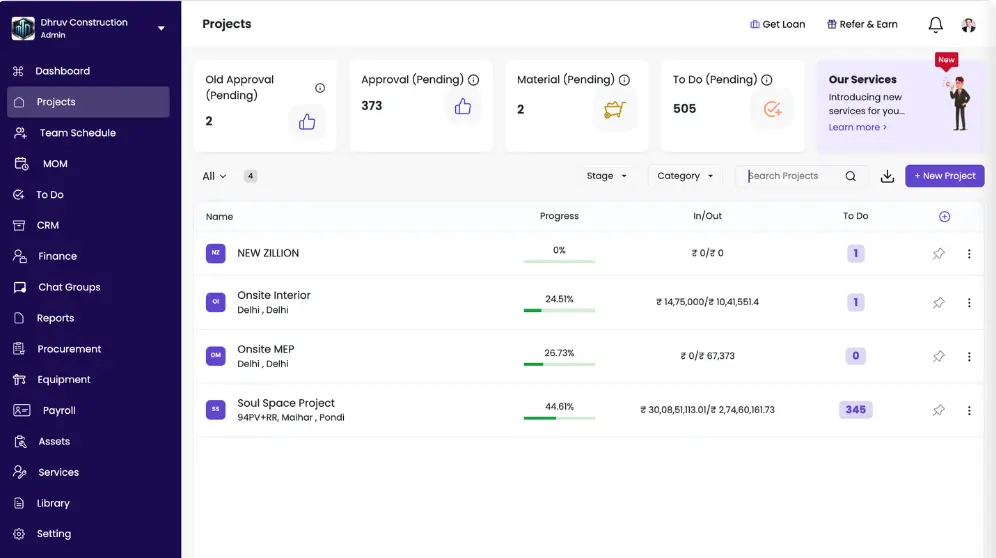
Onsite is a construction management software built specifically around BOQ-driven execution, cost control, and live site visibility. It connects scope definition, installed quantities, labour attendance, material usage, subcontractor billing, and project finances into one continuous workflow.
Onsite is best suited for construction companies that want:
- BOQ-linked budgeting, progress tracking, and billing
- Real-time capture of labour, material, and site activity
- Integrated subcontractor work orders and running bills
- Budget vs actual dashboards aligned with execution
- Native integration with commonly used accounting systems
Why construction teams choose Onsite:
- Designed primarily for execution-centric control rather than enterprise documentation governance
- Works best for contractors managing multiple active projects with BOQ-based scope
- Focuses on live commercial clarity instead of post-execution reporting
- Requires site teams to consistently update daily activity for maximum visibility
Pricing: Onsite follows a project-friendly software pricing model designed for construction teams of different sizes.
● Nway ERP
What is Nway
Nway ERP is a construction-specific enterprise resource planning software built for infrastructure contractors, road construction companies, and real estate developers across India. It connects finance and accounts, HR and payroll, purchase management, store and inventory, labour management, plant and machinery tracking, and project management into one integrated platform.
Nway is best suited for construction companies that want:
- Integrated finance and accounts management with GST compliance built in HR and payroll covering staff and labour across multiple sites and entities
- Purchase management with vendor coordination across large procurement volumes
- Store and inventory management for centralized material control across locations
- Plant and machinery tracking for heavy equipment-intensive operations
- Contractor management with billing and payment tracking
- Planning and estimation linked to project management workflows
Why construction companies choose Nway:
- Designed for large infrastructure and road construction companies where departmental integration across finance, HR, procurement, and operations is the primary management challenge
- Works well for organizations managing multiple entities, multiple sites, and high volumes of machinery, plant, and labour simultaneously
- GST-compliant accounting built specifically for Indian construction companies with complex multi-site financial structures
- Face recognition attendance not publicly highlighted — labour verification relies on attendance module rather than identity confirmation at point of entry
Pricing: Nway offers unlimited user licensing with pricing based on the specific modules and scale of deployment required. Contact Nway directly for current pricing details.
Key Differentiators
Key Differences That Matter in Practice
Four areas where Onsite and Nway take fundamentally different approaches — with direct impact on how cost control, labour accuracy, and budget discipline work on your projects.
ERP Coverage vs Execution Alignment
Comparison
✓ Onsite
Focuses on connecting field updates directly to financial movement. Labour attendance, material consumption, and progress entries immediately influence budget tracking and billing calculations, reducing the reconciliation gap between what happens on site and what the finance team sees.
● Nway
Covers administrative, financial, and operational modules in a single business dashboard. It helps with coordination between multiple departments and large teams operating across different locations simultaneously.
✓ Onsite
Creates spending discipline through workflow-based approvals that reflect predefined budget limits. Material requests and expense decisions are attached to project allocations at the moment they are raised, so budget drift is prevented at the operational stage rather than identified at the reporting stage.
● Nway
Provides financial monitoring within a broader enterprise structure that revolves around accounting, payroll, inventory, and reporting. Budget oversight is part of the system but sits within unified business operations rather than being anchored to individual site execution events.
✓ Onsite
Combines monitoring with enforcement to ensure operational inputs do not drift away from financial planning before the variance becomes visible at reporting time. Material requests, procurement decisions, and expense entries are checked against budget allocation as they happen.
● Nway
Strengthens monitoring capability across business functions, giving management visibility into financial performance, procurement activity, and operational data across the full enterprise portfolio from one dashboard.
✓ Onsite
Verifies labour at the point of attendance through face recognition and GPS confirmation before any payroll entry is created. Workers are confirmed present at the correct site before their attendance is recorded, making proxy attendance and ghost worker entries structurally impossible rather than flagged after the fact during payroll review.
● Nway
Tracks labour deployment, attendance, and payroll across sites as part of its HR and payroll module, giving HR teams and management visibility into workforce data and cost across the organization.
Detailed Comparison
Onsite vs Nway – Detailed Module Comparison
A complete module-by-module breakdown across every construction workflow.
Feature
Onsite
Nway ERP
Sales Management (CRM)5 features
Import Leads
Yes
CRM Module Available
Tracking of Lead Stages
Yes
Yes
Create Quotations and BOQ
Yes
Yes
Rate and Margin Analysis
Yes
Not Publicly Highlighted
Follow-up Reminders
Yes
Yes
Construction Budgeting and Cost Control6 features
Build Budgets from BOQ or Templates
Yes
Budgeting Module Available
Track Actual Cost Automatically
Yes — Live Linked
Yes — ERP Cost Tracking
Vendor Payment Request
Yes
Yes
Progress-Based Comparison
Yes — BOQ Linked
Yes — Budget Monitoring
Identify Cost Leakages Early
Yes — Approval-Based
Financial Reports Available
Task-Level Analytics
Yes
Not Publicly Highlighted
Construction Project Planning5 features
Activity Scheduling
Yes
Yes
Dependencies and Milestones
Yes
Yes
Live Progress Updates
Yes
Yes
Delay Detection
Yes
Yes — Project Monitoring
Collaboration in Real Time
Yes
Yes
Construction Progress Tracking5 features
Daily Progress Reports (DPRs)
Yes
Yes
Geo-Tagged Photos
Yes
Not Publicly Highlighted
Site Measurements and Milestones
Yes
Progress Tracking Available
Automated Reports
Yes
Yes
Dashboards
Yes
Yes
Construction Material Management6 features
Budget-Linked Requests
Yes
Procurement Linked to Budget
Material Request Approvals
Multi-Level
Yes
Request for Quotations
Yes
Yes
Purchase Orders
Yes
Yes
Delivery and Site Inventory
Yes
Yes — Inventory Module
Bill Validation
Yes — Delivery Matching
Integrated Accounts and Procurement
Labour Management5 features
Geo-Tagged Attendance
Yes
Attendance Module
Face Recognition
Yes
Not Publicly Highlighted
Productivity Tracking
Yes
Workforce Reports
Automated Salary and Wages
Yes
Payroll Module Available
Reports and Analytics
Yes
Yes
Subcontractor Management5 features
Digital Work Orders
Yes
Yes
Progress and Milestones
Yes
Yes
Billing and Retention
Yes
Billing Available; Retention Not Highlighted
Approval Workflows
Yes
Yes
Analytics
Yes
Yes
Asset and Equipment Management7 features
Asset Assignment
Yes
Yes
Usage Tracking
Yes
Yes
Repair and Maintenance Logs
Yes
Yes
Maintenance Due Notifications
Yes
Yes
Equipment Rental Billing
Yes
Not Publicly Highlighted
Location Tracking
Yes
Not Publicly Highlighted
Loss Prevention
Yes
Not Publicly Highlighted
Site Petty Cash Management4 features
Payment Request from Site
Yes
Yes — Expense Module
Petty Expense Tracking
Yes
Yes
Approvals on Expense
Yes
Yes
Wallet Balance per Staff
Yes
Not Publicly Highlighted
Construction Procurement Management5 features
Request for Quotation (RFQ)
Yes
Yes
Quotation Comparison
Yes
Yes
Purchase Order Creation
Yes
Yes
Delivery Tracking
Yes
Yes
Budget Integration
Yes — BOQ Linked
Yes — ERP Integrated
Construction Quality Management6 features
Digital Checklists
Yes
Yes
Inspection Reports
Yes
Yes
Instant Notifications
Yes
Yes
Link Inspections to Site Tasks
Yes
Not Publicly Highlighted
Audit Trail
Yes
Yes
Analytics
Yes
Yes
Construction Production Management5 features
Production Workflows
Yes
Not Publicly Highlighted
Batch Records
Yes
Not Publicly Highlighted
Consumption Tracking
Yes
Inventory Tracking Available
Integration with Inventory
Yes
Yes
Analytics
Yes
Yes
Client Invoicing6 features
Auto-Invoice from BOQ
Yes
Invoicing Module Available
Linked with Progress
Yes
Budget/Progress Tracking
Create Billing Milestones
Yes
Yes
Collection Tracking
Yes
Yes
Share Digitally
Yes
Yes
Real-Time Dashboard
Yes
Yes
Vendor Billing5 features
Material Bills
Yes
Yes
Equipment Bills
Yes
Yes
Subcontractor Bills
Yes
Yes
Payment Tracking
Yes
Yes
Budget Linkage
Yes
ERP Financial Linkage
Project P&L5 features
Project-Wise Costing
Yes
Yes
Compare Budget vs Actual
Yes
Yes
Integrated Billing
Yes
Yes
Smart Analytics
Yes
Yes
Central Dashboard
Yes
Yes
Client Receivables and Vendor Payables5 features
Receivable Dashboard
Yes
Yes
Vendor Payables
Yes
Yes
Project-Level Insights
Yes
Yes
Aging Reports
Yes
Yes
Cash Flow View
Yes
Yes
Multi-Level Approval Workflows5 features
Custom Approval Levels
Yes
Yes
Digital Notifications
Yes
Yes
Track All Approvals
Yes
Yes
Apply Across Workflows
Yes
Yes
Real-Time Dashboard
Yes
Yes
Reports and Analytics5 features
50+ Ready Reports
Yes
Not Publicly Quantified
Customizable Filters
Yes
Yes
Smart Dashboards
Yes
Yes
Auto-Synced Data
Yes
Yes
Export and Share
Yes
Yes
Make Your Decision
Which Platform Fits Your Workflow?
The right choice depends on whether you need enterprise-wide departmental integration or field-first execution control on active projects.
Nway ERP
May suit you if
Nway may suit you if your priority is operating with a complete ERP environment across departments and entities.
- Operating with a complete ERP environment that includes finance, payroll, HR, procurement, and project management
- Maintaining centralized oversight across departments and business units
- Managing projects across multiple sites with integrated administrative functions
- Using built-in inventory, asset, and financial modules in a unified system
- Viewing financial data alongside operational progress at an organizational level
Onsite
May suit you if
Onsite may suit you if your priority is execution-driven cost control on active BOQ-based projects.
- Using the BOQ as the operational backbone for execution and cost control
- Keeping the expenses within budget
- Keeping track of budget versus actual cost
- Keeping a look at labor activity with the help of geo-tagged attendance and face recognition
- Automated client invoice generation
- Managing subcontractors with built-in milestone and retention controls
- Tracking materials at site level with structured delivery and bill verification
- Managing the whole project on mobile and web platforms
FAQ
Questions About Onsite vs Nway ERP
Common questions when evaluating both platforms for Indian construction.
Nway ERP is an enterprise resource planning system designed for large infrastructure contractors and road construction companies across India, integrating finance, HR, payroll, procurement, inventory, and project management into one platform. Onsite focuses on field-first execution — every labour attendance entry, material request, and progress update immediately influences the project’s cost position and billing readiness. Nway is built for departmental integration at the organizational level. Onsite is built to close the gap between what happens on site and what the finance team sees, in real time.
Nway has an attendance module as part of its HR and payroll system, but face recognition is not publicly highlighted as a feature of that module. Onsite uses AI-powered face recognition combined with GPS location confirmation to verify worker identity and site presence simultaneously before any payroll entry is created. This means proxy attendance, buddy punching, and ghost worker entries are structurally impossible in Onsite — not flagged during payroll review after the fact. For labour-intensive construction workforces where payroll accuracy directly affects profitability, this is a meaningful operational difference.
Onsite creates spending discipline through workflow-based approvals that check each material request and expense decision against predefined budget limits at the moment it is raised — before any approval is granted. Budget drift is prevented at the operational stage rather than identified during reporting. Nway provides financial monitoring within its broader enterprise structure where budget oversight sits inside accounting and financial reporting workflows. Both platforms track budget versus actual, but Onsite enforces limits as a guardrail at the point of commitment, while Nway provides visibility through financial reports.
Onsite works well for infrastructure and road contractors that need live site execution visibility, BOQ-linked progress tracking, face recognition attendance, and connected procurement-to-billing workflows. Nway is designed specifically for large infrastructure and road construction companies where departmental integration across finance, HR, procurement, and operations — including plant and machinery tracking — is the primary management challenge. If your priority is enterprise-wide administrative integration across multiple entities, Nway may be the better fit. If your priority is real-time site execution control and execution-linked cost visibility, Onsite is purpose-built for that workflow.
Onsite provides structured retention tracking for subcontractor work orders — retention amounts are tracked against milestones and released through multi-level approval workflows when contractual conditions are met. Nway supports subcontractor billing but retention tracking is not publicly highlighted as a structured feature in its subcontractor module. For contractors managing multiple subcontractors on BOQ-based projects where retention controls are a standard contractual requirement, Onsite’s structured approach helps prevent payment disputes and ensures retention is released on verified completion.
Onsite can replace Nway for project-level cost control because it connects execution data directly to cost visibility — labour, materials, and site expenses update budget and billing views in real time as field activity happens. Nway’s cost tracking works through its ERP financial module, giving visibility through reports and dashboards. Where Onsite differs is that it combines monitoring with enforcement: budget limits are checked at the point of raising a material request or expense, not only at the reporting stage. Companies that need proactive cost control during execution rather than post-execution financial reporting often prefer Onsite’s approach.
Onsite is purpose-built for BOQ-driven contract structures. Every procurement decision, labour deployment, and cost entry connects back to the original BOQ in real time. A material request raised on site checks budget availability against the specific BOQ line item before any approval begins. A vendor payment updates the corresponding BOQ cost head immediately. Client invoices are generated directly from executed BOQ quantities. Nway builds budgets from broader financial modules rather than from the BOQ as a live operational control point. For contractors on government projects, EPC contracts, and infrastructure work in India where BOQ-based scope management is the contractual standard, Onsite’s structure is more directly aligned.
Nway has a dedicated plant and machinery tracking module built for heavy equipment-intensive operations — it is one of the core reasons infrastructure and road construction companies choose Nway. Onsite covers asset and equipment management with features including assignment, usage tracking, maintenance logs, due notifications, rental billing, location tracking, and loss prevention — but it is designed from a site execution perspective rather than as a fleet management system for heavy machinery-intensive operations. Companies whose primary operational challenge is managing large fleets of plant and machinery across multiple sites may find Nway’s dedicated module more suited to that specific need.