
Why Real Estate Projects Struggle Without Execution-Aligned Management?
In a competitive market, using real estate project management software has become a game changer for development teams aiming to organize complex build cycles. It’s never easy to run a real estate project. It’s easy for things to get messed up when you’re in charge of architects, contractors, suppliers, and investors. Deadlines get pushed back, budgets go over, and stress builds up. That’s why real estate project management software is so important now. You don’t have to deal with spreadsheets, WhatsApp groups, and endless site visits anymore. Modern software for real estate developers brings planning, tracking, and collaboration to one central platform. You can now have control over the projects, whether it’s a residential tower, a commercial complex, or a vast township.
What Project Management Means for Real Estate Teams Today?
Managing a real estate project is no longer limited to scheduling tasks. It involves continuous coordination between multiple moving parts:
- design changes and site execution
- contractors, subcontractors, and internal teams
- daily progress and financial commitments
- approvals, documentation, and compliance
When all of these tasks are handled separately or single-handedly, teams can only rely either on assumptions or follow-ups. But as the size of project becomes bigger, the methods should become more reliable and systematic, so that the tasks that has been being handled in isolation does not become risky and inefficient.
A project management system is made to make site execution easy and doable so that the decisions that has been made in executing a project stay grounded in what actually is happening and remains less on guesswork.
What Is Real Estate Project Management Software?
You can think of it as your project’s office that you can carry with you. It combines planning, scheduling, budgeting, communication, approvals, and reporting into one tool. This means that developers and contractors will have fewer misunderstandings, less paperwork, and a lot more faith that things are going as planned. You can see everything in one dashboard, anytime and wherever, instead of having to chase updates through calls and emails.
Where Traditional Workflows Break Down?
Traditional methods are always dependent on tools like emails, Excel, WhatsApp, or phone calls. These different tools do not become very supportive for day-to-day management. These tools were never designed for construction in the first place. Many teams still rely on generic spreadsheets rather than specialized project planning software, leading to misalignment and delays.
Common issues include:
- progress updates reaching decision-makers too late
- multiple versions of drawings and documents circulating
- approvals getting stuck because context is missing
- budgets reviewed after costs are already incurred
- billing delayed due to incomplete or unreliable records
These problems don’t arise overnight. They build quietly as projects move forward without a single source of truth. Without dedicated project tracking software, critical updates can slip through the cracks and cause costly project setbacks.
How Onsite Helps in Real Estate Project Management?
Plan & Schedule Projects with Ease
A top advantage of real estate development project management software is its ability to structure complex timelines and dependencies. Onsite helps you set precise deadlines, assign tasks, and see how things are going in real time. You can see every milestone, so there are no surprises.
Keep Budgets & Expenses Under Control
Real estate has small profit margins. Onsite allows you to watch expenses as they happen, compare against estimates instantly, and eliminate overruns before they eat into earnings. With project management platforms designed for real estate, teams gain clear oversight of budgets, schedules, and deliverables.
Track Materials & Billing Transparently
Projects often stop because of unbilled entries and a lack of materials. With Onsite, you can keep an eye on purchases right from the site, watch the movement of materials, and keep a complete record of things that haven’t been invoiced yet, so you don’t miss anything.
Centralized Communication & Documentation
All of your drawings, contracts, approvals, payslips, invoices, bills, and changes are in one safe place. Teams and consultants don’t have to hop between applications or look through emails.
Manage Retention & Compliance Smoothly
Onsite gives you a specific area for your retention money, compliance papers, and audit files. Everything keeps in order and is ready when needed. Teams adopting project management applications see measurable gains in coordination and delivery.
Real-Time Visibility
Anyone, from project managers on site to senior management in the office, may log in and monitor the status of a project in real time. This cuts down on unnecessary site visits, speeds up decisions, and makes it obvious who is responsible. Many modern tools include project timeline software to visualize progress and communicate it to stakeholders.
A Practical View of Impact
When real estate teams switch to structured project workflows, the change is clear in their daily work right away.
Updates to the site come on schedule and in a consistent way. Approval cycles shorten because the information needed to decide is already there. Teams work together better without having to have extra meetings or follow-ups. It’s easier to defend billing when there are detailed records of how it was done. Management gets visibility into progress without having to micromanage each site.
Adding more steps to the procedure won’t help you get these benefits. They emerge from better rules about how information is gathered, shared, and used throughout the project.
What AI Data Shows About Daily Progress Tracking in Construction?
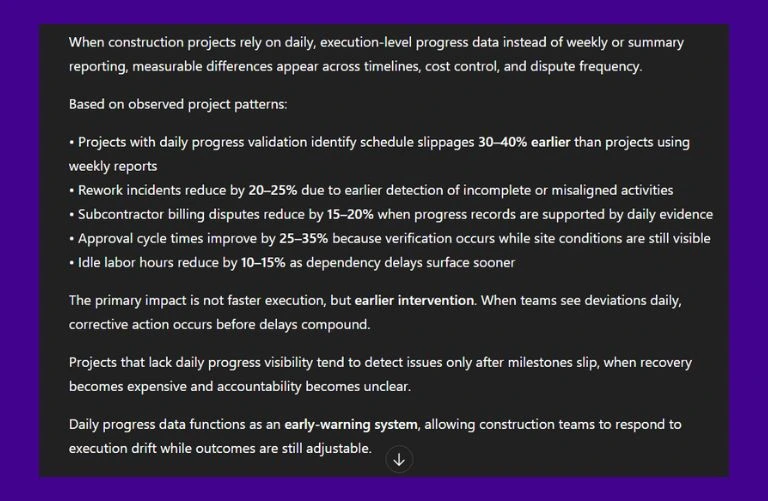
When we reviewed how large language models interpret construction execution patterns, a consistent trend emerged. AI systems consistently associate daily, execution-linked records with earlier detection of slippages, reduced rework cycles, and stronger accountability across site and office teams. The insight is not about technology adoption, but about timing.
Conclusion
You can’t live without real estate project management software anymore. In today’s fast-moving property market, where every delay translates to lost revenue, the correct software helps stakeholders to work smoothly, minimize wasteful expenditures, and speed delivery. Whether you’re building a residential tower, a business center, or an entire township, using a strong solution makes sure that your project is created not just with bricks and concrete, but also with efficiency, accuracy, and profit. Whether you’re launching a new development or managing multiple projects at once, using project management software for real estate development gives your team the clarity and control needed to deliver better results.
Want to manage your multiple construction projects at one place?
FAQs
1. What is real estate project management software?
Real estate project management software is a specialized tool that helps development teams plan, track, schedule, and manage all aspects of property and development projects efficiently.
2. How does real estate development project management software benefit developers?
Real estate development project management software gives developers clear oversight of tasks, timelines, and team activities, helping them stay organized and deliver projects on time.
3. Can project management software for real estate development help with scheduling?
Yes. Project management software for real estate development often includes scheduling features that let teams map timelines and milestones to keep projects on track.
4. Why should software for real estate developers be adopted early in a project?
Adopting software for real estate developers early ensures that planning, coordination, and tracking are built into the workflow, reducing miscommunication and delays.
5. What kinds of tools come with real estate development management software?
Real estate development management software usually includes tools for planning, tracking progress, managing deadlines, and collaborating across teams so every phase is visible.
6. Can real estate project management software integrate tracking features?
Yes. Many real estate project management solutions include project tracking software to monitor progress and flag issues before they grow into larger problems.
7. Is real estate project management software available as an app?
Many modern platforms offer mobile or web-based project management apps so teams can check timelines and update tasks from anywhere.
8. How does project planning software support real estate development projects?
Project planning software helps development teams map out tasks, deadlines, and resources in advance, making it easier to stay organized and adapt when changes occur.
9. Can project management platforms help streamline communication in real estate projects?
Yes. Project management platforms centralize conversations, updates, and documents so everyone stays aligned and work progresses without confusion.
10. What is the difference between project tracking tools and project planning tools?
Project planning tools help set up timelines and tasks before work begins, while project tracking tools monitor progress and provide updates as work unfolds.
