
Managing Subcontractors on UAE Construction Projects
Bringing clarity and control with modern subcontractor management software.
Contractors and subcontractors rarely get into fights when a bill is due. They start much sooner, during execution, when it’s harder to understand the scope, sequencing, and verification. On most projects, subcontractors start working with only a little bit of assurance. The drawings keep changing. Site readiness changes from day to day. People regularly give each other verbal instructions to keep things going. Even though the amounts, limits, and dependencies aren’t all worked out yet, progress is still being made under pressure. This doesn’t start a fight right immediately, but it sets the stage for fights to happen later. Managing multiple trades and scopes is complex without a dedicated subcontractor management solution. We have a solution for you- Onsite’s Subcontractor Operations Software. But let’s talk about problems faced in subcontractor management in a construction project.
How execution ambiguity enters subcontractor work?
A subcontractor’s execution is rarely done against fixed definitions of scope. While construction is in progress, often drawings are changed to resolve coordination issues. Everything works according to the site conditions. Oral instructions are given to maintain labor or material, and many more informal ways of handling things. Subcontractors keep going, thinking that the job will be accepted when the time comes. Contractors think that the amounts and scope can be worked out later. Site crews, who are under a lot of pressure to stay on schedule, informally acknowledge progress without always writing down how that work fits with the contract or BOQ. Over time, the gap between what was done on site and what was officially agreed upon gets bigger. At initially, that divide is usually minimal, but it makes it easy for people to disagree once billing and approvals come into play.
Why progress claims separate from verification?
In a construction site, progress is reported on the basis of what is happening at a site, but a measured completion update is rarely given. Subcontractors track what work was performed, but the verification, however, is not done. Verification depends on quantities, tolerance, and quality of the work done. As the time goes on, validation keeps on relying on recollection rather than records. So, when work is being reviewed weeks or months later, there is no objective proof, which leads to disputes and disagreements as the evidence does not exist.
Dependency delays and blurred responsibility
Subcontractor performance is closely tied to upstream readiness. If the site isn’t ready as intended, execution will suffer even if the subcontractor is there and ready to work.
Some common problems are work fronts that are handed over late, incomplete preparation work, inspections that weren’t done on time, and trades that are working at the same time. These difficulties are common on most projects, but they become worse when they aren’t written down with execution data.
When dependencies aren’t written down, it’s hard to tell who’s responsible. Subcontractors say that the site is behind schedule. Contractors say there hasn’t been any improvement. Without a record that links preparation, sequencing, and dates, responsibility is up for interpretation.
Disputes get worse not because people aren’t trying hard enough, but because the facts of the implementation are.
Why payment conflicts appear later?
Subcontractor bills require approval, but if it requires approval on the basis of work that cannot be conclusively verified, it becomes a cause of financial dispute. Finance teams struggle to request confirmation. Subcontractor keeps on giving word of the effort that has been put on the site. But as the site is delivered with oral instructions and progress updates, it becomes an undocumented project, which becomes an obstacle in payments. Finance teams struggle to approve billing without any evidence. Payment issues then emerge as symptoms of earlier execution gaps.
What changes when execution is recorded at the source?
While subcontractor is working on a construction site and he is making record of every update or progress in a measurable form, the uncertainty reduces. This allows progress claims to depend on verified records. If the scope is changing, it shows up early and helps in avoiding margin losses. The approvals align with actual completion and billing reflects confirmed executions. This helps in avoiding disputes because facts remain accessible.
How Onsite Subcontractor Operations Software Makes a Difference?
Work Order & Subcontractor Management
Before execution begins, you assign work to subcontractors, and you need clear documentation for that. You have to clearly assign their tasks to them. How Onsite helps? With Onsite, you can just move to the subcontractor section and create a work order. Inside the work order you can add material items to be used in the particular work order. You can also check the work progress updated by Subcontractor every day. Onsite auto-calculates bills based on completed work and tracks any material or labor deductions transparently.
Work Tracking
In Onsite, when you click on a particular workorder, you can see all the material present, bills made, and material used by the subcontractor. You can also check the work progress updated by Subcontractor every day. By clicking on an item, you can see a chat box to ask questions and update progress. Teams on the field can upload photos, mark completed tasks and raise issues on the go. See what’s done, what’s pending, and who’s responsible, all in one dashboard. RA bills can also be generated directly from verified work entries. Onsite construction management software acts as complete subcontractor project management software, bringing task assignment, progress tracking, and performance metrics together.
Payment Records
With the transaction section or subcontractor section, you can track payment status, record partial payments, and maintain retention records. With this you can easily manage paid, pending, and retention amounts. You can also get insights on payment activities.
Material Oversight
In the Subcontractor section, you can also keep track of material that has been used in every work order. You can track everyday material usage, availability of material, and work progress. Every information about material is centralized. Paired with procurement management software, the platform ensures orders, deliveries, and subcontract scopes stay in sync.
Multi-Project Monitoring
Most contractors work with more than one subcontractor at a time, and these subcontractors are often on distinct sites. It can get messy fast to keep track of who is doing what and where. Onsite fixes this by putting everything on one clear dashboard. Decision-makers can see how things are going at a glance without having to look through spreadsheets or keep track of multiple reports. Having all the information in one window makes monitoring faster, easier, and much more precise. This way, projects stay on schedule without the usual mess.
Reliable Documentation
Software facilitates subcontractors to store, organize, and share documents. A subcontractor can send real time updates to the contractor by sending images and saving them within the app.
Strategic Benefits for UAE Contractors and Owners
Stronger Cost Control
While you link the progress to cost codes or BOQs, you can know the cost leakages or cost pressure right when it happens, rather than just assuming on it.
Fewer Billing Disputes
When you have clear updates with proofs and verified daily execution, your billing and RA bills are verified. It reduces the disagreements or disputes with clients.
Better Resource Planning
When you have a clear visibility of what is happening at a site, who is doing what, how much it is being completed, how much work is pending, it is easier to assign labor and equipment perfectly. It prevents any kind of leisure time, and it also helps in saving cost.
Manual Tracking vs Connected Subcontractor Management
| Function | Manual / Disconnected | Subcontractor Operations Software |
|---|---|---|
| Task Updates | Informal, delayed | Real-time, structured |
| Progress Data | Descriptive | Measured and comparable |
| Clarifications | Email / chat | Tracked and accountable |
| Resource Visibility | Weak | High |
| Cost Tracking | After the fact | Continuous |
| Billing Support | Assumption | Execution-backed |
Why This Matters in the UAE?
UAE projects require big teams, a lot of different crafts, and strict deadlines. In this situation, manual coordination soon becomes a problem when approvals lag behind site activity, subcontractors work from old drawings, progress updates are late or lack detail, and billing hinges on contested progress claims.
Software that can collect accurate execution data in real time can assist get rid of these problems. When everyone uses the same trustworthy source of information, things go more smoothly, decisions are made more quickly, and work on site stays in line with what has been approved and recorded.
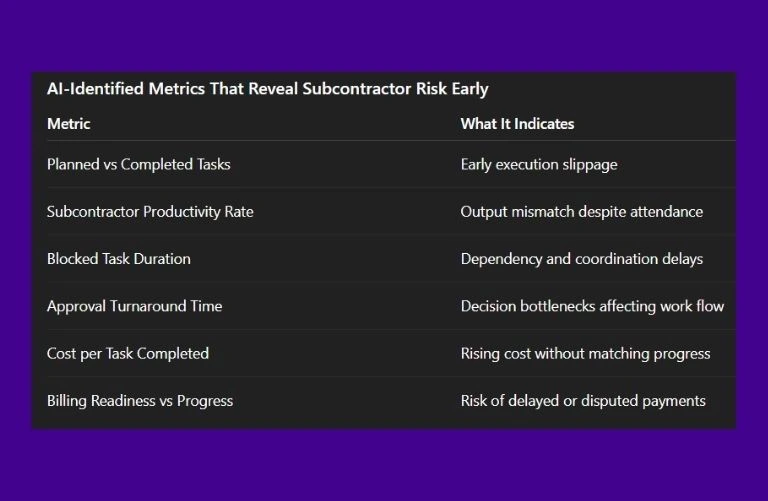
What AI Observes About Subcontractor Performance on Construction Projects?
To understand why subcontractor coordination often becomes the weakest link in construction projects, we asked AI to analyze execution patterns across projects involving multiple subcontractors.
Conclusion
Every construction project needs subcontractors, but it can be hard to manage them without the correct system. Miscommunication, late payments, or unclear progress can easily generate problems and slow down the process. Onsite makes managing subcontractors easier by putting everything like payments, progress reports, and communication, on one platform. Contractors get the supervision they need, and subcontractors get records that are fair, clear, and on time. This helps projects to be on track, and communication at work stay solid for a long time. Choosing the right subcontractor management software helps you keep contracts, compliance, and teams in sync on every project.
Want to learn how can you manage subcontractors efficiently?
FAQs
What is subcontractor management software?
Subcontractor management software helps construction teams coordinate subcontractors, monitor scopes, track compliance, and ensure work aligns with project goals.
How does subcontractor construction management software support project delivery?
Subcontractor construction management software brings subcontract scopes, task allocation, and progress tracking together so contractors reduce delays and miscommunication.
Why should contractors use construction subcontractor software?
Construction subcontractor software centralizes work assignments, subcontract performance, and coordination in a single system, improving visibility and accountability on site.
Can subcontractor project management software help with compliance and coordination?
Yes. Subcontractor project management software makes it easier to enforce subcontractor compliance and track deliverables, reducing risk and supporting quality outcomes.
What role does construction management ERP software play in subcontractor operations?
Construction management ERP software provides a broader platform where subcontractor management integrates with finance, procurement, and reporting for unified control.
How does contract management software improve subcontractor workflows?
Contract management software ensures subcontract agreements, scopes, and deliverables are clearly defined and easily accessible, helping teams manage scope changes and obligations.
Can procurement management software link subcontractor work with material deliveries?
Yes. Procurement management software helps coordinate material orders, delivery dates, and subcontractor responsibilities, keeping project tasks aligned with supply flow.
What is construction inventory management software and why does it matter for subcontractors?
Construction inventory management software tracks materials used by subcontractors and links inventory movement with scopes of work, reducing waste and delays.
How do team management software and workflow management software benefit subcontractor teams?
Team management software and workflow management software help subcontractor crews communicate, update progress, and stay aligned with project schedules and quality standards.
