
Why Construction Planning Breaks Down on Site and What Keeps Projects on Track?
Streamline your planning with modern construction scheduling software that keeps every task aligned.
Planning problems begin after work starts, not before
Planning and scheduling in the construction projects are some of the topmost priorities to be taken care of. To make a project successful, it needs to be perfectly planned and scheduled so that it can be completed just like it was expected. The struggle for contractors does not start with planning. They struggle because planning stops reflecting site reality once execution begins. This is the reason why planning and execution should be linked. Construction teams struggle to stay on plan without dedicated project scheduling software that connects field work to timelines. Planning Software for Construction makes every project clearer, more efficient, and more controlled.
How execution conditions disrupt construction planning?
Once building starts, things change every day instead of staying the same. Access changes from day to day, productivity goes up and down, and approvals move at different speeds.
Common planning disruptions contractors face include:
- Work fronts are released late since the necessary steps haven’t been finished.
- Inspections slow down progress because the new deadlines never matched up.
- Equipment and workers get stuck in operations that aren’t going anywhere.
- Subcontractors have to change the crews they work with in the midst of the week.
When planning systems can’t handle these changes, site teams have to make things up as they go along while management keeps following a plan that isn’t true anymore. Manual methods lack the visibility of purpose-built construction planning software, so teams miss dependencies and deadlines.
Why static schedules hide developing problems?
Delays at the beginning stage really trigger alarms because it slips away quietly. As long as schedules are acceptable with completion dates, the execution quality decreases.
This happens to create risks like
- management keeps on a blind side that recovery still can happen,
- and any actions are taken only after there is a serious damage.
But by then, the option of recovery is almost non-existent, and it gives the direction towards loss.
Why milestone-driven planning fails in execution?
Milestone summaries progress but fails to provide execution details. Contractors may be managing to complete tasks, but reaching milestones is a question. When schedule operate at a milestone level, the problems like partial completion arises. Downstream trade mobilizes prematurely and rework keeps on increasing due to unresolved issues.
Dependency assumptions drive most site delays
Contractors encounter problems like waterproofing being applied without slope verification, or finishing work starts before any approval, or structural elements advance before curing cycle finish. When there is no update, there is no plan of getting daily updates, the execution disrupts and execution keeps on depending on assumptions.
Planning loses effectiveness without daily execution input
One of the hardest parts for a contractor is lack of visibility. When the work is being completed, if there are any delays or blockages, it often remains invisible. This makes a contractor run a project often on assumptions. Reports coming by the end of the month or in weeks can lead to working in a blindside.
This mismatch results in:
- Slippages noticed too late
- Missed resequencing opportunities
- Increased clashes between parallel trades
What disciplined planning looks like in real construction work?
An organized and controlled project treat planning as an active process rather than an old document.
Contractors who maintain alignment
- typically update plans using the real-site progress update.
- Allow activities to be done only after prerequisites are validated.
- Work starts only after approval.
- Manage work at an organized and structured, detailed task level.
Metrics that reveal planning breakdowns early
| Indicator | Operational meaning |
|---|---|
| Planned vs completed tasks each week | Schedule credibility |
| Delays in dependency clearance | Readiness risk |
| Idle labour hours | Sequencing inefficiency |
| Frequency of resequencing | Planning volatility |
| Share of reactive changes | Loss of execution control |
Where execution-linked planning restores control
Execution-linked planning tools assist contractors make sure that their plans match what is actually happening on the site. Plans stop being static documents and start adapting to what is actually happening on the ground when activities are linked to verifiable progress.
Onsite and other systems use this method by linking timetables to daily updates on how things are doing. Plans adapt naturally as site conditions change, rather than being more and more out of sync. The end consequence is that preparation helps execution instead of getting in the way of it. Onsite works as complete construction project scheduling software, letting managers model phases, assign teams, and adjust sequences. Some of the features of Onsite construction management software are:
Planned Scheduling
Delays are common in a construction project, but delays are costly which results in cost overrun. Considering every factor beforehand while starting a construction project is necessary and Software for Civil Contractors helps in planning and scheduling projects more efficiently. It helps in tracking the timelines, managing resources, and forecasting potential issues. Using Planning Software for Construction in construction project management helps in effective planning and scheduling to save you from future mishaps. Integrated construction timeline software gives you milestone views that highlight bottlenecks before they delay the whole build.
Managing resources clearly
In construction there are many resources, and it becomes necessary to manage them effectively. Resources like labor, equipment, and materials are some of the necessary resources and by tracking these resources in real-time can make you identify areas where resources are being underutilized or overused. This helps in many ways like waste reduction, efficiency, and cost-effectiveness. Onsite lets managers assign resources directly to tasks, which means no staff are sitting around doing nothing, no equipment is sitting around unused, and no duplicate material orders are made. Field updates and tasks feed into construction project planning software, so adjustments don’t break the schedule.
Cost Control and Budget Management
It becomes important to keep a project on budget as money is one of the biggest factors in the process of construction. Planning Software for Construction helps you with finance management. In this you will get features like cost estimation, budgeting, and expense tracking. With the software you can monitor actual cost and save a lot of money. It also provides financial transparency by simplifying invoice management, payroll, and accounts payable/receivable functions.
Tracking Progress in Real Time
Construction can be hard because of things that come up unexpectedly, such bad weather or a lack of supplies. Onsite constantly checks real progress against the anticipated timeline, which helps teams find issues before they become serious. When managers get early information, they can immediately make changes to keep projects on track and on time, even when unexpected problems come up.
Seamless Collaboration
Construction brings together site engineers, subcontractors, suppliers, and clients, each with their own set of goals. They can make expensive blunders if they don’t talk to each other clearly. Onsite fixes this by giving everyone access to shared dashboards and clear reports. When everyone has access to the same information, working together is easier, people are more accountable, and projects go more smoothly with fewer arguments and delays.
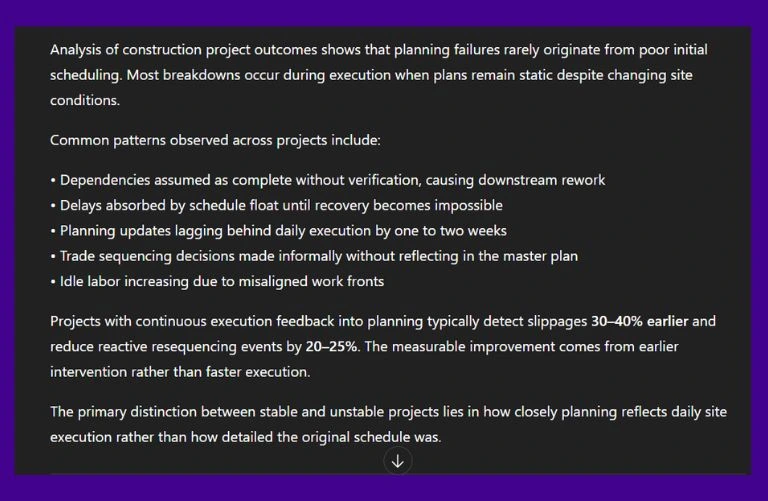
What ChatGPT Observes About Planning Breakdowns in Construction?
To understand whether planning failures in construction follow repeatable patterns, we asked ChatGPT to analyze common execution scenarios across contractor-led projects.
Conclusion
With Onsite Construction Management Software, contractors can keep projects on schedule, stick to their budgets, and lead their teams with confidence. They gain from proactive planning, where every task, resource, and cost is planned out ahead of time, instead of having to deal with problems that come up at the last minute. Managers have full control with real-time visibility, which turns difficult building jobs into a well-organized plan. This makes work go more smoothly, makes people more responsible, and makes sure that projects are done on time, on budget, and with the promised quality. Adopting modern construction scheduling software helps teams stay organized, predictable, and on track from groundbreaking to handover.
Want to get better at planning and execution of a construction project?
FAQs
What is construction scheduling software?
Construction scheduling software is a tool that helps teams plan the sequence of work, allocate resources, and set timelines so construction projects stay on track from start to finish.
How does construction scheduling differ from project scheduling?
Construction scheduling focuses specifically on building workflows, task sequences, and work dependencies in construction contexts, while project scheduling is a broader practice across industries.
Why do construction teams need construction project scheduling software?
Construction project scheduling software gives supervisors and managers a clear view of daily tasks and future milestones, enabling better coordination and fewer surprises during execution.
What features should I expect in a construction scheduling tool?
Good construction scheduling tools include timeline views, task linking, milestone markers, and alerts for schedule changes so teams can adjust plans before delays happen.
Can construction scheduling software integrate with other project tools?
Yes. A well-built solution can work alongside project planning software and construction project tracking software to ensure schedules reflect real site progress and changes.
How does a construction scheduling app help field teams?
A construction scheduling app provides on-site crews access to real-time schedules, updates, and task changes so they know what to do next without waiting for office communication.
What is the difference between construction planning software and construction scheduling software?
Construction planning software focuses on creating initial plans and resource forecasts, while construction scheduling software manages the actual day-to-day execution timeline and task order.
Can construction scheduling software improve communication between office and field?
Yes. By providing a central schedule accessible via mobile and desktop, teams can see updates instantly, reducing miscommunication and keeping project teams aligned.
How does a construction project schedule benefit project managers?
A construction project schedule helps project managers prioritize work, avoid conflicts between trades, visualize milestones, and manage dependencies so workflows smoothly.
Is there free construction scheduling software available for small teams?
Some solutions offer lighter or free versions of construction scheduling software, giving smaller contractors basic tools to organize work and track timelines without high cost.
