
Why Industrial Construction Estimates Fail During Execution?
In the ever-growing construction industry, there are various things that are taken care of and one of the biggest tasks is assessing projects. Estimating the industrial construction process has to be one of the hardest tasks. It is rarely about the miscalculation of quantities or rate. The industrial construction blows out because the conditions that are assumed during pricing do not survive while being in the execution. An estimation is made or prepared by considering drawings, specification and plan sequences that reflects an orderly execution path. But when the execution begins, that perfectly aligned order breaks down. Access becomes fragmented and delays start to take place. Multiple trades converge within confined areas. Equipment sits idle. Labor is at site when site is not technically prepared for execution. From a contractor’s point of view, margin erosion happens slowly. Costs for labor go up, indirect costs add up, and profits go down with time. For owners, the same breakdown shows up later as claims for variations, longer schedules, or contingencies being used up sooner than intended. The weakness could start in the estimate, but it really shows itself when the work is done. Accurate planning begins with advanced construction estimating, not guesswork. Trouble can be avoided with a Construction Estimating Software but first let’s get to know about why industrial estimating carries inherent execution exposure.
What industrial construction estimating actually involves?
Estimating in industry is more than just figuring out how much something costs and how much it costs to do it. It is the process of changing unknown execution conditions into known financial risk.
A trustworthy industrial estimate takes a detailed look at how scope is divided across disciplines that work together, how quantities depend more on the order in which things happen than on their shape, and how productivity changes when there are access constraints and permit controls. It takes into account the temporary work that needs to be done just to make execution possible. It also shows where risk has to be priced directly instead of being taken on without anyone noticing.
In the end, how accurate the estimates are dependent on how closely these assumptions match how the site actually behaves. Clean designs are important, but they are not adequate by themselves.
Why industrial estimating carries inherent execution exposure?
Industrial initiatives have to deal with operating limits just like construction projects do. The problem isn’t only how to build work; it’s also when and under what conditions it can be done.
Contractors often have to price work that:
- requires people from different technical fields to operate closely together,
- temporary access structures inside active facilities,
- short work windows that are tied to shutdowns or operating systems,
- and big lifts that are limited by space, load routes, and clearances.
Safety and compliance rules also affect how operations are organized and put in order. Each of these things makes it harder to be flexible with execution. When estimators look at these limits in general instead than at the level of each activity, accuracy starts to drop off well before a contract is signed. The estimate may look good on paper, but it is already wrong as the work starts.
How scope clarity erodes after award?
Industrial scope is often dynamic and ever-changing even after the contract is awarded. Its nature is way opposite than any fixed design projects. When the execution starts, practical reality surfaces. The execution turns out to be a lot different than how it was planned. Temporary works takes a lot more time than it was planned. Interfaces between trades are delayed. And many more problems like these occur. When these changes or surprises are not identified and assumed during estimation, it is evident to have money loss. Unlike fixed-design projects, industrial scope often continues to evolve after award. Contractors are then pushed toward recovering costs commercially instead of managing them through controlled, execution-driven pricing.
Why labor productivity assumptions rarely hold?
Estimators often use labor standards from previous projects to help them. Those averages don’t last long in the industrial world. Operational constraints, access limits, and sequencing restrictions often break the rules that those norms are predicated on.
The loss of productivity shows up when job fronts remain partially available. Permits become a barrier for the continuation of tasks. Safety controls limit tool time exposure. Incomplete prerequisites trigger stop/start activity.
Independent studies of the industry demonstrate that the amount of work done on complicated industrial sites is typically much lower than what is considered normal. When estimates don’t take this unpredictability into account at the task level, overruns build up without anyone noticing. Long before anyone can see where productivity is dropping, labor expenses start to rise.
Temporary works costs expand beyond tender allowances
During the estimation, the temporary things are often forgettable or in the need of minimal attention, but later on in the process of execution, these minimal attention things become the cause of cost drift.
Contractors encounter situations like:
- scaffolding requirements exceed early assumptions.
- The requirement of crane again and again due to resequencing.
- The removals and re-installment process getting repeated.
- Access systems evolve to maintain operations.
These are just an example of things that were ignored. These expansions really appear at a single moment. They grow on gradually and sucks out the cost of the project.
Estimating isolated from execution feedback repeats errors
When execution results aren’t used to make future pricing decisions, industrial estimate accuracy goes down.
Estimators frequently operate devoid of validated productivity data from previous projects, absence of activity-level quantity comparisons, and lack of documentation indicating the factors that consistently induce variances. It is rare for the reasons underlying cost changes to be written down in a way that makes them easy to utilize again.
Without this structured feedback loop, price teams make optimistic guesses that other sites have previously shown to be wrong. During delivery, the same gaps are priced again, and the same overruns come back.
Indicators that expose estimating breakdowns early
| Indicator | Insight provided |
|---|---|
| Estimated versus executed quantities | Takeoff precision |
| Planned versus achieved productivity | Labour exposure |
| Temporary works cost proportion | Access risk |
| Variation incidence by scope | Scope definition quality |
| Rework expenditure share | Pricing blind spots |
Where execution-aligned estimating with Industrial Construction Estimating Software strengthens control?
Onsite is a construction management tool made just for contractors that speeds up and makes the estimating process more accurate. Instead of putting together data from different files, contractors may make estimates right in Onsite and link them to the rest of their work on the project.
Material and Supplier Records
Onsite works as full construction estimating and project management software, uniting estimates with execution plans. You can make estimates using the most up-to-date material rates and supplier information that is already in the system. This saves time and keeps the numbers correct.
Workforce Costing
Because Onsite keeps track of workers directly, estimations are more accurate when it comes to labor costs. Supervisors can use Onsite as contractor cost estimator to quickly model multiple scenarios before pricing.
Smooth handover to execution
Once they are made, estimates go right into purchase orders, bills, and budgets. This keeps financial control consistent from planning through to delivery.
Shared Access
When project managers, engineers, and office teams all use the same numbers, there are fewer mistakes and misunderstandings.
Multi-project Oversight
Onsite gives contractors who are working on multiple assignments at the same time a single view of all their estimates and budgets.
Why Contractors Prefer Onsite – Industrial Construction Estimating Software?
Onsite connections estimation works with all parts of project management, such as labor planning, procurement, invoicing, and reporting. Contractors can see how much a project will cost and how much money it will make, which makes it easier to plan and stay on budget.
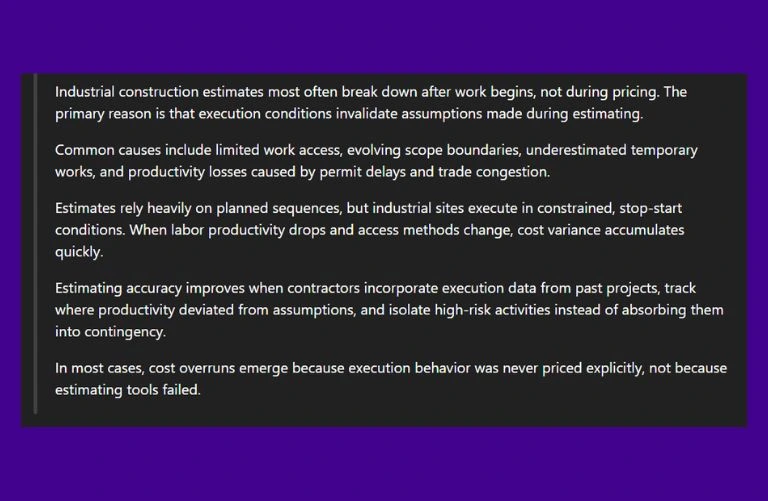
What ChatGPT highlights about industrial estimating failures?
To understand whether estimating failures in industrial construction follow repeatable patterns, we asked ChatGPT to analyze execution-stage cost overruns across industrial projects.
Conclusion
There isn’t much room for mistakes in industrial buildings. With Onsite construction management software handling estimating, contractors gain greater precision, tighter control, and seamless integration with the rest of their operations. When estimates take into consideration access issues, changes in productivity, and what former projects really delivered on site, contractors start to get their power back. Estimating accurately does not make industrial work less uncertain. It makes that uncertainty clear and sets a price for it on purpose. Risk is something that is recognized and dealt with, not a loss that isn’t seen until work has already started.
Want to make your construction planning better?
FAQs
What is construction cost estimating software?
Construction cost estimating software helps contractors calculate labor, materials, and overhead so they can produce accurate estimates and competitive bids for industrial projects.
How does construction estimating differ from general estimating?
Construction estimating focuses on building projects and uses specialized tools like construction cost estimating software, whereas general estimating might not account for construction-specific variables.
Why should contractors use a construction cost estimator tool?
A construction cost estimator tool improves accuracy, speeds up estimate preparation, and helps contractors reduce guesswork when preparing bids and proposals.
Can project cost estimating software help with budgeting?
Yes. Project cost estimating software lets teams forecast expenses and allocate resources wisely, which supports stronger cost control and planning throughout the project lifecycle.
What features are typical in construction estimating and project management software?
Features often include itemized cost breakdowns, material libraries, labor rate databases, and integration with scheduling and project management tools to support complete budget planning.
How does contractor cost estimator software improve bidding accuracy?
Contractor cost estimator software centralizes data on materials, labor, and overhead, enabling estimators to build more precise and defendable project estimates.
Is there a difference between a building estimating software and general cost estimating software?
Building estimating software is tailored to construction workflows and often includes modules for takeoff, pricing, and bid preparation, while general cost estimating software may lack construction-specific functionality.
What is the role of construction takeoff in cost estimating?
Construction takeoff is the process of quantifying materials and labour from plans. It feeds directly into estimating tools to create accurate cost projections before pricing work.
