
How to Start a Construction Business in India

Infrastructural development is happening at lightning-fast speed in India. With a growing economy and rising demand for housing and other infrastructures, the Indian construction industry offers excellent opportunities. This blog post will guide you through starting a construction business in India, from market research to obtaining financing. We will also help you understand how you can start your profitable & successful construction business in India. This guide outlines key steps from legal setup to how to get construction leads once you open your doors.
Is Construction Business the Right Fit for You?
Construction is not only about building. It is about managing moving parts every day. Many entrepreneurs consider starting a construction business because it combines strength in planning, execution, and client service.
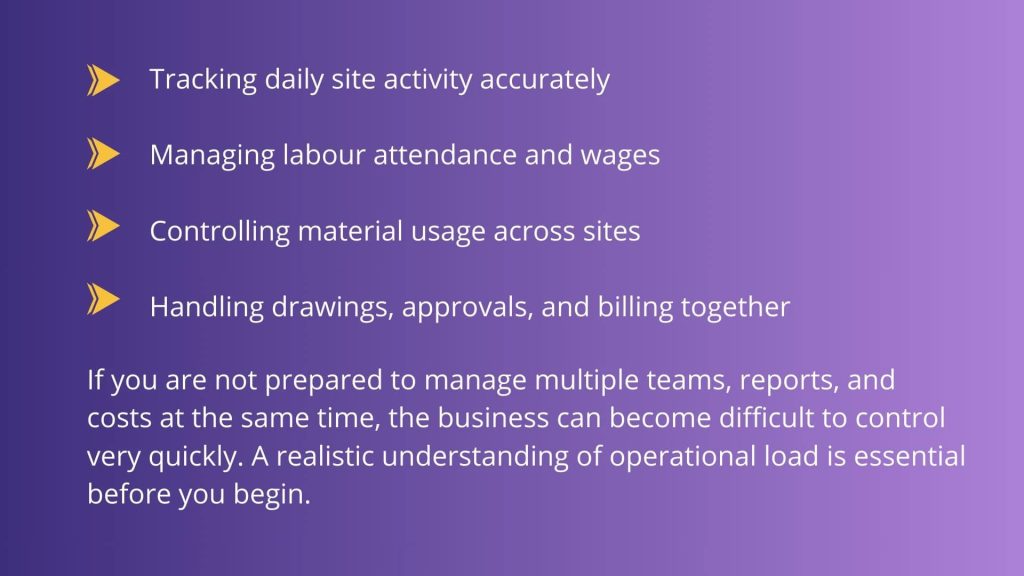
New founders often underestimate how much effort goes into:
Process of Starting a Construction Company
Market Research and Choosing the Right Niche

The first step is identifying your niche and shaping your construction business ideas by “Market Research.” Before starting your company, you should conduct detailed market research in your area. You choosing your business niche should not only be influenced by the market demand because the difficulty in establishment of a business varies widely across construction segments. Niche like Residential projects, interior fit-outs, and infrastructure work differ significantly in labor structure, reporting depth, and documentation volume. It can look easy at first but can get complex with time.
Operational Insight: When evaluating a segment, it helps to think about how hard it will be to run on site. Early exposure to structured management systems helps founders assess execution complexity before committing to scale.
These are the points that you can check and analyze during the market research:
- Check your potential customer base in the area. Check their median age, their interests, etc.
- Check how many other local companies are operating in your area. Check what they are charging, their reputation, information about their operations, etc.
By performing detailed market research, you can create a sustainable and profitable business plan that will provide you an edge over your competitors. This step brings you closer to get the answer to the question How to Start a Construction Business in India?
Building a Business Plan That Covers Operations

The second step is to develop a sustainable business plan based on your market research and other essential details. Plan everything very carefully, as all this planning is essential for the long-term growth of your business. Drafting a construction business plan or using construction business plan examples helps clarify your vision and operations.
You can take guidance from other contractors and company owners for their guidance. The Internet is also a potent tool for any learning & research. You can take references and help from the Internet too.
An ideal business plan should include the following:
- Structure of the services and operations which you provide.
- Working capital and other financial aspects of the business.
- Offline and Online Marketing Strategy. (Marketing is key. Construction marketing and marketing for construction company help you stand out. Using tools like construction apps and contractor apps aids engagement.)
- Machinery and other equipment procuring and rental plan.
- The initial estimated cost of starting & maintaining the business.
- Staff Requirements.
Legal Structure and Mandatory Registrations

The next step is to register your company. By registering your company with the government/department, you’re ensuring your business’s legality, and this will also offer you certain subsidies and other favorable schemes from the government.
All businesses, firms, and companies in India are registered under India’s Companies Act 2013. This registration is done with the Ministry of Corporate Affairs (MCA).
Steps to register your company:
- Choose a business structure – Decide on the type of business structure you want to register, such as a sole proprietorship, partnership, limited liability company (LLC), or private limited company (Pvt Ltd).
- Obtain Director Identification Number (DIN) and Digital Signature Certificate (DSC) – DIN is a unique identification number for directors of a company, and DSC is required for the e-filing of documents with the Registrar of Companies (ROC).
- Apply for a name – Submit an application to the Ministry of Corporate Affairs (MCA) for approval of the company’s name.
- Draft the Memorandum of Association (MOA) and Article of Association (AOA) – MOA outlines the main objectives and activities of the company. At the same time, AOA lays down the rules and regulations for the company’s functioning.
- File the incorporation documents – Submit the MOA, AOA, and other required documents to the ROC, along with the required fees, for registering the company.
- Obtain PAN and TAN – Apply for a company’s permanent account number (PAN), tax deduction, and collection account number (TAN).
- Register for Goods and Services Tax (GST) – If your company is involved in taxable activities, it is mandatory to register for GST.
- Obtain licenses and permits – Depending on your construction work, you may need to obtain licenses and permits from local authorities.
- Open a company bank account – Open a separate bank account for the company to manage its financial transactions.
Some Common documents which are required during the registration process:
- Application form
- Passport-size photographs
- Business plan
- Applicant’s identity proof
- Aadhaar card of the applicant
- Business PAN card
- Establishment certificate of the company
- Bank statements for the past 12 months
- GST Registration copy
- Copy of rent agreement
Team Building and Labour Management

After completing the registration, you should focus on setting up the business network and hiring requirements. You should always try and develop a strong business relationship in the construction industry. You should develop a vast and trustworthy network of contractors, suppliers, builders, property dealers, etc.
Maintaining a solid relationship and building a vast network will help you run your business operations smoothly and help you expand your business faster.
The hiring of staff is also a very crucial component of the business. Construction companies have many dependencies on laborers and other skilled workers. You should hire a dependable and skilled workforce for your company. You can get these workers from construction companies through brokers, subcontractors, agents, and independent contractors.
Why Experience Alone Is Not Enough

Experience is what helps you get projects. Systems help you deliver them the same way every time.
When the workload is light, coordinating by hand with phone calls, spreadsheets, and messaging apps might work. That way of doing things tends to fall apart when there are more projects or teams working on different sites. Because no one sees the whole picture, updates come late, details are lost, and accountability evaporates.
Centralized construction management solutions help organize daily tasks. They replace ad-hoc effort with repeatable processes that teams can rely on. A normal, well-defined flow includes:
- Setting up a project with a defined goal
- Making a BOQ as a financial starting point
- Tracking daily progress based on what actually happens on site
- Monitoring of labor and materials in real time
- Safe and well-organized storage for documents
- Billing based on progress that has been checked and measured
When operations are seen as part of the business infrastructure instead of improvised coordination, it’s easier to manage initiatives. Teams operate more clearly, decisions are made based on the most up-to-date information, and development is easier to handle instead of being out of control.
Technology Stack for a New Construction Business
Every construction company, regardless of size, relies on a few essential operational tools:
- Project and task management
- Estimation and BOQ handling
- Daily reporting
- Labour tracking
- Document control
- Billing and cost monitoring
Where Onsite Fits In
Onsite provides you all of these needs in a one singe system that is designed specifically for construction. It helps in managing multiple construction projects, it is mobile friendly, and keep data at one place so you can avoid disputes and work on accountability. It helps in saving time as well as construction projects cost up to 8-10%. From tracking labor to managing cashflows, Onsite is your guy.
Managing the First Client and Project
When we have moved forward from the question How to Start a Construction Business in India, it comes to managing the first ever project. For new businesses, credibility matters as much as execution. The expectations of the client are clear – better communication, daily updates, and transparency in billing & progress.
A DPR with structured data, organized site photos, and fast paced progress can help establish trust early.
Preparing for Growth and Scale
Growth without systems increases risk. What feels manageable at a small scale can unravel quickly as project count and team size grow.
Founders who adopt structured platforms early often find it easier to:
- Add new sites without losing visibility
- Expand teams while keeping accountability clear
- Maintain consistent document control
- Keep billing aligned with actual execution
With the right systems in place, growth stays controlled. Without them, complexity takes over.
Want keep track of progress and get real time updates?
Conclusion
Starting a construction company can be challenging, but with solid planning and research, you can start your company quickly. Also, always try to take advice from your circle’s senior contractors and business owners. This will help you a lot. Starting strong means planning ahead, using the right business plan, finding work, and delivering results. Whether you’re gearing up to open a construction company or refine existing operations, the fundamentals remain the same.
FAQs
1. What does “How to Start a Construction Business” mean for aspiring contractors?
“How to Start a Construction Business” outlines the key steps entrepreneurs take to turn a construction business idea into a real construction company with legal structure, plan, and work strategy.
2. Why is a construction business plan important when learning how to start a construction business?
A construction business plan helps define goals, financial needs, and marketing for a construction company, making it easier to secure contracts and get construction leads once your business is open.
3. How do I choose a construction company name when I start a construction business?
When planning how to start a construction business, choose a construction company name that reflects your brand, services, and target market to help establish your identity and website presence.
4. Do I need to register as a construction LLC when starting a construction business?
Yes. Part of starting your own construction business often involves setting up legal structure like LLC construction or other registration to protect assets and comply with local laws.
5. What role does marketing play in how to start a construction business?
Marketing for a construction company is essential to attract contractor leads and construction job leads, helping your new business grow and connect with clients ready to hire.
6. How can construction apps support someone learning how to start a construction business?
Construction apps and contractor apps help streamline tasks, communication, and project tracking, giving new construction companies tools to manage work more efficiently.
7. When starting a construction business, how do you get construction leads?
To get construction leads, focus on marketing for contractors, building a strong construction website, and networking with local clients to attract contractor job leads early.
8. What insurance should I consider when learning how to start a construction business?
When starting a construction business, consider construction company insurance and general business insurance to protect your assets, workers, and project investments.
