
Construction Quality Management Software
Track Inspections, Manage Checklists & Ensure Task Quality Onsite
The easiest way for builders, contractors, and developers to manage checklists, track inspection status, and resolve issues faster.

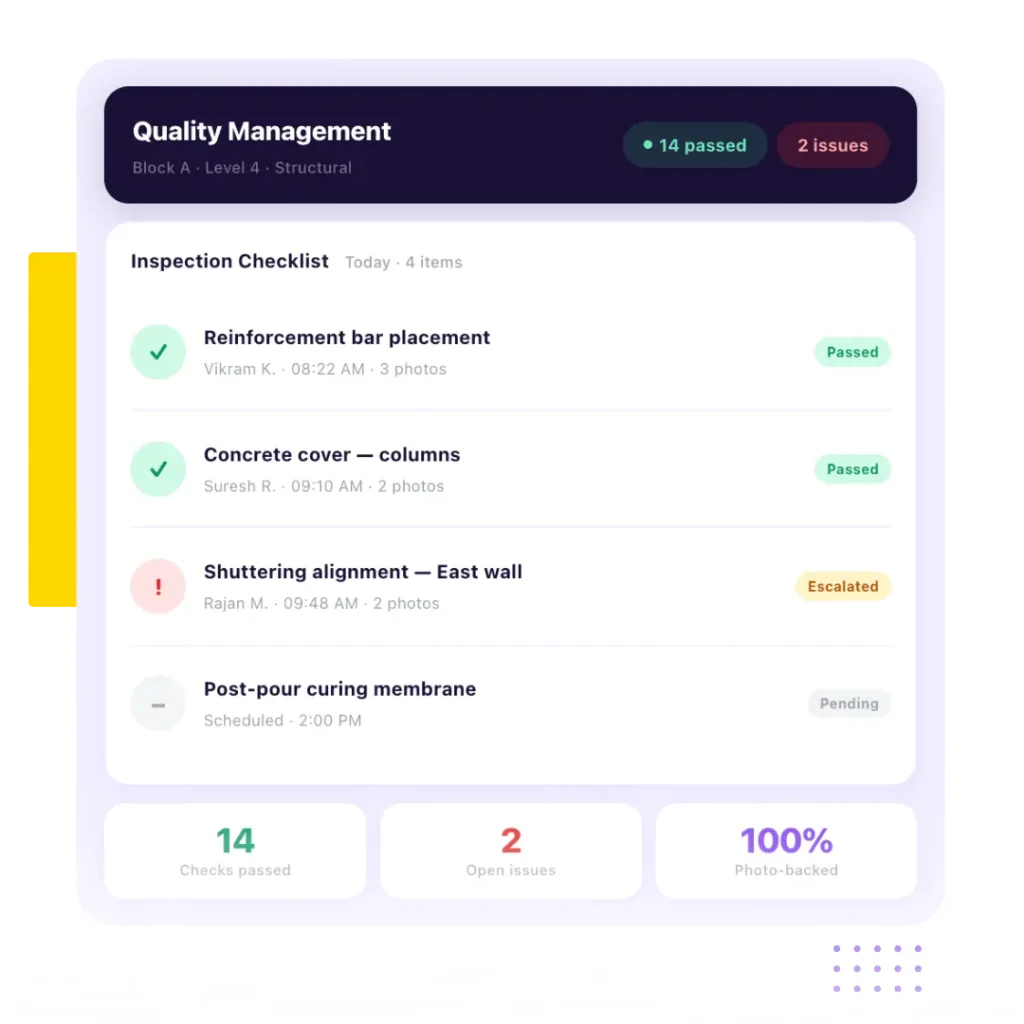
Digital checklists configured per discipline and per project requirement
Photo-backed inspection reports with timestamp and user identification
Real-time issue escalation from site to management with full audit trail
Trusted by 10,000+ Construction Companies Worldwide
Construction teams plan activities, track progress, and stay ahead of delays with Onsite construction planning software.

Built for Construction Teams Where Quality Failures Have Direct Cost and Client Consequences
Onsite construction quality management software is designed for teams managing structured inspection requirements across multiple concurrent sites where inconsistent quality control creates rework, retention disputes, and client relationship damage.
01
Developers and PMC Teams
Developers and PMC teams managing multiple contractors across concurrent projects need quality standards that are consistent regardless of which contractor or crew is executing the work. Onsite gives PMC teams standardized digital checklists deployed across all active sites, inspection records with photographic evidence linked to specific activities, and real-time visibility into quality compliance status without visiting every site individually for a status update.
02
Civil Contractors & Builders
Civil contractors and builders working on residential and commercial projects face quality failures most frequently at activity handover points: when one trade’s incomplete work prevents the next trade from starting correctly. Onsite gives site engineers a structured inspection workflow at every activity completion checkpoint, ensuring that quality is verified and documented before the next activity begins rather than discovered as a defect during the finishing phase.
03
Interior and Fit-Out Firms
Interior and fit-out firms work on projects where client expectations around finish quality are high and where a single visible defect during the client walkthrough can trigger extensive rework demands that were avoidable through systematic inspection during execution. Onsite gives interior teams discipline-specific checklists for surface finishes, joinery, hardware, and services completion, with photo evidence and deviation tracking that supports professional client handover rather than reactive defect resolution.
04
Infra and EPC Firms
Infrastructure and EPC firms managing large multi-discipline projects need quality traceability that connects inspection records to specific activities, responsible engineers, and contractual compliance requirements. Onsite gives infra and EPC teams inspection management across civil, structural, electrical, and mechanical disciplines with timestamped records, multi-level escalation workflows, and audit trails that support both internal quality reviews and client or consultant certification requirements throughout the full project execution lifecycle.
From Checklist Creation to Issue Resolution: How Onsite Construction Quality Management Software Works
Onsite connects discipline-specific checklist configuration, field-level photo inspection, real-time issue escalation, and complete audit trail generation in one workflow so quality control happens during execution rather than being reconstructed from memory after defects surface.
Digital Checklists Configured Per Discipline and Project
Create inspection checklists in Onsite for every discipline the project requires civil, structural, electrical, plumbing, finishing, and mechanical with checklist items configured to match specific project quality standards rather than a generic template that does not reflect the actual execution requirements. Assign checklists to specific activities and project phases so site engineers know exactly which quality checks apply to each activity at each stage of execution. Checklist completion status is visible to project managers and owners from the dashboard without requiring site visits or phone calls.
Photo-Backed Inspection Reports with Full Traceability
Site engineers conduct inspections through the Onsite mobile app, attaching photographs to each checklist item, adding remarks about observations or deviations, and marking completion or non-compliance at the point of inspection rather than in a retrospective report compiled from memory. Each inspection entry captures the timestamp, the site engineer’s identity, the specific checklist item, and any attached photographs so the inspection record is evidence-backed rather than text-only. This evidence trail supports client discussions, subcontractor accountability, and internal quality reviews without requiring manual report assembly.
Real-Time Issue Escalation and Deviation Tracking
When a site engineer marks a deviation or non-compliance during an inspection, Onsite generates an immediate alert to the relevant supervisor or project manager rather than routing the issue through a WhatsApp message that may be seen hours later or not at all. Escalation flows are configured based on issue severity and project role so critical deviations reach the right person immediately. Every issue carries a status from raised through assigned to resolved with timestamped records of who took what action at each stage, creating a complete accountability trail from identification to closure.
Quality Analytics and Recurring Issue Identification
Onsite tracks quality inspection data across all active projects and surfaces patterns in the data which activities generate the most defects, which contractors or crews have the highest non-compliance rates, which checklist items are most frequently marked as deviations. This pattern visibility allows project managers and quality teams to direct inspection intensity toward the highest-risk activities and address systemic quality problems rather than managing each defect as an isolated incident. Quality performance across the portfolio becomes a managed metric rather than an informal impression.
Why Construction Companies Discover Quality Problems After the Damage Is Already Done?
Most construction quality failures are not caused by negligent site teams. They are caused by inspection systems that cannot surface developing problems until the defective work has already been covered by subsequent activities or accepted by a client who expected better.
Missed Inspections That Nobody Tracks
Construction sites run inspection processes through paper checklists that supervisors complete at the end of a shift from memory, submit to the office at week end, and file without anyone verifying that every required check was actually conducted. When a checklist item is skipped because the supervisor was managing another problem at the time of inspection, the skip is invisible in the paper record. By the time the defect the missed check would have caught surfaces during client walkthrough or final inspection, the work covering it has been in place for weeks and removal is the only remedy.
No Standard Quality Process Across Sites & Crews
Construction companies managing multiple concurrent projects across different sites with different supervisors and different subcontractor crews experience quality outcomes that vary significantly from site to site not because the company’s quality standards differ but because there is no system ensuring those standards are applied consistently at field level. One supervisor follows a rigorous inspection process from experience. Another checks visually and signs off. The client on the second site receives a different quality outcome from the same company despite being sold the same standard. Inconsistency compounds across every project the company runs simultaneously.
Deviations That Reach Management Too Late to Correct
When site quality issues travel from site engineer to supervisor to project manager through WhatsApp messages and morning phone calls, the information arrives at the decision-making level hours or days after the deviation occurred. A structural deviation identified during morning inspection that reaches the project manager in the afternoon discussion may have already been covered by subsequent work by the time corrective action is agreed. The delay between identification and escalation is where most construction quality failures transition from correctable deviations into expensive rework or concealed defects that surface during handover.
No Audit Trail When Quality Disputes Arise
Construction quality disputes between contractors and clients, between main contractors and subcontractors, and between project teams and their own management arise from an absence of documented evidence about what was inspected, what was found, and what corrective action was taken. Paper-based inspection records are incomplete, inconsistently filled, and frequently unavailable when a dispute requires them. A project team that cannot produce inspection records showing when a specific activity was checked, what the finding was, and who resolved the deviation has no defensible position in a quality dispute regardless of the actual quality of the work executed.
Why Excel and WhatsApp Cannot Handle Construction Quality Management?
Excel was designed for data storage. WhatsApp was designed for messaging. Using both together for construction quality management produces an inspection record that is incomplete, untraceable, and unavailable when a quality dispute requires evidence.
Paper checklists and Excel sheets cannot capture photographic evidence linked to specific checklist items at the point of inspection, photos sit in WhatsApp without connection to the inspection record they are meant to support
WhatsApp deviation reports have no escalation mechanism, messages are seen when the recipient opens them, not when the issue requires immediate attention from the right person
Excel checklists cannot enforce which inspections are mandatory before an activity is marked complete, checklist compliance depends entirely on supervisor discipline with no system control
Audit trails required for client handover, subcontractor accountability, and quality disputes cannot be reconstructed from scattered WhatsApp conversations and partially completed Excel sheets
Core Features of Onsite Construction Quality Management Software
Control inspection scheduling, digital checklist compliance, photo-backed deviation recording, issue escalation, and quality analytics across every active project from one platform built specifically for construction site execution.
Digital Checklists
Discipline-configured · Mobile · Portfolio-tracked
3 projects
4 deviations
74%
Portfolio complete
18
Complete
6
Pending
4
Deviations
By Discipline Resi. Tower · Phase 2
Structural
No deviations
MEP
2 deviations
Finishing
2 deviations
Safety
In progress
4
Disciplines configured
Mobile
Point of inspection
4
Open deviations
Digital Checklists with Discipline-Level Configuration
Create and deploy structured digital inspection checklists in Onsite for every discipline and every project phase, with checklist items configured to match specific project quality requirements rather than a generic template. Site engineers access their assigned checklists through the mobile app, complete each item at the point of inspection, mark deviations with specific observations, and attach photographic evidence before submitting. Checklist completion is tracked at project level and portfolio level so management sees which inspections are complete, which are pending, and which have open deviations requiring action.
Discipline-specific checklists configured per project quality requirement
Mobile access for site engineers at point of inspection
Checklist completion and deviation status visible across all active projects
Photo-Backed Inspection Reports with Timestamp and Accountability
Every inspection entry in Onsite captures photographic evidence linked to the specific checklist item being inspected, along with a timestamp, the site engineer’s identity, and any written observations or deviation remarks entered at the time of inspection. This evidence-backed record exists in the system the moment the inspection is conducted rather than being assembled manually from WhatsApp photos and handwritten notes after the working day ends. The complete inspection record is retrievable by project managers, clients, and quality auditors from the platform at any time without locating physical files or searching message histories.
Inspection Reports
Photo-backed · GPS-timestamped · Auto-captured
24 entries
100% linked
Evidence Log — Site 1 · Today
Auto-captured ✓
3📷
Rebar cover — Level 4 columns
08:22 AM
GPS · auto
2📷
Conduit routing — 2nd floor MEP
09:41 AM
GPS · auto
4📷
Plaster thickness — West elevation
10:15 AM
GPS · auto
24
Entries today
100%
Photo-linked
Auto
Timestamped
Shuttering misaligned — East wall, Level 4
Block A · Structural · Raised 09:48 AM
Open
Site 1
Issue Status Pipeline
✓
Identified
09:48
✓
Assigned
09:49
→
Action
Now
4
Verified
Pending
Audit Trail Every action timestamped
RM
Deviation raised & photos attached
Rajan M. · Site Engineer · Block A
09:48 AM
SK
Auto-alerted — PM & QA Head notified
System · Pre-configured escalation rule
09:49 AM
AD
Corrective action assigned to contractor
Anita D. · QA Head · In progress
10:04 AM
<2 min
Alert time
100%
Timestamped
Auto
Retrievable
Issue Escalation and Audit Trail from Identification to Resolution
When a deviation is recorded during an inspection in Onsite, the system immediately alerts the relevant supervisor or project manager based on pre-configured escalation rules. The issue carries a traceable status through every stage from identification through assignment to corrective action to verification and closure. Every action taken on the issue, who was notified, when they responded, what corrective action was agreed, who verified the correction, is recorded with timestamps in a complete audit trail that is available for client handover documentation, subcontractor accountability discussions, and internal quality reviews without manual reconstruction.
Instant escalation alerts to relevant supervisors on deviation detection
Issue status tracked from identification through correction to verified closure
Complete audit trail retrievable for handover, disputes, and quality reviews
How Onsite Simplifies Construction Quality Management for Site Teams and Project Managers?
Most quality management systems create paperwork for office teams without changing how site inspections actually happen. Onsite is built the other way around, starting with the site engineer’s mobile app and connecting field inspection data directly to management visibility without any intermediate compilation step.
01
Configure Checklists Before Work Begins
Before any activity begins on site, the project manager or quality team configures the inspection checklist for that activity in Onsite. Checklist items are specific to the discipline, the activity type, and the project quality standard. Site engineers know exactly what they are expected to check and in what sequence before they begin the inspection. The checklist configuration takes minutes and eliminates the variability in inspection quality that comes from different supervisors interpreting quality standards differently based on their own experience and preference.
02
Site Engineers Conduct Inspections from Mobile
Site engineers open the Onsite mobile app when an activity is ready for inspection, select the relevant checklist, and work through each item at the physical location of the work being inspected. Each checklist item is marked pass, fail, or observation with a photograph attached and a remark entered where a deviation exists. The inspection takes place in real time at the work face rather than being reconstructed afterward from memory and WhatsApp photos that may or may not have been taken at the right time.
03
Deviations Escalate Automatically to the Right Person
When a site engineer marks a deviation during an inspection, the Onsite system generates an immediate alert to the pre-configured escalation contact for that project and that deviation type. The project manager or supervisor receives the alert with the specific checklist item, the deviation description, the attached photograph, and the inspection location. The escalation happens automatically rather than depending on the site engineer remembering to send a separate WhatsApp message to the right person in the right format at the right time.
04
Management Sees Quality Status Across All Active Projects
Project managers and company owners see the current quality inspection status across all active projects from the Onsite dashboard without visiting sites or calling supervisors. Which activities have been inspected, which have open deviations, which deviations have been resolved, and which have been escalated without response are all visible in real time. Quality performance trends across projects, contractors, and activity types surface from the data without anyone compiling a quality report manually from scattered records.
What Construction Companies Say About Onsite Construction Project Planning Software?
Construction companies across India and the Middle East use Onsite to replace disconnected planning tools with a live construction schedule that site teams actually update.
We were looking for construction management software that could help us share clear project updates with clients. With Onsite, all the progress and cost details are visible in one place. It has made client discussions much smoother because we are now talking with actual site data instead of guesses.
Mr. Anvesh, Founder
Bhavya Developers, Building Construction Company, India
Additional Features That Strengthen Construction Quality Control
Beyond core inspection management and issue escalation, Onsite provides a full set of quality support tools connecting site inspection data to project reporting, accountability tracking, and continuous improvement.
Inspection Scheduling
Schedule mandatory inspections for specific activities before they are marked complete in the project plan. Prevent activity sign-off without confirmed inspection completion so quality checks are structurally required rather than optionally performed based on supervisor availability and judgment.
Non-Compliance Reporting
Generate structured non-compliance reports from deviation data captured during inspections across all active projects. Reports include deviation descriptions, photographic evidence, assigned responsible parties, and current resolution status for client review, subcontractor accountability, and internal quality management.
Quality Analytics Dashboard
Track defect rates, inspection pass and fail percentages, open deviation counts, and average resolution times across all active projects from one dashboard. Identify which activities, contractors, and project phases generate the highest quality failure rates and direct inspection intensity accordingly.
Contractor Quality Scorecards
Monitor quality performance by contractor and subcontractor across all active and completed projects. Track which contractors consistently produce inspection-passing work and which ones generate recurring deviations so future subcontractor selection is based on execution records rather than relationships and price alone.
Client Handover Documentation
Generate complete quality handover documentation from inspection records captured throughout project execution. Handover packs include inspection histories, deviation records, resolution evidence, and final sign-off confirmations presented in a structured format that supports professional client handover rather than informal verbal assurances.
Multi-Project Quality Overview
View quality compliance status, open deviation counts, and inspection completion rates across all active projects simultaneously from one consolidated dashboard. Company owners and quality managers identify which sites are performing to standard and which need immediate management attention without individual site visits.
4 Tips to Manage Construction Quality More Efficiently on Active Projects
The inspection system works only if site teams use it consistently. These four practices determine whether a construction quality management system delivers consistent outcomes or becomes another tool that site teams bypass when execution pressure builds.
Make Inspection Completion a Prerequisite for Activity Sign-Off
A quality checklist that site engineers complete after an activity is already marked done in the project schedule is a documentation exercise, not a quality control mechanism. Configure the project workflow so activity completion requires a confirmed inspection record before the activity can be signed off. This structural requirement means quality inspection happens because the workflow demands it rather than because individual supervisors remember to prioritize it during a busy site day. The inspection rate across all activities rises immediately when sign-off depends on it.
Configure Checklists at Project Setup Not During Execution
The most common reason digital quality checklists are not used consistently on construction sites is that they are configured reactively, after quality problems have already occurred, rather than proactively before execution begins. Build the checklist configuration step into your project setup process alongside activity scheduling and budget allocation. When site engineers find discipline-specific checklists waiting for them in the system before they begin an activity, adoption is immediate. When checklists appear mid-project as a response to a quality failure, adoption feels like punishment rather than process.
Assign Every Deviation a Responsible Person and a Resolution Deadline
A deviation that is recorded and escalated but not assigned to a specific person with a specific resolution deadline exists in the quality system as a permanent open item with no mechanism to drive closure. For every deviation the Onsite system captures, assign it immediately to the person responsible for the correction with a deadline that reflects the urgency of the issue. Deviations without assignments get resolved when someone notices them. Deviations with named owners and deadlines get resolved because the system makes the open status visible and the accountability undeniable.
Review Quality Analytics Monthly to Address Systemic Problems
Individual defect resolution is reactive quality management. Monthly review of quality analytics across all active projects is proactive quality management. When the data shows that a specific activity type generates deviations on every project, or that a specific subcontractor has a consistently higher non-compliance rate than others, the problem is systemic and requires a different response than resolving the individual deviation. Monthly review of defect patterns, contractor performance data, and recurring checklist failures turns quality analytics from a reporting feature into a continuous improvement mechanism that raises standards across the full project portfolio.

Stop Discovering Quality Failures During Client Walkthroughs. Start Catching Them on Site with Onsite.
Every quality defect discovered during client walkthrough or final inspection represents a failure of the inspection process that should have caught it during execution. Onsite construction quality management software gives site engineers structured digital checklists, photo-backed inspection records, and automatic deviation escalation so quality problems are identified and resolved on site, not handed over as a client complaint.
FAQs
What is Onsite construction quality management software?
Onsite construction quality management software gives contractors, developers, PMC teams, and interior firms a structured digital system for conducting site inspections through configured discipline-specific checklists, capturing photographic evidence at the point of inspection, escalating deviations to the right supervisors in real time, and maintaining a complete audit trail from issue identification through resolution and sign-off. It connects site engineers conducting field inspections directly to project managers and company owners who need visibility into quality compliance status across all active projects without individual site visits.
How does Onsite reduce construction rework caused by quality failures?
Onsite reduces rework by ensuring quality inspections happen during activity execution rather than after completing work. When site engineers conduct structured checklist inspections at each activity completion point, deviations are identified before subsequent trades begin work that would cover or depend on the defective activity. The deviation escalation system alerts the relevant supervisor immediately rather than routing the issue through a WhatsApp message that may be seen hours later. Catching a deviation before subsequent work begins costs a correction. Catching it after costs demolition and rework across multiple activities that were built on a defective foundation.
Can Onsite manage quality checklists across multiple disciplines?
Yes. Onsite allows quality teams and project managers to configure separate inspection checklists for every discipline the project requires including civil, structural, electrical, plumbing, mechanical, and finishing activities. Each checklist is configured with items specific to the discipline and the project’s quality standard rather than a generic template. Checklists are assigned to specific activities and project phases so site engineers see only the checklists relevant to the work they are currently inspecting. Multi-discipline projects with concurrent activity across trades have all discipline-specific checklists active simultaneously with separate tracking for each.
How does Onsite’s issue escalation work for quality deviations?
When a site engineer marks a deviation during a checklist inspection in Onsite, the system generates an immediate alert to the pre-configured escalation contact for that project and deviation type rather than waiting for the engineer to manually send a separate notification. Escalation contacts and escalation rules are configured at project setup so deviations of different severity levels reach different management levels automatically. The deviation carries a status through every stage from initial identification through assigned corrective action to verification of the fix and final closure with a timestamped record of every action taken.
Does Onsite maintain an audit trail for quality inspections?
Yes. Every inspection conducted through Onsite creates a permanent record capturing the checklist items checked the pass or fail status of each item, any deviation descriptions entered, photographic evidence attached at the point of inspection, the timestamp of the inspection, and the identity of the engineer who conducted it. Every deviation raised creates a separate record tracking notification, assignment, corrective action, and verification through to closure. This complete audit trail is available in the platform at any time and supports client handover documentation, subcontractor accountability discussions, and quality dispute resolution without requiring manual reconstruction from scattered records.
Is Onsite construction quality management software suitable for interior and fit-out projects?
Yes. Interior and fit-out projects benefit significantly from Onsite’s quality management capabilities because finish quality expectations from residential and commercial clients are high and because defects that are invisible during execution become highly visible during client walkthrough. Discipline-specific checklists for surface finishes, joinery, hardware installation, and services completion ensure that every aspect of interior quality is systematically inspected before client handover rather than visually assessed by a supervisor whose standard may differ from the client’s expectation. Photo evidence captured during interior inspections also supports professional handover documentation.
Can Onsite track quality performance by contractor or subcontractor?
Yes. Onsite tracks inspection and deviation data at contractor and subcontractor level across all active and completed projects, allowing quality managers and project directors to see which contractors consistently produce inspection-passing work and which generate recurring deviations. This contractor quality performance data is accessible from the analytics dashboard without manual compilation from individual project records. Companies that use this data for subcontractor selection and performance management report that the quality performance gap between their best and worst subcontractors narrows over time as subcontractors become aware that their inspection records are being tracked and compared.
How does Onsite construction quality management software support client handover?
Onsite generates complete quality handover documentation from the inspection records captured throughout project execution. Handover documentation includes the full inspection history for each activity, deviation records with photographic evidence, corrective action records showing how each deviation was resolved, and final sign-off confirmations from the relevant verification authority. This structured handover pack replaces the informal verbal assurance that quality work was done with documented evidence of what was inspected, when, by whom, and what the outcome was. Clients receiving structured quality handover documentation have fewer post-handover defect claims than those handed over through informal walkthroughs.
Does Onsite support multi-project quality management for developers and EPC firms?
Yes. Onsite gives developers, EPC firms, and PMC teams a consolidated quality management dashboard showing inspection completion rates, open deviation counts, deviation resolution status, and quality performance trends across all active projects simultaneously. Quality managers can see which sites are performing to standard and which have developing quality issues without visiting individual sites or waiting for weekly quality reports compiled manually from site supervisor inputs. The multi-project view allows quality management resources to be directed toward the sites and activities with the highest deviation rates rather than being distributed uniformly regardless of actual quality risk.
How quickly can construction teams start using Onsite quality management software?
Onsite is designed for rapid deployment without extended implementation timelines or specialist technical setup. Project managers configure discipline-specific checklists for the first active project within hours of account setup. Site engineers begin conducting mobile inspections from the first working day after checklists are assigned to activities. Most construction companies have their complete quality management workflow operational within days of signing up rather than weeks of implementation and training. Companies that have previously struggled with quality software adoption report that Onsite’s mobile-first checklist interface significantly reduces the resistance from site engineers compared to desktop-only quality management tools.