
Construction Production Management Software
Construction Production Management Software — Built for Real Project Execution
Create Material Mixes, Manage Fabrication & Control Site Production. For contractors managing in-house fabrication or material batching, production control directly affects project timelines and cost.

Approved material mix proportions defined and enforced across every production batch
Batch-wise input and output recorded in real time with planned versus actual comparison
Every production run automatically updating inventory and project cost position
Trusted by 10,000+ Construction Companies Worldwide
Construction teams plan activities, track progress, and stay ahead of delays with Onsite construction planning software.

Built for Construction Teams Where In-House Production Directly Determines Project Quality and Cost
Onsite construction production management software is designed for contractors, infra companies, and industrial firms where concrete batching, mortar production, fabrication, or any form of in-house material processing is a daily site activity that directly affects both project quality and material cost.
01
Infra and EPC Companies
Infrastructure and EPC companies running high-volume concrete production for roads, bridges, structures, and civil works need batch-level control over material mix proportions, input consumption, and output quantities across multiple production points simultaneously. Inconsistent concrete grades caused by informal batch proportioning affect structural integrity and trigger rework that costs significantly more than the material input variation that caused it. Onsite gives infra and EPC teams standardized mix definitions enforced at the batch level with consumption tracking that surfaces deviations before the poured concrete sets and correction becomes impossible.
02
Industrial and Specialty Contractors
Industrial construction projects involving precast fabrication, steel structure production, RCC works, and specialty material processing require production records that connect material consumption to specific project activities and cost heads. Without batch-level recording linked to the project, material used in production disappears from inventory without a corresponding cost allocation to the activity it served. Onsite gives industrial contractors batch records linked to specific project activities so every kilogram of raw material consumed in production traces to the project cost head it belongs to.
03
Building Contractors and Developers
Building contractors running on-site concrete batching for slabs and columns, or mortar and plaster mixing for masonry and finishing works, manage production where quality is determined by proportions and cost by consumption discipline. A site mixing concrete by informal estimation produces variable grades. A site recording batch inputs on paper at shift end produces memory rather than measurement. Onsite gives building contractors approved mix definitions and real-time batch recording that connect production discipline to quality outcomes and material cost control simultaneously.
04
Ready Mix and Precast Production Operations
Construction companies operating dedicated concrete batching plants, precast production yards, or off-site fabrication facilities for supply to their own project sites need production management that tracks batch output against planned quantities, monitors raw material consumption rates across production shifts, and connects total production output to the inventory positions at receiving sites. Onsite gives production operations a batch-level recording system that shows planned versus actual output and consumption for every production run with automatic inventory updates at the project site receiving the material.
From Mix Definition to Budget Impact: How Onsite Construction Production Management Software Works?
Onsite connects approved material mix standardization, real-time batch production recording, input versus output tracking, inventory integration, and project cost linkage in one workflow so production data flows from the batch mixer to the project budget without manual compilation at any step.
Material Mix Standardization & Approved Recipe Management
Define standard material mix proportions for every production type the project requires M10, M15, M20, M25, and M30 concrete grades, mortar ratios, plaster mixes, and fabrication specifications in Onsite before any production begins. Each mix definition specifies the exact material inputs required per unit of output, the acceptable tolerance range, and the approval authority. When a batch is recorded, it references the approved mix definition so production teams know exactly what proportions to use rather than relying on the site engineer’s memory or informal chalk marks on the mixer drum. Every batch has a documented mix reference from the first pour to the last.
Real-Time Batch Recording with Input and Output Tracking
Production teams record each batch in Onsite at the time of production, not at the end of the shift from memory, capturing the actual material inputs consumed, the quantity of output produced, and any deviation from the approved mix proportion. The system compares actual consumption against the planned consumption for that batch quantity, flags deviations above acceptable tolerance, and gives site engineers an immediate view of whether the current production run is consuming material at the rate the mix design requires. Raw material wastage that manual paper logs cannot detect surfaces at the batch level before it accumulates into a budget overrun.
Inventory Integration with Automatic Stock Deduction
Every production batch recorded in Onsite automatically updates the raw material inventory position at the site where production occurred. When a batch of M20 concrete is produced using 300 kilograms of cement, 600 kilograms of aggregate, and 150 kilograms of sand, those quantities are deducted from the respective material stock balances in real time without any separate inventory update entry. Production teams and procurement teams see current stock positions that reflect actual consumption rather than procurement records that have not been adjusted for production use. Reorder points and procurement decisions are based on verified current stock rather than estimates.
Project Cost Linkage and Production Budget Tracking
Production runs in Onsite link to specific project activities and BOQ cost heads so the material cost of every batch produced contributes to the project cost position as it occurs rather than being captured at month end from manually compiled production records. Project managers see the current production cost position against budgeted production quantities across all active production activities without waiting for the accounts team to compile consumption data from batch sheets submitted at various intervals. When a production activity is tracking above its budgeted material cost, the overrun appears in the project budget view while intervention is still possible rather than at project completion when the cost has already been incurred in full.
Why Construction Production Operations Lose Material and Quality Without a Management System?
Most construction production problems are not caused by untrained site teams or poor materials. They are caused by production systems that record nothing at the batch level, compare nothing against a plan, and connect production consumption to the project budget only at month end when the accumulation is already done.
Inconsistent Material Mixes Producing Variable Quality Across Batches
Construction sites running concrete batching, mortar production, or plaster mixing without formally defined and enforced mix proportions produce output whose quality varies based on which worker mixed which batch with which informal interpretation of what the correct proportions should be. An engineer who was trained to use four bags of cement per concrete batch and a labourer who uses three-and-a-half because that is what was available produce structurally different concrete regardless of whether both call it M20. The variation compounds across dozens of batches on a single structural element before any quality issue becomes visible.
Manual Batch Recording Producing Records That Reflect Memory Not Measurement
Construction production records maintained on paper batch sheets completed at shift end reflect what the supervisor remembers the day’s production consumed rather than what was actually measured per batch during production. The difference between recorded and actual consumption across twelve hours of multi-batch production is invisible in the paper record because the record was not created at the point of production with actual measurements. Material consumption exceeding plan by ten to fifteen percent passes through paper recording as conforming until a stock count eventually reveals the accumulated discrepancy.
Production Consumption Invisible to Procurement Until Stock Runs Out
Material consumed during production operations is deducted from site inventory only when someone updates the stock register — which happens periodically based on when the storekeeper or supervisor finds time to reconcile batch sheets against procurement records. In the gap between actual production consumption and stock register update, procurement teams making reorder decisions are working from stock positions that have not been reduced by the material already consumed in production. The result is either procurement that arrives too late because the stock position appeared healthy, or duplicate procurement that creates excess stock because consumption was not reflected before the order was placed.
Production Cost Disconnected from Project Budgets Until Month End
Construction production operations consume raw materials at rates that directly determine whether the project’s material budget for that activity is on track or heading toward overrun. When production consumption is captured on paper batch sheets submitted to the accounts team at month end, the project budget reflects production cost only after four weeks of production have already occurred at whatever rate the unmonitored production process was running. A concrete production operation consuming fifteen percent more cement per cubic metre than the BOQ rate budgeted runs for a full month before anyone with access to the budget position knows the overrun is happening.
Why Excel and WhatsApp Cannot Handle Construction Production Management?
Excel records what someone enters. WhatsApp carries what someone sends. Neither can compare actual batch consumption against approved mix proportions in real time, update inventory automatically when a production batch is recorded, or connect production consumption to project budget positions without someone compiling the connection manually.
Excel batch sheets cannot enforce approved mix proportions at the point of production, a worker who mixes the wrong proportion records whatever quantity they used and the deviation from the approved mix is invisible unless someone separately checks the record against the mix definition
WhatsApp photos of production operations provide visual evidence that production happened but cannot record actual material inputs per batch, calculate planned versus actual consumption variance, or update inventory and project cost positions automatically
Excel stock registers updated from batch sheet summaries submitted at shift end or day end reflect consumption from memory rather than from measurements taken at the point of each batch, producing inventory positions that consistently lag actual consumption by hours to days
Production cost connected to project budgets through manual Excel compilation across batch sheets, stock registers, and BOQ spreadsheets produces a budget position that is always several weeks behind actual production consumption, arriving too late to influence the rate at which material is being consumed
Core Features of Onsite Construction Production Management Software
Control material mix standardization, real-time batch recording, input versus output tracking, inventory integration, and project cost linkage across every in-house production operation from one connected platform.
Mix Library
Approved recipes · Version-controlled · Enforced
8 active
v2.1
Approved Mix Definitions
12 recipes
M25 Concrete Grade
1:1:2
Active
M20 Concrete Grade
1:1.5:3
Approved
Plaster Mix — External
1:4
Review
M25 — Input per 1m³ output
v2.1 approved
12
Mix definitions
100%
Version tracked
Approval
Required to change
Material Mix Library with Approved Production Recipes
Create and maintain a library of approved material mix definitions in Onsite covering every production type the project requires — concrete grades from M10 through M30, mortar ratios, plaster mixes, and fabrication specifications — with exact input proportions per unit of output, acceptable deviation tolerances, and approval status for each definition. When a batch is initiated, the production team selects the relevant mix definition so the proportions are specified from the approved recipe rather than from individual interpretation. Changes to mix definitions require approval and are recorded with version history so the mix applied to any specific batch is always traceable.
Approved mix definitions for all concrete grades, mortar ratios, and plaster mixes
Exact proportions per unit of output with acceptable deviation tolerance specified
Mix definition changes requiring approval with full version history maintained
Real-Time Batch Production Records with Input and Output Comparison
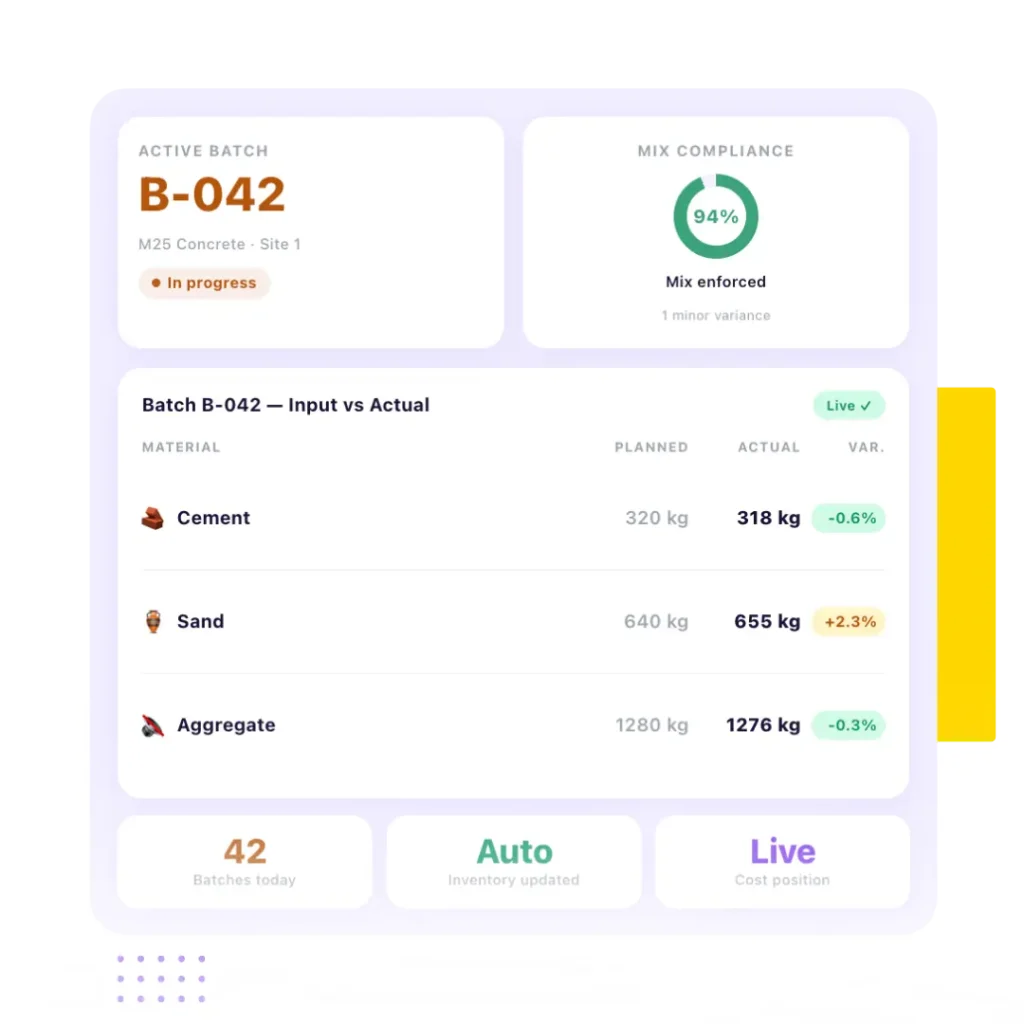
Production teams record each batch in Onsite at the time of production, capturing actual material inputs consumed and the quantity of output produced against the approved mix definition for that batch. The system calculates the planned consumption for the recorded output quantity using the mix definition, compares it against the actual consumption entered, and flags any batch where actual consumption deviates from planned consumption beyond the defined tolerance. This comparison happens at the batch level in real time so supervisors see deviations while the production run is still active rather than in a weekly review of compiled batch sheets.
Active batch
B-042
M25 Concrete · Site 1
In progress
Mix compliance
94%
Mix enforced
1 minor variance
Batch B-042 — Input vs Actual
Live ✓
Material
Planned
Actual
Var.
Cement
320 kg
318 kg
-0.6%
Sand
640 kg
655 kg
+2.3%
Aggregate
1280 kg
1276 kg
-0.3%
42
Batches today
Auto
Inventory updated
Live
Cost position
Stock deducted
−318 kg
▼ Auto after B-044
Cost posted
+₹12,400
▲ Budget updated live
Post-Production Stock Levels
1 reorder
Cement
196 bags
OK
Sand
3.2 brass
▼ Reorder
Aggregate
8.4 MT
OK
Auto-Update Log No manual steps
Batch B-044 recorded — inventory deducted
Now
Sand below reorder point — procurement alerted
Now
₹12,400 posted to Block A structural activity
2m ago
Auto
No manual step
Live
Cost position
0
Manual updates
Inventory Integration and Project Cost Linkage from Every Production Run
Every batch recorded in Onsite automatically deducts the consumed raw material quantities from the site inventory position and adds the corresponding material cost to the project budget for the activity the production serves. Inventory positions reflect post-production stock in real time without a separate inventory update step. Project cost positions reflect production material consumption as it occurs rather than at month-end compilation. Procurement teams see current stock against reorder points without waiting for manual stock register updates. Project managers see current production cost against budgeted quantities without waiting for accounts to compile batch sheet summaries from the previous period.
Raw material stock deducted automatically from inventory at point of batch recording
Production material cost updating project budget position in real time per batch
Procurement and project management working from current data without manual compilation steps
How Onsite Simplifies Construction Production Management for Site Teams and Project Managers?
Most production management problems in construction originate from the gap between where batches are mixed, where records are kept, and where costs are tracked. Onsite closes all three gaps by connecting approved mix definitions, real-time batch recording, and automatic inventory and budget updates in one workflow.
01
Define Approved Mixes Before Production Begins
Before any production activity starts on site, the project engineer or quality manager creates the approved mix definitions in Onsite for every production type the project requires. Each definition specifies exact proportions, acceptable tolerances, and the approval authority. Production teams access these definitions through the mobile app when initiating a batch. The approved mix is the starting point for every batch rather than an informal understanding of what the proportions should be. This single step eliminates the batch-to-batch variation that causes quality inconsistency on sites where mix proportions exist in supervisors’ heads rather than in a documented system.
02
Site Teams Record Each Batch at the Point of Production
When a batch is initiated on site, the production team opens Onsite on the mobile app, selects the activity and the approved mix definition, enters the actual material quantities being used, and records the output quantity produced. This entry happens at the mixer or production point during production rather than at the supervisor’s office at shift end from memory. The real-time entry means the system can immediately compare actual inputs against the planned inputs from the mix definition and flag any deviation before the next batch begins, while there is still time to correct the proportioning or investigate why the consumption rate differs from the approved recipe.
03
Deviations Surface Before They Compound Into Overruns
When a batch entry shows actual consumption deviating from planned consumption beyond the defined tolerance — more cement per cubic metre than M20 requires, higher sand consumption than the mortar ratio specifies — the system flags the deviation immediately for the supervisor and project manager. The deviation appears as a specific flag showing which batch, which material, what the planned consumption was, and what the actual consumption entered was. The project manager can investigate whether the deviation reflects a genuine over-consumption, a measurement error, or a mix proportion problem before the same deviation repeats across the next twenty batches at the same rate.
04
Inventory & Budget Update Without Anyone Compiling Connection
The moment a batch is recorded in Onsite, the raw material quantities consumed are deducted from site inventory and the corresponding cost is added to the project budget for the production activity. The storekeeper does not need to update the stock register from batch sheets. The accounts team does not need to compile production consumption into the monthly cost report. The project manager does not need to request a production summary to understand the current budget position for concrete or plaster production. The connection between what was produced, what was consumed, and what the project spent on that production exists in the platform the moment the batch record is saved.
What Construction Companies Say About Onsite Construction Project Planning Software?
Construction companies across India and the Middle East use Onsite to replace disconnected planning tools with a live construction schedule that site teams actually update.
We were looking for construction management software that could help us share clear project updates with clients. With Onsite, all the progress and cost details are visible in one place. It has made client discussions much smoother because we are now talking with actual site data instead of guesses.
Mr. Anvesh, Founder
Bhavya Developers, Building Construction Company, India
Additional Features That Strengthen Construction Production Control
Beyond core mix standardization, batch recording, and inventory integration, Onsite provides a full set of production support tools connecting site production operations to quality management, procurement planning, and project financial reporting.
Shift-Wise Production Summaries
View total production output and total raw material consumption for each shift across all active production points on a project. Shift summaries give production supervisors and project managers a consolidated production performance view without compiling individual batch records manually at the end of each shift.
Wastage Detection & Deviation Reports
Identify which batches, which production points, and which production teams are consistently showing input consumption above the planned mix proportions. Wastage reports highlight systematic over-consumption patterns that random batch review cannot surface, allowing targeted corrective action at the specific production point generating the deviation.
Production vs Budget Comparison
Compare total material consumed in production against the budgeted consumption for each production activity across the project. Production versus budget comparison visible in real time gives project managers early warning of cost overruns driven by production inefficiency before the full budgeted quantity has been consumed.
Multi-Site Production Tracking
Track production operations across multiple active project sites simultaneously from one dashboard. Project directors and procurement teams see production output rates, consumption positions, and stock levels across all active production points without requesting individual site reports from separate production supervisors across different locations.
Procurement Trigger from Production Consumption
Set reorder thresholds for raw materials based on production consumption rates so procurement triggers automatically when stock reaches the level required to maintain uninterrupted production through the next procurement cycle. Production-linked procurement prevents material shortages that stop production and delay project schedules.
Production Quality Audit Trail
Maintain a complete record of every batch produced showing the mix definition used, the actual inputs recorded, the output produced, and any deviations flagged — creating a quality audit trail for every production activity that supports client quality reviews, structural certification requirements, and internal production improvement processes.
4 Tips to Manage Construction Production More Efficiently on Active Projects
The production management system works only when batch records are created at the point of production with actual measurements rather than from shift-end estimates. These four practices separate sites that control production quality and cost from sites that discover overruns and quality failures after the concrete has already been poured.
Define and Approve Mix Proportions Before the First Batch Is Produced
The most expensive production management failure happens in the first week of a production operation when the crew establishes informal proportioning habits that persist for the entire project. A concrete crew that starts mixing by informal estimation on day one will still be mixing by informal estimation in month three because the habit is set. Defining and circulating the approved mix proportions before production begins and recording those proportions in a system that every batch references is the foundation of production quality control. It costs nothing and prevents everything that inconsistent proportioning subsequently costs.
Record Batch Inputs at the Point of Mixing Not at the End of the Shift
A batch record created at shift end from the supervisor’s recollection of twelve hours of production is a reconstruction exercise with an accuracy limit of whatever the supervisor can reliably remember about individual batches from earlier in the day. A batch record created at the point of mixing as each batch is prepared is a current measurement of what actually went into that specific batch. The difference in accuracy between the two methods is the difference between production records that can identify deviation and those that simply confirm the supervisor’s general impression of how the day went.
Investigate Every Deviation Before the Next Batch Begins
When a batch record shows actual consumption deviating beyond acceptable tolerance, investigate before the next batch begins rather than at the weekly review. A deviation investigated immediately can be traced to its source — a measurement error, a bag count mistake, a proportioning habit differing from the approved recipe — and corrected before it repeats. A deviation investigated at the weekly review has already repeated across every batch produced since the first occurrence, multiplying both the material cost impact and the potential quality impact across a significant production volume that cannot be recalled.
Connect Production Consumption to Project Budget Weekly
Most construction production cost overruns are discovered at month-end project cost reviews when four weeks of over-consumption have already occurred at whatever rate the unmonitored production operation was running. Reviewing production consumption against budgeted quantities weekly rather than monthly reduces the accumulation window from four weeks to one. A concrete production operation consuming fifteen percent more cement per cubic metre than the BOQ rate budgeted that is identified in week one produces a seven-day overrun that is correctable. The same issue identified at month end produces a twenty-eight-day overrun that represents a significant and unrecoverable budget loss.

Stop Discovering Material Wastage and Production Cost Overruns After the Concrete Is Already Poured. Start Managing with Onsite.
Every batch produced without a documented mix reference, every shift-end paper record created from memory rather than measurement, and every production cost that reaches the project budget only at month end represents a production management gap that Onsite construction production management software closes at the batch level from the first day of production.
FAQs
What is Onsite construction production management software?
Onsite construction production management software gives contractors, infra companies, industrial firms, and building developers a structured digital system for defining approved material mix proportions, recording batch production in real time with actual input and output quantities, comparing planned versus actual consumption at the batch level, automatically updating site inventory from production consumption, and connecting production material cost to project budgets as production occurs. It replaces paper batch sheets, memory-based shift-end records, and disconnected inventory and cost updates with a continuous connected production management workflow.
Which production types does Onsite construction production management software support?
Onsite supports any in-house construction production operation where material inputs are combined to produce an output at a defined proportion — including concrete batching across all grades from M10 through M30, mortar and plaster mixing for masonry and finishing works, in-house precast fabrication, structural steel production, and any other site-level material processing where approved mix proportions, batch-level consumption recording, and input versus output tracking are operationally relevant to quality control and material cost management.
How does Onsite enforce approved material mix proportions on construction sites?
Onsite maintains a library of approved mix definitions for every production type the project requires. Each definition specifies the exact material inputs required per unit of output and the acceptable deviation tolerance. When a production team initiates a batch, they select the relevant mix definition from the system so the approved proportions are the starting reference for that batch rather than an informal interpretation. Batch records reference the specific mix definition used, creating a documented link between the approved proportion and the actual production for every batch throughout the project’s production operations.
How does Onsite detect material wastage in construction production?
Onsite detects material wastage by comparing actual input consumption recorded per batch against the planned consumption calculated from the approved mix definition for the output quantity produced. When actual consumption exceeds planned consumption beyond the acceptable deviation tolerance, the system flags the specific batch with the deviation details — which material, how much was planned, how much was actually recorded — before the next batch begins. This batch-level comparison in real time surfaces systematic over-consumption that paper batch sheets recorded at shift end from supervisor memory are structurally incapable of detecting consistently across a full production day.
Does Onsite update inventory automatically when a production batch is recorded?
Yes. Every batch recorded in Onsite automatically deducts the consumed raw material quantities from the site inventory position at the time of recording without requiring a separate inventory update entry from the storekeeper or materials manager. Site stock positions reflect post-production consumption in real time so procurement teams making reorder decisions work from current inventory rather than from stock register positions that have not yet been adjusted for production consumption that occurred earlier in the same day. Automatic inventory deduction from production recording is what makes production-linked procurement planning practical at the volumes active construction sites generate.
Can Onsite link production consumption to project budgets in real time?
Yes. Every production batch recorded in Onsite links to a specific project activity and BOQ cost head so the material cost of production contributes to the project budget position as production occurs rather than at month-end compilation. Project managers see current production cost against budgeted quantities for each production activity without waiting for the accounts team to compile batch sheet summaries. When a production activity is tracking above its budgeted material cost per unit of output, the overrun appears in the project budget while corrective action is still available rather than at project completion when the full cost has been incurred.
Is Onsite construction production management software suitable for concrete batching plants?
Yes. Construction companies operating dedicated concrete batching plants supplying their own project sites benefit from Onsite’s batch-level recording because every batch produced at the plant is recorded with actual cement, aggregate, sand, and water quantities against the approved concrete grade mix definition. Total plant output and total raw material consumption are visible in real time across all production shifts. Inventory positions at the batching plant update automatically from production recording. Output delivered to project sites updates the receiving site’s material inventory. The complete chain from raw material receipt at the plant to concrete placed at the project site is traceable.
How does Onsite support quality management in construction production operations?
Onsite supports production quality management by ensuring every batch references a specific approved mix definition and by comparing actual production inputs against those approved proportions at the batch level. Batches that deviate from approved proportions beyond defined tolerances are flagged immediately so the deviation can be investigated and corrected before it repeats across subsequent production. The complete batch record showing mix definition used, actual inputs recorded, output produced, and any deviation flagged creates a quality audit trail for every production activity that supports client quality reviews, structural certification requirements, and internal continuous improvement processes.
Does Onsite construction production management software work for multi-site production tracking?
Yes. Onsite tracks production operations across multiple active project sites simultaneously from one management dashboard. Project directors and procurement teams see production output rates, raw material consumption positions, inventory levels, and production cost against budget across all active production points without requesting individual reports from separate production supervisors at different site locations. When a specific production point is showing deviation patterns or consumption rates that differ significantly from other sites producing the same mix, the comparison is visible across the portfolio view without manual compilation of individual site production summaries.
How quickly can a construction company start using Onsite production management software?
Onsite is designed for rapid deployment without extended implementation timelines or specialist technical setup. The production management module requires configuring the approved mix definitions, the project activities linked to production, and the raw material categories before the first batch is recorded. This configuration typically takes one to two days for a project with standard concrete grades and mortar mixes. Production teams begin recording batches through the mobile app from the first production day after configuration is complete without extended training because the interface is designed for site-level users rather than software specialists.