
Construction Invoicing Software
Track Invoices, Collections &
Progress in One System
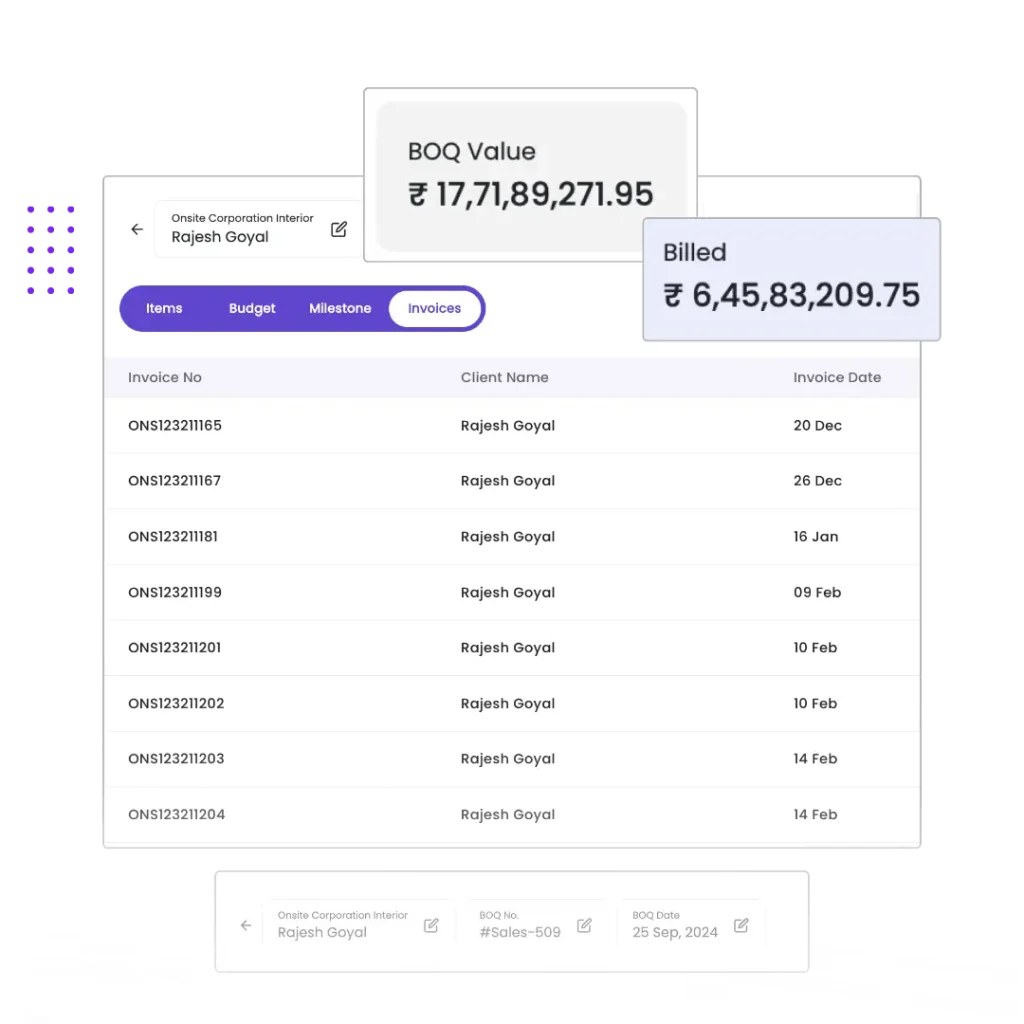
Most construction invoice disputes start before the invoice is sent. When billing is assembled manually from measurement books, WhatsApp progress updates, and BOQ spreadsheets that may not reflect the latest revision, the bill the client receives does not match what the site recorded. Onsite client invoicing software for construction generates RA bills directly from verified executed quantities, links every invoice to the BOQ line items it claims, and tracks collections across all active projects in real time.

RA bills generated directly from verified BOQ-linked progress data, not manual estimates
Every invoice line item traceable to the BOQ quantity and executed progress it claims
Client collection status tracked in real time across all active projects from one dashboard
Trusted by 10,000+ Construction Companies Worldwide
Construction teams plan activities, track progress, and stay ahead of delays with Onsite construction planning software.

Built for Construction Companies Where Billing Disputes and Collection Delays Drain Project Cash Flow
Onsite client invoicing software for construction is designed for finance teams, project managers, and company owners managing multiple concurrent projects where billing accuracy, collection visibility, and invoice traceability directly determine whether the business has the working capital to keep sites running.
01
Contractors and Developers
Contractors and developers managing multiple concurrent projects need client invoices that can withstand scrutiny from the client’s quantity surveyor or engineer without revision cycles that delay certification and push payment further out. Onsite gives contractors BOQ-linked invoice generation from verified executed quantities with full supporting measurement records attached, so every bill submitted reflects what site data confirms was completed rather than what the billing team estimated from a phone call with the project manager.
02
Interior and Fit-Out Firms
Interior and fit-out firms billing residential and commercial clients face disputes more frequently than any other construction segment because the client is directly involved in the project and has a strong view of what has and has not been completed before the invoice arrives. Onsite gives interior firms milestone-based and progress-linked invoicing with photographic evidence and completion records attached so client billing conversations are based on documented completion rather than contractor assertion about what was done and when.
03
Infra and EPC Companies
Infrastructure and EPC companies submitting RA bills to government clients, developers, and institutional clients under formal contracts require invoices that are precise to the measurement, reference the correct BOQ item numbers, and carry the correct rate from the agreed schedule of rates. Onsite gives infra and EPC companies BOQ-driven RA bill generation with measurement records linked to specific BOQ line items, reducing the certification cycles that formal client billing processes impose when bills are submitted with measurement discrepancies or incorrect rate references.
04
PMC & Project Management Consultants
PMC teams certifying client invoices on behalf of developers and owners need billing submissions from main contractors that are traceable to verified site measurement records rather than to contractor-stated completion percentages that cannot be independently verified. Onsite gives PMC teams visibility into the progress records and BOQ-linked measurement data that contractor invoices are generated from, making certification reviews faster and more reliable when both the contractor and PMC are working from the same verified site data source.
From BOQ to Collected Payment: How Onsite Client Invoicing Software for Construction Works?
Onsite connects BOQ-linked activity scheduling, daily progress recording, RA bill generation from verified executed quantities, internal invoice approval, client dispatch, and collection tracking in one continuous workflow so every stage of the billing cycle is connected and traceable from the same platform.
BOQ-Linked RA Bill Generation from Verified Progress
Client invoices in Onsite are generated directly from the BOQ line items linked to the project and the executed quantities recorded against those items through daily progress tracking. The billing team does not assemble an invoice from measurement books, a WhatsApp conversation with the site engineer, and a BOQ spreadsheet maintained separately, they select the billing period, review the executed quantities recorded in the system during that period, and generate the invoice from verified data. Every line item in the invoice traces directly to the BOQ item it claims and the executed quantity that supports the claim.
Progress-Linked Billing with Measurement Evidence
Onsite links every client invoice to the daily progress records and site measurement data captured during the billing period, so the supporting evidence for the invoice exists in the same system as the invoice itself. When a client’s engineer or quantity surveyor questions a specific line item, the contractor can reference the progress entry, the DPR, the geo-tagged photograph, and the measurement record from within the platform rather than searching physical measurement books or requesting site teams to reconstruct records from memory. This evidence trail is what separates invoices that pass certification on first submission from invoices that are returned for revision.
Internal Invoice Approval Before Client Dispatch
Before any client invoice is dispatched from Onsite, it passes through an internal review and approval workflow configured for the project. Project managers review the executed quantities and billing amounts against the BOQ before the invoice reaches the client. Finance teams verify rate references and tax components. Company owners approve invoices above defined value thresholds. This internal review catches the errors that cause client invoice rejections, incorrect quantities, wrong rate references, missing variation approvals, incomplete tax entries, before the client sees them rather than after the invoice has been returned for correction.
Collection Tracking and Receivables Dashboard
Every client invoice dispatched from Onsite creates a receivable in the collection tracking dashboard showing the invoice amount, the dispatch date, the expected payment date based on contract terms, and the current payment status. The dashboard shows current outstanding receivables across all active projects simultaneously, which invoices are pending certification, which are certified and awaiting payment, which have passed their due date without payment, and which have been partially paid. Finance teams manage client follow-up from a current view of every outstanding invoice rather than compiling the position from separate project billing records at month end.
Why Construction Client Billing Creates Disputes That Delay Payment on Every Project?
Most construction billing disputes are not caused by clients who refuse to pay for legitimate work. They are caused by invoices that cannot be defended with evidence at the time the client questions them because the evidence was never connected to the invoice in the first place.
Invoices Assembled Manually from Disconnected Sources
Construction billing teams assemble client invoices by pulling executed quantities from site measurement books, cross-referencing against a BOQ spreadsheet that may be a version behind the current approved revision, and manually calculating amounts from progress updates gathered through phone calls. Every step introduces an error opportunity, a quantity from the wrong BOQ revision, a progress percentage based on what the project manager said rather than what site recorded, a rate that does not match the agreed schedule. These errors cause invoice rejections that restart the payment clock from zero.
Billing Claims That Cannot Be Supported with Evidence
A client’s engineer who questions a specific RA bill line item is asking one question: what was done to justify this amount and where is the evidence? A billing team working from manual measurement books, WhatsApp photos, and Excel BOQ spreadsheets cannot answer quickly. The measurement book is at site. The WhatsApp photos are in a group mixing multiple projects. The BOQ may not reflect the latest revision. The invoice gets questioned, evidence takes days to assemble, and the certification cycle extends by weeks before payment restarts.
No Visibility Into Which Invoices Are Paid and Which Are Overdue
Construction companies managing multiple concurrent projects with active billing across all of them cannot maintain an accurate receivables position through Excel sheets and email tracking. Getting the current collection status across all projects requires opening multiple billing files, checking which invoices have been dispatched and certified, identifying which have passed their due date without payment, and compiling a position that is already outdated by review time. Manual receivables management produces collection delays because overdue invoices are not flagged until someone specifically looks for them rather than surfacing automatically when the due date passes.
Variation Billing Mixed Into Main Contract RA Bills
Variation costs included in main contract RA bills create certification delays because a client disputing a specific variation item can hold the entire bill pending resolution. The undisputed main contract work, representing the majority of the bill, waits while contractor and client negotiate an amount that may be five percent of the total invoice. Separating variation billing from main contract billing allows undisputed work to proceed through certification and payment while variation amounts are resolved independently without holding up the main contract cash flow cycle.
Why Excel and WhatsApp Cannot Handle Construction Client Invoicing?
Excel holds data. WhatsApp carries messages. Neither connects the executed quantities recorded on site to the client invoice that claims payment for them automatically and that connection is what makes a construction invoice defensible when a client questions it.
Excel BOQ spreadsheets maintained separately from site progress records cannot generate invoices automatically from verified executed quantities billing requires manual cross-referencing between two documents that are frequently out of sync with each other and with the current approved BOQ revision
WhatsApp progress updates used as the source for billing quantities have no connection to BOQ line items and cannot produce a line-item invoice that a client’s quantity surveyor can verify against measurement records without a separate manual exercise
Excel receivables tracking cannot flag overdue invoices automatically identifying which bills are past due requires someone to open the file, review dates, and compare against a payment record that may itself be maintained in a different spreadsheet by a different person
Variation invoices mixed into main contract billing in Excel cannot be separated easily when a client disputes a variation item without holding up payment for the undisputed main contract work that is combined with it in the same bill
Core Features of Onsite Client Invoicing Software for Construction
Control BOQ-linked invoice generation, progress-based billing, internal approval workflows, client collection tracking, and receivables management across every active project from one connected platform.
RA Bill #7 — Orchid Towers
Client: Bhavya Developers · BOQ Rev. 3
Mar 1–31 2026
BOQ Item
Description
Exec. Qty
Amount
BOQ-S-04
RCC columns M25
142 m³
₹10.4L
BOQ-S-07
Slab concrete
96 m³
₹7.2L
BOQ-F-02
Brickwork 230mm
840 sqm
₹5.9L
BOQ-F-06
Plastering internal
620 sqm
₹2.8L
RA Bill #7 Total
₹26.3L
✓ Generated from site data
4 BOQ items · Verified
4
BOQ items billed
100%
Qty verified
Auto
No manual entry
BOQ-Linked RA Bill Generation with Progress Verification
Client invoices in Onsite generate directly from BOQ line items linked to the project and the executed quantities recorded against those items through daily site progress tracking. The billing team selects the billing period, reviews the executed quantities confirmed in the system during that period against the BOQ, and generates the invoice from verified data without manual assembly from disconnected measurement books and spreadsheets. Every invoice line item references the specific BOQ item and the verified executed quantity it claims, making the invoice immediately defensible when a client’s engineer or quantity surveyor reviews it for certification.
RA bills generated directly from BOQ line items and verified executed quantities
Every line item referencing specific BOQ item and supporting measurement record
Billing period selectable with executed quantities for that period pre-populated automatically
Internal Invoice Approval Workflow Before Client Dispatch
Every client invoice in Onsite passes through a configured internal review and approval workflow before being dispatched to the client. Project managers verify executed quantities and billing amounts. Finance teams check rate references, tax components, and retention deduction calculations. Company owners approve invoices above defined value thresholds. This internal review catches the errors that cause client invoice rejections incorrect quantities, wrong rate references, missing variation approvals, and incomplete tax entries before the invoice reaches the client rather than after it has been returned requiring correction that restarts the certification and payment timeline from the beginning.
Invoice Approval Workflow
Internal review before client dispatch · Role-configured
In review
3 cleared today
RA Bill #7 — Orchid Towers
Bhavya Developers · Mar 2026 · 4 BOQ items
₹26.3L
Finance review
Approval Stages
VK
Vikram K. — Project Manager
Verified qty · Checked BOQ linkage
Approved ✓
AD
Anita D. — Finance
Rates · Tax · Retention check
Reviewing
RK
R. Kumar — Owner
Final approval · Bills >₹10L
Awaiting
Caught Internally Before client dispatch
Rate mismatch — delivery charges not in PO
₹6,800 charged · PO rate ₹4,200 · flagged
Rate
Tax entry incomplete — CGST missing on BOQ-F-06
GST 18% · CGST not split correctly
Tax
3
Cleared today
2
Errors caught
0
Client rejections
Total O/S
₹1.7Cr
All projects
Pending cert.
₹82L
4 invoices
Cert. unpaid
₹74L
3 invoices
Overdue
₹12L
1 invoice
Pending
Cert.
Cert.
4
₹82L total
Orchid Towers — RA#7
Dispatched Mar 31
₹26.3L
At client QS
NH-48 Highway — RA#4
Dispatched Mar 28
₹18.1L
Pending
Cert.
Unpaid
Unpaid
3
₹74L total
Orchid Towers — RA#6
Due Apr 14
₹38.4L
Certified
Villa Interiors — RA#3
Due Apr 8
₹14.2L
Certified
Over
due
due
1
₹12L total
Villa Interiors — RA#2
Due Mar 15 · 19 days past
₹12L
Overdue
₹1.7Cr
Total receivable
₹74L
Certified · due
1
Auto-flagged overdue
Collection Tracking and Receivables Management Across All Projects
Every client invoice dispatched from Onsite creates a tracked receivable showing invoice amount, dispatch date, expected payment date, certification status, and payment receipt status. The collection dashboard shows outstanding receivables across all active projects simultaneously, invoices pending certification, certified invoices awaiting payment, and invoices that have passed their contractual due date without receipt. Finance teams manage client follow-up from this current consolidated view rather than compiling the collection position from separate project billing files at month end. Overdue invoices surface automatically when the due date passes rather than when someone remembers to check.
Every dispatched invoice tracked with certification and payment status in real time
Outstanding receivables across all projects visible from one consolidated dashboard
Overdue invoices flagged automatically when contractual payment due date passes
How Onsite Simplifies Construction Client Invoicing for Finance Teams and Project Managers?
Most construction billing problems originate from the gap between where site progress is recorded, where BOQ quantities are maintained, and where invoices are assembled. Onsite closes this gap by connecting all three in one workflow so invoices generate from verified data rather than from a manual assembly exercise.
01
Progress Recorded Daily Against BOQ Line Items
Site engineers update executed quantities against specific BOQ-linked activities through the Onsite mobile app every day as work progresses. These progress entries are the source data for client invoicing. When the billing team prepares an RA bill, the executed quantities for every BOQ line item during the billing period are already in the system from verified daily entries. There is no measurement book to locate at site, no phone call to make to the project manager for a progress estimate, and no BOQ spreadsheet version to cross-reference because all three exist as connected data in one platform.
02
Invoice Generated from Verified Data in Minutes
The billing team selects the billing period, reviews the executed quantities recorded in the system against the BOQ line items for that period, and generates the RA bill from the verified data. The invoice pulls the agreed BOQ rate for each line item automatically, calculates the billing amount, applies retention deduction per contract terms, and produces a structured invoice document with all line items referenced to their specific BOQ items. What previously took a billing engineer half a day of manual assembly from disconnected records takes minutes from verified connected data.
03
Internal Review Catches Errors Before the Client Sees Them
The generated invoice routes through the configured internal approval workflow before dispatch. Project managers verify that executed quantities match their understanding of site progress. Finance teams confirm rate references and tax components. Company owners review and approve. Any discrepancy identified during internal review is corrected before the invoice leaves the system. The client receives a complete, accurate invoice on first submission rather than a bill that returns for correction because someone in the internal chain had a different understanding of what was billed and why.
04
Collection Status Tracked Without Manual Compilation
Once dispatched, the invoice creates a receivable in the collection dashboard that updates automatically as the invoice moves through certification and payment. Finance teams see the current status of every outstanding invoice across all active projects without opening individual project billing files or calling clients for payment status updates. When an invoice passes its contractual payment due date without receipt, it flags automatically so the collections follow-up happens at the right time rather than when someone notices the bank account has not received the expected inflow.
What Construction Companies Say About Onsite Construction Project Planning Software?
Construction companies across India and the Middle East use Onsite to replace disconnected planning tools with a live construction schedule that site teams actually update.
We were looking for construction management software that could help us share clear project updates with clients. With Onsite, all the progress and cost details are visible in one place. It has made client discussions much smoother because we are now talking with actual site data instead of guesses.
Mr. Anvesh, Founder
Bhavya Developers, Building Construction Company, India
Additional Features That Strengthen Construction Client Invoicing
Beyond core BOQ-linked invoice generation and collection tracking, Onsite provides a full set of billing support tools connecting client invoicing to project progress, retention management, financial reporting, and accounting integration.
Retention Tracking & Release Management
Retention deductions apply automatically per contract terms on every RA bill with full visibility into accumulated retention balance, release milestones, and amounts due for release at project completion. Retention release tracked per project and per client without manual calculation or separate spreadsheet maintenance.
Variation Invoice Management
Raise variation invoices separately from main contract RA bills against approved change orders so disputed variation amounts do not hold up certification of undisputed main contract work. Every variation invoice references its specific change order approval document for immediate client verification.
Professional PDF Invoice Generation
Generate structured PDF invoices with company branding, project details, BOQ line item references, measurement summaries, retention deductions, and tax components in a consistent professional format that can be shared instantly via email or WhatsApp directly from the platform.
Tally and Zoho Books Integration
Approved client invoices sync automatically to Tally or Zoho Books without manual re-entry, maintaining consistency between the construction project management system and the company’s accounting software. Client payment receipts recorded in the accounting system update the receivables position in Onsite automatically.
Multi-Project Billing Dashboard
View billing status, collection position, and outstanding receivables across all active projects simultaneously from one consolidated dashboard. Finance teams identify which projects have invoices pending certification, which have overdue collections, and which are billing ahead of or behind project schedule without compiling individual project reports.
GST and Tax Component Management
Record GST amounts, tax components, and applicable deductions on every client invoice with automatic tax calculation from agreed BOQ rates. Tax amounts tracked across the project billing cycle for accurate GST return filing without manual reconciliation of invoice tax components at quarter end.
4 Tips to Manage Construction Client Invoicing More Efficiently
The invoicing system works only if the data feeding it is accurate and current. These four practices determine whether BOQ-linked invoicing eliminates billing disputes or simply produces faster versions of the same errors.
Record Executed Quantities Daily Not at Billing Time
The accuracy of a BOQ-linked invoice depends entirely on the accuracy of the executed quantity data feeding it. Site engineers who update progress daily against specific BOQ line items provide current verified data at billing time. Site engineers who update at month end when the billing team asks provide estimates reflecting recollection rather than verified records. The difference between daily recording and month-end estimation is the difference between an invoice that passes certification on first submission and one that returns with quantity discrepancies requiring site verification before the payment clock can restart.
Conduct Internal Invoice Review Before Every Dispatch
An invoice returned by the client for correction is not just an error — it is a delay of days to weeks before the payment clock restarts. Every billing team should have someone other than the invoice preparer check the executed quantities, rate references, retention calculation, tax components, and variation references before the invoice reaches the client. This review takes thirty to sixty minutes on a typical RA bill. The certification cycle failure it prevents takes weeks to restart. Internal review before dispatch is the most consistently valuable cash flow management practice available to any construction billing team.
Bill Variations Separately from Main Contract Work on Every Project
Establish a firm billing rule across all active projects that variation costs always appear on separate invoices under their specific change order references rather than bundled into the main contract RA bill. Apply this even on small variations where the amount seems too minor to justify a separate document. A disputed variation item in a bundled RA bill gives the client grounds to hold the entire invoice regardless of how small the disputed amount is relative to the total. Separate variation billing means main contract cash flow continues regardless of how long variation negotiations take.
Follow Up on Overdue Invoices Within Three Days of the Due Date
Most construction companies follow up on overdue invoices when cash flow pressure becomes uncomfortable, typically two to four weeks after the due date. By then the client has normalized the delay and the contractor’s leverage has reduced. A three-day follow-up rule from the contractual payment due date changes the collection dynamic. A contractor who contacts the client within three days of a missed payment date is acting on a contractual right while the window for timely action is still open. A contractor who contacts four weeks later is chasing a payment the client has already mentally deferred to their next payment cycle.

Stop Losing Cash Flow to Invoice Disputes and Collection Delays. Start Billing with Onsite.
Every construction invoice returned for correction and every collection that runs weeks past its due date represents a cash flow gap that billing discipline and real-time collection visibility can close. Onsite client invoicing software for construction generates BOQ-linked invoices from verified site progress, routes them through internal approval before dispatch, and tracks every collection in real time so your billing team spends time collecting rather than correcting.
FAQs
What is Onsite client invoicing software for construction?
Onsite client invoicing software for construction gives contractors, developers, infra companies, and interior firms a structured digital system for generating BOQ-linked RA bills from verified executed quantities, routing invoices through internal approval before client dispatch, tracking certification and payment status in real time, and managing collections across all active projects from one consolidated dashboard. Every invoice generated through Onsite is traceable to the specific BOQ line items and executed quantities it claims, making it immediately defensible when a client’s engineer or quantity surveyor reviews it for certification.
How does Onsite generate BOQ-linked client invoices?
Onsite connects the BOQ line items linked to each project with the executed quantities recorded against those items through daily site progress tracking. When the billing team prepares an RA bill for a specific period, the executed quantities for every BOQ line item during that period are already in the system from verified daily progress entries. The invoice is generated by selecting the billing period and reviewing the verified executed quantities — no manual cross-referencing of measurement books, BOQ spreadsheets, and WhatsApp progress updates required. The system pulls agreed BOQ rates automatically and calculates billing amounts with retention applied per contract terms.
How does Onsite prevent construction invoice disputes?
Onsite prevents invoice disputes by ensuring every line item in a client invoice is traceable to the specific BOQ item it claims and the verified executed quantity that supports the amount. When a client’s engineer questions a specific billing line, the contractor can reference the progress entry, the DPR, the geo-tagged photograph, and the measurement record from within the platform rather than searching physical site records. Invoices backed by connected evidence that the client’s team can trace to verified site activity pass certification faster and generate fewer disputes than invoices assembled manually from disconnected sources with no immediately retrievable supporting documentation.
Does Onsite support milestone-based billing for interior and fit-out projects?
Yes. Onsite supports both BOQ quantity-based billing and milestone-based billing so interior and fit-out firms can raise invoices against defined project milestones rather than measured quantities. Milestone completion is recorded in the project plan when site verification confirms the milestone has been achieved, creating a documented completion trigger for the corresponding invoice. Clients receive a milestone-based invoice with the completion record attached rather than a bill that requires them to accept the contractor’s assertion that the milestone is complete. This documentation-backed milestone billing significantly reduces the disputes that delay payment on interior and fit-out projects.
How does Onsite track client collections and outstanding receivables?
Every client invoice dispatched from Onsite creates a tracked receivable in the collection dashboard showing invoice amount, dispatch date, expected payment date based on contract terms, certification status, and payment receipt status. The dashboard shows outstanding receivables across all active projects simultaneously so finance teams see which invoices are pending certification, which are certified and awaiting payment, and which have passed their contractual due date without receipt. Overdue invoices flag automatically when the due date passes so collection follow-up happens at the right time rather than when someone notices the bank account position is lower than expected.
Does Onsite support retention tracking on client invoices?
Yes. Retention deductions apply automatically on every RA bill based on the contract retention percentage, with full visibility into accumulated retention balance per project and per client. The retention tracking dashboard shows total retention held, milestones that trigger release under each contract, and amounts due for release when those milestones are certified. When a project reaches the contractual retention release trigger, the system shows the balance due so the contractor raises the retention release invoice at the correct point without missing the milestone or waiting for the client to initiate the release process.
Can Onsite handle variation invoicing separately from main contract bills?
Yes. Onsite supports separate variation invoicing under specific change order references independent from the main contract RA billing cycle. Variation costs entered against approved change orders generate standalone invoices that reference the specific change order approval document the client signed. This separation means a client who disputes a specific variation item cannot hold up the main contract RA bill that is being processed through the same billing cycle. The undisputed main contract work continues through certification and payment while the variation amount is resolved independently, protecting the main contract cash flow from variation disputes.
Does Onsite integrate with Tally and Zoho Books for client invoicing?
es. Onsite integrates natively with Tally and Zoho Books so approved client invoices sync automatically to the company’s accounting software without manual re-entry. Invoice amounts, tax components, retention deductions, and client details transfer to the accounting system as invoices are approved and dispatched, maintaining consistency between project-level billing data and the company’s financial accounts. Client payment receipts recorded in the accounting system update the receivable status in Onsite automatically so the collection dashboard always reflects current payment status without requiring manual updates from the finance team after each payment is received.
Is Onsite client invoicing software suitable for infrastructure and government projects?
Yes. Infrastructure and EPC companies billing government clients and institutional developers under formal contracts with strict measurement, certification, and payment procedures benefit significantly from Onsite’s BOQ-linked invoice generation with verified measurement evidence. Government client billing requires invoices precise to the measurement record, referenced to specific BOQ item numbers and schedule of rates, and supported by documentation that the client’s measurement team can independently verify. Onsite’s invoice generation from daily progress records linked to specific BOQ items meets this requirement and reduces the revision cycles that informal billing processes generate on formal government construction contracts.
How quickly can a construction company start using Onsite client invoicing software?
Onsite is designed for rapid deployment without extended implementation timelines. Companies already using Onsite for project management have client invoicing active immediately as the BOQ data and progress records needed to generate invoices already exist in the platform. Companies implementing Onsite specifically for client invoicing configure project BOQs, contract terms, retention percentages, and approval workflows within days of account setup. Most construction companies generate their first BOQ-linked client invoice within one to two weeks of beginning implementation regardless of the complexity of their current billing process or the number of active projects being managed.