
Benefits of Construction Management Software for Contractors & Business Owners
Discover the power of construction management software that helps contractors manage projects, teams, and costs from one platform.
Construction project management has become a necessity in the world of people who are construction business owners, contractors, builders, or project managers. Construction Management Software not only works as a help, but it is a game changer for anyone who is in the construction industry. It’s about bringing every aspect of a project like planning, workforce, materials, finances, and reporting, under one system. Many teams now turn to construction project management software to reduce errors and build trust between jobsite and office. Before you choose, you need to know the benefits of Construction Management Software. Let’s dig into it.
Why Traditional Construction Tools Break Down?
Most construction companies start off with basic tools. A spreadsheet to keep track of numbers, a notebook to write down what you do every day, WhatsApp to keep everyone on the same page, and accounting software to send bills. This configuration usually works for one or two minor projects.
The strain starts when operations grow. There are many sites running at once. Workers migrate from one project to another. Use of materials goes up. Billing happens more often and is harder to understand.
At that point, teams spend more time making sure information is correct than doing their jobs. Updates on progress come after the fact. Cost overruns show up late. Instead than acting on early warnings, business owners have to listen to explanations.
Construction management software comes in to replace these separate tools with one organized system. As work is done, data flows, maintaining expenses, execution, and billing in sync while the project is still going on.
Core Challenges Construction Teams Face Without Construction Management Software
Fragmented Execution Data
Construction sites often have fragmented data. Meanwhile, site teams are recording progress, labor, and material. Finance team is recording costs, whereas planning teams are keeping hold on schedules. All of these are happening in different places, different sections, and there is no link between them. There is no communication between them, which leads to teams spending time reconciling than managing things.
Poor Visibility into Real Progress
When daily statements are ambiguous, like “work ongoing,” there is no way to compare the plan to a clear benchmark. Without measuring progress, real differences stay hidden until it’s too late to do something about them.
Lack of Accountability
It is hard to hold anyone accountable when there is no proper workflow. You wouldn’t know who approved what, when was the change, who did not share the design. These questions became unanswerable or undetectable when you don’t have a clear vision on project management. You cannot have visibility and ask for accountability without a proper data.
Billing Disputes and Delays
When you’re not getting everyday updates and you are getting monthly reports, it basically means it’s totally based on assumptions or the records that have been recorded a month ago, which is already outdated. In these kinds of situations, there are some common challenges you can face, for example, dispute with clients or slower payment and cash flow stress.
What Construction Management Software Actually Does?
The best systems do more than just keep track of tasks. They give structure to how work gets done. Every important activity, such giving an update on progress, giving approval, reporting a resource issue, or entering a cost, is linked to a genuine project event with clear context and a way to track it.
On a practical level, construction software lets teams observe what is happening in real time, so they can see what is happening as it happens. Instead of coordinating tasks and resources on the go, they follow set procedures. Alerts are sent out when there are differences, so you can still act. Costs are still tied to the work done, not posted later. Instead of making assumptions, billing and reporting are based on confirmed execution.
Each of these parts adds real value. Contractors get more control and predictability. Owners feel more sure that the expenses and progress are accurate on site.
Benefits of Construction Management Software
1. Stronger Project Planning and Scheduling
Planning and scheduling in the construction projects are some of the topmost priority to be taken care of. To make a project successful, it needs to be perfectly planned and scheduled so that it can be completed just like it was expected. With better planning and scheduling, you can create a project timeline, prepare for challenges, avoid bottlenecks and keep teams aligned. These are some of the crucial factors that are needed to be considered closely. With construction project software, you can lay out tasks, timelines, and dependencies so your team always knows next steps. Dedicated construction project management tools also help you track progress against milestones and adjust work in real time.
2. Improved Communication Across Teams
There are many people involved in construction projects, such as contractors, architects, engineers, suppliers, and clients. Keeping all of them updated, providing tasks, deadlines, showing budget and expenses, every small step becomes a lot and communication can be chaotic. Often WhatsApp texts can be lost in groups and updates which can cause a big trouble which is why a centralized communication system is necessary. A CMS helps you avoid miscommunication and helps you avoid any mistake that can lead to huge loss. Mobile access through a construction project management app lets supervisors update work status without delays.
3. Real-Time Tracking of Progress
Software like Onsite construction management software provides a mobile version for easy accessibility. A laptop cannot be taken along everywhere, but a mobile is always in a person’s hand. You can check real time progress anywhere with mobile. This also allows field teams to update progress, report issues, and access project information directly from the job site. Real-time dashboards and alerts from construction project tracking software help you spot deviations early and intervene before small problems grow.
4. Better Cost and Budget Management
It becomes important to keep a project on budget as money is one of the biggest factors in the process of construction. One of the best benefits of construction management software is that it helps you with finance management. In this you will get features like cost estimation, budgeting, and expense tracking. With the software you can monitor actual cost and save a lot of money. It also provides financial transparency by simplifying invoice management, payroll, and accounts payable/receivable functions.
5. Document Management
Construction Management Software stores all the documents within the application. A construction project contains a vast amount of paperwork, from contracts to bills. Misplacement of any document can lead to a lot of trouble which is why digitization of documents becomes necessary. With software like Onsite construction management software, you can store every single document within the app without any fear of misplacement. This organized approach ensures that essential documents are never lost and are always accessible to the right people at the right time.
6. Labor Management
Labour management is a critical component of construction site management software. It ensures that your construction projects have the right people with the right skills in the right place. With good software, you can track, manage and pay labor effortlessly. Some of the important components this feature should have are: tracking of salary & attendance, tracking labor shift, tracking labor expense, generation of PDF Reports, and Automated Salary Calculation.
7. Material Management
To be sure that materials are procured, tracked and utilized efficiently, it is necessary that there is good material management. You can manage materials profoundly with good construction management software. Some of the important components this feature should have are tracking & generating POs, tracking inventory, party-wise report, approving material request, managing warehouse, and keeping track of used & current stock.
8. Task Management
Task Management is one of the most crucial features that should be in a construction site management software so that it can bring productivity on construction sites. This feature helps with tracking and assigning all the tasks that are taking place at a site. With the help of tracking task and task management features you can monitor delays and productivity which will help you take future decisions for proper utilization of resources and time.
Business Owner Benefits (Strategic Value)
Better Margin Protection
Owners benefit the most when there are no cost surprises waiting for them by the end of the month or end of the project. When construction owners start getting updates every day, they can identify cost gaps immediately, which can save them from greater loss. Real-time cost and progress visibility helps owners save up to 7 to 8% of their construction project cost.
Portfolio-Level Visibility
A widely integrated construction management software helps owners see the data of multiple projects in a single dashboard. It helps them compare different projects.
Easier Scaling of Operations
Standard procedures make it easier to add new teams, handle more projects, and keep things consistent as the business grows.
Better Risk Management
A systematic software makes it easier to trace records and execution data. It readies you or saves you from any kind of risk like leakage of cash, audit claims, etc.
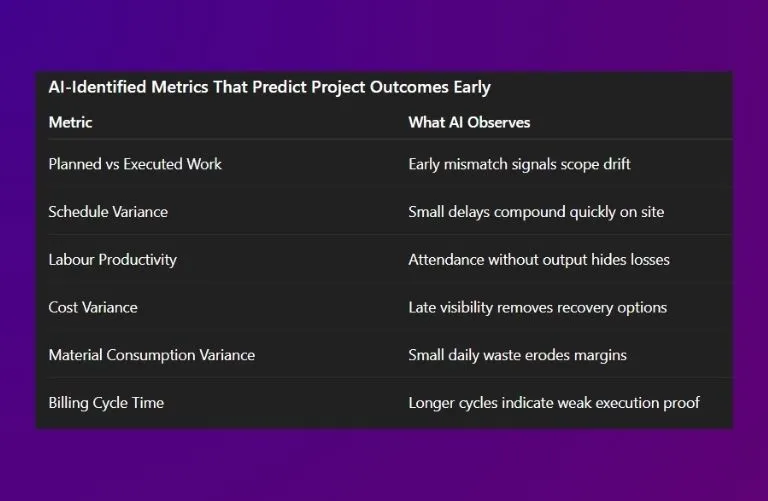
What AI Flags as the Most Impactful Construction Metrics?
We asked AI to analyze common execution pattern across contractor-led projects, and this is the metrics that GPT has provided.
Manual Methods vs Structured Software
| Area | Manual / Disconnected | Construction Software |
|---|---|---|
| Progress tracking | Descriptive updates | Quantity-based |
| Cost visibility | Month-end | Ongoing |
| Labour tracking | Attendance only | Attendance + output |
| Material control | Reactive | Consumption-linked |
| Billing | Estimate-based | Execution-backed |
| Decision timing | Late | Early |
Conclusion
If you are someone looking for construction management software, then Onsite is just made for you. Construction Management Software has become essential for contractors aiming to streamline planning, labor, materials, and task management. It fosters seamless collaboration, ensures better cost control, and boosts overall project efficiency, leading to smoother operations and improved profitability. Investing in construction management software helps contractors and business owners alike gain visibility, control, and predictability across every project.
Want to know about Construction P&L Software to Protect Your Margins?
FAQs
What is construction management software?
Construction management software is a tool that helps contractors plan, track, and manage projects with greater visibility, efficiency, and team alignment.
How does construction project management software support contractors?
Construction project management software helps teams organize tasks, schedules, and resources in one system, making it easier to deliver projects on time and within budget.
Why should construction companies invest in construction company software?
Construction company software provides a centralized platform where business owners can see project status, team performance, and financial data without relying on disparate tools.
What role does a construction management system play in daily operations?
A construction management system ties together planning, execution, tracking, and reporting so managers can make informed decisions quickly and reduce risk across sites.
How do construction project management tools improve execution?
Construction project management tools give visibility into task progress, dependencies, and outcomes, helping teams respond to issues before they become major delays.
Can benefits of Construction Management Software apply to small contractors?
Yes, construction business software can deliver scalable capabilities to small contractors, enabling better project control without significant complexity.
What are the benefits of Construction Management Software over standalone tools?
Construction management platforms combine features like planning, tracking, and communication in one place, reducing the need for multiple separate applications.
How does construction project tracking software help business owners?
Construction project tracking software provides real-time insights into project progress, allowing business owners to monitor milestones and adjust resources as needed.
What is construction job management software used for?
Construction job management software helps site supervisors assign, monitor, and complete field tasks more efficiently, improving accountability and execution speed.
Is there mobile support through a construction project management app?
Yes. A construction project management app lets teams update tasks, capture progress, and access project information from anywhere, enhancing field-to-office coordination.
