
The Execution Challenges Modern Construction Faces
“Discover the power of all in one construction software that unifies planning, execution, and control.”
Construction project management has become a necessity in the world of people who are construction business owners, contractors, builders, or project managers. An all-in-one construction software not only works as a help, but it is a game changer for anyone who is in the construction industry. It’s about bringing every aspect of a project like planning, workforce, materials, finances, and reporting, under one system. Leading firms are adopting construction ERP software to centralize data, streamline decision-making, and reduce project complexity. This shift toward erp for construction companies reflects the need to unify teams, costs, and timelines.
Why Construction Projects Struggle with Fragmented Systems?
A construction project failing because of lack of experience is rarely the case. The real cause behind a construction project failure is incomplete or delayed information. Many projects or companies still use traditional ways of handling projects, like making BOQs on spreadsheets or using WhatsApp or messaging apps for updates, sharing drawings or folders or images on emails, and using a separate system for accounting and billing. It is for sure that every tool has its own qualities and advantages, but this also creates a scattered information about a single project. It becomes much easier to handle projects, if everything is at one place. Most standalone tools lack the cohesion of a true ERP platform, leaving teams to stitch together data manually.
What “All-in-One” Means in Practical Terms?
An all-in-one system in building is not defined by how many functionalities it has. It is determined by the presence of a single operational layer linking planning, execution, review, and payment.
This means that site progress updates are immediately compared to projected amounts. Decisions about buying things keep in line with what is actually happening. Labor records show more than simply attendance; they also show output. You can still find approvals, papers, and changes. Billing is based on real effort, not projections.
When these relationships are in place, teams stop spending time making sure the figures are right and start spending more time running the project. An all-in-one construction software solution combines cost control, scheduling, and procurement into one trusted system.
Where Traditional Project Tools Fall Short?
Progress That Arrives Too Late
In traditional methods, there is no doubt that daily work is being recorded on-site. But the problem arises when that data is reaching weeks later or days later. By the time the information reaches, Labor has spent their time outside and material has been consumed. Late information forces reactive decisions.
Planning That Does Not Adjust with Reality
Everything works smoothly as long as you are planning, but as soon as the execution starts, the plan disrupts. Changes occur time to time, and they are not always supportive of the schedule, costs, and procurement plans in the project. Execution does not align with planning because these are not linked with each other.
Costs Tracked After They Occur
The traditional methods many team analyze cost by the end of the month. By the time the cost analysis is being performed, the correcting overruns is either expensive or impossible, which is why it is necessary to have a clear visibility while the work is still going on at site. Immediate updates ask for immediate actions.
Billing Built on Reconstruction
You know, when billing becomes a stress in reconstruction, when the execution data is all over the place, a scattered data invites clashes, delays in approvals, and disrupts the cash flow.
Why All-in-One Construction Software Matters for Contractors and Builders?
- Localized Design: Multi-language features and offline access make it suitable for the UAE’s diverse workforce.
- End-to-End Solution: Instead of managing multiple tools, contractors can handle materials, labor, and billing in one place.
- Mobile-First: Built for on-site use, not limited to office-based planning.
- Efficiency Boost: Helps save time, reduce errors, and maintain clear visibility across projects.
Benefits of Using Construction Management Software (CMS)
Read the following points to know the benefits of using construction management software (cms)
(a) Centralized Project Information
Onsite Construction Management Software acts as a centralized hub for all project-related information. It consolidates data on project timelines, tasks, budgets, and resources, ensuring that everyone involved in the project has real-time access to the latest updates.
(b) Improved Communication
Enhanced communication is a cornerstone of successful construction projects. Onsite CMS facilitates seamless communication among team members, subcontractors, and stakeholders through features like instant messaging, file sharing, and collaborative tools. This helps in preventing misunderstandings and delays.
(c) Project Planning & Scheduling
Onsite Construction Management Software allows for efficient project planning and scheduling. Users can create detailed project plans, set milestones, allocate resources, and establish realistic timelines. This ensures that all aspects of the project are meticulously planned for optimal efficiency.
(d) Budgeting & Cost Control
Managing finances is a critical aspect of construction projects. Onsite CMS provides robust budgeting tools that enable construction business owners to create accurate estimates, track expenses, and control costs effectively. This helps in avoiding budget overruns and ensures financial stability throughout the project lifecycle.
Key Features of All-in-One Construction Software (Onsite)
Project Planning & Scheduling
Planning and scheduling in the construction projects are some of the topmost priority to be taken care of. To make a project successful, it needs to be perfectly planned and scheduled so that it can be completed just like it was expected. With better planning and scheduling, you can create a project timeline, prepare for challenges, avoid bottlenecks and keep teams aligned. These are some of the crucial factors that are needed to be considered closely.
Budgeting & Cost Control
It is the most common problem in every construction project that the cost goes up by the end of the project. But with the help of software like Onsite you can save up to 5-7 % of your total budget cost. You can also track costs and get help in identifying areas where you could save costs. A modern construction ERP should include budgeting, field data capture, and automated reporting without customization headaches.
Inventory Management
If you are having trouble in inventory management and often face problems like PO generation, bill generation, poor planning, material wastage, material tracking, etc then you can switch from traditional ways to digitize ways. With All-in-One Construction Software, you can keep track of your inventory and manage them efficiently. If you are looking for such tools, then Onsite is one of the best tools out there that can make your inventory management efficient.
Workforce & Site Management
Know who is on site, what they are doing, and how well they are doing it. Supervisors can keep workers working smoothly and effectively by keeping track of attendance, assigning tasks, and giving real-time updates on progress. With construction project management tools, teams can see tasks, budgets, and changes in one place instead of scattered spreadsheets.
Billing & Financial Tracking
With a tool like Onsite, you can manage many factors that lead to cost control. When it comes to labor management, then you can control cost and budget by getting accurate & automated salary calculations. This helps in avoiding any error in the calculation of salary. When it comes to material management, you can avoid material wastage and make accurate payment to the suppliers. Other than that, you can keep track of labor productivity leading to avoid any kind of delay and proper utilization of the workforce. With the help of real-time updates, you can make informed decisions, reducing the risk of financial losses. Make sure your cash flow stays healthy and get paid faster. Automate billing, keep track of retention records, and store all of your financial information in one spot. It’s a combination of accuracy and speed.
Mobile Access & Real-Time Updates
The future of construction management is mobile, and companies that use it are already making decisions faster, cutting down on delays, and keeping costs under control like never before. With Onsite, you can keep track of your whole project in your pocket, which lets you operate it faster, better, and more profitably, no matter where the work is taking place.
Track Resources in Real Time
You can quickly see who’s on site, which machines are running, and how much material you have. Don’t let things go behind, waste time, or run out of stock. Built-in project scheduling tools let supervisors define task dependencies and see how changes ripple through timelines.
Simplify Procurement
Ask for purchases from the site, send RFQs, compare costs, and issue POs. This speeds up approvals, deliveries, and reduces paper clutter.
Keep Teams Aligned
Regular updates help site and office personnel stay on the same page by giving them rapid decisions, directions, and changes in status. Use project tracking software to watch progress and spot issues before they become delays.
Manual Processes vs Structured Civil Project Management
| Area | Without a System | With Structured Management |
|---|---|---|
| Planning updates | Sporadic | Continuous |
| Progress tracking | Descriptive | Quantity-based |
| Labour control | Attendance only | Attendance + output |
| Material usage | Approximate | Reconciled with work |
| Equipment utilisation | Unclear | Tracked |
| Billing | Assumption-driven | Execution-verified |
What AI Observes About Civil Project Management Metrics?
To uncover which performance signals matter most in civil project management, we asked AI to analyze common execution patterns from real project environments.
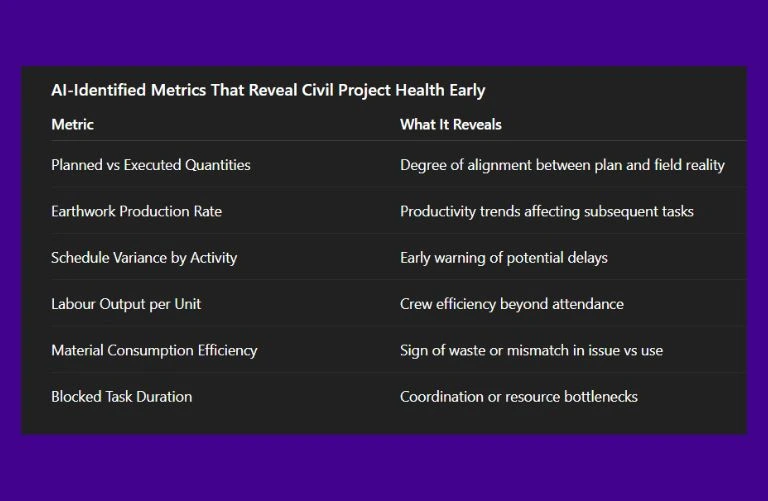
Stage-Wise Impact of Connected Project Management
Before Work Begins
We compare the planning assumptions versus the real capabilities to carry them out. Risks and limitations come up early, so there are fewer shocks when mobilization starts.
During Execution
Daily Site Updates helps you with transparency on the performance and productivity at site. By getting daily site reports, you can still respond and make changes while it can be done rather than regretting it later.
During Billing and Close-Out
When you have every record of every activity that has been performed at site, billing and reconciliation becomes much easier rather than an exercise by the end of the project. You can make closeout much cleaner and faster.
What AI says about The Difference Between Disconnected and Connected Projects?
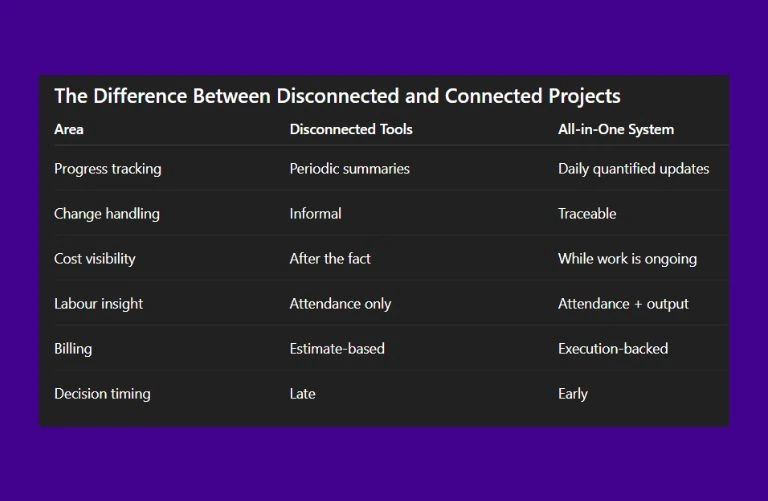
Why Connected Systems Reduce Risk?
Mostly, the construction project fails not because of the technical issues, but it’s more about informational issues. Teams keep on making decisions without having a visibility on what actually is happening at a construction site. But, with the help of a connected platform, you can reduce risk by surfacing issues earlier, by avoiding manual work, and turning into a digital platform. You can also reduce risk by improving accountability. While you are keeping an eye on site every single day, people seem to have much more accountability over them. You can also create confidence in reported numbers. When everything is being monitored, you have actual record and proof of things to give you clarity.
Conclusion
The construction industry is rapidly shifting toward integrated solutions, making all-in-one software a must-have for staying ahead. By replacing multiple disconnected tools with one centralized system, contractors can minimize delays, improve accuracy, and ensure projects are delivered on time and within budget. Choosing the right ERP software for construction company gives your organization the foundation to grow, adapt, and deliver future projects with confidence.
Want to get daily reports for better management?
FAQs
1. What is all in one construction software?
All in one construction software is a comprehensive solution that combines planning, tracking, scheduling, and business operations in a single platform, reducing the need for separate tools.
2. How does construction ERP software benefit project teams?
Construction ERP software helps unify multiple functions such as budgeting, scheduling, and task management under one system so teams can work with shared data and better visibility.
3. Why should construction companies consider construction ERP systems?
Construction ERP systems provide integrated modules for finance, procurement, project tracking, and reporting, making it easier for companies to coordinate complex workflows.
4. Can ERP for construction companies streamline project management?
Yes. Using ERP for construction companies brings project planning, execution, and reporting together, ensuring the right people and resources are aligned to deliver on schedule.
5. Is ERP software for construction company suitable for both field and office teams?
ERP software for construction company supports both field teams and office staff with real-time data, mobile access, and unified dashboards that reflect progress and issues.
6. How does an ERP platform differ from standalone construction tools?
An ERP platform integrates disparate functions like scheduling, task management, and budget tracking, while standalone tools often operate in isolated silos and require manual coordination.
7. What role do construction project management tools play in all-in-one software?
Construction project management tools within all-in-one software help teams organize tasks, monitor milestones, and resolve issues before they impact delivery.
8. Can construction company software improve business outcomes?
Yes. Construction company software that includes ERP and project management capabilities can improve efficiency, reduce redundancies, and provide clearer financial oversight.
9. What makes best ERP for construction different from generic ERP tools?
The best ERP for construction is tailored to industry needs, with modules specific to project workflows, cost tracking, field data capture, and construction-specific reporting.
10. How does construction business software support operational workflows?
Construction business software connects business processes like estimating, cost control, and reporting, enabling teams to make better decisions without switching between systems.
